Admit rate has ranged 57%–89% over the last 5 years — notably volatile. Source: IPEDS via Urban Institute.
Acceptance & SAT from Common Data Set / IPEDS; net price, earnings & graduation from the U.S. Dept. of Education College Scorecard. Figures lag ~1–2 years — verify with the school.
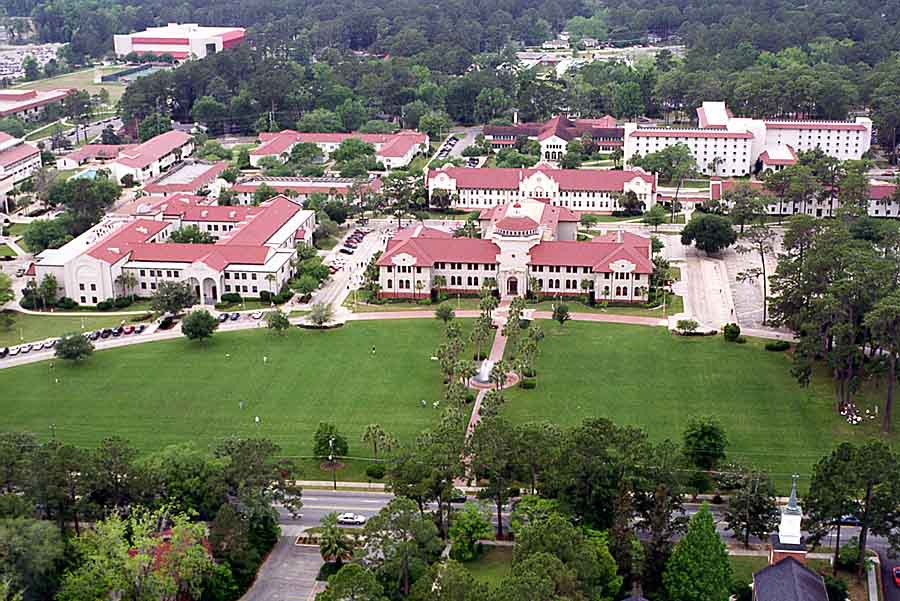
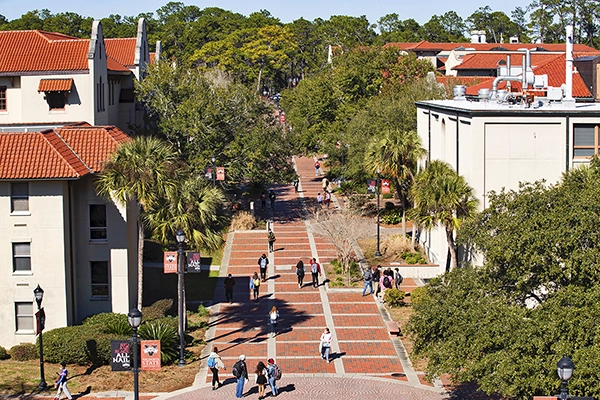
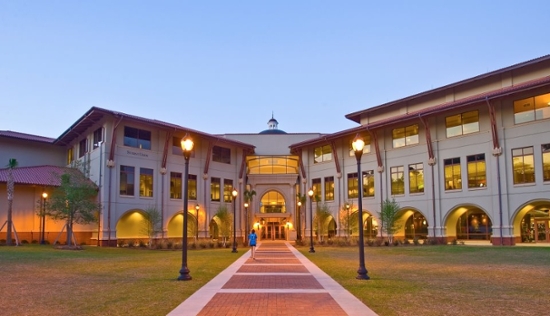
Valdosta State University is a public institution in southern Georgia that blends accessibility with strong regional programs in nursing, business, and the arts. With a 72% acceptance rate and test-optional policies for high-achieving students, VSU attracts a diverse undergraduate body who enjoy a lively campus culture anchored by Greek life and proximity to Chick-fil-A. While graduation rates lag national averages, the university emphasizes career-ready degrees—including eight fully online programs at $299 per credit—that deliver a reported $1.4M lifetime earnings boost over high school diplomas.
Admission requirements
Test scores required
Required
High school transcript
Grade point average
Test scores (SAT/ACT)
College-prep program
TOEFL (non-native English)
Source: IPEDS Admissions survey (2022) via Urban Institute. Covers formal factors only — it does not reflect essays, extracurriculars, or other holistic criteria.
More details
Undergrad enrollment
6,622
In-state tuition
$6,124
Out-of-state tuition
$17,836
6-Year Grad Rate
42%
Online Degree Cost
$299/credit
Greek Life Participation
21%
Avg Earnings 1 Yr Post-Grad
$36,427
Outcomes & value
Outcomes & value
Median earnings (10 yr)
$49,361
Value (earnings ÷ net price)
4.5×
Median debt at graduation
$24,779
Graduation rate
42%
First-year retention
72%
Reducing loan balance (3 yr)
41%
Pell (lower-income) share
52%
First-gen share (among federal-aid recipients)
31%
Top-earning majors
Median earnings by field of study (highest credential), ~2 years after completion.
Registered Nursing, Nursing Administration, Nursing Research and Clinical Nursing$58,898
Computer and Information Sciences, General$48,432
Information Science/Studies$39,729
Accounting and Related Services$39,009
Finance and Financial Management Services$38,289
Chemistry
Campus & location
Campus safety
On-campus violent crimes (2024)
8
Per 1,000 students
0.82
On-campus criminal offenses classed as violent (murder/non-negligent manslaughter, rape, robbery, aggravated assault) for the most recent reported year. Source: U.S. Dept. of Education Campus Safety and Security (Clery Act). Counts reflect what’s reported to the school, and urban campuses often report more partly due to non-student incidents nearby — read alongside campus size and setting, not as a standalone safety verdict.
Climate
Pleasant days / yr
120
Summer high
91°F
Winter low
47°F
Annual rain
47.5"
Natural-hazard risk
Relatively Low
Pleasant days counts days per year with a mean temperature of 55–75°F, a high at or below 90°F, a low at or above 45°F, and little precipitation — a transparent comfort measure, not a weighting we invented. Computed from Open-Meteo ERA5 daily history (2019–2023). Natural-hazard risk is the county’s composite rating from the FEMA National Risk Index.
Deep dive — research, future-scholar output & economic mobility▾
Research output
Institutional h-index
109
Scholarly works
3,712
Institutional research volume and impact from OpenAlex. The h-index reflects large research universities and will be low for teaching-focused liberal-arts colleges — not a measure of undergraduate quality.
Economic mobility
Mobility rate
1.3%
Bottom → top quintile
16%
From bottom quintile
8%
Mobility rate = the share of students who both start in the bottom household-income quintile and reach the top quintile; bottom → top is that chance conditional on starting at the bottom. Source: Opportunity Insights Mobility Report Cards (Chetty, Friedman, Saez, Turner & Yagan). Reflects 1980–82 birth cohorts, so it’s directional, not current.
Quick answers
What is the acceptance rate at Valdosta State University?
Valdosta State University's acceptance rate is approximately 72% (Valdosta, GA), based on the most recent figures we compiled from public and primary sources.
What SAT score do you need for Valdosta State University?
Admitted students at Valdosta State University typically score 920–1100 on the SAT (the middle-50% range). Scores outside this band are still admitted, especially with strong applications.
How much does Valdosta State University cost?
At Valdosta State University, the average net price (after aid) is about $10,945 per year. Actual cost varies with financial aid and residency.
How many undergraduates attend Valdosta State University?
Valdosta State University enrolls approximately 6,622 undergraduate students.
Where is Valdosta State University located?
Valdosta State University is located in Valdosta, GA.
Admissions
Valdosta State maintains a 72% acceptance rate, making it accessible to most applicants while still screening for academic preparedness. The middle 50% of admitted students score between 930-1108 on the SAT or 16-22 on the ACT, though high school GPAs above 3.2 exempt applicants from standardized test requirements entirely—a policy adopted in 2022 to reduce barriers. Applications are due by June 15, with a $40 fee, and the university accepts both diplomas and GEDs. Notably, out-of-state students face slightly more selective review than Georgia residents.
Earnings = median of students working ~10 years after entry; debt = median of graduates. Value divides 10-yr earnings by one year’s net price — read it as earnings per dollar of annual cost, not a full lifetime ROI; it favors lower-cost schools. Source: U.S. Dept. of Education College Scorecard. Figures lag ~2 years and reflect all students, not your intended major.
$35,420
Teacher Education and Professional Development, Specific Levels and Methods$35,274
Teacher Education and Professional Development, Specific Subject Areas$34,847
Source: U.S. Dept. of Education College Scorecard (field-of-study earnings). Figures cover graduates who received federal aid and lag ~2 years; not all programs report data.
VSU offers over 100 degree programs, with business, health professions, and education dominating enrollment. Standouts include:
A nursing program frequently cited as one of Georgia’s best
Robust physics and history departments
An arts-focused curriculum with dedicated facilities
Eight fully online undergraduate degrees are available at $299 per credit (most courses last 8 weeks), targeting working adults. The university organizes majors into ‘focus areas’ like Business and Social/Behavioral Services to help students explore related fields. While not a research powerhouse, VSU emphasizes practical training—its library holdings are notably extensive for a regional institution.
Campus culture thrives on Greek life (21% of students join sororities/fraternities) and events like Fall Explosion, with Niche reviewers calling the party scene ‘lively’ both on- and off-campus. The Student Union houses a Starbucks and Chick-fil-A, while recreation facilities include:
A climbing wall
Yoga classes
An outdoor pool
Over 100 student organizations span interests from politics to music, and the university promotes residential living by touting proximity to classes and amenities. The Office of Student Life coordinates programming through its Campus Activities Board.
A 42% six-year graduation rate (bottom quartile nationally)
$36,427 median earnings one year post-graduation, rising to $39,416 later
Men graduate at just 32% vs. women’s higher rates
The university highlights that bachelor’s holders earn ~$1.4M more lifetime than high school graduates, though this aligns with typical ROI for any four-year degree. Retention after freshman year hovers around 70%, suggesting academic support gaps.
Valdosta State carves a niche by merging accessibility with career-aligned programs, particularly in nursing and online education. Its test-optional policy for strong students and lively Greek scene attract applicants seeking a traditional college experience without cutthroat admissions. While graduation rates lag, the university’s sub-$300/credit online degrees and lifetime earnings data appeal to pragmatic learners. For Georgians wanting a vibrant campus culture paired with straightforward pathways to in-demand jobs, VSU delivers—provided students navigate its academic support challenges.
Valdosta State University logo · sourceAbout VSU - Valdosta State University · sourceValdosta State University - Valdosta State University · sourceDirections to the VSU Student Union - Valdosta State University · source