Admit rate has ranged 59%–69% over the last 5 years — notably volatile. Source: IPEDS via Urban Institute.
Acceptance & SAT from Common Data Set / IPEDS; net price, earnings & graduation from the U.S. Dept. of Education College Scorecard. Figures lag ~1–2 years — verify with the school.
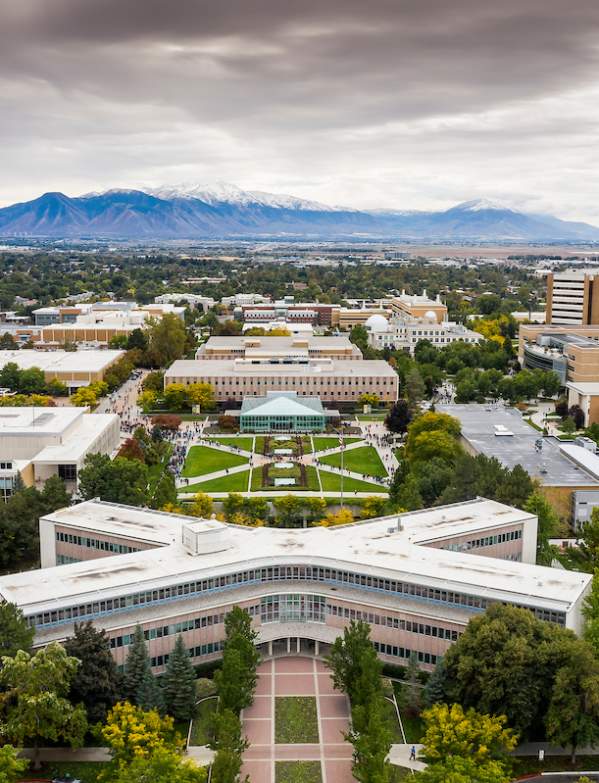
Brigham Young University is a singular proposition in American higher education: a massive, academically rigorous private university owned by The Church of Jesus Christ of Latter-day Saints, where a deeply religious, honor-code-governed campus culture coexists with powerhouse programs in business, engineering, and animation. Its defining characteristic is the stark value equation—a top-tier education offered at a fraction of the cost of comparable private schools, funded by church subsidies and resulting in one of the nation's highest yield rates as admitted students flock to enroll. The experience is immersive, structured, and intensely communal, producing graduates with low debt and strong career outcomes, but it demands full buy-in to a unique way of life.
Admission requirements
Test-optional — scores considered if submitted
Required
High school transcript
Grade point average
Letters of recommendation
TOEFL (non-native English)
Considered (not required)
Test scores (SAT/ACT)
College-prep program
Source: IPEDS Admissions survey (2022) via Urban Institute. Covers formal factors only — it does not reflect essays, extracurriculars, or other holistic criteria.
More details
Undergrad enrollment
32,952
In-state tuition
$6,688
Out-of-state tuition
$6,688
No-Loan Policy
No
Graduation Rate
81%
Meets Full Need
No
First-Year Retention
Not stated in sources
Demonstrated Interest
Not considered
Median Earnings (10yr)
$75,790
Outcomes & value
Outcomes & value
Median earnings (10 yr)
$75,790
Value (earnings ÷ net price)
4.9×
Median debt at graduation
$11,069
Graduation rate
81%
First-year retention
91%
Reducing loan balance (3 yr)
80%
Pell (lower-income) share
32%
First-gen share (among federal-aid recipients)
14%
Financial health
2.2 / 3.0Meets the federal financial-responsibility standard
U.S. Dept. of Education Financial Responsibility Composite Score (FY2022-23). Scale −1.0 to 3.0; ≥1.5 meets the standard. Reported for private nonprofit & for-profit institutions only — public universities are state-backed and not scored, so this is a stability signal, not a ranking.
Top-earning majors
Median earnings by field of study (highest credential), ~2 years after completion.
Computer Engineering$87,604
Computer Science$83,848
Computer and Information Sciences, General$76,460
Chemical Engineering$76,460
Electrical, Electronics, and Communications Engineering$71,351
Biomathematics, Bioinformatics, and Computational Biology
Campus & location
Campus safety
On-campus violent crimes (2024)
4
Per 1,000 students
0.11
On-campus criminal offenses classed as violent (murder/non-negligent manslaughter, rape, robbery, aggravated assault) for the most recent reported year. Source: U.S. Dept. of Education Campus Safety and Security (Clery Act). Counts reflect what’s reported to the school, and urban campuses often report more partly due to non-student incidents nearby — read alongside campus size and setting, not as a standalone safety verdict.
Climate
Pleasant days / yr
75
Summer high
86°F
Winter low
21°F
Annual rain
21.2"
Annual snow
88.7"
Natural-hazard risk
Relatively High
Pleasant days counts days per year with a mean temperature of 55–75°F, a high at or below 90°F, a low at or above 45°F, and little precipitation — a transparent comfort measure, not a weighting we invented. Computed from Open-Meteo ERA5 daily history (2019–2023). Natural-hazard risk is the county’s composite rating from the FEMA National Risk Index.
Deep dive — research, future-scholar output & economic mobility▾
Research output
Institutional h-index
562
Scholarly works
74,879
Institutional research volume and impact from OpenAlex. The h-index reflects large research universities and will be low for teaching-focused liberal-arts colleges — not a measure of undergraduate quality.
Economic mobility
Mobility rate
0.7%
Bottom → top quintile
30%
From bottom quintile
2%
Mobility rate = the share of students who both start in the bottom household-income quintile and reach the top quintile; bottom → top is that chance conditional on starting at the bottom. Source: Opportunity Insights Mobility Report Cards (Chetty, Friedman, Saez, Turner & Yagan). Reflects 1980–82 birth cohorts, so it’s directional, not current.
Quick answers
What is the acceptance rate at Brigham Young University?
Brigham Young University's acceptance rate is approximately 68% (Provo, UT), based on the most recent figures we compiled from public and primary sources.
What SAT score do you need for Brigham Young University?
Admitted students at Brigham Young University typically score 1270–1460 on the SAT (the middle-50% range). Scores outside this band are still admitted, especially with strong applications.
How much does Brigham Young University cost?
At Brigham Young University, the average net price (after aid) is about $15,564 per year. Actual cost varies with financial aid and residency.
How many undergraduates attend Brigham Young University?
Brigham Young University enrolls approximately 32,952 undergraduate students.
Where is Brigham Young University located?
Brigham Young University is located in Provo, UT.
Admissions
BYU's admissions process is a study in contrasts: it boasts an around 68%, which suggests accessibility, but the students who enroll are academically formidable, creating a campus where the median admitted student had an unweighted GPA of 3.89 and SAT scores in the 1270–1460 range. The university was for the spring 2024 entry cycle, but submitted scores are typically high, with the middle 50% ACT range being 28–32. What truly sets BYU apart is its —the percentage of admitted students who choose to enroll. At nearly 80%, it rivals the Ivy League, a testament to the powerful draw of its mission, culture, and unparalleled value for members of the LDS Church. The indicates that demonstrated interest is not considered in admissions decisions; the focus is on academic preparation, character, and alignment with the university's religious standards. All applicants, regardless of personal faith, must agree to live by the BYU Honor Code, which includes adherence to dress and grooming standards and abstaining from alcohol, coffee, tea, and premarital sex.
Earnings = median of students working ~10 years after entry; debt = median of graduates. Value divides 10-yr earnings by one year’s net price — read it as earnings per dollar of annual cost, not a full lifetime ROI; it favors lower-cost schools. Source: U.S. Dept. of Education College Scorecard. Figures lag ~2 years and reflect all students, not your intended major.
$71,015
Business/Managerial Economics$70,456
Mechanical Engineering$67,772
Source: U.S. Dept. of Education College Scorecard (field-of-study earnings). Figures cover graduates who received federal aid and lag ~2 years; not all programs report data.
Don't let the low sticker price fool you—BYU is an academic heavyweight. The Princeton Review notes its "academic rigor," and the university touts a #1 ranking in the West for student engagement and a #5 national ranking for graduates who go on to earn PhDs. The curriculum is broad, but the school has developed a reputation for specific, elite programs that punch far above the university's overall ranking. U.S. News and student observers consistently highlight:
The Marriott School of Business, particularly its highly ranked Accounting program.
The College of Engineering and Technology.
The College of Fine Arts and Communications, home to an Animation program considered one of the best in the world, feeding talent directly to studios like Pixar and Disney.
Creative Writing.
With 59% of degrees awarded in STEM fields, the academic orientation is decidedly practical and pre-professional. The culture is studious and competitive; as one Reddit commentator put it, BYU is "a (subsidized) cheap (for members) undergraduate option with above average academics." The focus is on delivering a high-return education that prepares students for immediate employment or top graduate programs.
Student life at BYU is "heavily influenced by the Church," creating a campus environment unlike any other. This is not a place of frat parties and tailgates in the conventional sense; social life is organized, wholesome, and deeply integrated with the LDS faith. The campus is dry (no alcohol), and activities reflect that: intramural sports are huge, as are organized social events like swing dancing, concerts, and football games. Dating culture is pronounced and often oriented toward marriage, a frequent topic of discussion among students. The social structure is anchored by the "ward" system—congregations organized by geographic area within student housing—which provides a built-in community for every student. As described by Niche, students enjoy a packed calendar of sanctioned events. The First-Year Experience office encourages involvement in clubs, Y-Serve (the massive service organization), and academic associations. It's a highly structured, all-inclusive community where the line between campus life and church life is blurred; for students who share the faith, it's a seamless, enriching experience. For others, it requires adaptation to a unique set of social norms and expectations.
BYU's return on investment is its crowning argument. The six-year graduation rate is a solid 81%, indicating students are progressing efficiently through their rigorous programs. The career outcomes are strong, driven by the university's pre-professional focus and its powerful alumni network, particularly within the global LDS community. While early-career salary figures vary by source, the long-term financial picture is robust, with a high median earnings figure ten years after entry. The Career Center conducts a graduate outcomes survey six months post-graduation to track employment and further education. The combination of high graduation rates, strong median earnings, and the low creates one of the most favorable debt-to-income profiles for graduates of any major university in the country.
This is where BYU changes the entire calculus of a private education. The average after aid is remarkably low, especially for members of the LDS Church, who pay a significantly reduced tuition rate subsidized by church tithing funds. The university offers financial aid from federal, state, and institutional programs in the form of grants, scholarships, and loans. It is critical to note: BYU is not a "no-loan" institution and does not advertise a policy of meeting 100% of demonstrated need without loans. Students routinely utilize federal student loans as part of their financial aid packages, as outlined in the university's financial aid checklist and policies. The true financial advantage comes from the low baseline cost, not from an ultra-aggressive, loan-free aid policy. Prospective students are directed to the university's Net Price Calculator for a personalized estimate.
BYU stands alone. It is not merely a religious university; it is a fully integrated intellectual and spiritual ecosystem operated by a global church. Its standout features are inextricably linked: 1. The Unbeatable Value Proposition: A top-100 national academic experience with elite specialty programs, offered at a public-university price for members. This creates the 80% rate—students admitted to Stanford and BYU often choose BYU. 2. The Culture is the Curriculum: The education extends far beyond the classroom. The Honor Code and ward system create a pervasive culture of discipline, service, and community that shapes character and professional networks as much as any lecture. 3. Outcome-Oriented Rigor: The academic environment is intense and competitive, focused on producing employable graduates and future PhDs. This is not a liberal arts retreat; it's a professional and intellectual training ground. 4. A Self-Contained World: For LDS students, it's a four-year immersion in the heart of their faith with peers who share their values and life goals. For others, it's a unique opportunity to experience that world while accessing a first-rate education, provided they can navigate its distinct rules and social landscape. In the end, BYU's distinctiveness is its coherence. Every element—admissions, academics, cost, social life, and outcomes—reinforces its central mission, creating an exceptionally clear and powerful choice for the students it serves.
Brigham Young University seal · sourceList of Brigham Young University buildings - Wikipedia · sourceBrigham Young University | Explore Utah Valley | Utah Valley · sourceWelcome to Brigham Young University · source