Admit rate has ranged 32%–38% over the last 5 years, though the latest figure above (29%) falls outside that window. Source: IPEDS via Urban Institute.
Acceptance & SAT from Common Data Set / IPEDS; net price, earnings & graduation from the U.S. Dept. of Education College Scorecard. Figures lag ~1–2 years — verify with the school.
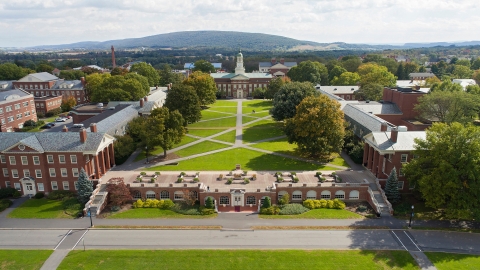
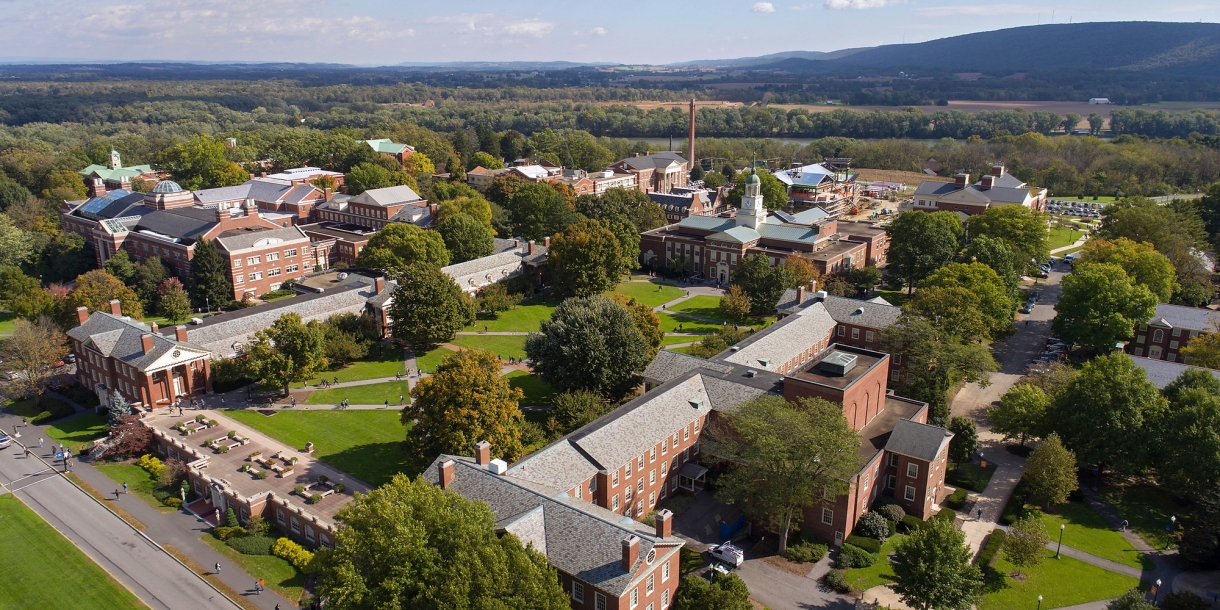
Bucknell University carves out a distinctive niche as a small, residential liberal arts college with the resources and rigor of a larger university, anchored by its highly-regarded engineering and management programs. Set in the pastoral Susquehanna Valley of central Pennsylvania, it offers a cohesive, immersive campus experience where nearly 90% of students live on a beautiful, self-contained campus. The culture is one of high academic engagement and strong post-graduate outcomes, though it can feel insular and homogenous, with a student body that is overwhelmingly white and, by some accounts, politically disengaged.
Admission requirements
Test-optional — scores considered if submitted
Required
High school transcript
Grade point average
Letters of recommendation
College-prep program
TOEFL (non-native English)
Considered (not required)
Class rank
Test scores (SAT/ACT)
Demonstrated competencies
Source: IPEDS Admissions survey (2022) via Urban Institute. Covers formal factors only — it does not reflect essays, extracurriculars, or other holistic criteria.
More details
Undergrad enrollment
3,876
In-state tuition
$67,812
Out-of-state tuition
$67,812
Graduation Rate
86%
On-Campus Housing
89%
Demonstrated Interest
Considered (Important)
Median Earnings (10yr)
$93,807
Student-to-Faculty Ratio
9:1
First-Year Retention Rate
94%
Average Starting Salary (Class of 2025)
$73,346
Outcomes & value
Outcomes & value
Median earnings (10 yr)
$93,807
Value (earnings ÷ net price)
2.3×
Median debt at graduation
$27,000
Graduation rate
86%
First-year retention
94%
Reducing loan balance (3 yr)
90%
Pell (lower-income) share
12%
First-gen share (among federal-aid recipients)
12%
Financial health
2.7 / 3.0Meets the federal financial-responsibility standard
U.S. Dept. of Education Financial Responsibility Composite Score (FY2022-23). Scale −1.0 to 3.0; ≥1.5 meets the standard. Reported for private nonprofit & for-profit institutions only — public universities are state-backed and not scored, so this is a stability signal, not a ranking.
Top-earning majors
Median earnings by field of study (highest credential), ~2 years after completion.
Computer Engineering$87,604
Computer and Information Sciences, General$81,498
Chemical Engineering$76,460
Mechanical Engineering$69,002
Biomedical/Medical Engineering$66,821
Accounting and Related Services$66,147
Applicants here also applied to
The schools that most often appear alongside Bucknell on applicants’ lists, from our self-reported outcomes corpus.
Co-application frequency from self-reported results — directional peer discovery, not a recommendation.
Campus & location
Campus safety
On-campus violent crimes (2024)
14
Per 1,000 students
3.57
On-campus criminal offenses classed as violent (murder/non-negligent manslaughter, rape, robbery, aggravated assault) for the most recent reported year. Source: U.S. Dept. of Education Campus Safety and Security (Clery Act). Counts reflect what’s reported to the school, and urban campuses often report more partly due to non-student incidents nearby — read alongside campus size and setting, not as a standalone safety verdict.
Climate
Pleasant days / yr
89
Summer high
84°F
Winter low
25°F
Annual rain
42.6"
Annual snow
24.5"
Natural-hazard risk
Relatively Low
Pleasant days counts days per year with a mean temperature of 55–75°F, a high at or below 90°F, a low at or above 45°F, and little precipitation — a transparent comfort measure, not a weighting we invented. Computed from Open-Meteo ERA5 daily history (2019–2023). Natural-hazard risk is the county’s composite rating from the FEMA National Risk Index.
Deep dive — research, future-scholar output & economic mobility▾
Research output
Institutional h-index
192
Scholarly works
10,744
Institutional research volume and impact from OpenAlex. The h-index reflects large research universities and will be low for teaching-focused liberal-arts colleges — not a measure of undergraduate quality.
Economic mobility
Mobility rate
1.5%
Bottom → top quintile
55%
From bottom quintile
3%
Mobility rate = the share of students who both start in the bottom household-income quintile and reach the top quintile; bottom → top is that chance conditional on starting at the bottom. Source: Opportunity Insights Mobility Report Cards (Chetty, Friedman, Saez, Turner & Yagan). Reflects 1980–82 birth cohorts, so it’s directional, not current.
Quick answers
What is the acceptance rate at Bucknell University?
Bucknell University's acceptance rate is approximately 29% (Lewisburg, PA), based on the most recent figures we compiled from public and primary sources.
What SAT score do you need for Bucknell University?
Admitted students at Bucknell University typically score 1310–1470 on the SAT (the middle-50% range). Scores outside this band are still admitted, especially with strong applications.
How much does Bucknell University cost?
At Bucknell University, the average net price (after aid) is about $40,766 per year. Actual cost varies with financial aid and residency.
How many undergraduates attend Bucknell University?
Bucknell University enrolls approximately 3,876 undergraduate students.
Where is Bucknell University located?
Bucknell University is located in Lewisburg, PA.
Admissions
Gaining admission to Bucknell is a selective, holistic process where demonstrated interest matters. The university's overall is 29%, but the pathway is significantly clearer for those who apply Early Decision, where acceptance rates have historically been around 55%—nearly double the regular decision rate. This strategic advantage underscores how seriously Bucknell values commitment from applicants. The admitted class is academically strong, with an average high school GPA of 3.74 on a 4.0 scale. For the Class of 2029, Bucknell received 11,561 applications, admitted 3,723 students, and enrolled 1,040. The middle 50% SAT range for admitted students is 1310–1470, with a composite average around 1380. The admissions office explicitly ranks 'demonstrated interest' as an 'important' factor in their evaluation, meaning campus visits, interviews, and engagement with admissions representatives can meaningfully influence a decision.
Earnings = median of students working ~10 years after entry; debt = median of graduates. Value divides 10-yr earnings by one year’s net price — read it as earnings per dollar of annual cost, not a full lifetime ROI; it favors lower-cost schools. Source: U.S. Dept. of Education College Scorecard. Figures lag ~2 years and reflect all students, not your intended major.
Civil Engineering
$65,610
Multi/Interdisciplinary Studies, Other$63,005
Source: U.S. Dept. of Education College Scorecard (field-of-study earnings). Figures cover graduates who received federal aid and lag ~2 years; not all programs report data.
Bucknell's academic identity is defined by its three distinct colleges: the College of Arts & Sciences, the College of Engineering, and the Freeman College of Management. This structure allows it to offer the intimate, teaching-focused environment of a top liberal arts college alongside professionally-oriented programs that consistently rank among the best in the nation for undergraduate engineering and business. The university offers 69 majors, with the most popular being in the social sciences, engineering, and business/management. The student-to-faculty ratio is an exceptionally low 9:1, facilitating close mentorship and collaborative research opportunities between students and professors, which the Princeton Review highlights as a signature strength. This environment yields strong retention and graduation rates; the first-year retention rate is 94%, and the four-year graduation rate is 86%. The curriculum encourages interdisciplinary exploration, championing the idea that a student can 'major in English and go to medical school' or 'major in engineering and become a manager.'
Life at Bucknell is intensely residential and communal, creating what students and publications often describe as a 'bubble.' A full 89% of undergraduates live in college-owned, -operated, or -affiliated housing, leading to a shared daily rhythm of dorm life, dining halls, and campus events. This fosters a strong sense of community and makes it easy to form close friendships, but it can also contribute to a feeling of insularity from the surrounding town of Lewisburg. The campus culture is often characterized as affluent and socially oriented, with a significant Greek life presence. Demographically, the student body lacks diversity; one Reddit analysis estimates the population is about 80% white, with a political breakdown of roughly 20% conservative, 15% liberal, and 65% politically unaware or uninterested. Students report feeling extremely safe on campus, with 95% saying they feel 'extremely safe and secure.' The university promotes a 'co-curricular' environment aimed at developing 'intellectual maturity, personal conviction and strength of character' through over 150 student organizations, Division I athletics, and community engagement opportunities.
A Bucknell degree is a substantial investment that pays strong dividends in the job market. The university reports that 93% of the Class of 2025 secured employment, graduate school admission, or a fellowship within nine months of graduation. Those entering the workforce commanded an impressive average starting salary of $73,346, which notably exceeds the national average for bachelor's degree recipients. The median earnings for graduates ten years after entry are $93,807. These outcomes underscore the value of Bucknell's blend of liberal arts grounding and professional preparation. For context, the university notes that bachelor's degree holders nationally earn a median of $1,543 per week compared to $930 for high school graduates, a gap that compounds significantly over a career. The strong graduation rate of 86% ensures most students are positioned to capitalize on this return on investment in a standard timeframe.
Bucknell is among the most expensive private universities in the country, with a total annual that can exceed $70,000. However, the university is committed to making this education accessible through need-based financial aid. The average net price after grants and scholarships is $40,766. A significant portion of the student body receives aid, with one source noting 38.68% of students receive financial aid with an average aid package of $52,500. Bucknell offers need-based institutional grants, and its financial aid policies are designed to meet the demonstrated need of admitted students. The university utilizes a Calculator to help families estimate their actual cost. While Bucknell employs need-based grants heavily, the provided sources do not explicitly confirm a universal 'no-loan' policy for all qualifying students, indicating that loans may still be a component of some aid packages.
Bucknell stands out for its rare and potent hybrid model: the close-knit, all-in residential community and teaching focus of an elite liberal arts college, seamlessly integrated with the resources, facilities, and career-oriented punch of a top-tier undergraduate engineering and business school. You don't have to choose between studying poetry in a seminar of ten and conducting advanced lab research in a state-of-the-art engineering facility—you can do both, often with the same professor mentoring you. This creates graduates who are both broadly educated and immediately employable, evidenced by starting salaries that soar above the national average. The trade-off is that this high-achieving, affluent bubble in rural Pennsylvania can feel socially and culturally homogeneous, a world unto itself. For students seeking a beautiful, immersive, and highly structured campus experience that delivers unequivocally strong professional outcomes without sacrificing a liberal arts foundation, Bucknell is a compelling and distinctive choice.
Bucknell University seal · sourcePlan a Visit to Bucknell University | Lewisburg, PA · sourceFacilities | Bucknell University · sourceBucknell University - Profile, Rankings and Data | US News Best Colleges · source