Admit rate has ranged 75%–78% over the last 5 years. Source: IPEDS via Urban Institute.
Acceptance & SAT from Common Data Set / IPEDS; net price, earnings & graduation from the U.S. Dept. of Education College Scorecard. Figures lag ~1–2 years — verify with the school.
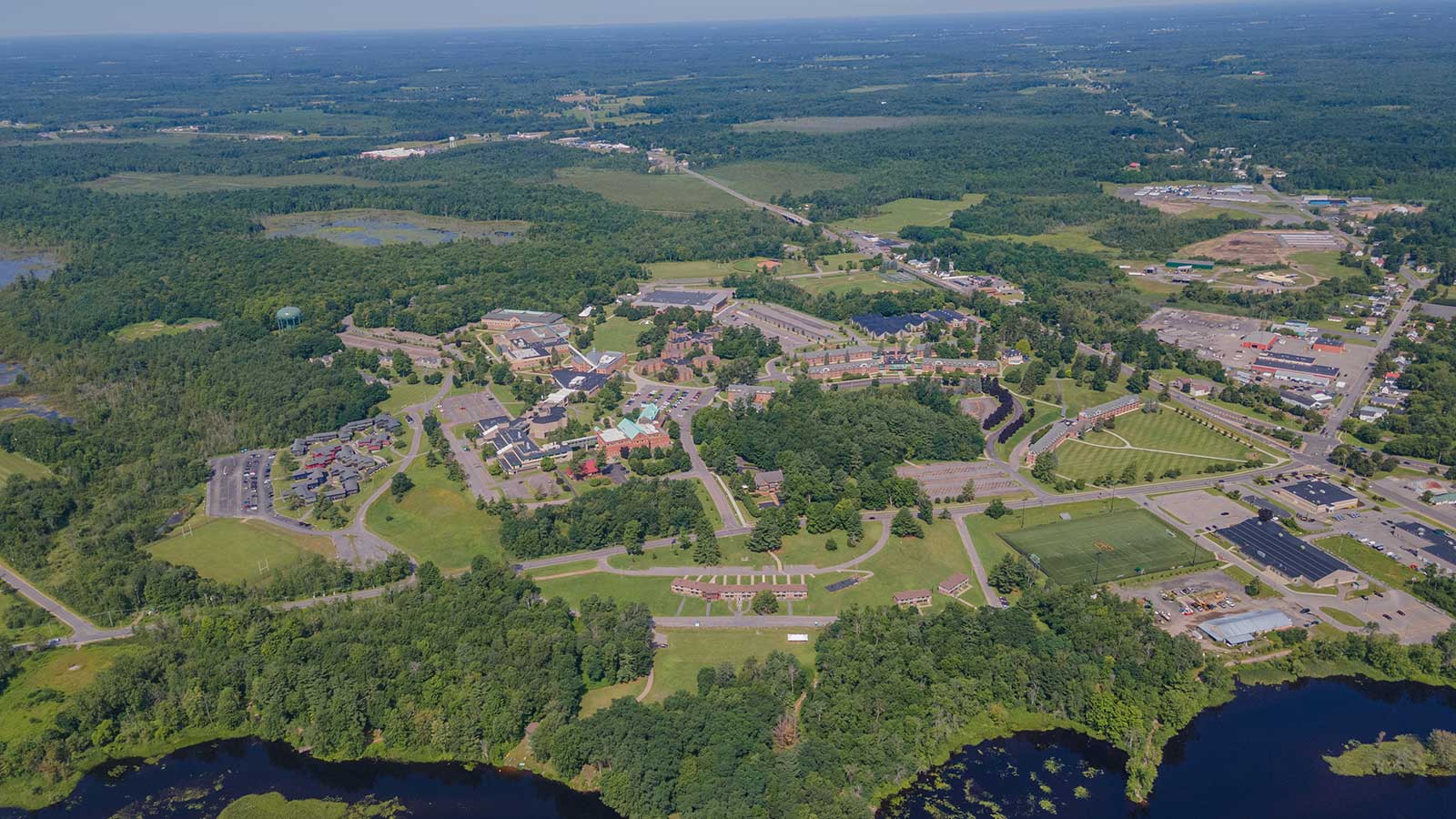
Clarkson University is a private STEM powerhouse in the remote, snowy reaches of Potsdam, New York, where a 77% acceptance rate belies a fiercely pragmatic, hands-on engineering and business culture. The campus vibe is intensely close-knit and resilient, defined by over 200 student clubs and a near-total residential experience that bonds students against the long winters. Its singular claim to fame is a potent return on investment: graduates consistently land salaries that punch far above the school's modest selectivity, with a median earnings figure of $89,696 a decade out, placing its alumni among the top earners nationally.
Admission requirements
Test-optional — scores considered if submitted
Required
High school transcript
Grade point average
Class rank
Letters of recommendation
TOEFL (non-native English)
Considered (not required)
Test scores (SAT/ACT)
College-prep program
Source: IPEDS Admissions survey (2022) via Urban Institute. Covers formal factors only — it does not reflect essays, extracurriculars, or other holistic criteria.
More details
Undergrad enrollment
2,196
In-state tuition
$59,398
Out-of-state tuition
$59,398
Graduation Rate
75%
On-Campus Living
89%
Demonstrated Interest
Considered
Median Earnings (10yr)
$89,696
Students Receiving Aid
100%
Outcomes & value
Outcomes & value
Median earnings (10 yr)
$89,696
Value (earnings ÷ net price)
3.0×
Median debt at graduation
$26,000
Graduation rate
75%
First-year retention
85%
Reducing loan balance (3 yr)
86%
Pell (lower-income) share
22%
First-gen share (among federal-aid recipients)
15%
Financial health
2.0 / 3.0Meets the federal financial-responsibility standard
U.S. Dept. of Education Financial Responsibility Composite Score (FY2022-23). Scale −1.0 to 3.0; ≥1.5 meets the standard. Reported for private nonprofit & for-profit institutions only — public universities are state-backed and not scored, so this is a stability signal, not a ranking.
Top-earning majors
Median earnings by field of study (highest credential), ~2 years after completion.
Computer Science$78,074
Computer Engineering$76,460
Electrical, Electronics, and Communications Engineering$70,009
Chemical Engineering$68,858
Mechanical Engineering$67,802
Aerospace, Aeronautical, and Astronautical/Space Engineering$67,748
Applicants here also applied to
The schools that most often appear alongside Clarkson University on applicants’ lists, from our self-reported outcomes corpus.
Co-application frequency from self-reported results — directional peer discovery, not a recommendation.
Campus & location
Campus safety
On-campus violent crimes (2024)
0
Per 1,000 students
0.00
On-campus criminal offenses classed as violent (murder/non-negligent manslaughter, rape, robbery, aggravated assault) for the most recent reported year. Source: U.S. Dept. of Education Campus Safety and Security (Clery Act). Counts reflect what’s reported to the school, and urban campuses often report more partly due to non-student incidents nearby — read alongside campus size and setting, not as a standalone safety verdict.
Climate
Pleasant days / yr
85
Summer high
78°F
Winter low
15°F
Annual rain
47.5"
Annual snow
55.5"
Natural-hazard risk
Relatively Low
Pleasant days counts days per year with a mean temperature of 55–75°F, a high at or below 90°F, a low at or above 45°F, and little precipitation — a transparent comfort measure, not a weighting we invented. Computed from Open-Meteo ERA5 daily history (2019–2023). Natural-hazard risk is the county’s composite rating from the FEMA National Risk Index.
Deep dive — research, future-scholar output & economic mobility▾
Research output
Institutional h-index
310
Scholarly works
16,596
Institutional research volume and impact from OpenAlex. The h-index reflects large research universities and will be low for teaching-focused liberal-arts colleges — not a measure of undergraduate quality.
Economic mobility
Mobility rate
3.0%
Bottom → top quintile
53%
From bottom quintile
6%
Mobility rate = the share of students who both start in the bottom household-income quintile and reach the top quintile; bottom → top is that chance conditional on starting at the bottom. Source: Opportunity Insights Mobility Report Cards (Chetty, Friedman, Saez, Turner & Yagan). Reflects 1980–82 birth cohorts, so it’s directional, not current.
Quick answers
What is the acceptance rate at Clarkson University?
Clarkson University's acceptance rate is approximately 77% (Potsdam, NY), based on the most recent figures we compiled from public and primary sources.
What SAT score do you need for Clarkson University?
Admitted students at Clarkson University typically score 1200–1390 on the SAT (the middle-50% range). Scores outside this band are still admitted, especially with strong applications.
How much does Clarkson University cost?
At Clarkson University, the average net price (after aid) is about $30,305 per year. Actual cost varies with financial aid and residency.
How many undergraduates attend Clarkson University?
Clarkson University enrolls approximately 2,196 undergraduate students.
Where is Clarkson University located?
Clarkson University is located in Potsdam, NY.
Admissions
Clarkson's admissions process is moderately selective, with a published of 77%. The middle 50% SAT range for admitted students is 1200–1390, and the average high school GPA of incoming students is 3.82. The university employs a Regular Decision deadline of January 15 and offers an Early Decision I option with a November 1 deadline; sources indicate the Early Decision acceptance rate is notably higher, hovering between 50-60%. Demonstrated interest is a factor in admissions, as tracked through the . While the overall pool is accessible, the admitted class is academically solid, with 58% of enrollees reporting a GPA of 3.75 or higher.
Earnings = median of students working ~10 years after entry; debt = median of graduates. Value divides 10-yr earnings by one year’s net price — read it as earnings per dollar of annual cost, not a full lifetime ROI; it favors lower-cost schools. Source: U.S. Dept. of Education College Scorecard. Figures lag ~2 years and reflect all students, not your intended major.
Mathematics$65,947
Engineering-Related Fields$63,749
Source: U.S. Dept. of Education College Scorecard (field-of-study earnings). Figures cover graduates who received federal aid and lag ~2 years; not all programs report data.
Clarkson's academic identity is unapologetically centered on solving real-world problems through engineering, business, and the sciences. The curriculum is built around hands-on research, personalized advising, and experiential learning. This focus is reflected in the most popular majors for recent graduates: Mechanical Engineering (22%), Engineering/Industrial Management (11%), and Civil Engineering (9%) dominate. The university encourages students to 'use math and science creatively,' with programs like computer science highlighted. The academic environment is described as intensely collaborative and practical, preparing students not just with theory but with the tools to be immediate problem-solvers in their fields.
Life at Clarkson is defined by its tight-knit, all-in community, largely shaped by its remote North Country location. An overwhelming 89% of students live in college-owned, -operated, or -affiliated housing, creating a highly residential and immersive campus experience. Students forge bonds through a dense network of over 200 clubs, activities, and organizations, which include 10 fraternities and sororities and more than 40 club sports. The Office of Student Life actively fosters this community through programs designed to develop leadership and civic responsibility. The atmosphere is frequently described as friendly and close-knit, where smiles and greetings are common—a social cohesion that feels essential amidst the picturesque but isolated setting.
Clarkson's ultimate selling point is its remarkable return on investment. According to the Brookings Institution, a Clarkson education boosts lifetime income by 42 percent, and Payscale ranks its graduates in the top two percent nationwide for earnings. The Class of 2023 reported an average starting salary of $71,735 for undergraduates. More impressively, Clarkson ranks 'in the top 50 schools whose grads earn the most,' with the Class of 2019 earning salaries more than 10 percent above the national average. This strong outcomes focus is supported by a 75% graduation rate, ensuring most students who start finish with a highly marketable degree.
The published average after aid is $30,305. Clarkson reports that 100% of full-time beginning undergraduates receive grant or scholarship aid, with the average aid package totaling $55,072. The university offers both need-based and non-need-based (merit) grants, loans, and scholarships. To qualify for , students must complete the FAFSA (Clarkson's federal school code is 002699). A notable merit-based incentive is a $1,000 scholarship awarded to any student who completes an official undergraduate admissions visit to the Potsdam campus. It's important to note that Clarkson does not offer need-based financial assistance to international students.
Clarkson University stands out for delivering a uniquely high-impact, high-value proposition: a collaborative, hands-on STEM education in a remote, bonding environment that translates directly into exceptional career earnings. It's a place where the isolation fosters intense focus and camaraderie, and the pragmatic curriculum—dominated by engineering and management—is laser-targeted at industry needs. The result is an alumni cohort that consistently outperforms its peer institutions on salary metrics, landing Clarkson in the top 50 schools for graduate earnings. For students undaunted by a small-town, snowy setting and seeking a direct, no-frills path to a lucrative STEM or business career, Clarkson offers a compelling and financially astute choice.
Clarkson University seal · sourcePotsdam Campus | Clarkson University · sourceHigh School Group Visits | Clarkson University · sourceOfficial Clarkson University Campus Virtual Tour! - YouTube · source
.jpg?width=1600)