Admit rate has ranged 74%–85% over the last 5 years — notably volatile. Source: IPEDS via Urban Institute.
Acceptance & SAT from Common Data Set / IPEDS; net price, earnings & graduation from the U.S. Dept. of Education College Scorecard. Figures lag ~1–2 years — verify with the school.
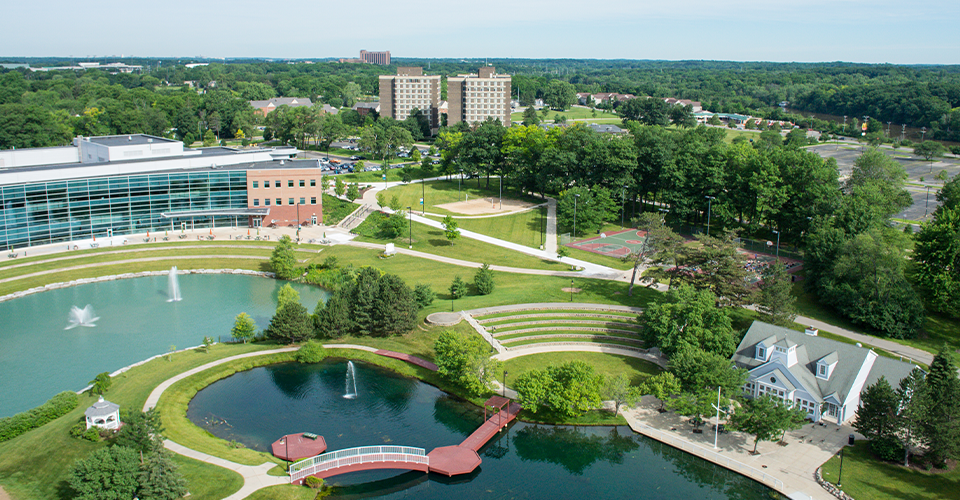
Eastern Michigan University is a sprawling public institution in Ypsilanti that serves as a pragmatic, accessible engine of upward mobility for Michigan. It’s defined by its sheer scale of offerings—over 200 undergraduate programs—and a deeply diverse, commuter-heavy student body where campus life is often self-made through clubs and a notably strong Black student community. While its graduation rates signal the challenges of serving a broad population, its mission is clear: to provide a direct, career-oriented education with a sticker price that makes a bachelor's degree a tangible reality for thousands.
Admission requirements
Test-optional — scores considered if submitted
Required
High school transcript
Grade point average
TOEFL (non-native English)
Considered (not required)
Test scores (SAT/ACT)
College-prep program
Source: IPEDS Admissions survey (2022) via Urban Institute. Covers formal factors only — it does not reflect essays, extracurriculars, or other holistic criteria.
More details
Undergrad enrollment
10,055
In-state tuition
$16,240
Out-of-state tuition
$16,240
Student-Faculty Ratio
14:1
Median Earnings (10yr)
$51,793
Graduation Rate (6-year)
46%
First-Year Receiving Grant/Scholarship Aid
96%
Outcomes & value
Outcomes & value
Median earnings (10 yr)
$51,793
Value (earnings ÷ net price)
3.4×
Median debt at graduation
$25,000
Graduation rate
46%
First-year retention
69%
Reducing loan balance (3 yr)
44%
Pell (lower-income) share
37%
First-gen share (among federal-aid recipients)
34%
Top-earning majors
Median earnings by field of study (highest credential), ~2 years after completion.
Mechanical Engineering Related Technologies/Technicians$69,338
On-campus criminal offenses classed as violent (murder/non-negligent manslaughter, rape, robbery, aggravated assault) for the most recent reported year. Source: U.S. Dept. of Education Campus Safety and Security (Clery Act). Counts reflect what’s reported to the school, and urban campuses often report more partly due to non-student incidents nearby — read alongside campus size and setting, not as a standalone safety verdict.
Climate
Pleasant days / yr
93
Summer high
81°F
Winter low
22°F
Annual rain
36.8"
Annual snow
31.8"
Natural-hazard risk
Relatively Moderate
Pleasant days counts days per year with a mean temperature of 55–75°F, a high at or below 90°F, a low at or above 45°F, and little precipitation — a transparent comfort measure, not a weighting we invented. Computed from Open-Meteo ERA5 daily history (2019–2023). Natural-hazard risk is the county’s composite rating from the FEMA National Risk Index.
Deep dive — research, future-scholar output & economic mobility▾
Research output
Institutional h-index
196
Scholarly works
10,323
Institutional research volume and impact from OpenAlex. The h-index reflects large research universities and will be low for teaching-focused liberal-arts colleges — not a measure of undergraduate quality.
Economic mobility
Mobility rate
1.2%
Bottom → top quintile
19%
From bottom quintile
6%
Mobility rate = the share of students who both start in the bottom household-income quintile and reach the top quintile; bottom → top is that chance conditional on starting at the bottom. Source: Opportunity Insights Mobility Report Cards (Chetty, Friedman, Saez, Turner & Yagan). Reflects 1980–82 birth cohorts, so it’s directional, not current.
Quick answers
What is the acceptance rate at Eastern Michigan University?
Eastern Michigan University's acceptance rate is approximately 80% (Ypsilanti, MI), based on the most recent figures we compiled from public and primary sources.
What SAT score do you need for Eastern Michigan University?
Admitted students at Eastern Michigan University typically score 920–1170 on the SAT (the middle-50% range). Scores outside this band are still admitted, especially with strong applications.
How much does Eastern Michigan University cost?
At Eastern Michigan University, the average net price (after aid) is about $15,407 per year. Actual cost varies with financial aid and residency.
How many undergraduates attend Eastern Michigan University?
Eastern Michigan University enrolls approximately 10,055 undergraduate students.
Where is Eastern Michigan University located?
Eastern Michigan University is located in Ypsilanti, MI.
Admissions
Eastern Michigan University operates as a broadly accessible public institution, with an admissions process that is transparent and focused on core academic preparedness rather than hyper-selectivity. The university reports an of 80%, positioning it as a less selective school where most applicants who meet baseline standards are admitted. The middle 50% SAT range for admitted students is 920–1170, with an ACT range of 18–27. The average incoming freshman has a GPA of 3.28, an ACT score of 22, and an SAT score of 1100, though the university emphasizes these are averages, not minimum cutoffs. The process is straightforward: a $35 application fee, and consideration of factors like high school GPA and rigor of coursework. Notably, EMU does not have a binding Early Decision program; its admissions cycle appears to be centered on regular decision. The university's size is reflected in its applicant volume, with one source noting 18,548 applied and 14,416 were accepted for a recent cycle.
Earnings = median of students working ~10 years after entry; debt = median of graduates. Value divides 10-yr earnings by one year’s net price — read it as earnings per dollar of annual cost, not a full lifetime ROI; it favors lower-cost schools. Source: U.S. Dept. of Education College Scorecard. Figures lag ~2 years and reflect all students, not your intended major.
$63,997
Registered Nursing, Nursing Administration, Nursing Research and Clinical Nursing$62,409
Computer Science$62,209
Source: U.S. Dept. of Education College Scorecard (field-of-study earnings). Figures cover graduates who received federal aid and lag ~2 years; not all programs report data.
EMU’s academic identity is built on volume, choice, and practical orientation. Students choose from a vast array of over 200 undergraduate majors and minors and more than 150 graduate programs, many offered in hybrid or fully online formats. This scale is organized into five colleges. The student-to-faculty ratio is a manageable 14:1, and 41.6% of classes have fewer than 20 students, suggesting opportunities for more personalized instruction despite the university's size. The average incoming freshman GPA is 3.43. While the curriculum spans the liberal arts, professional programs are prominent. Nursing and Psychology are among the most popular majors. The university also highlights U.S. News & World Report-ranked programs in Engineering, Computer Science, and Nursing as points of distinction. The academic approach is student-centered, aiming to support engagement and success through this broad menu of options.
Life at EMU is often described as what you make of it—a campus where diversity and self-driven involvement are the cornerstones. The university actively promotes a diverse and inclusive environment, with Campus Life offices dedicated to helping students "explore new interests, identities, and communities." A standout feature frequently noted by students is the vibrant and well-organized Black student community, supported by a strong Black Student Union, Greek life, and related organizations. The campus hosts events like the Cultural Expo, where students share food, stories, and performances. While it has a significant commuter population, the university offers a range of student-centered activities aimed at fostering belonging and development. The overall vibe is welcoming and supportive, with a focus on creating community for those who seek it out.
Outcomes at EMU tell a story of economic impact and variable completion rates, reflective of its mission as an access-oriented public university. The four-year graduation rate is 24%, while the six-year rate has reached 45% for recent cohorts. For graduates, the median earnings six years after entry are reported as $43,148. The university boasts a strong job placement claim for its graduates, stating that 89% get jobs. More specific data from the College of Business for 2024-2025 shows an 85% employment rate upon graduation for its graduates, with an average salary of $87,700, and 80% employed in a field utilizing their degree. On a macroeconomic scale, EMU emphasizes its broad impact, reporting that its alumni earned $4.8 billion in post-tax income in fiscal year 2024, with $746 million of that directly attributable to the university—a testament to its role in generating workforce value for the region.
Affordability is a central tenet of EMU's value proposition. The average after aid is $15,407. A significant majority of students receive grant or scholarship aid, with 96% of full-time, first-year undergraduates receiving such support in the most recent academic year. The financial aid process is standard for public universities: students must file the FAFSA to be considered for federal, state, and institutional . The university promotes several scholarship programs, including the Eagle Guarantee, Michigan Achievement Scholarship, and Emerald Scholarship, which are designed to cover tuition costs and provide additional funds for expenses. Loan funding is part of the aid package for many students, as the Office of Financial Aid automatically considers eligibility for federal loans upon FAFSA submission. The net price calculator is a key tool for prospective families to estimate their actual cost.
Eastern Michigan University stands out not for exclusivity, but for its deliberate role as a high-capacity, practical educational hub for Michigan. Its defining characteristic is scale: an enormous catalog of over 200 undergraduate programs provides a path for almost any career interest, all delivered with a 14:1 student-faculty ratio that prevents students from getting lost. It carves a distinct niche through its authentically diverse and self-empowered student culture, particularly the celebrated and tightly-knit Black student community that organizes a rich social and Greek life. While its graduation rates highlight the challenges of serving a broad-access population, its economic argument is powerful—transforming a relatively low into solid median earnings and claiming a 89% job placement rate. EMU is the workhorse of Michigan public higher ed: unpretentious, sprawling, and focused on turning access into tangible outcomes.
Eastern Michigan University seal · sourceEastern Michigan University | Become More You | 300+ Degree Programs · sourceCampus Map & Directions - Eastern Michigan University · sourceEastern Michigan University College of Business named among nation's best for 18th consecutive year by The Princeton Review - EMU Today · source