Admit rate has ranged 39%–66% over the last 5 years — notably volatile, though the latest figure above (68%) falls outside that window. Source: IPEDS via Urban Institute.
Acceptance & SAT from Common Data Set / IPEDS; net price, earnings & graduation from the U.S. Dept. of Education College Scorecard. Figures lag ~1–2 years — verify with the school.
Monroe University is a career-obsessed, industry-driven institution in the Bronx that operates with the pragmatic urgency of a New York minute. It’s less a traditional liberal arts college and more a direct pipeline to the city's workforce, with a curriculum explicitly designed to align with the local and international economy. The campus is a genuine melting pot—multicultural, multiethnic, and multigenerational—serving students who are there to get a practical degree, build a professional network, and graduate ready to work.
Admission requirements
Test-optional — scores considered if submitted
Required
High school transcript
Grade point average
Class rank
Letters of recommendation
TOEFL (non-native English)
Considered (not required)
Test scores (SAT/ACT)
College-prep program
Demonstrated competencies
Source: IPEDS Admissions survey (2022) via Urban Institute. Covers formal factors only — it does not reflect essays, extracurriculars, or other holistic criteria.
More details
Undergrad enrollment
5,701
In-state tuition
$18,464
Out-of-state tuition
$18,464
Graduation Rate
57%
Student Body Vibe
Multicultural, multiethnic, multigenerational
Financial Aid Reach
92% of first-year students receive grants/scholarships
Top Specializations
Protective Services, Public Administration, Health Services
First-Year Credit Pace
45 credits (vs. typical 30)
Median Earnings (10yr)
$41,236
Outcomes & value
Outcomes & value
Median earnings (10 yr)
$41,236
Value (earnings ÷ net price)
2.8×
Median debt at graduation
$18,818
Graduation rate
57%
First-year retention
67%
Reducing loan balance (3 yr)
31%
Pell (lower-income) share
55%
First-gen share (among federal-aid recipients)
49%
Earnings = median of students working ~10 years after entry; debt = median of graduates. divides 10-yr earnings by net price — read it as earnings per dollar of annual cost, not a full lifetime ROI; it favors lower-cost schools. Source: U.S. Dept. of Education College Scorecard. Figures lag ~2 years and reflect all students, not your intended major.
Financial health
1.8 / 3.0Meets the federal financial-responsibility standard
U.S. Dept. of Education Financial Responsibility Composite Score (FY2022-23). Scale −1.0 to 3.0; ≥1.5 meets the standard. Reported for private nonprofit & for-profit institutions only — public universities are state-backed and not scored, so this is a stability signal, not a ranking.
Top-earning majors
Median earnings by field of study (highest credential), ~2 years after completion.
Accounting and Related Services$37,291
Business Administration, Management and Operations$37,208
Computer and Information Sciences, General$34,908
Public Health$34,388
Hospitality Administration/Management$33,352
Criminal Justice and Corrections
Campus & location
Campus safety
On-campus violent crimes (2024)
1
Per 1,000 students
0.13
On-campus criminal offenses classed as violent (murder/non-negligent manslaughter, rape, robbery, aggravated assault) for the most recent reported year. Source: U.S. Dept. of Education Campus Safety and Security (Clery Act). Counts reflect what’s reported to the school, and urban campuses often report more partly due to non-student incidents nearby — read alongside campus size and setting, not as a standalone safety verdict.
Climate
Pleasant days / yr
91
Summer high
83°F
Winter low
29°F
Annual rain
54.3"
Annual snow
19.6"
Natural-hazard risk
Relatively High
Pleasant days counts days per year with a mean temperature of 55–75°F, a high at or below 90°F, a low at or above 45°F, and little precipitation — a transparent comfort measure, not a weighting we invented. Computed from Open-Meteo ERA5 daily history (2019–2023). Natural-hazard risk is the county’s composite rating from the FEMA National Risk Index.
Deep dive — research, future-scholar output & economic mobility▾
Research output
Institutional h-index
44
Scholarly works
480
Institutional research volume and impact from OpenAlex. The h-index reflects large research universities and will be low for teaching-focused liberal-arts colleges — not a measure of undergraduate quality.
Quick answers
What is the acceptance rate at Monroe University?
Monroe University's acceptance rate is approximately 68% (Bronx, NY), based on the most recent figures we compiled from public and primary sources.
How much does Monroe University cost?
At Monroe University, the average net price (after aid) is about $14,522 per year. Actual cost varies with financial aid and residency.
How many undergraduates attend Monroe University?
Monroe University enrolls approximately 5,701 undergraduate students.
Where is Monroe University located?
Monroe University is located in Bronx, NY.
Admissions
Monroe's admissions process is designed for accessibility, with a clear focus on students ready for a fast-paced, career-oriented education. The university is less selective, with an of 68%. Regular applications are typically due by August 15, and SAT/ACT scores must be received by September 1. The process does not appear to hinge on standardized testing prestige but rather on demonstrating college readiness and a clear vocational focus. While sources discuss the as a key resource for understanding admissions factors like demonstrated interest, specific details on Monroe's CDS regarding the importance of interviews, status, or demonstrated interest are not provided in the snippets. The admissions checklist emphasizes a unique academic promise: by the end of the first year, Monroe students will have earned 45 credits, compared to the typical 30 at other colleges, accelerating their path to a degree.
Selectivity: Less selective with a 68% acceptance rate.
Deadlines: Regular applications due August 15; SAT/ACT scores by September 1.
Pace: Promises an accelerated credit load of 45 credits in the first year.
Teacher Education and Professional Development, Specific Levels and Methods$31,314
Source: U.S. Dept. of Education College Scorecard (field-of-study earnings). Figures cover graduates who received federal aid and lag ~2 years; not all programs report data.
Academics at Monroe are unapologetically pragmatic. The curriculum is industry-driven, and professors are noted for their real-world experience and dedication to student success. Undergraduate degrees are explicitly designed to align with industries that drive the New York and international economies. There is no pretense of a classic liberal arts core; instead, programs like the Bachelor's in Professional Studies offer a career-focused curriculum that teaches real-world skills for students who "know what they want to accomplish."
The most specialized majors, based on degrees awarded, are in Protective Services (like Criminal Justice), Public Administration and Social Service, and Parks, Recreation, & Leisure Studies. Other significant programs include Health Services Administration (23% of online bachelor's students) and Business Administration (15%). The graduate school is also highly ranked and industry-driven, preparing students for managerial and leadership positions. This is an institution built for the student who views college as a direct professional investment, not an intellectual exploration.
Life at Monroe is active and community-oriented, reflecting the diverse backgrounds of its student body. The campus atmosphere is described as welcoming with a strong sense of community, enhanced by its multicultural, multiethnic, and multigenerational makeup. The Student Activities Office hosts a wide range of events, from a Winter Open House to introduce the semester's schedule to late-night games and campus celebrations. The official student life Instagram account showcases a lively scene with students behind the scenes of these events.
The university has campuses in the Bronx, New Rochelle, and even St. Lucia, with the St. Lucia campus offering its own set of student clubs and resources. This isn't a campus dominated by Greek life or century-old traditions; it's a practical, engaging environment where students from various backgrounds connect over shared professional goals and the shared experience of navigating a fast-track education in New York.
Monroe's outcomes tell the story of its mission: to graduate students into the workforce efficiently. The graduation rate is 57%, which the university notes is among the highest in the country for students receiving Pell Grants. About 24% of students transfer out before completion. For those who graduate, the focus on career preparation aims to translate into employment. The university's Presidential Partnership Program is highlighted as a standout initiative for outcomes. While specific recent salary data isn't detailed in the provided snippets beyond the canonical figure, the College Scorecard lists median earnings, and the institution promotes its graduates' success in entering their chosen fields. The outcome is less about graduate school placements and more about immediate, tangible career entry.
Monroe positions itself as an affordable, high-value investment. The average net price after aid is $14,522. A significant majority (92%) of full-time beginning undergraduates receive grant or scholarship aid, with the average need-based award for first-year students being $14,579. The university encourages families to use its Calculator to estimate costs based on potential aid.
Financial aid includes federal need-based grants and loans, as well as specific scholarships like the Flight 3407 Memorial Scholarships. The available sources do not indicate that Monroe has a "no-loan" policy for low-income students or that it meets 100% of demonstrated financial need without loans. Instead, the aid structure appears to be a mix of grants and federal loan options, aimed at making the career-focused education accessible.
Monroe University stands out for its singular, unwavering focus on career acceleration. It rejects the model of a leisurely, exploratory undergraduate experience in favor of a pragmatic, high-velocity path to a professional degree. This is crystallized in its promise of 45 credits in the first year—a 50% faster pace than the national norm—catering to students eager to enter or advance in the workforce.
Its identity is deeply intertwined with the New York economy, crafting programs specifically for the city's job market in fields like protective services, health administration, and business. Furthermore, it creates a distinctive environment by serving a non-traditional, diverse student body—working adults, career-changers, students—forging a community based on shared ambition rather than shared high school pedigree. Monroe isn't trying to be an Ivy; it's trying to be the most efficient and effective engine for upward mobility in the Bronx.
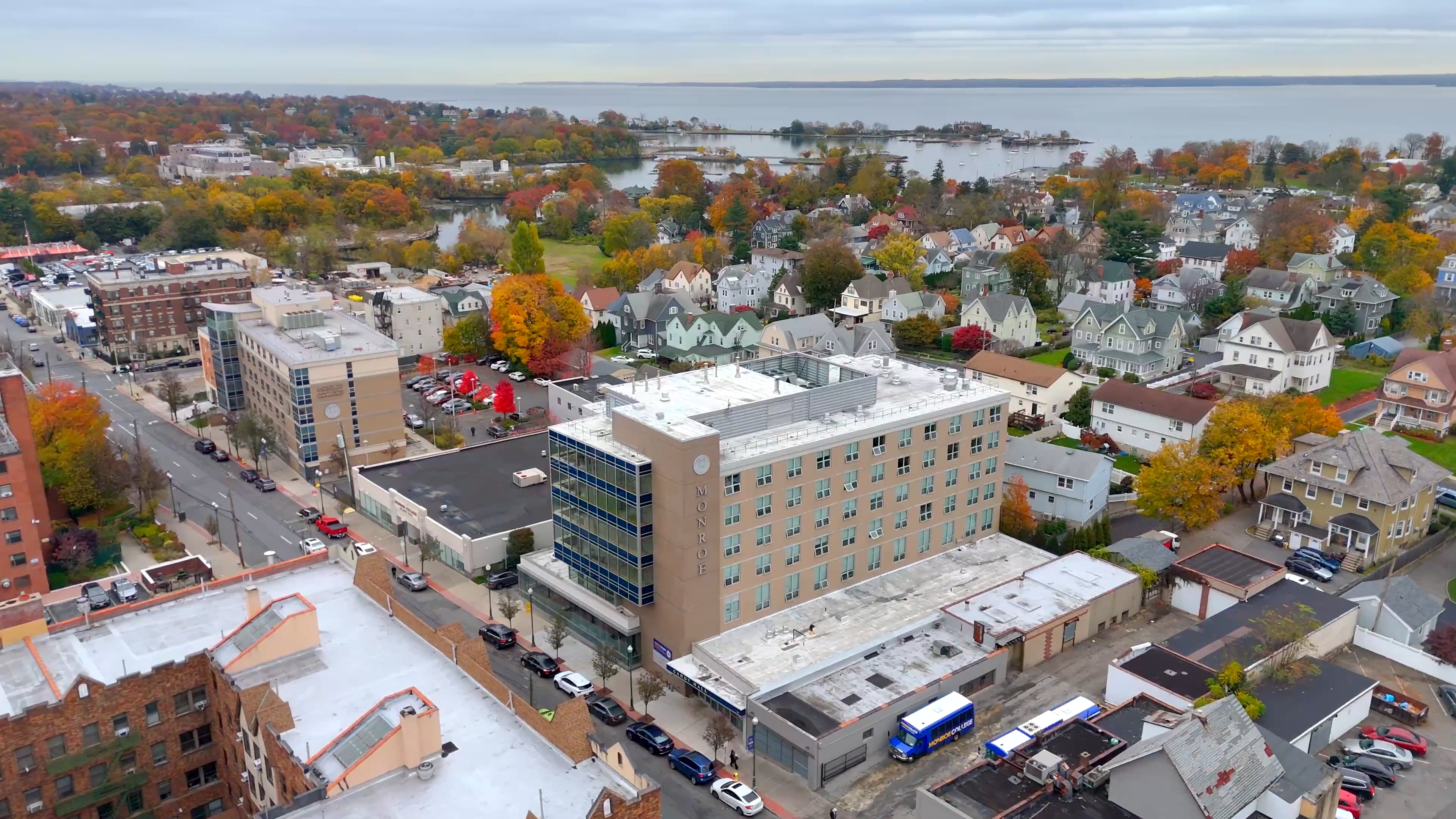
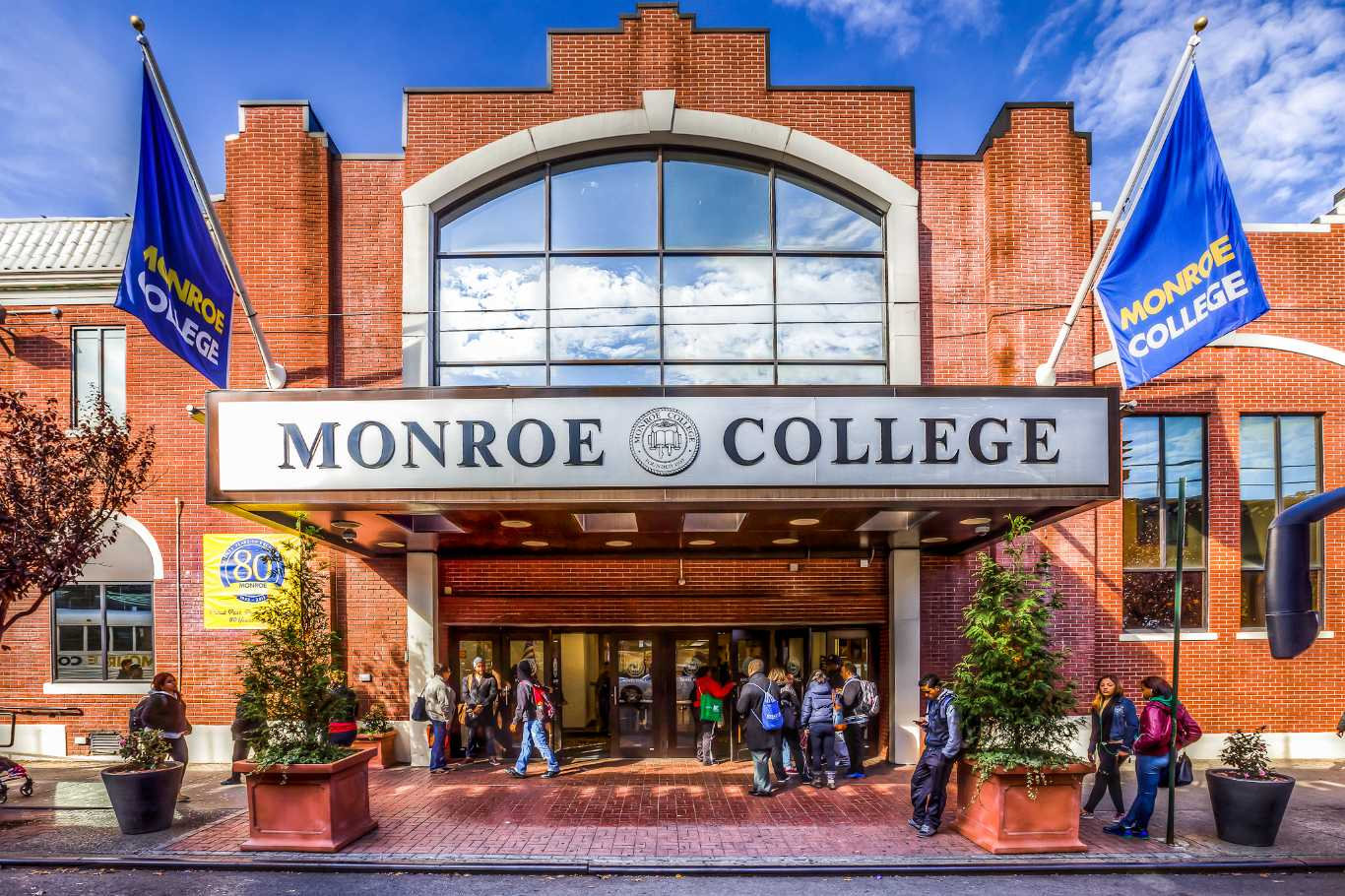
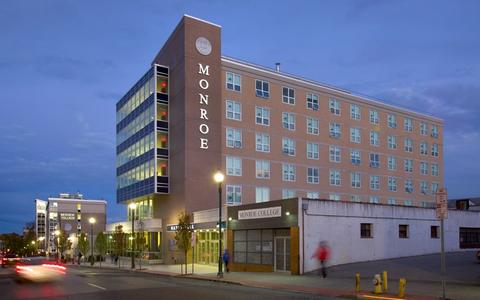
Monroe University seal · sourceLife on the New Rochelle, NY Campus | Monroe University · sourceMonroe University | The New Rochelle Experience · sourceGaddy Hall | Monroe University · source