Admit rate has ranged 45%–62% over the last 5 years — notably volatile. Source: IPEDS via Urban Institute.
Acceptance & SAT from Common Data Set / IPEDS; net price, earnings & graduation from the U.S. Dept. of Education College Scorecard. Figures lag ~1–2 years — verify with the school.
SUNY New Paltz is the Hudson Valley's creative and intellectual hub, a public university where a robust arts scene and a serious academic culture collide against a backdrop of historic small-town charm. It's a place where you're as likely to find a student hunched over a ceramics wheel as you are one analyzing data in a STEM lab, all drawn by a reputation for quality that makes it one of the most selective and sought-after campuses in the SUNY system. The vibe is fiercely independent, artistically charged, and grounded in the practical outcomes of a public education.
Admission requirements
Test-optional — scores considered if submitted
Required
High school transcript
Grade point average
Letters of recommendation
College-prep program
Considered (not required)
Test scores (SAT/ACT)
Source: IPEDS Admissions survey (2022) via Urban Institute. Covers formal factors only — it does not reflect essays, extracurriculars, or other holistic criteria.
More details
Undergrad enrollment
6,086
In-state tuition
$8,572
Out-of-state tuition
$18,822
Graduation Rate
72%
Typical Student Debt
$18,750
Median Earnings (10yr)
$58,073
First-Year Retention Rate
85.3%
Outcomes & value
Outcomes & value
Median earnings (10 yr)
$58,073
Value (earnings ÷ net price)
3.1×
Median debt at graduation
$18,750
Graduation rate
72%
First-year retention
85%
Reducing loan balance (3 yr)
71%
Pell (lower-income) share
32%
First-gen share (among federal-aid recipients)
32%
Top-earning majors
Median earnings by field of study (highest credential), ~2 years after completion.
Electrical, Electronics, and Communications Engineering$68,219
Computer Engineering$67,324
Computer and Information Sciences, General$58,221
Design and Applied Arts$51,273
Accounting and Related Services$45,794
Economics$43,128
Campus & location
Campus safety
On-campus violent crimes (2024)
5
Per 1,000 students
0.70
On-campus criminal offenses classed as violent (murder/non-negligent manslaughter, rape, robbery, aggravated assault) for the most recent reported year. Source: U.S. Dept. of Education Campus Safety and Security (Clery Act). Counts reflect what’s reported to the school, and urban campuses often report more partly due to non-student incidents nearby — read alongside campus size and setting, not as a standalone safety verdict.
Climate
Pleasant days / yr
88
Summer high
82°F
Winter low
23°F
Annual rain
54.2"
Annual snow
36.5"
Natural-hazard risk
Relatively Moderate
Pleasant days counts days per year with a mean temperature of 55–75°F, a high at or below 90°F, a low at or above 45°F, and little precipitation — a transparent comfort measure, not a weighting we invented. Computed from Open-Meteo ERA5 daily history (2019–2023). Natural-hazard risk is the county’s composite rating from the FEMA National Risk Index.
Deep dive — research, future-scholar output & economic mobility▾
Economic mobility
Mobility rate
3.7%
Bottom → top quintile
37%
From bottom quintile
10%
Mobility rate = the share of students who both start in the bottom household-income quintile and reach the top quintile; bottom → top is that chance conditional on starting at the bottom. Source: Opportunity Insights Mobility Report Cards (Chetty, Friedman, Saez, Turner & Yagan). Reflects 1980–82 birth cohorts, so it’s directional, not current.
Quick answers
What is the acceptance rate at State University of New York at New Paltz?
State University of New York at New Paltz's acceptance rate is approximately 62% (New Paltz, NY), based on the most recent figures we compiled from public and primary sources.
What SAT score do you need for State University of New York at New Paltz?
Admitted students at State University of New York at New Paltz typically score 1170–1340 on the SAT (the middle-50% range). Scores outside this band are still admitted, especially with strong applications.
How much does State University of New York at New Paltz cost?
At State University of New York at New Paltz, the average net price (after aid) is about $18,809 per year. Actual cost varies with financial aid and residency.
How many undergraduates attend State University of New York at New Paltz?
State University of New York at New Paltz enrolls approximately 6,086 undergraduate students.
Where is State University of New York at New Paltz located?
State University of New York at New Paltz is located in New Paltz, NY.
Admissions
Don't let the public-school label fool you—getting into New Paltz is a genuine competition. The university describes its process as "very competitive," routinely fielding over 16,000 applications for a first-year class of about 1,150 seats. While the sits around 62%, that figure masks the academic caliber of the students who enroll. The middle 50% of admitted students present SAT scores between 1170 and 1340, and the average GPA hovers around 3.55, with a significant portion of the class (39%) reporting a GPA of 3.75 or higher. The university is , meaning SAT/ACT scores are not required for admission. The rate—the percentage of admitted students who choose to enroll—is reported at 10.7%, indicating that New Paltz is often one of several attractive options for its admits.
Earnings = median of students working ~10 years after entry; debt = median of graduates. Value divides 10-yr earnings by one year’s net price — read it as earnings per dollar of annual cost, not a full lifetime ROI; it favors lower-cost schools. Source: U.S. Dept. of Education College Scorecard. Figures lag ~2 years and reflect all students, not your intended major.
Finance and Financial Management Services$43,128
Mathematics$41,007
Source: U.S. Dept. of Education College Scorecard (field-of-study earnings). Figures cover graduates who received federal aid and lag ~2 years; not all programs report data.
New Paltz operates as a comprehensive university, offering a wide-ranging curriculum across more than 100 undergraduate majors and minors, plus over 50 graduate programs. The academic experience is defined by strong, hands-on programs in both the arts and sciences. It's a campus of dual identities: a respected hub for fine & performing arts, and a growing center for STEM, business, and education.
Program Breadth: Students can choose from a vast array of programs, including Accounting, Adolescence Education (in subjects like Biology, Chemistry, English, and Social Studies), Computer Science, Engineering, and Music Therapy.
Pedagogical Highlights: The curriculum emphasizes writing across disciplines (with 100% of programs incorporating writing in the disciplines) and culminative experiences (92% of programs require a senior capstone or similar project). Undergraduate research opportunities are also widely available.
Specialized Strengths: Data shows the university awards a significant number of degrees in specialized fields like English, History, and Cultural & Gender Studies, pointing to deep roots in the liberal arts alongside its professional and artistic offerings.
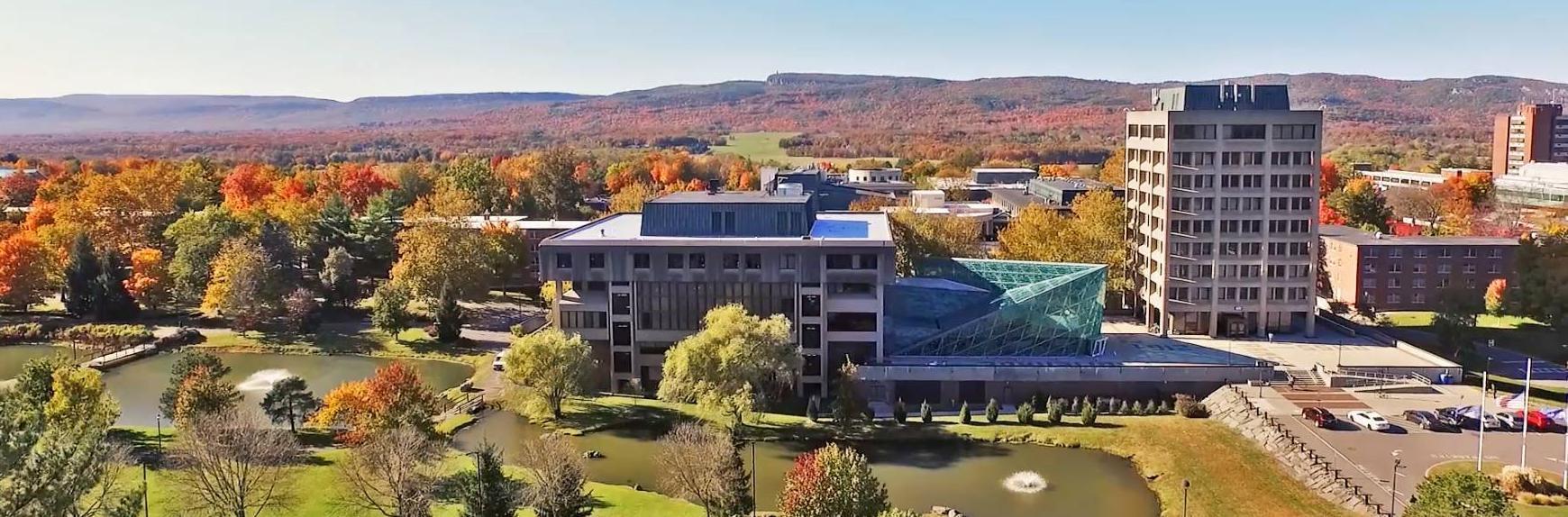
Life at New Paltz is deeply intertwined with its location. The university bills itself as a "center for Hudson Valley arts and culture," and that's not just marketing—it's the daily reality. The campus pulses with creative energy, fueled by its robust arts programs. Students report a constant calendar of "many music and theater performances" each week. This isn't a suitcase school; the small-town college atmosphere in the village of New Paltz fosters a tight-knit community where the campus itself is the social hub.
Beyond the stage and studio, student life is built around connection. There are multiple on-campus networking events, a vibrant club scene, and guest lectures from visiting scholars and celebrities. A well-connected conversation partner program links international and domestic students, and the university organizes outstanding cultural activities and field trips that leverage its proximity to New York City and the natural beauty of the Hudson Valley. The campus serves as the primary meeting place, creating a self-contained yet dynamic environment.
New Paltz students tend to stick around and finish what they start. The first-year retention rate is a healthy 85.3%, and the six-year graduation rate is 72%. After crossing the stage, graduates enter the workforce with solid prospects. Within six months of graduation, 57% of alumni have found employment, while another 26% head directly to graduate school.
The financial return on a New Paltz degree is compelling, especially given its public-university price tag. The median earnings for graduates ten years after entry is $58,073. This strong outcome is achieved while carrying a relatively manageable debt burden, with the typical graduate holding about $18,750 in student loans. The data paints a picture of a university that effectively prepares students for both immediate employment and advanced study, delivering strong value.
As a public institution within the State University of New York system, New Paltz offers a significant cost advantage, especially for in-state students. The average —what students actually pay after grants and scholarships are applied—is $18,809. A strong majority of students (71%) receive some form of grant or scholarship aid, with the average financial aid package (including loans and work-study) totaling $9,611. Merit-based scholarships are available, with awards ranging from $100 to $4,000 per year depending on the program.
It's important to note that SUNY New Paltz does not advertise a "no-loan" policy or a guarantee to meet 100% of demonstrated financial need with grant aid alone. Financial aid packages typically include a combination of scholarships, grants, loans, and work-study. Students and families are encouraged to use the university's Net Price Calculator for an early, personalized estimate of costs and aid.
SUNY New Paltz stands out for mastering a difficult balance. It delivers the academic heft and career outcomes of a selective university while retaining the accessible cost and public mission of a state school. But its true differentiator is culture. It has successfully fused a rigorous, comprehensive academic portfolio with the soul of an arts college. This isn't a campus where the arts are siloed off; the creative energy from its highly-regarded fine and performing arts programs permeates the environment, making it a unique and attractive destination for students across all disciplines who want a vibrant, intellectually stimulating community. You come here for a serious education, but you get it in a place that values expression, independent thinking, and the vibrant cultural life of the Hudson Valley. It's the SUNY that feels most like a private liberal arts college, without the private college price tag.
State University of New York at New Paltz seal · sourceSUNY New Paltz | The State University of New York at New Paltz · sourceSUNY New Paltz | The State University of New York at New Paltz · sourceVisitors Guide | SUNY New Paltz · source