Admit rate has ranged 58%–64% over the last 5 years. Source: IPEDS via Urban Institute.
Acceptance & SAT from Common Data Set / IPEDS; net price, earnings & graduation from the U.S. Dept. of Education College Scorecard. Figures lag ~1–2 years — verify with the school.
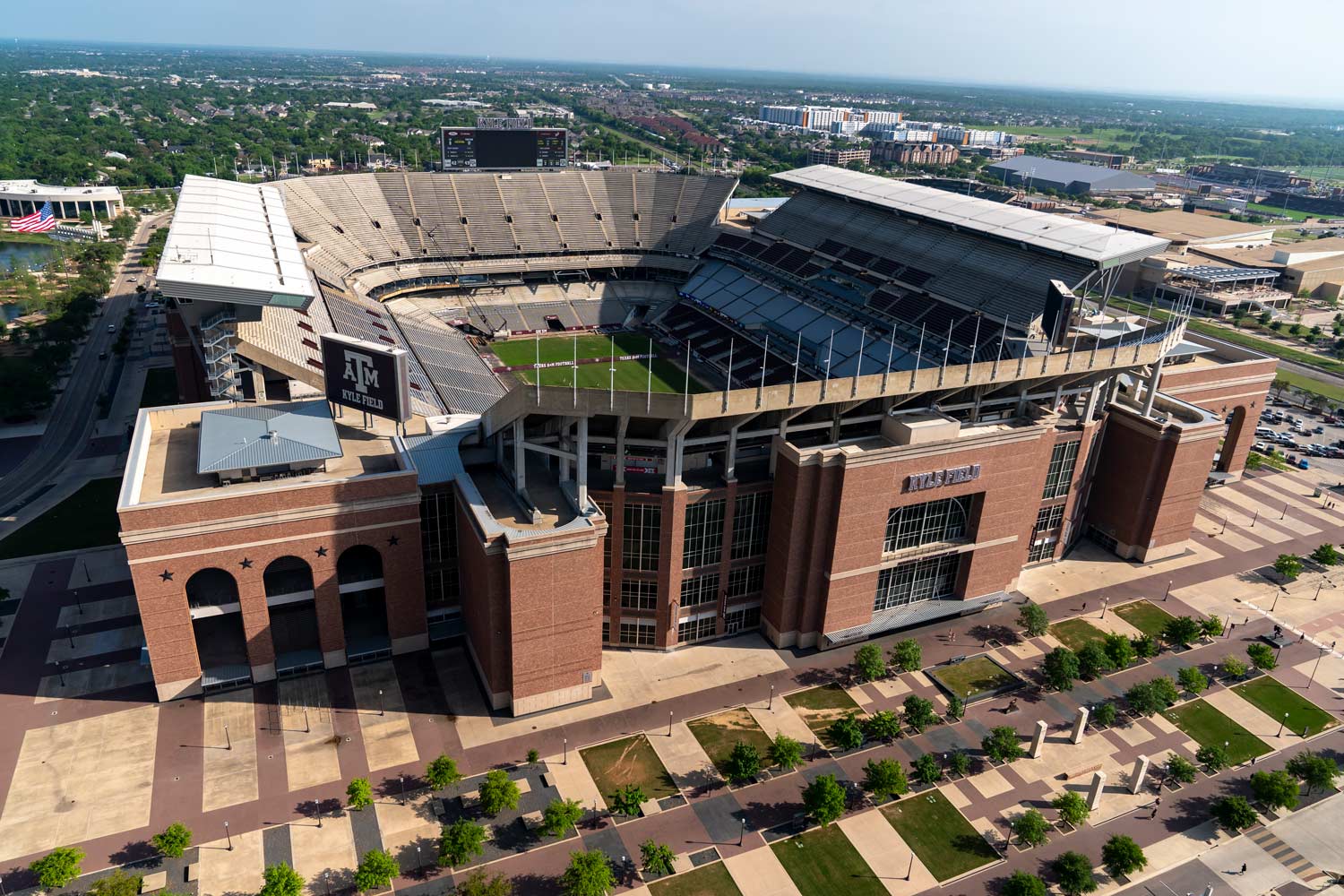
Texas A&M University-College Station is a sprawling, tradition-steeped public powerhouse where the Aggie spirit—a potent blend of military heritage, relentless school pride, and a culture of service—permeates everything. It's an institution built on scale, offering over 140 undergraduate degrees, with its engineering and business schools drawing national attention, all while operating under the unique Texas policy that guarantees admission to the top 10% of in-state high school graduates. The result is a massive, self-assured community that feels more like a loyal nation than a mere campus.
Admission requirements
Test scores required
Required
High school transcript
Grade point average
Class rank
Test scores (SAT/ACT)
TOEFL (non-native English)
Considered (not required)
College-prep program
Source: IPEDS Admissions survey (2022) via Urban Institute. Covers formal factors only — it does not reflect essays, extracurriculars, or other holistic criteria.
More details
Undergrad enrollment
59,615
In-state tuition
$13,154
Out-of-state tuition
$40,124
Early Decision
Not offered
Graduation Rate
84%
Meets Full Need
No (~70% on average)
Demonstrated Interest
Considered
Median Earnings (10yr)
$72,097
Outcomes & value
Outcomes & value
Median earnings (10 yr)
$72,097
Value (earnings ÷ net price)
3.4×
Median debt at graduation
$17,804
Graduation rate
84%
First-year retention
94%
Reducing loan balance (3 yr)
82%
Pell (lower-income) share
20%
First-gen share (among federal-aid recipients)
30%
Top-earning majors
Median earnings by field of study (highest credential), ~2 years after completion.
Petroleum Engineering$92,124
Marine Transportation$86,129
Chemical Engineering$80,669
Electrical, Electronics, and Communications Engineering$77,062
Computer and Information Sciences, General$77,024
Business/Commerce, General$76,460
Campus & location
Campus safety
On-campus violent crimes (2024)
94
Per 1,000 students
1.22
On-campus criminal offenses classed as violent (murder/non-negligent manslaughter, rape, robbery, aggravated assault) for the most recent reported year. Source: U.S. Dept. of Education Campus Safety and Security (Clery Act). Counts reflect what’s reported to the school, and urban campuses often report more partly due to non-student incidents nearby — read alongside campus size and setting, not as a standalone safety verdict.
Climate
Pleasant days / yr
94
Summer high
95°F
Winter low
45°F
Annual rain
42.6"
Annual snow
1.4"
Natural-hazard risk
Relatively Moderate
Pleasant days counts days per year with a mean temperature of 55–75°F, a high at or below 90°F, a low at or above 45°F, and little precipitation — a transparent comfort measure, not a weighting we invented. Computed from Open-Meteo ERA5 daily history (2019–2023). Natural-hazard risk is the county’s composite rating from the FEMA National Risk Index.
Quick answers
What is the acceptance rate at Texas A&M University-College Station?
Texas A&M University-College Station's acceptance rate is approximately 57% (College Station, TX), based on the most recent figures we compiled from public and primary sources.
What SAT score do you need for Texas A&M University-College Station?
Admitted students at Texas A&M University-College Station typically score 1150–1400 on the SAT (the middle-50% range). Scores outside this band are still admitted, especially with strong applications.
How much does Texas A&M University-College Station cost?
At Texas A&M University-College Station, the average net price (after aid) is about $21,315 per year. Actual cost varies with financial aid and residency.
How many undergraduates attend Texas A&M University-College Station?
Texas A&M University-College Station enrolls approximately 59,615 undergraduate students.
Where is Texas A&M University-College Station located?
Texas A&M University-College Station is located in College Station, TX.
Admissions
Admission to Texas A&M is governed by a distinctive dual-track system shaped by Texas state law. The most significant pathway is automatic admission for Texas residents who rank in the top 10% of their high school class, a policy that fundamentally shapes the incoming class profile. For all other applicants—including those in the second decile and all out-of-state students—the process is holistic and considerably more selective. While the university's overall is 57%, the rate for this non-automatic admit pool is much tighter, with estimates suggesting it may be around 30% or even lower for the most competitive majors. The university does not offer an early decision or early action program, and it does consider demonstrated interest as part of its evaluation, alongside the rigor of secondary school record, class rank, GPA, standardized test scores, and extracurricular activities. The rate—the percentage of admitted students who enroll—is approximately 40%. The middle 50% SAT range for admitted students is 1150–1400, with a corresponding ACT range of 24–32.
Earnings = median of students working ~10 years after entry; debt = median of graduates. Value divides 10-yr earnings by one year’s net price — read it as earnings per dollar of annual cost, not a full lifetime ROI; it favors lower-cost schools. Source: U.S. Dept. of Education College Scorecard. Figures lag ~2 years and reflect all students, not your intended major.
Computer Engineering$75,011
Information Science/Studies$74,367
Source: U.S. Dept. of Education College Scorecard (field-of-study earnings). Figures cover graduates who received federal aid and lag ~2 years; not all programs report data.
Scale defines the academic experience at Texas A&M, with the university offering more than 140 undergraduate degree programs. This vast menu ensures there's a path for nearly every interest, from the sciences and performing arts to communications and economics. The most popular majors cluster in engineering and business, management, and marketing, reflecting the school's historic strengths and industry connections. Other highly pursued majors include psychology, multi-disciplinary studies, and biomedical sciences. The academic heart of the university is its comprehensive selection of over 130 programs of study. While the undergraduate experience can be large-lecture hall at the introductory level, the university's reputation, particularly in engineering, is a point of significant pride and discussion among students, who often compare its standing to other top-tier public engineering schools. The breadth of choice is the defining feature, providing a 'broad base of knowledge and experience' across a remarkably wide academic landscape.
Life outside the classroom at Texas A&M is an all-encompassing culture, not just a collection of activities. The Aggie identity, forged through deep-rooted traditions and a storied military past, creates a cohesive and spirited community. Students describe campus life as vibrant and diverse, with an overwhelming array of ways to get involved:
Organizations: With more than 150 student clubs and organizations, there are avenues for every interest, from community service and multicultural programming to sports clubs and outdoor recreation.
Campus Events: A constant calendar of events, explored during New Student Conferences (NSC), helps students connect with future classmates and discover the resources of Aggieland.
The Aggie Network: The sense of belonging is powerful, fostered by a student life apparatus dedicated to helping students 'participate fully in the university experience.' This results in a campus environment that feels both massive and intimate, where school pride is palpable and the network of fellow Aggies is a lifelong bond.
Texas A&M delivers strong post-graduation results, characterized by high completion rates and solid earning potential. The university boasts a six-year graduation rate of 84%, significantly above the national average of 62.2% for its cohort. This success extends to students from all backgrounds; the university has been recognized nationally for its success with low-income students, achieving a low-income student graduation rate of 60 percent. For graduates, the median salary six years after entry is $59,386. The combination of a robust graduation rate and positive early-career earnings underscores the value of the Aggie degree and the strength of its alumni network in facilitating career entry and advancement.
As a public institution, Texas A&M's cost structure differs for in-state and out-of-state students, with the average after aid being $21,315. The university provides a net price calculator to help families estimate their actual cost after accounting for grants and scholarships. Financial aid is a mix of need-based and non-need-based support, and the university reports meeting about 70% of demonstrated financial need on average for those who qualify. This support comes through a combination of grants, scholarships, loans, and work-study. Institutional scholarships are also available, awarded based on academic achievement and extracurricular activities. For many students, financing their education will include federal or parent loans, with the university providing resources to understand loan debt and repayment options.
Texas A&M stands out not merely as a university but as a cultural institution with a fiercely independent identity. Its character is defined by several unique factors: the Texas Top 10% automatic admission law, which guarantees a core of high-achieving in-state students and creates a two-tiered admissions reality; the sheer scale and scope of its academic offerings, providing a comprehensive public research university experience; and, most distinctly, the Aggie Spirit. This is an all-encompassing ethos of tradition, service, and unmatched school pride that originates from its history as a military college and now binds together a network of over 60,000 students. It's a place where the phrase 'former student' is preferred over 'alumni,' and the sense of shared identity often outweighs the anonymity of a large student body. For students who buy in, it offers the resources of a mega-university wrapped in the loyalty of a tight-knit tribe, with a proven track record of graduation success and a powerful national reputation in key fields like engineering.
Texas A&M University-College Station seal · sourceLife at Texas A&M University | Texas A&M University Engineering · sourceAbout | Texas A&M University · sourceCampus Destinations | Texas A&M University · source