Admit rate has ranged 49%–64% over the last 5 years — notably volatile. Source: IPEDS via Urban Institute.
Acceptance & SAT from Common Data Set / IPEDS; net price, earnings & graduation from the U.S. Dept. of Education College Scorecard. Figures lag ~1–2 years — verify with the school.
The College of New Jersey (TCNJ) is a public liberal arts powerhouse that delivers a private-college experience at a state-school price. Known for its collaborative, hands-on academics and a campus culture that’s more focused than frenetic, TCNJ attracts high-achieving New Jersey students who want rigorous programs in education, nursing, engineering, and the sciences without the giant lecture halls. The vibe is studious but social, with a strong emphasis on undergraduate research and internships that translate directly into impressive post-graduation outcomes.
Admission requirements
Test-optional — scores considered if submitted
Required
High school transcript
TOEFL (non-native English)
Considered (not required)
Grade point average
Class rank
Letters of recommendation
Test scores (SAT/ACT)
College-prep program
Demonstrated competencies
Source: IPEDS Admissions survey (2022) via Urban Institute. Covers formal factors only — it does not reflect essays, extracurriculars, or other holistic criteria.
More details
Undergrad enrollment
7,105
In-state tuition
$19,632
Out-of-state tuition
$25,752
Housing
44% on-campus, 56% off-campus
No-Loan Policy
Not Stated in Sources
Graduation Rate
86%
Meets Full Need
Not Stated in Sources
ED Share of Class
Not Stated in Sources
Signature Programs
Education, Nursing, Engineering, Sciences
First-Year Retention
Not Stated in Sources
Demonstrated Interest
Not Stated in Sources
Student Organizations
Outcomes & value
Outcomes & value
Median earnings (10 yr)
$73,323
Value (earnings ÷ net price)
2.7×
Median debt at graduation
$23,250
Graduation rate
86%
First-year retention
91%
Reducing loan balance (3 yr)
84%
Pell (lower-income) share
21%
First-gen share (among federal-aid recipients)
21%
Top-earning majors
Median earnings by field of study (highest credential), ~2 years after completion.
Registered Nursing, Nursing Administration, Nursing Research and Clinical Nursing$75,946
Computer and Information Sciences, General$70,009
Electrical, Electronics, and Communications Engineering$68,219
Computer Engineering$67,660
Accounting and Related Services$64,581
Engineering Science
Campus & location
Campus safety
On-campus violent crimes (2024)
9
Per 1,000 students
1.15
On-campus criminal offenses classed as violent (murder/non-negligent manslaughter, rape, robbery, aggravated assault) for the most recent reported year. Source: U.S. Dept. of Education Campus Safety and Security (Clery Act). Counts reflect what’s reported to the school, and urban campuses often report more partly due to non-student incidents nearby — read alongside campus size and setting, not as a standalone safety verdict.
Climate
Pleasant days / yr
90
Summer high
85°F
Winter low
29°F
Annual rain
51.2"
Annual snow
16.1"
Natural-hazard risk
Relatively High
Pleasant days counts days per year with a mean temperature of 55–75°F, a high at or below 90°F, a low at or above 45°F, and little precipitation — a transparent comfort measure, not a weighting we invented. Computed from Open-Meteo ERA5 daily history (2019–2023). Natural-hazard risk is the county’s composite rating from the FEMA National Risk Index.
Deep dive — research, future-scholar output & economic mobility▾
Research output
Institutional h-index
201
Scholarly works
9,364
Institutional research volume and impact from OpenAlex. The h-index reflects large research universities and will be low for teaching-focused liberal-arts colleges — not a measure of undergraduate quality.
Quick answers
What is the acceptance rate at The College of New Jersey?
The College of New Jersey's acceptance rate is approximately 62% (Ewing, NJ), based on the most recent figures we compiled from public and primary sources.
What SAT score do you need for The College of New Jersey?
Admitted students at The College of New Jersey typically score 1140–1340 on the SAT (the middle-50% range). Scores outside this band are still admitted, especially with strong applications.
How much does The College of New Jersey cost?
At The College of New Jersey, the average net price (after aid) is about $27,646 per year. Actual cost varies with financial aid and residency.
How many undergraduates attend The College of New Jersey?
The College of New Jersey enrolls approximately 7,105 undergraduate students.
Where is The College of New Jersey located?
The College of New Jersey is located in Ewing, NJ.
Admissions
TCNJ is a selective public institution where the admissions process rewards applicants who show clear academic readiness. The college operates on a policy for first-year applicants, though historically admitted students have averaged a 1265 on the SAT and a 28 on the ACT. The middle 50% SAT range for admitted students is 1140–1340. A significant strategic advantage exists for students who apply via Early Decision; TCNJ is one of the few public institutions to offer this binding option, and the for Early Decision applicants is notably higher than the overall rate—sources cite figures of 74.9%, 75%, and 76% for ED, compared to the overall 62% acceptance rate. This suggests a strong preference for committed candidates. The college reviews a range of factors in admissions, and while the provided sources do not specify TCNJ's stance on demonstrated interest in its , the existence of an Early Decision plan indicates a value placed on candidate commitment.
Earnings = median of students working ~10 years after entry; debt = median of graduates. Value divides 10-yr earnings by one year’s net price — read it as earnings per dollar of annual cost, not a full lifetime ROI; it favors lower-cost schools. Source: U.S. Dept. of Education College Scorecard. Figures lag ~2 years and reflect all students, not your intended major.
$58,866
Mechanical Engineering$58,402
Business Administration, Management and Operations$56,797
Source: U.S. Dept. of Education College Scorecard (field-of-study earnings). Figures cover graduates who received federal aid and lag ~2 years; not all programs report data.
TCNJ’s academic identity is built on a foundation of collaborative, undergraduate-focused education across more than 160 programs housed within eight academic schools. The curriculum emphasizes hands-on learning, with professors often integrating their own research into the classroom and a strong institutional focus on community-based learning, research, and internship opportunities. The college is particularly well-regarded for its robust programs in fields like education, nursing, biology, engineering, and public health. An honors program enriches the academic offerings for top students. The student-faculty dynamic is a point of pride, fostering an environment where, as one review source notes, the emphasis is on "collaborative academics." This creates a culture where students are actively engaged in their learning, moving beyond passive lecture formats.
Life at TCNJ strikes a balance between a tight-knit residential feel and a wealth of activities. Approximately 44% of students live in college-owned, -operated, or -affiliated housing, while 56% live off campus, creating a mix of on-campus energy and independent living. The campus culture is active and organized, with more than 230 student organizations spanning academic, cultural, service, and special-interest groups. Greek life is a visible part of the social scene, with fraternities and sororities providing a structured avenue for parties and social events, as noted in student discussions. The college administration actively promotes a campus culture focused on safety and a living and learning environment free from power-based personal violence. The overall vibe, as described by the campus life office, is about building a lifelong support network through friendships and shared activities.
TCNJ’s investment in hands-on, career-focused academics pays off in strong post-graduation results. The college reports a high outcome rate for its graduates; for the Class of 2021, 86.9% of respondents were employed, pursuing further education, or otherwise successfully launched one year after graduation, with only 12.9% still seeking their next step. This aligns with a consistently high graduation rate. In terms of earnings, data shows that graduates of The College of New Jersey often earn more than the typical college graduate early in their careers. The college's focus on practical experience through internships and research appears to effectively prepare students for the workforce or advanced study.
As a public institution, TCNJ offers a cost structure that is generally lower than private liberal arts colleges, though its reflects its selectivity and program quality. The average net price after aid—the cost students and families actually pay—is reported by various sources within a range, but the canonical figure is $27,646. A significant portion of the student body receives financial aid, with one source noting 46.22% of students receive aid with an average package of $16,045. The college provides a net price calculator for families to estimate their individual cost. The provided sources do not indicate that TCNJ has a policy of meeting 100% of demonstrated financial need without loans for all admitted students; financial aid packages can include student loans. However, as a New Jersey public college, it participates in state-based aid programs for residents.
TCNJ carves out a distinctive niche by merging the intimate, collaborative pedagogy of a private liberal arts college with the mission and accessibility of a public institution. It stands out for its deliberate scale—large enough to offer over 160 programs and a vibrant campus life, but small enough to prioritize undergraduate research and close faculty mentorship. This model produces tangible results: high graduation rates, strong early-career outcomes, and a loyal student body. Its offering of Early Decision, rare for a public university, signals a community seeking students who are as committed to TCNJ as it is to them. For high-achieving New Jersey students (and a growing number of out-of-state applicants) seeking a rigorous, engaged education without the massive lecture halls of a research university, TCNJ represents a compelling and high-value alternative.
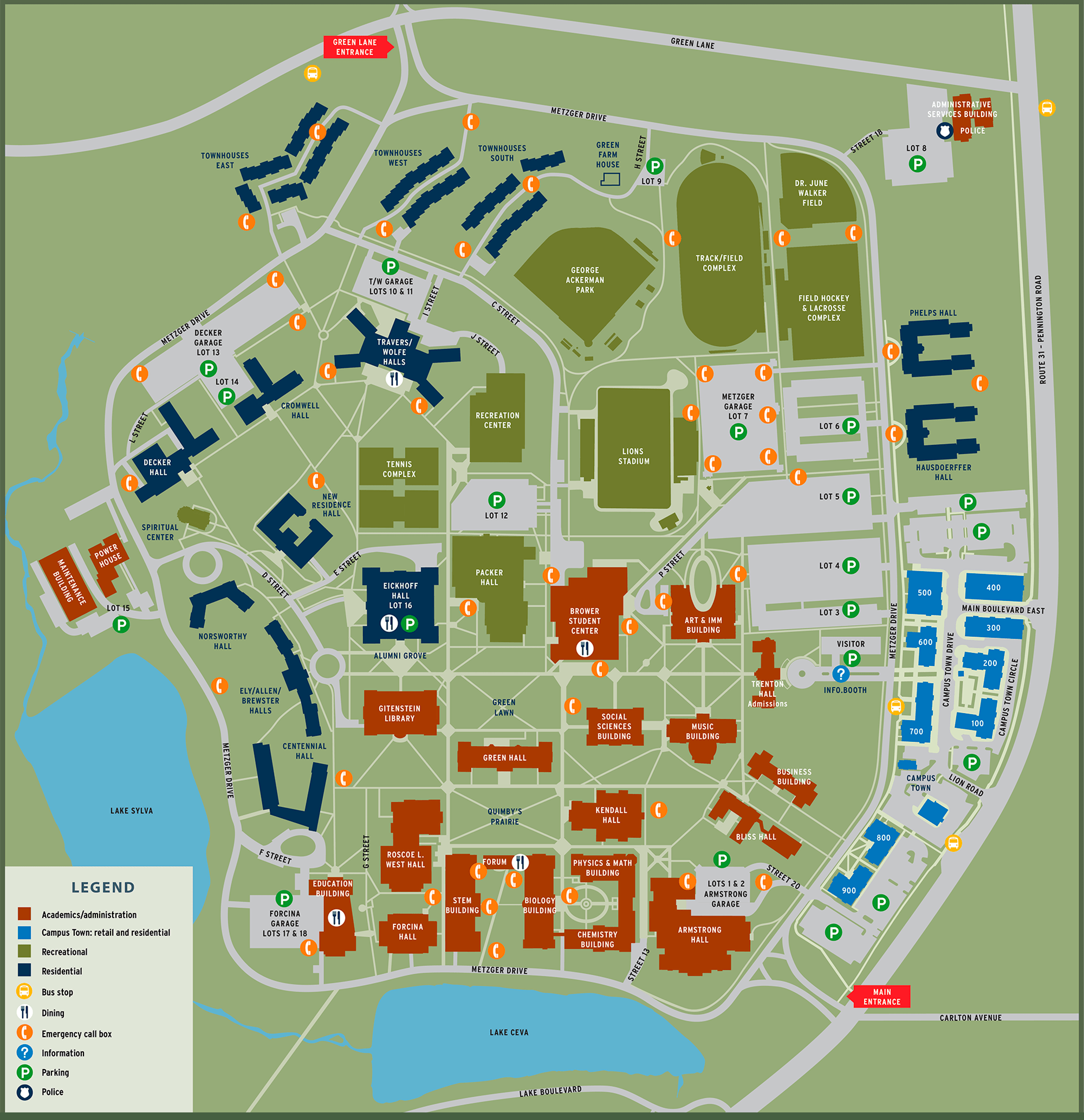
The College of New Jersey seal · sourceCampus Map | The College of New Jersey · sourceThe College of New Jersey - Profile, Rankings and Data | US News Best Colleges · sourceGet to Know The College of New Jersey · source