Admit rate has ranged 64%–76% over the last 5 years — notably volatile. Source: IPEDS via Urban Institute.
Acceptance & SAT from Common Data Set / IPEDS; net price, earnings & graduation from the U.S. Dept. of Education College Scorecard. Figures lag ~1–2 years — verify with the school.
The University of Central Missouri is a public, regional university in Warrensburg that operates with a straightforward, accessible mission: to provide a practical, career-focused education at a reasonable cost. It’s a place where a 21-to-1 student-faculty ratio promises personal attention, and a sprawling catalog of over 150 majors—with particular strength in education, business, and health professions—ensures students can find a direct path to the workforce. The vibe is active and community-oriented, set on a campus described as one of the most beautiful in the country, where the majority of students live off-campus but are drawn into hundreds of student organizations and events.
Admission requirements
Test-optional — scores considered if submitted
Required
High school transcript
Grade point average
TOEFL (non-native English)
Considered (not required)
Class rank
Letters of recommendation
Test scores (SAT/ACT)
College-prep program
Source: IPEDS Admissions survey (2022) via Urban Institute. Covers formal factors only — it does not reflect essays, extracurriculars, or other holistic criteria.
More details
Undergrad enrollment
5,648
In-state tuition
$10,050
Out-of-state tuition
$18,600
Popular Majors
Education, Business, Health Professions
Graduation Rate
54%
On-Campus Housing
28% of students
Off-Campus Housing
72% of students
Student-Faculty Ratio
21-to-1
Median Earnings (10yr)
$49,560
Outcomes & value
Outcomes & value
Median earnings (10 yr)
$49,560
Value (earnings ÷ net price)
3.4×
Median debt at graduation
$21,000
Graduation rate
54%
First-year retention
74%
Reducing loan balance (3 yr)
53%
Pell (lower-income) share
27%
First-gen share (among federal-aid recipients)
33%
Top-earning majors
Median earnings by field of study (highest credential), ~2 years after completion.
Co-application frequency from self-reported results — directional peer discovery, not a recommendation.
Campus & location
Campus safety
On-campus violent crimes (2024)
2
Per 1,000 students
0.18
On-campus criminal offenses classed as violent (murder/non-negligent manslaughter, rape, robbery, aggravated assault) for the most recent reported year. Source: U.S. Dept. of Education Campus Safety and Security (Clery Act). Counts reflect what’s reported to the school, and urban campuses often report more partly due to non-student incidents nearby — read alongside campus size and setting, not as a standalone safety verdict.
Climate
Pleasant days / yr
79
Summer high
87°F
Winter low
27°F
Annual rain
43.6"
Annual snow
17.2"
Natural-hazard risk
Relatively Low
Pleasant days counts days per year with a mean temperature of 55–75°F, a high at or below 90°F, a low at or above 45°F, and little precipitation — a transparent comfort measure, not a weighting we invented. Computed from Open-Meteo ERA5 daily history (2019–2023). Natural-hazard risk is the county’s composite rating from the FEMA National Risk Index.
Deep dive — research, future-scholar output & economic mobility▾
Research output
Institutional h-index
87
Scholarly works
5,047
Institutional research volume and impact from OpenAlex. The h-index reflects large research universities and will be low for teaching-focused liberal-arts colleges — not a measure of undergraduate quality.
Economic mobility
Mobility rate
0.8%
Bottom → top quintile
17%
From bottom quintile
5%
Mobility rate = the share of students who both start in the bottom household-income quintile and reach the top quintile; bottom → top is that chance conditional on starting at the bottom. Source: Opportunity Insights Mobility Report Cards (Chetty, Friedman, Saez, Turner & Yagan). Reflects 1980–82 birth cohorts, so it’s directional, not current.
Quick answers
What is the acceptance rate at University of Central Missouri?
University of Central Missouri's acceptance rate is approximately 64% (Warrensburg, MO), based on the most recent figures we compiled from public and primary sources.
How much does University of Central Missouri cost?
At University of Central Missouri, the average net price (after aid) is about $14,462 per year. Actual cost varies with financial aid and residency.
How many undergraduates attend University of Central Missouri?
University of Central Missouri enrolls approximately 5,648 undergraduate students.
Where is University of Central Missouri located?
University of Central Missouri is located in Warrensburg, MO.
Admissions
UCM's admissions process is characterized by its accessibility. The university explicitly states, 'ALL STUDENTS are encouraged to apply!' and individually reviews each application. With an of 64%, it falls into the 'somewhat selective' or 'less selective' category, making it a realistic target for a broad range of students. The middle 50% of admitted students who submit test scores have an ACT composite between 17 and 24, and an average SAT score around 1050. The admissions office can be reached at (660) 543-4290 or via toll-free number 877-SAY-UCMO (877-729-8266), with email inquiries directed to [email protected]. The is the primary source for official institutional data.
Earnings = median of students working ~10 years after entry; debt = median of graduates. Value divides 10-yr earnings by one year’s net price — read it as earnings per dollar of annual cost, not a full lifetime ROI; it favors lower-cost schools. Source: U.S. Dept. of Education College Scorecard. Figures lag ~2 years and reflect all students, not your intended major.
Source: U.S. Dept. of Education College Scorecard (field-of-study earnings). Figures cover graduates who received federal aid and lag ~2 years; not all programs report data.
Academic life at UCM is defined by breadth and a deliberate focus on real-world application. The university offers more than 150 undergraduate majors and programs, which are described as 'cutting-edge' and designed to follow industry trends. This vast selection is taught by experienced faculty within a 21-to-1 student-to-faculty ratio, a structure intended to provide the 'personal attention you need to succeed.' The academic philosophy emphasizes experiential learning, aiming to graduate students who are prepared for their careers. Popular majors cluster in practical, high-demand fields: Education; Business, Management, Marketing, and Related Support Services; and Health Professions. UCM notes that it is consistently ranked as a top university by publishers like U.S. News & World Report and The Princeton Review, and that its top-ranked academic programs have earned national recognition.
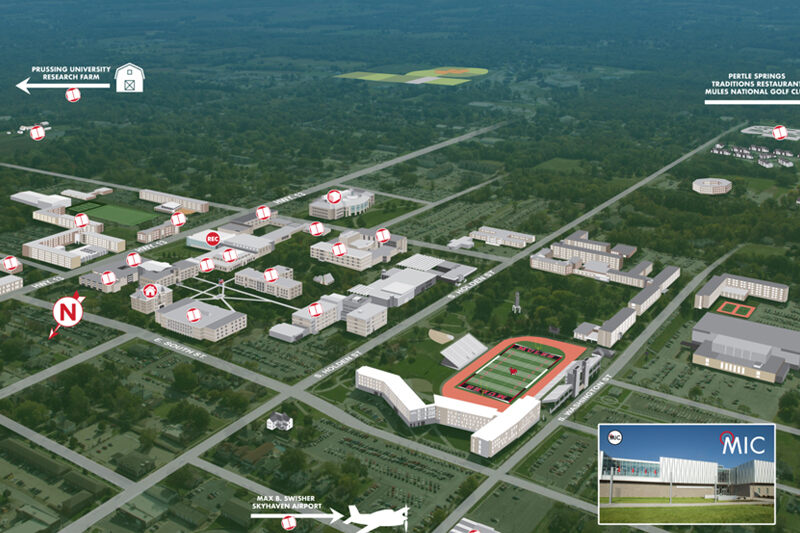
Life outside the classroom is pitched as 'active and creative, fun and fantastic.' The Warrensburg campus is touted as 'one of the most beautiful college campuses in the country,' serving as the backdrop for a residential experience where only 28% of students live in college-owned, -operated, or -affiliated housing; the overwhelming majority—72%—live off-campus. This creates a commuter-influenced dynamic, but the university counters with 'hundreds of opportunities to get involved,' from student organizations to academic events. A key hub for community and inclusivity is The Center for Multiculturalism and Inclusivity, located in the Elliott Student Union, which provides space for individuals, student groups, and campus-wide programs. The overall culture is promoted as one of community and unforgettable moments.
UCM's outcomes reflect its mission as a career-launching public institution. The four-year graduation rate is 39%, while the six-year rate is 54%. For graduates, the median salary six years after entry is $41,593. The university's Career and Life Design Center tracks a 'career outcomes rate,' which is the percentage of graduates who are employed, continuing their education, or serving in the military. External data shows a range of earnings for alumni, with averages reported around $61,468 for some fields like technology, while other analyses note an average alumni salary of $41,386. These figures underscore the university's focus on translating education into employability and economic mobility for its graduates.
Affordability is a central part of UCM's value proposition. The average —the cost after aid and scholarships are applied—is $14,462. The university provides a Net Price Calculator to help prospective students estimate their individual cost and emphasizes exploring scholarship options through its online UCM Scholarship Finder. A significant majority of students (54.08%) receive financial aid, with the average aid package bringing the cost down to $15,117 for many. The Office of Student Financial Services guides students through the FAFSA, explains different types of aid, and directs them to scholarship resources. While the university maintains standard financial aid policies and procedures, there is no indication in the provided sources of a 'no-loan' policy or a guarantee to meet 100% of demonstrated financial need without loans.
The University of Central Missouri stands out for its unpretentious, practical approach to higher education. It doesn't chase ultra-selectivity; instead, it offers a high-access gateway to a comprehensive and career-aligned curriculum. Its singular character is built on a combination of scale—over 150 majors—and a stated commitment to personal attention through its 21-to-1 faculty ratio. The campus beauty is a point of pride, as is the active, involved student life that seeks to engage a predominantly off-campus population. Ultimately, UCM's distinctiveness lies in its balance: a large-program offering with a mid-sized feel, a focus on real-world readiness, and a clear value equation centered on a manageable and solid graduate outcomes in fields that drive the regional and national economy.
University of Central Missouri seal · sourceUniversity of Central Missouri UCM Among Missouri's Best Universities · sourceUCM Campus Maps · sourceAbout the University of Central Missouri · source