Admit rate has ranged 65%–74% over the last 5 years — notably volatile, though the latest figure above (64%) falls outside that window. Source: IPEDS via Urban Institute.
Acceptance & SAT from Common Data Set / IPEDS; net price, earnings & graduation from the U.S. Dept. of Education College Scorecard. Figures lag ~1–2 years — verify with the school.
The University of North Carolina Wilmington is the state's coastal university, a public institution that leverages its location not just as a backdrop but as a core part of its identity. It offers a surprisingly rigorous academic environment—designated as a 'Doctoral University: High Research Activity'—where popular, career-focused programs like nursing and business thrive alongside a quintessential college-town vibe in historic Wilmington. This is a school for students who want a serious education without the cutthroat pressure, where the beach is a legitimate study break and the campus culture is defined by a relaxed, friendly, and outdoorsy ethos.
Admission requirements
Test-optional — scores considered if submitted
Required
High school transcript
Grade point average
Class rank
Letters of recommendation
TOEFL (non-native English)
Considered (not required)
Test scores (SAT/ACT)
College-prep program
Source: IPEDS Admissions survey (2022) via Urban Institute. Covers formal factors only — it does not reflect essays, extracurriculars, or other holistic criteria.
More details
Undergrad enrollment
14,922
In-state tuition
$7,277
Out-of-state tuition
$24,152
No-Loan Policy
No
Graduation Rate
71%
Meets Full Need
No
Most Popular Majors
Nursing, Business, Psychology
Demonstrated Interest
Not considered
Median Earnings (10yr)
$54,967
First-Year Retention Rate
88% (2021)
Four-Year Graduation Rate
56%
Regular Decision Deadline
February 1
Outcomes & value
Outcomes & value
Median earnings (10 yr)
$54,967
Value (earnings ÷ net price)
2.7×
Median debt at graduation
$19,500
Graduation rate
71%
First-year retention
88%
Reducing loan balance (3 yr)
63%
Pell (lower-income) share
24%
First-gen share (among federal-aid recipients)
26%
Top-earning majors
Median earnings by field of study (highest credential), ~2 years after completion.
Computer Science$64,493
Registered Nursing, Nursing Administration, Nursing Research and Clinical Nursing$59,253
Business/Managerial Economics$55,512
Health Professions and Related Clinical Sciences, Other$46,478
Computer and Information Sciences, General$45,715
Business Administration, Management and Operations
Applicants here also applied to
The schools that most often appear alongside University of North Carolina Wilmington on applicants’ lists, from our self-reported outcomes corpus.
Co-application frequency from self-reported results — directional peer discovery, not a recommendation.
Campus & location
Campus safety
On-campus violent crimes (2024)
18
Per 1,000 students
0.97
On-campus criminal offenses classed as violent (murder/non-negligent manslaughter, rape, robbery, aggravated assault) for the most recent reported year. Source: U.S. Dept. of Education Campus Safety and Security (Clery Act). Counts reflect what’s reported to the school, and urban campuses often report more partly due to non-student incidents nearby — read alongside campus size and setting, not as a standalone safety verdict.
Climate
Pleasant days / yr
117
Summer high
86°F
Winter low
42°F
Annual rain
57.4"
Natural-hazard risk
Relatively High
Pleasant days counts days per year with a mean temperature of 55–75°F, a high at or below 90°F, a low at or above 45°F, and little precipitation — a transparent comfort measure, not a weighting we invented. Computed from Open-Meteo ERA5 daily history (2019–2023). Natural-hazard risk is the county’s composite rating from the FEMA National Risk Index.
Deep dive — research, future-scholar output & economic mobility▾
Research output
Institutional h-index
226
Scholarly works
13,939
Institutional research volume and impact from OpenAlex. The h-index reflects large research universities and will be low for teaching-focused liberal-arts colleges — not a measure of undergraduate quality.
Quick answers
What is the acceptance rate at University of North Carolina Wilmington?
University of North Carolina Wilmington's acceptance rate is approximately 64% (Wilmington, NC), based on the most recent figures we compiled from public and primary sources.
What SAT score do you need for University of North Carolina Wilmington?
Admitted students at University of North Carolina Wilmington typically score 1230–1340 on the SAT (the middle-50% range). Scores outside this band are still admitted, especially with strong applications.
How much does University of North Carolina Wilmington cost?
At University of North Carolina Wilmington, the average net price (after aid) is about $20,109 per year. Actual cost varies with financial aid and residency.
How many undergraduates attend University of North Carolina Wilmington?
University of North Carolina Wilmington enrolls approximately 14,922 undergraduate students.
Where is University of North Carolina Wilmington located?
University of North Carolina Wilmington is located in Wilmington, NC.
Admissions
UNCW's admissions process is moderately selective, with a focus on strong academic preparation. The university received 13,101 applications for a recent cycle, admitting roughly 64% of applicants. Admitted students typically present a strong academic profile: the middle 50% SAT range is 1230–1340, the ACT range is 24–29, and the weighted GPA for admitted seniors falls between 3.80 and 4.43, indicating a student body with a solid A/B average. The regular decision application deadline is February 1.
While the overall is 64%, the landscape differs significantly for in-state versus out-of-state applicants. As a public university in the UNC System, UNCW prioritizes North Carolina residents. In 2023, the university admitted 4,120 out-of-state students from 5,995 applicants, resulting in an out-of-state acceptance rate of approximately 68%. A stated institutional goal is to reduce out-of-state freshman enrollment, reflecting a commitment to its in-state mandate. The indicates that factors like academic GPA, rigor of secondary school record, and standardized test scores are very important in admissions decisions, while demonstrated interest is not considered.
Earnings = median of students working ~10 years after entry; debt = median of graduates. Value divides 10-yr earnings by one year’s net price — read it as earnings per dollar of annual cost, not a full lifetime ROI; it favors lower-cost schools. Source: U.S. Dept. of Education College Scorecard. Figures lag ~2 years and reflect all students, not your intended major.
$43,201
Chemistry$39,909
Mathematics$38,597
Source: U.S. Dept. of Education College Scorecard (field-of-study earnings). Figures cover graduates who received federal aid and lag ~2 years; not all programs report data.
UNCW has carved out a distinctive academic niche, earning the elevated Carnegie Classification of 'Doctoral University: High Research Activity.' This signals a commitment to undergraduate education infused with research opportunities, all within a coastal context that influences many of its programs. The university describes its academic experience as one that 'stimulates creative inquiry, critical thinking and thoughtful expression.'
Student sentiment often highlights receiving a 'good education... without the pressure of a more competitive campus.' The curriculum is anchored by several high-demand, career-oriented majors. The most popular programs are:
Registered Nursing (21% of degrees)
Business Administration and Management (18%)
Psychology (8%)
Speech Communication and Rhetoric (5%)
Kinesiology and Exercise Science
This focus on practical, health, and business fields aligns with strong post-graduate outcomes. The university's location near the Atlantic Ocean also provides a natural laboratory for marine biology, environmental science, and film studies, given Wilmington's vibrant arts and film culture.
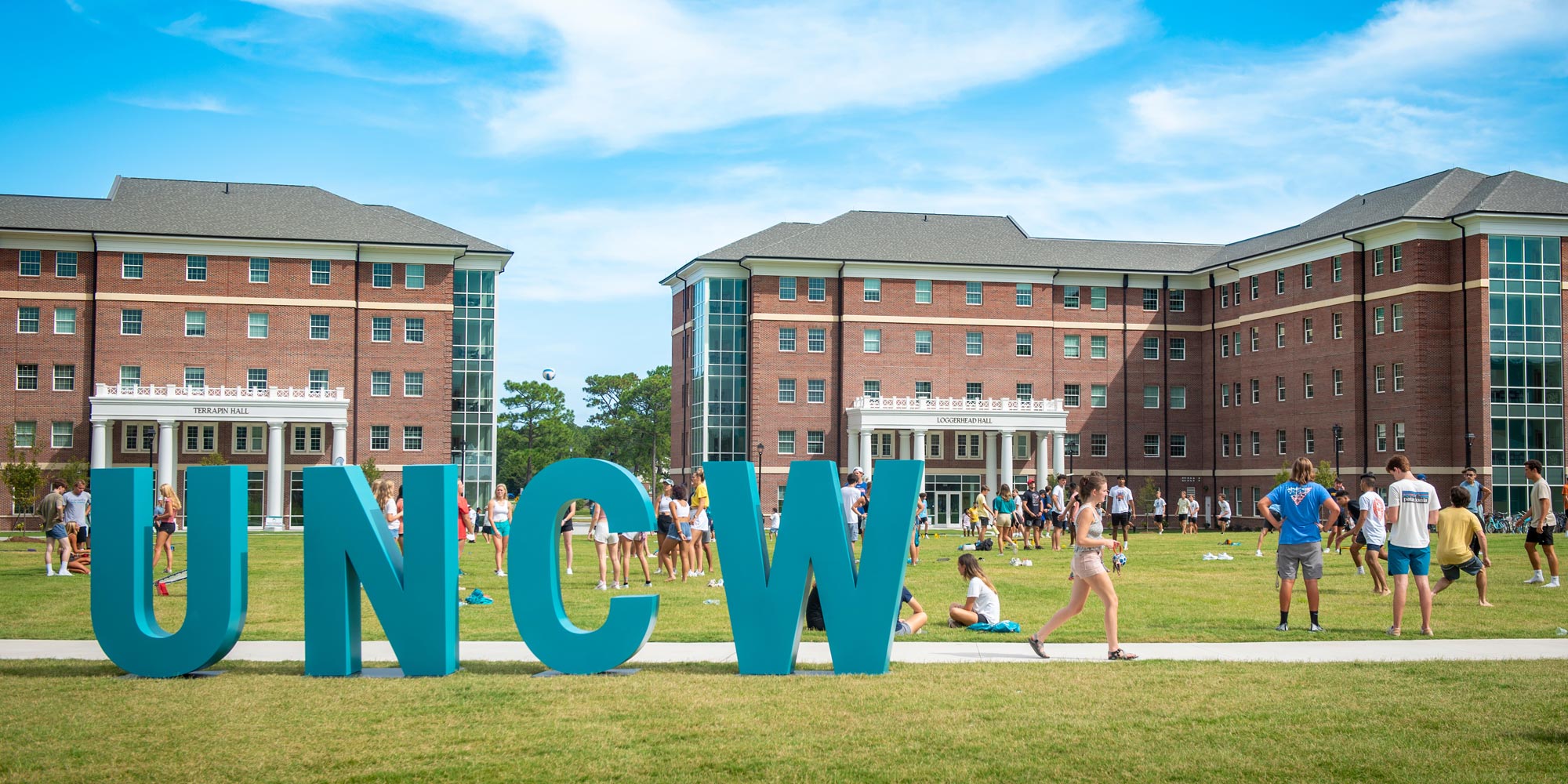
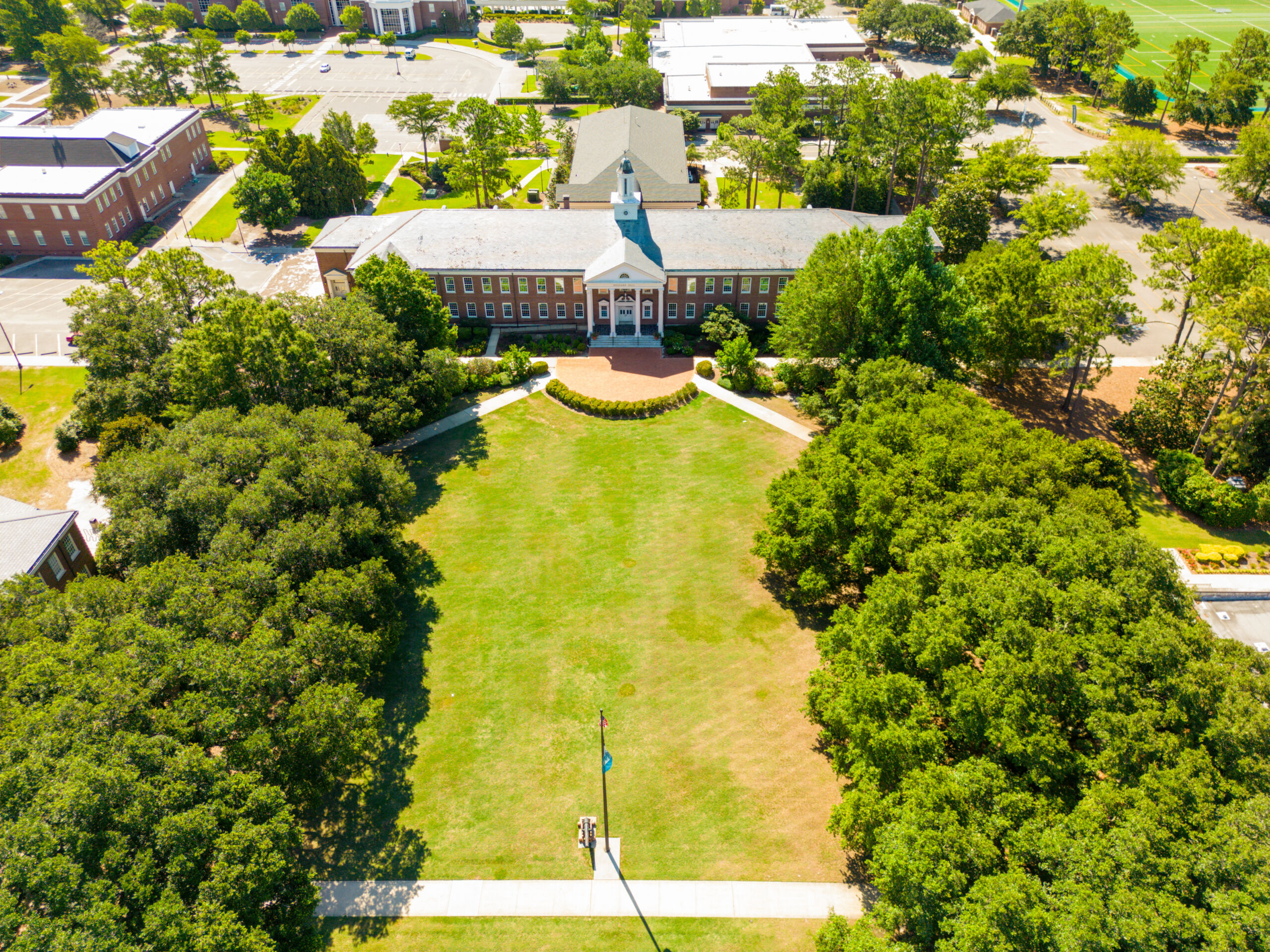
Life at UNCW is inextricably linked to its setting. The campus itself is frequently described as 'beautiful,' but the real draw is Wilmington—a historic riverfront city where the campus is 'just minutes from the beach.' This proximity shapes the student experience, fostering a culture that is relaxed, outdoorsy, and socially oriented. Students report loving 'the downtown area, the beaches, [and] boardwalk.'
The Campus Life office serves as the 'crossroads of the UNCW community,' promoting a philosophy that 'all students have the ability to practice leadership.' This happens through a vibrant ecosystem of Registered Student Organizations (RSOs), campus employment, and service opportunities. The overall vibe, as noted by visitors and students, is friendly; the people and culture are often cited as major positives. While some note the social scene can feel a bit insular at times, the combination of a cohesive campus community and the attractions of a dynamic coastal city—celebrating arts, film, and music—creates a compelling and active college environment far from the stereotypical isolated campus.
UNCW graduates enter the workforce with solid earning potential, particularly given the university's focus on in-demand fields. The median earnings for graduates ten years after entry is $54,967. Other data points show an average starting salary around $35,500, with mid-career median earnings rising to approximately $56,300. For context, UNCW ranks 21st in North Carolina for average graduate salary.
Graduation rates tell a story of a student body that typically takes more than four years to complete their degrees. The four-year graduation rate is 56%, while the six-year rate is significantly higher at 71%. This pattern is common at public universities and suggests many students may co-op, change majors, or balance work and studies. The university's own strategic data shows its first-year retention rate has been strong and improving, reaching 88% in 2021, which is above the UNC System average of 85.9% for that year. This indicates students are generally satisfied and persist after their first year, even if their path to a degree extends beyond the traditional four-year timeline.
As a public institution, UNCW offers a relatively affordable education, especially for North Carolina residents. The average —the cost after grants and scholarships are applied—is $20,109. Other sources estimate this figure between $18,606 and $19,300. Approximately 55% of full-time beginning undergraduates receive grant or scholarship aid.
The university provides a net price calculator for families to estimate their individual cost. Its financial aid packages are primarily composed of grants, scholarships, and federal student loans. Importantly, UNCW is not listed among the colleges that meet 100% of demonstrated financial need with a 'no-loan' policy. Its aid office notes that for students without demonstrated financial need, the university may automatically offer unsubsidized loan eligibility. Some institutional scholarships may require demonstrated need, but the overarching policy is not to replace all loans with grants. This makes maximizing federal, state, and institutional grant aid crucial for managing costs.
UNCW stands out because it successfully merges two often-disconnected ideals: a serious, research-active academic environment and a genuinely laid-back, location-enhanced quality of life. It’s not just a university near the beach; the coastal setting is woven into its academic programs and campus culture. It has achieved the 'Doctoral University: High Research Activity' designation—a mark of academic stature—while maintaining a student culture that is notably less pressured and more collaborative than at flagship research giants.
Its popularity is driven by a clear-value proposition: strong, accredited programs in nursing, business, and the sciences that lead to good jobs, delivered in a beautiful, friendly setting where your classroom might be a few miles from the ocean. It serves its state mission diligently, with a high in-state enrollment, while also drawing out-of-state students attracted to the unique coastal Carolina experience. In essence, UNCW offers a 'best of both worlds' scenario—the academic heft and career focus of a strong public university, paired with the vibe and recreational perks of a coastal college town, all without the extreme selectivity or stress of its more famous sister schools in the UNC System.
University of North Carolina Wilmington seal · sourceAbout UNCW | UNCW · sourceUniversity of North Carolina at Wilmington - North Carolina History · sourceUniversity of North Carolina Wilmington | About Wilmington NC · source
_176.jpg?width=1600)