Admit rate has ranged 7%–10% over the last 5 years. Source: IPEDS via Urban Institute.
Acceptance & SAT from Common Data Set / IPEDS; net price, earnings & graduation from the U.S. Dept. of Education College Scorecard. Figures lag ~1–2 years — verify with the school.
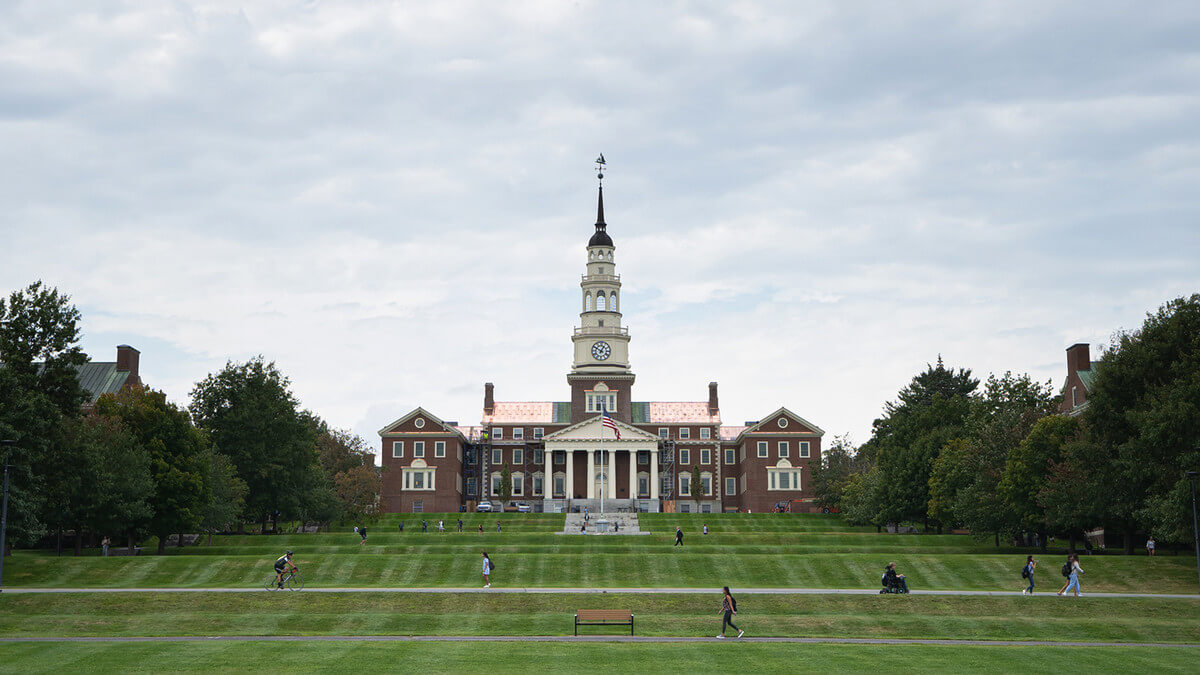
Colby College is a small, fiercely selective liberal arts college in Waterville, Maine, that has transformed itself from a quiet New England outpost into a powerhouse with a national draw. Its character is defined by a rigorous, hands-on academic culture, a tight-knit residential community in a stunning natural setting, and a remarkably generous financial aid policy that meets full need without loans. This is a place for students who want intense faculty mentorship, a collaborative but driven peer group, and the resources of a much larger university, all packaged within the intimate scale of a classic liberal arts college.
Admission requirements
Test-optional — scores considered if submitted
Required
High school transcript
Letters of recommendation
TOEFL (non-native English)
Considered (not required)
Grade point average
Class rank
Test scores (SAT/ACT)
College-prep program
Demonstrated competencies
Source: IPEDS Admissions survey (2022) via Urban Institute. Covers formal factors only — it does not reflect essays, extracurriculars, or other holistic criteria.
Key deadlines (2026-2027)
Early Decision — Early Decision I
November 15, 2026
ED2 — Early Decision II
January 1, 2027
Regular Decision — Regular Decision
January 15, 2027
Financial Aid — CSS Profile & FAFSA Priority Deadline
January 15, 2027
More details
Undergrad enrollment
2,407
In-state tuition
$69,600
Out-of-state tuition
$69,600
No-Loan Policy
Yes, incomes < $75k contribute $0
Graduation Rate
89%
Meets Full Need
Yes
Median Earnings (10yr)
$80,490
Student-to-Faculty Ratio
10:1
Outcomes & value
Outcomes & value
Median earnings (10 yr)
$80,490
Value (earnings ÷ net price)
4.7×
Median debt at graduation
$19,157
Graduation rate
89%
First-year retention
94%
Reducing loan balance (3 yr)
87%
Pell (lower-income) share
14%
First-gen share (among federal-aid recipients)
11%
Earnings = median of students working ~10 years after entry; debt = median of graduates. divides 10-yr earnings by net price — read it as earnings per dollar of annual cost, not a full lifetime ROI; it favors lower-cost schools. Source: U.S. Dept. of Education College Scorecard. Figures lag ~2 years and reflect all students, not your intended major.
Financial health
3.0 / 3.0Meets the federal financial-responsibility standard
U.S. Dept. of Education Financial Responsibility Composite Score (FY2022-23). Scale −1.0 to 3.0; ≥1.5 meets the standard. Reported for private nonprofit & for-profit institutions only — public universities are state-backed and not scored, so this is a stability signal, not a ranking.
Top-earning majors
Median earnings by field of study (highest credential), ~2 years after completion.
Economics$57,995
Political Science and Government$47,118
Anthropology$44,971
International/Globalization Studies$42,682
English Language and Literature, General$41,193
Psychology, General$38,289
Area Studies
Applicants here also applied to
The schools that most often appear alongside Colby on applicants’ lists, from our self-reported outcomes corpus.
Co-application frequency from self-reported results — directional peer discovery, not a recommendation.
Campus & location
Campus safety
On-campus violent crimes (2024)
6
On-campus criminal offenses classed as violent (murder/non-negligent manslaughter, rape, robbery, aggravated assault) for the most recent reported year. Source: U.S. Dept. of Education Campus Safety and Security (Clery Act). Counts reflect what’s reported to the school, and urban campuses often report more partly due to non-student incidents nearby — read alongside campus size and setting, not as a standalone safety verdict.
Climate
Pleasant days / yr
87
Summer high
78°F
Winter low
17°F
Annual rain
49"
Annual snow
58.1"
Natural-hazard risk
Relatively Low
Pleasant days counts days per year with a mean temperature of 55–75°F, a high at or below 90°F, a low at or above 45°F, and little precipitation — a transparent comfort measure, not a weighting we invented. Computed from Open-Meteo ERA5 daily history (2019–2023). Natural-hazard risk is the county’s composite rating from the FEMA National Risk Index.
Deep dive — research, future-scholar output & economic mobility▾
Research output
Institutional h-index
176
Scholarly works
6,226
Institutional research volume and impact from OpenAlex. The h-index reflects large research universities and will be low for teaching-focused liberal-arts colleges — not a measure of undergraduate quality.
Future-scholar output
Science & engineering PhDsper-capita yield 6.3
Share of this school’s graduates who go on to earn research doctorates (2010–20), by national rank and per-capita yield (NSF institutional-yield ratio). A signal of a research-oriented student culture — not a causal promise, since it partly reflects who enrolls. Only top producers appear. Source: NSF NCSES, Baccalaureate Origins of U.S. Research Doctorate Recipients.
Economic mobility
Mobility rate
0.9%
Bottom → top quintile
Quick answers
What is the acceptance rate at Colby College?
Colby College's acceptance rate is approximately 7% (Waterville, ME), based on the most recent figures we compiled from public and primary sources.
What SAT score do you need for Colby College?
Admitted students at Colby College typically score 1460–1550 on the SAT (the middle-50% range). Scores outside this band are still admitted, especially with strong applications.
How much does Colby College cost?
At Colby College, the average net price (after aid) is about $17,180 per year. Actual cost varies with financial aid and residency.
How many undergraduates attend Colby College?
Colby College enrolls approximately 2,407 undergraduate students.
Where is Colby College located?
Colby College is located in Waterville, ME.
Admissions
Getting into Colby is an intensely competitive proposition, placing it among the most selective liberal arts colleges in the country. The college received 20,144 applications for the Class of 2029, admitting just 7% of applicants. The academic profile of admitted students is exceptionally high: nearly 95% are expected to graduate in the top 10% of their high school class, with median SAT scores of 1520 and median ACT scores of 34. The middle 50% SAT range for admitted students is 1460–1550, and the middle 50% ACT range is 32–34. While the overall is extremely low, applying Early Decision can provide a significant advantage; in past cycles, the Early Decision acceptance rate has been as high as 43%, compared to a single-digit overall rate. The admissions process is need-aware, meaning a family's ability to pay is considered, but the college pledges to meet 100% of demonstrated financial need for all admitted students.
Source: U.S. Dept. of Education College Scorecard (field-of-study earnings). Figures cover graduates who received federal aid and lag ~2 years; not all programs report data.
Mobility rate = the share of students who both start in the bottom household-income quintile and reach the top quintile; bottom → top is that chance conditional on starting at the bottom. Source: Opportunity Insights Mobility Report Cards (Chetty, Friedman, Saez, Turner & Yagan). Reflects 1980–82 birth cohorts, so it’s directional, not current.
Colby's academic environment is characterized by rigorous, intimate, and experiential learning. With a student-to-faculty ratio of 10:1, the college emphasizes close collaboration with professors, who are described as "world-class scholars and teachers." Learning extends beyond the classroom through research assistantships, independent study projects, and real-world problem-solving. The college offers 49 majors, with the social sciences being the most popular area of study—accounting for 27% of 2024 graduates. Other leading majors include biological and biomedical sciences (10%), psychology (10%), and multi/interdisciplinary studies (8%). The curriculum is known for its strength in the humanities, social sciences, and natural sciences. This intense academic focus yields strong results, with a graduation rate of 87%.
Life at Colby is defined by a strong, residential community set against the backdrop of a beautiful, rural Maine campus. The college describes its education as being characterized by "academic rigor, a strong community, a friendly campus atmosphere, global reach, and active engagement." Students connect through a vibrant array of clubs and organizations. The social scene has its own character; as one student notes, "Colby social life has more alcohol than most liberal arts colleges. The party scene is pitiful compared to big state schools though." A unique tradition is the Colby Affirmation, which all students sign upon arrival, committing to open and honest dialogue. Students generally report feeling safe on campus, with visible and accessible security, and rare incidents of crime like theft. It's a cohesive, all-in environment where the campus itself is the center of gravity.
A Colby degree delivers strong postgraduate results. An impressive 98% of the Class of 2024 were employed or enrolled in graduate school within one year of graduation. The college reports that its graduates earn a median annual salary of more than $129,500. According to federal data, graduates earn a median of $80,490 ten years after enrolling. Economics is noted as the most lucrative major for graduates. These outcomes are supported by a high graduation rate, which the college reports as 87%.
Colby's sticker price is high, with a total of $94,650, including $72,910 for tuition and fees and room and board. However, the college's financial aid policy is one of the most progressive and generous in the country. Colby meets 100% of every admitted student's demonstrated financial need without including loans in financial aid packages—a policy known as the Colby Commitment. Furthermore, the college has expanded its "$0 contribution" policy: families with a total income of $75,000 or less and typical assets can expect to contribute $0 toward the cost of attendance. The average after aid is $17,180, and 42.79% of students receive financial aid, with an average aid package of $75,056. It's important to note that while the admissions process is need-aware, the aid commitment for those admitted is absolute.
Colby stands out for its potent combination of elite academic selectivity, a deeply immersive residential experience, and a financial aid policy that fundamentally alters access. It's not just a small liberal arts college; it's one that has aggressively invested in its facilities, faculty, and student support to compete at the very top tier. The "no-loan" pledge and the $0 contribution threshold for families earning under $75k are not just marketing points—they are transformative commitments that allow the college to assemble a socioeconomically diverse student body without burdening them with debt. Academically, it offers the intense mentorship and close-knit community of a classic liberal arts college, but with the resources and postgraduate outcomes typically associated with larger research universities. The result is a singular environment: intensely collaborative, set in the natural beauty of Maine, and populated by students who are both academically ferocious and, thanks to the aid policy, from remarkably broad walks of life.
Colby College seal · sourceColby College — Admissions, Tuition & Acceptance Rate | Appily · sourceAbout Colby | Colby College · sourceColby College - Profile, Rankings and Data | US News Best Colleges · source