Admit rate has ranged 5%–7% over the last 5 years, though the latest figure above (4%) falls outside that window. Source: IPEDS via Urban Institute.
Acceptance & SAT from Common Data Set / IPEDS; net price, earnings & graduation from the U.S. Dept. of Education College Scorecard. Figures lag ~1–2 years — verify with the school.
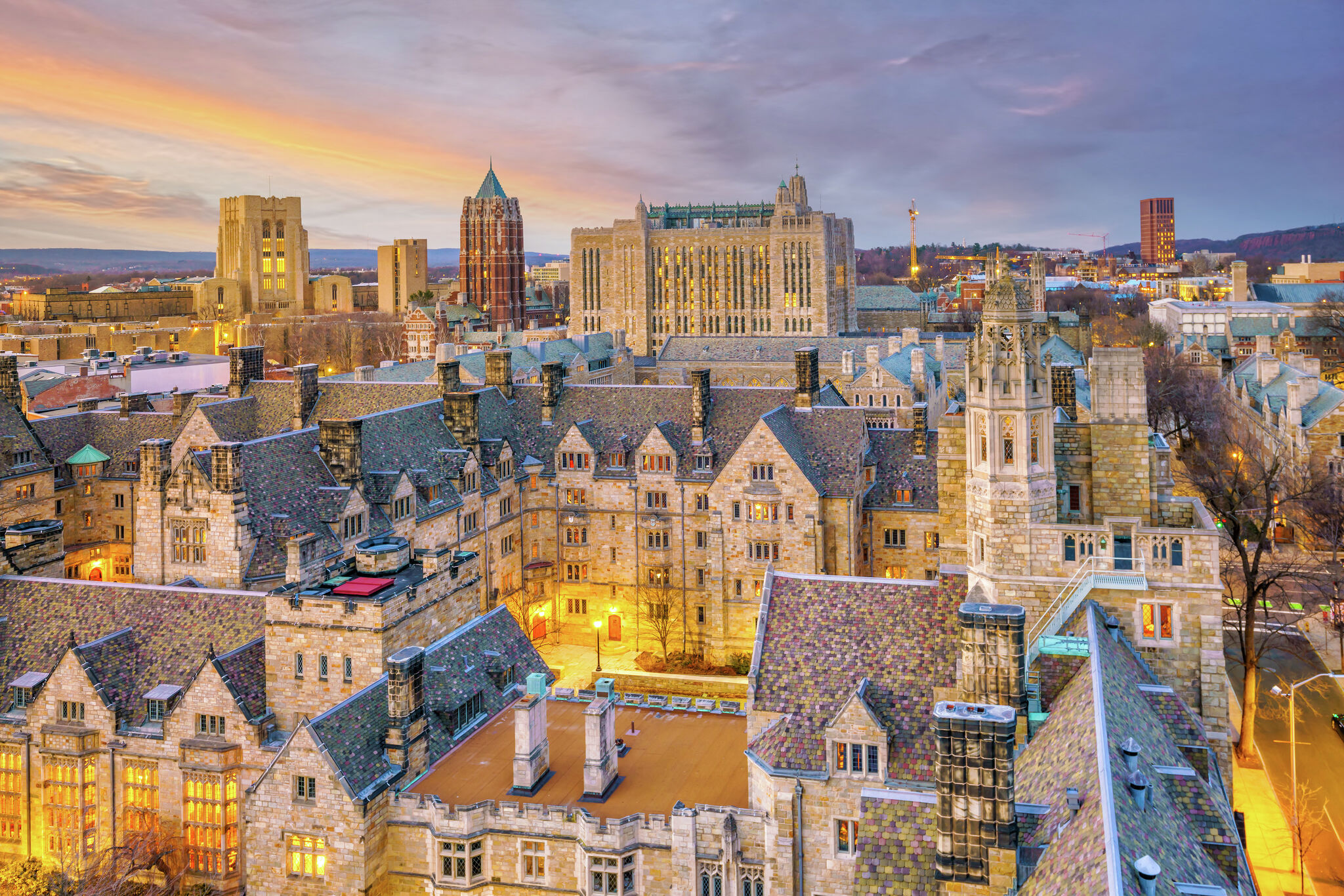
Yale University isn't just an Ivy League institution; it's a self-contained world of Gothic spires, fiercely independent intellectualism, and a residential college system that defines the undergraduate experience. With a famously generous no-loan financial aid policy and an academic culture that prizes exploration over rigid requirements, Yale attracts a globally-minded student body that thrives within a vibrant, collaborative—and surprisingly unstressed—campus community. It’s a place where world-class resources in everything from political science to the arts are matched by a commitment to making that elite education accessible.
Admission requirements
Test-optional — scores considered if submitted
Required
High school transcript
Letters of recommendation
TOEFL (non-native English)
Considered (not required)
Grade point average
Class rank
Test scores (SAT/ACT)
Demonstrated competencies
Source: IPEDS Admissions survey (2022) via Urban Institute. Covers formal factors only — it does not reflect essays, extracurriculars, or other holistic criteria.
Key deadlines (2026-2027)
Restrictive Early Action — Single-Choice Early Action
November 1, 2026
Regular Decision — Regular Decision
January 2, 2027
Financial Aid — FAFSA Priority Deadline
March 1, 2027
More details
Undergrad enrollment
6,758
In-state tuition
$67,250
Out-of-state tuition
$67,250
No-Loan Policy
Yes, for all students
Graduation Rate
96%
Meets Full Need
Yes
Demonstrated Interest
Not considered
Median Earnings (10yr)
$100,533
First-Year Retention Rate
99%
Outcomes & value
Outcomes & value
Median earnings (10 yr)
$100,533
Value (earnings ÷ net price)
4.2×
Median debt at graduation
$12,975
Graduation rate
96%
First-year retention
99%
Reducing loan balance (3 yr)
86%
Pell (lower-income) share
20%
First-gen share (among federal-aid recipients)
25%
Financial health
3.0 / 3.0Meets the federal financial-responsibility standard
U.S. Dept. of Education Financial Responsibility Composite Score (FY2022-23). Scale −1.0 to 3.0; ≥1.5 meets the standard. Reported for private nonprofit & for-profit institutions only — public universities are state-backed and not scored, so this is a stability signal, not a ranking.
Top-earning majors
Median earnings by field of study (highest credential), ~2 years after completion.
Computer and Information Sciences, General$122,038
Economics$86,621
Natural Resources Conservation and Research$60,161
International Relations and National Security Studies$52,107
Political Science and Government$48,823
English Language and Literature, General
Applicants here also applied to
The schools that most often appear alongside Yale on applicants’ lists, from our self-reported outcomes corpus.
Co-application frequency from self-reported results — directional peer discovery, not a recommendation.
Campus & location
Campus safety
On-campus violent crimes (2024)
21
Per 1,000 students
1.35
On-campus criminal offenses classed as violent (murder/non-negligent manslaughter, rape, robbery, aggravated assault) for the most recent reported year. Source: U.S. Dept. of Education Campus Safety and Security (Clery Act). Counts reflect what’s reported to the school, and urban campuses often report more partly due to non-student incidents nearby — read alongside campus size and setting, not as a standalone safety verdict.
Climate
Pleasant days / yr
96
Summer high
80°F
Winter low
28°F
Annual rain
56.3"
Annual snow
22.4"
Pleasant days counts days per year with a mean temperature of 55–75°F, a high at or below 90°F, a low at or above 45°F, and little precipitation — a transparent comfort measure, not a weighting we invented. Computed from Open-Meteo ERA5 daily history (2019–2023).
Deep dive — research, future-scholar output & economic mobility▾
Research output
Institutional h-index
1,796
Scholarly works
410,365
Institutional research volume and impact from OpenAlex. The h-index reflects large research universities and will be low for teaching-focused liberal-arts colleges — not a measure of undergraduate quality.
Share of this school’s graduates who go on to earn research doctorates (2010–20), by national rank and per-capita yield (NSF institutional-yield ratio). A signal of a research-oriented student culture — not a causal promise, since it partly reflects who enrolls. Only top producers appear. Source: NSF NCSES, Baccalaureate Origins of U.S. Research Doctorate Recipients.
Economic mobility
Quick answers
What is the acceptance rate at Yale University?
Yale University's acceptance rate is approximately 4% (New Haven, CT), based on the most recent figures we compiled from public and primary sources.
What SAT score do you need for Yale University?
Admitted students at Yale University typically score 1470–1570 on the SAT (the middle-50% range). Scores outside this band are still admitted, especially with strong applications.
How much does Yale University cost?
At Yale University, the average net price (after aid) is about $23,777 per year. Actual cost varies with financial aid and residency.
How many undergraduates attend Yale University?
Yale University enrolls approximately 6,758 undergraduate students.
Where is Yale University located?
Yale University is located in New Haven, CT.
Admissions
Gaining admission to Yale is an exercise in statistical improbability, a process that has grown only more selective in recent cycles. For the Class of 2030, the university received over 54,919 applications and admitted just 2,328 students, resulting in an overall of approximately 4.2%. The process is bifurcated into a Single-Choice Early Action round and Regular Decision, with a significant advantage for early applicants: the Early Action acceptance rate was 10.9%, admitting 779 students from 7,140 applicants, while the Regular Decision rate plummeted to around 2.9%. Yale does not consider demonstrated interest in its evaluations, meaning campus visits or frequent contact with admissions officers offer no formal advantage. The admitted class is academically formidable, with the overwhelming majority of students scoring above the 95th percentile on standardized tests. For the most recent cycle, the middle 50% SAT range was 1470–1560, and the middle 50% ACT range was 33–35. Yale has reinstated a test-required policy, reinforcing that high scores are a baseline expectation in a pool where nearly every applicant has a near-perfect academic record.
Earnings = median of students working ~10 years after entry; debt = median of graduates. Value divides 10-yr earnings by one year’s net price — read it as earnings per dollar of annual cost, not a full lifetime ROI; it favors lower-cost schools. Source: U.S. Dept. of Education College Scorecard. Figures lag ~2 years and reflect all students, not your intended major.
$47,260
History$47,260
Area Studies$39,009
Source: U.S. Dept. of Education College Scorecard (field-of-study earnings). Figures cover graduates who received federal aid and lag ~2 years; not all programs report data.
Mobility rate = the share of students who both start in the bottom household-income quintile and reach the top quintile; bottom → top is that chance conditional on starting at the bottom. Source: Opportunity Insights Mobility Report Cards (Chetty, Friedman, Saez, Turner & Yagan). Reflects 1980–82 birth cohorts, so it’s directional, not current.
Yale College offers a quintessential liberal arts education defined by extraordinary freedom and depth. There is no core curriculum, allowing students to design a unique path from over 80 majors spanning the humanities, social sciences, sciences, and engineering. This flexibility encourages intellectual wandering and deep, interdisciplinary study. Popular and renowned majors include Economics, Political Science, History, English, Biological Sciences, Computer Science, Engineering Sciences, and Global Affairs. The academic environment is intensely rigorous but notably collaborative rather than cutthroat; peer competition is described as less intense and stressful than at some peer institutions, fostering a spirit of shared intellectual curiosity. The university's graduate and professional schools, particularly the consistently top-ranked Yale Law School, cast a long shadow, offering undergraduates access to renowned faculty and research opportunities. The emphasis is on independent thinking and leadership, supported by a faculty and resource base that is, across nearly all departments, considered world-class.
Life at Yale revolves around its fourteen residential colleges, micro-communities that provide a home, dining hall, and social nucleus for students from all majors and years. This system creates an immediate sense of belonging and a vibrant, house-centric culture that balances lively social areas with quiet, quaint spaces for study. The campus itself is an architectural marvel of Gothic and modern design, fostering a distinct sense of place. Student life is exceptionally rich, supported by a vast array of over 500 student organizations, a thriving arts and culture scene (from world-class museums to student theater), and Division I athletics. The community is deeply diverse, bringing together people of varied cultures and nationalities. Reviews from current students highlight a campus culture that is "really vibrant," where top academics coexist with a strong community spirit and a manageable level of stress. University-wide support systems for student wellbeing, activities, and engagement are robust, ensuring that the experience extends far beyond the classroom.
A Yale degree is a powerful launchpad, with outcomes that demonstrate both immediate employability and strong long-term earning potential. Within six months of graduation, 95.3% of the Class of 2024 were employed or enrolled in graduate school. For those employed full-time, the mean starting salary was $94,028. The long-term financial return is significant, with median earnings for alumni reaching $93,562 five years after graduation. Yale's graduation rate is among the highest in the nation, with 98% of students graduating within eight years and a first-year retention rate of 99%. This combination of high completion rates and strong post-graduate placement underscores the value of the Yale network and the caliber of its career preparation resources through the Office of Career Strategy.
Yale has undertaken one of the most aggressive and generous financial aid reforms in higher education, fundamentally changing who can afford to attend. The university operates on a no-loan policy, meeting 100% of every admitted student's demonstrated financial need with grant aid alone, regardless of citizenship or immigration status. This commitment is not merely rhetorical; the average need-based Yale Scholarship for recipients is almost $73,000, a figure that exceeds the cost of tuition. For families with typical assets and incomes below $75,000, the expected parent share is $0, making Yale tuition-free. The university provides tools like the MyinTuition cost estimator to give prospective families immediate, personalized estimates, which can be as low as $3,700 for books and personal expenses for those with the highest need. This policy transforms Yale from a prohibitively expensive institution into an affordable option for a remarkably broad socioeconomic range of students.
Yale distinguishes itself through a powerful, almost paradoxical, combination of elite exclusivity and radical accessibility. Its residential college system creates a uniquely intimate and supportive community within a massive research university, fostering lifelong bonds and a strong sense of identity. Academically, it offers the ultimate in liberal arts freedom—no core curriculum—paired with resources that are second to none, from its #1-ranked law school to its world-renowned arts institutions. Yet, its most defining characteristic might be its financial aid policy. Yale's unwavering commitment to a no-loan, full-need-met model dismantles the economic barrier to entry, actively creating a student body that is diverse in both thought and background. This means the intense, collaborative intellectual life in its Gothic courtyards is populated not just by the wealthy, but by the best students from every walk of life. It's a place where unparalleled tradition meets a progressive commitment to equity, making it not just a great university, but a consequential one.
Yale University seal · sourcePlan Your Visit | Yale Visitor Center · sourceCT's Yale University makes list of 'most beautiful places' to visit · sourceLife at Yale | Yale University · source