Admit rate has ranged 76%–86% over the last 5 years — notably volatile, though the latest figure above (72%) falls outside that window. Source: IPEDS via Urban Institute.
Acceptance & SAT from Common Data Set / IPEDS; net price, earnings & graduation from the U.S. Dept. of Education College Scorecard. Figures lag ~1–2 years — verify with the school.
James Madison University blends Southern charm with academic rigor, offering a vibrant campus life in Virginia's Shenandoah Valley. Known for its strong business and education programs, JMU strikes a balance between competitive academics and a collaborative, spirited community. With an 81% six-year graduation rate and a reputation for happy students, it's a public university that feels like a tight-knit private college.
Admission requirements
Test-optional — scores considered if submitted
Required
High school transcript
Grade point average
College-prep program
TOEFL (non-native English)
Considered (not required)
Letters of recommendation
Test scores (SAT/ACT)
Source: IPEDS Admissions survey (2022) via Urban Institute. Covers formal factors only — it does not reflect essays, extracurriculars, or other holistic criteria.
More details
Undergrad enrollment
20,888
In-state tuition
$14,250
Out-of-state tuition
$31,604
Location
Harrisonburg, VA
Clubs/Orgs
400+
Most Popular Majors
Psychology, Computer Science, Visual/Performing Arts
ROI Break-Even Point
3.6 years
Student-Faculty Ratio
18:1
6-Year Graduation Rate
81%
Median Earnings 1 Year Out
$36,427
Outcomes & value
Outcomes & value
Median earnings (10 yr)
$69,954
Value (earnings ÷ net price)
3.0×
Median debt at graduation
$20,093
Graduation rate
80%
First-year retention
92%
Reducing loan balance (3 yr)
82%
Pell (lower-income) share
17%
First-gen share (among federal-aid recipients)
21%
Top-earning majors
Median earnings by field of study (highest credential), ~2 years after completion.
Computer and Information Sciences, General$72,659
Information Science/Studies$72,290
Finance and Financial Management Services$67,380
Business/Managerial Economics$64,493
Registered Nursing, Nursing Administration, Nursing Research and Clinical Nursing$63,965
Systems Science and Theory
Applicants here also applied to
The schools that most often appear alongside James Madison University on applicants’ lists, from our self-reported outcomes corpus.
Co-application frequency from self-reported results — directional peer discovery, not a recommendation.
Campus & location
Campus safety
On-campus violent crimes (2024)
6
Per 1,000 students
0.26
On-campus criminal offenses classed as violent (murder/non-negligent manslaughter, rape, robbery, aggravated assault) for the most recent reported year. Source: U.S. Dept. of Education Campus Safety and Security (Clery Act). Counts reflect what’s reported to the school, and urban campuses often report more partly due to non-student incidents nearby — read alongside campus size and setting, not as a standalone safety verdict.
Climate
Pleasant days / yr
90
Summer high
86°F
Winter low
28°F
Annual rain
34.9"
Annual snow
16.2"
Natural-hazard risk
Very Low
Pleasant days counts days per year with a mean temperature of 55–75°F, a high at or below 90°F, a low at or above 45°F, and little precipitation — a transparent comfort measure, not a weighting we invented. Computed from Open-Meteo ERA5 daily history (2019–2023). Natural-hazard risk is the county’s composite rating from the FEMA National Risk Index.
Deep dive — research, future-scholar output & economic mobility▾
Research output
Institutional h-index
249
Scholarly works
14,463
Institutional research volume and impact from OpenAlex. The h-index reflects large research universities and will be low for teaching-focused liberal-arts colleges — not a measure of undergraduate quality.
Economic mobility
Mobility rate
0.7%
Bottom → top quintile
40%
From bottom quintile
2%
Mobility rate = the share of students who both start in the bottom household-income quintile and reach the top quintile; bottom → top is that chance conditional on starting at the bottom. Source: Opportunity Insights Mobility Report Cards (Chetty, Friedman, Saez, Turner & Yagan). Reflects 1980–82 birth cohorts, so it’s directional, not current.
Quick answers
What is the acceptance rate at James Madison University?
James Madison University's acceptance rate is approximately 72% (Harrisonburg, VA), based on the most recent figures we compiled from public and primary sources.
What SAT score do you need for James Madison University?
Admitted students at James Madison University typically score 1170–1340 on the SAT (the middle-50% range). Scores outside this band are still admitted, especially with strong applications.
How much does James Madison University cost?
At James Madison University, the average net price (after aid) is about $23,322 per year. Actual cost varies with financial aid and residency.
How many undergraduates attend James Madison University?
James Madison University enrolls approximately 20,888 undergraduate students.
Where is James Madison University located?
James Madison University is located in Harrisonburg, VA.
Admissions
JMU's admissions process is moderately selective, with hovering between 71-76% in recent years. The middle 50% of admitted students score between 1210-1370 on the SAT or 26-31 on the ACT, though test scores became optional post-pandemic. While the university doesn't officially report average GPAs, Reddit threads suggest admitted students typically have around a 3.5 GPA. Notably, JMU saw over 31,000 applicants for just 4,900 enrolled spots in recent cycles, indicating growing popularity.
JMU offers over 70 undergraduate majors, with psychology (6%), computer science (6%), and visual/performing arts (6%) being the most popular. The university is particularly known for its business and education programs, which students describe as rigorous but not cutthroat compared to nearby UVA. A distinctive feature is JMU's emphasis on applied learning—students work closely with faculty on research and internships early in their academic careers. The food science program and industrial design majors are hidden gems, while the '8/10' rated dining options (peaking at 9.5/10 on good days) suggest academics aren't the only thing JMU does well.
Earnings = median of students working ~10 years after entry; debt = median of graduates. Value divides 10-yr earnings by one year’s net price — read it as earnings per dollar of annual cost, not a full lifetime ROI; it favors lower-cost schools. Source: U.S. Dept. of Education College Scorecard. Figures lag ~2 years and reflect all students, not your intended major.
$60,623
Engineering, General$57,943
Accounting and Related Services$56,114
Source: U.S. Dept. of Education College Scorecard (field-of-study earnings). Figures cover graduates who received federal aid and lag ~2 years; not all programs report data.
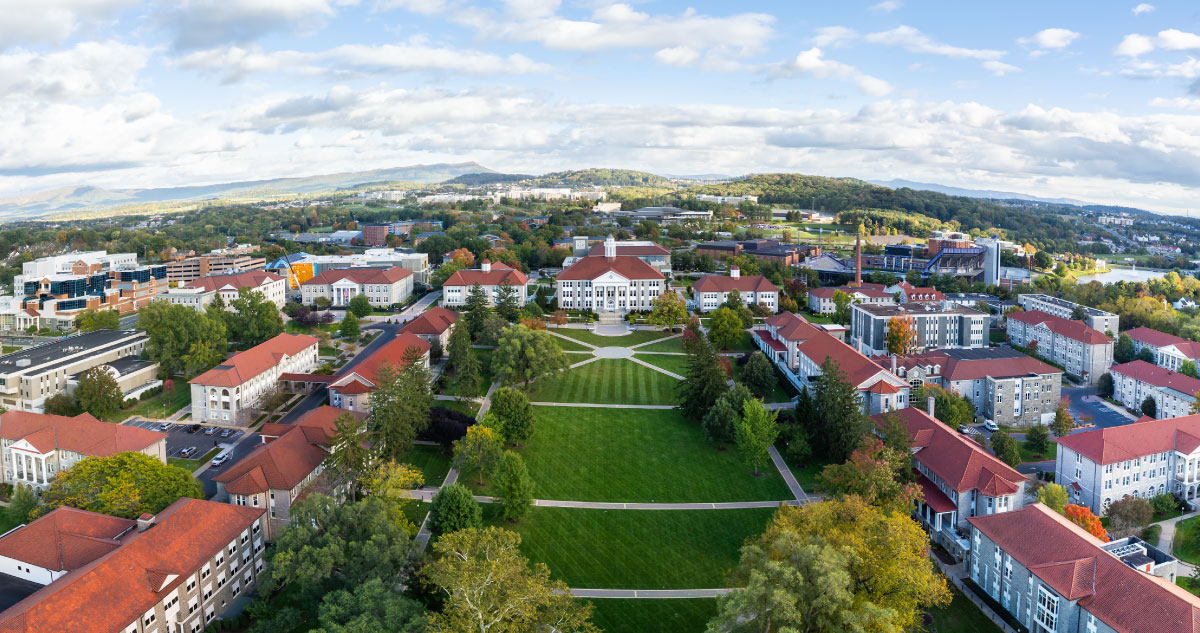
Life at JMU revolves around its picturesque campus and remarkably active student body. With over 400 clubs (from quidditch teams to professional societies) and a social scene that balances Greek life (about 20% participation) with alternative options, students describe an inclusive but energetic vibe. The Village dorm area is particularly social, while the surrounding Shenandoah Valley offers hiking and outdoor activities. Multiple sources highlight the 'happy minds thrive' philosophy—backed by top-rated dining halls and a campus that students call 'beautiful' without reservation. Friday afternoon 'Festival' gatherings on the quad are a cherished tradition.
JMU boasts strong outcomes, with an 81% six-year graduation rate that's remained steady for a decade. Within six months of graduation, 65% of alumni are employed full-time, with median earnings of $36,427 one year out. The university calculates that students typically recoup their educational investment within 3.6 years—an impressive ROI for a public institution. Five years post-graduation, alumni see significant salary bumps, contributing to JMU's ranking as a top value college. Notably, the career center reports high satisfaction rates among graduates in both employment and further education.
As a public Virginia university, JMU offers relative affordability with in-state tuition around $13,000 and out-of-state near $30,000. The calculator suggests significant aid packages are available, though the university notes its own scholarships aren't factored into initial estimates. About 60% of students receive some form of financial aid, with need-based grants averaging $8,000. The total (including room/board) typically runs $25,000-$42,000 depending on residency status—a value play compared to private peers with similar outcomes.
JMU occupies a sweet spot—a public university with private-college attention (18:1 student-faculty ratio) and Division I school spirit. It's the kind of place where students cheer as loudly for championship football games as they do for undergraduate research symposia. The 'JMU vibe' combines Southern hospitality with intellectual curiosity, set against the stunning backdrop of the Blue Ridge Mountains. Unlike larger state schools, JMU maintains a cohesive identity: collaborative rather than cutthroat, tradition-rich but innovative, and unapologetically enthusiastic about purple-and-gold pride.
James Madison University logo · sourceJames Madison University - JMU · sourceAerial Tour of JMU's Campus · sourceThis #NationalHigherEducationDay, as our faculty and staff prepare for our newest Dukes to arrive on campus in the fall, we are reminded of the important role James Madison University plays in Virginia · source