Admit rate has ranged 17%–24% over the last 5 years. Source: IPEDS via Urban Institute.
Acceptance & SAT from Common Data Set / IPEDS; net price, earnings & graduation from the U.S. Dept. of Education College Scorecard. Figures lag ~1–2 years — verify with the school.
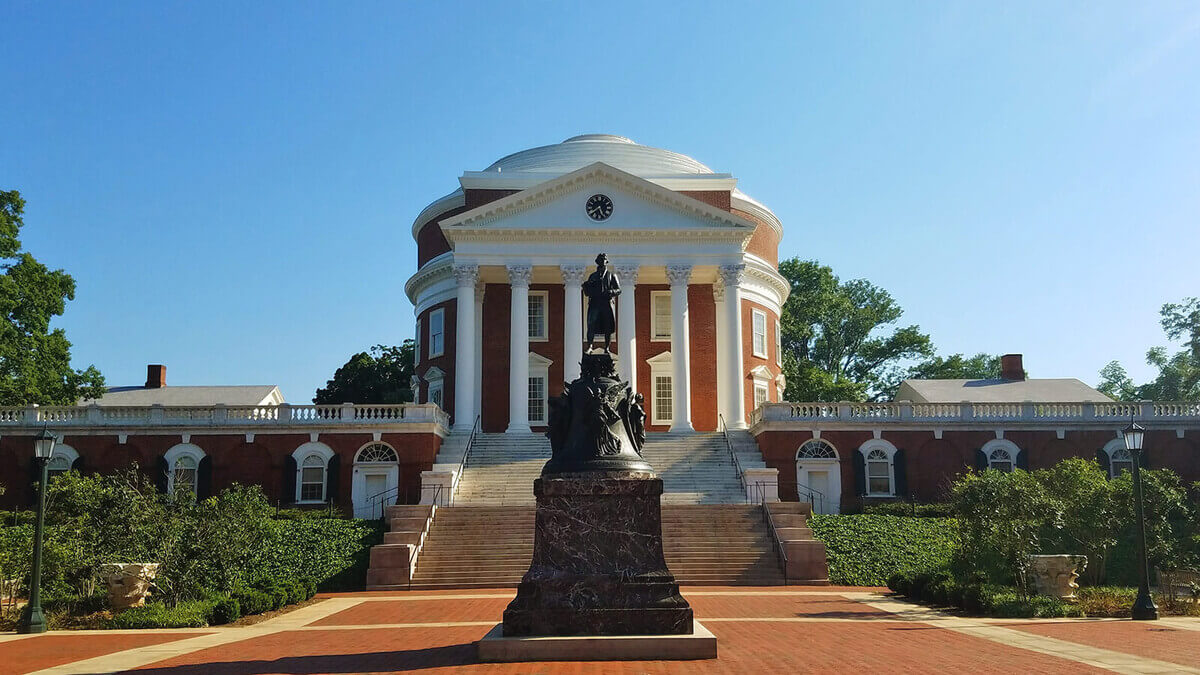
The University of Virginia is a public Ivy with a distinctively Southern, tradition-steeped character, where a rigorous, expanding STEM curriculum coexists with a famously vibrant social scene. Founded by Thomas Jefferson, its Grounds are a UNESCO World Heritage Site, but its modern identity is defined by a powerful blend of academic prestige, a robust student-run honor system, and a commitment to meeting the full financial need of every undergraduate—a rarity among public universities.
Admission requirements
Test-optional — scores considered if submitted
Required
High school transcript
Letters of recommendation
College-prep program
Considered (not required)
Grade point average
Class rank
Test scores (SAT/ACT)
TOEFL (non-native English)
Source: IPEDS Admissions survey (2022) via Urban Institute. Covers formal factors only — it does not reflect essays, extracurriculars, or other holistic criteria.
More details
Undergrad enrollment
17,597
In-state tuition
$21,803
Out-of-state tuition
$59,512
Top Majors
Computer Science, Economics, Biology
STEM Majors
44% of undergraduates
No-Loan Policy
Yes, for in-state families with income ≤ $50k
Graduation Rate
96%
Meets Full Need
Yes
Demonstrated Interest
Not considered
Median Earnings (10yr)
$86,863
Outcomes & value
Outcomes & value
Median earnings (10 yr)
$86,863
Value (earnings ÷ net price)
4.0×
Median debt at graduation
$17,500
Graduation rate
96%
First-year retention
98%
Reducing loan balance (3 yr)
86%
Pell (lower-income) share
16%
First-gen share (among federal-aid recipients)
16%
Top-earning majors
Median earnings by field of study (highest credential), ~2 years after completion.
Computer and Information Sciences, General$92,077
Computer Engineering$90,146
Systems Engineering$82,808
Business/Commerce, General$82,440
Aerospace, Aeronautical, and Astronautical/Space Engineering$74,576
Electrical, Electronics, and Communications Engineering
Applicants here also applied to
The schools that most often appear alongside UVA on applicants’ lists, from our self-reported outcomes corpus.
Co-application frequency from self-reported results — directional peer discovery, not a recommendation.
Campus & location
Campus safety
On-campus violent crimes (2024)
45
Per 1,000 students
1.72
On-campus criminal offenses classed as violent (murder/non-negligent manslaughter, rape, robbery, aggravated assault) for the most recent reported year. Source: U.S. Dept. of Education Campus Safety and Security (Clery Act). Counts reflect what’s reported to the school, and urban campuses often report more partly due to non-student incidents nearby — read alongside campus size and setting, not as a standalone safety verdict.
Climate
Pleasant days / yr
88
Summer high
88°F
Winter low
31°F
Annual rain
40.1"
Annual snow
10.3"
Natural-hazard risk
Relatively Low
Pleasant days counts days per year with a mean temperature of 55–75°F, a high at or below 90°F, a low at or above 45°F, and little precipitation — a transparent comfort measure, not a weighting we invented. Computed from Open-Meteo ERA5 daily history (2019–2023). Natural-hazard risk is the county’s composite rating from the FEMA National Risk Index.
Quick answers
What is the acceptance rate at University of Virginia-Main Campus?
University of Virginia-Main Campus's acceptance rate is approximately 17% (Charlottesville, VA), based on the most recent figures we compiled from public and primary sources.
What SAT score do you need for University of Virginia-Main Campus?
Admitted students at University of Virginia-Main Campus typically score 1410–1540 on the SAT (the middle-50% range). Scores outside this band are still admitted, especially with strong applications.
How much does University of Virginia-Main Campus cost?
At University of Virginia-Main Campus, the average net price (after aid) is about $21,565 per year. Actual cost varies with financial aid and residency.
How many undergraduates attend University of Virginia-Main Campus?
University of Virginia-Main Campus enrolls approximately 17,597 undergraduate students.
Where is University of Virginia-Main Campus located?
University of Virginia-Main Campus is located in Charlottesville, VA.
Admissions
Gaining admission to UVA is a highly selective, academically-driven process that favors Virginia residents but attracts top-tier talent from across the country. The university reports an overall of 17%, with a significant advantage for in-state applicants (a 17% in-state admit rate versus 12% for out-of-state applicants for one recent class). The middle 50% SAT range for admitted students is 1410–1540, and the middle 50% ACT composite range is 32–35. Academic achievement is paramount: 90% of admitted students are in the top 10% of their high school class. The university considers a student's secondary school record, class rank, GPA, standardized test scores, and the rigor of their secondary school record as "very important" factors in admission. Demonstrated interest is "not considered," according to the factor grid (C7). Applying early can be advantageous; Early Decision acceptance rates are notably higher than the overall rate, with recent cycles showing rates around 24-25.7% for ED, compared to lower rates for Early Action and Regular Decision. For the Class of 2029, the early in-state acceptance rate was 29.5%, while the out-of-state rate was 21%.
Earnings = median of students working ~10 years after entry; debt = median of graduates. Value divides 10-yr earnings by one year’s net price — read it as earnings per dollar of annual cost, not a full lifetime ROI; it favors lower-cost schools. Source: U.S. Dept. of Education College Scorecard. Figures lag ~2 years and reflect all students, not your intended major.
$74,576
Chemical Engineering$72,605
Civil Engineering$68,666
Source: U.S. Dept. of Education College Scorecard (field-of-study earnings). Figures cover graduates who received federal aid and lag ~2 years; not all programs report data.
UVA offers a comprehensive, research-intensive education across 12 schools, providing a wide range of majors, minors, degrees, and certificates. The academic landscape is shifting towards STEM; about 44% of undergraduate majors were in STEM fields recently, a significant jump from 35% a decade ago. The most popular majors reflect both this trend and the strength of the McIntire School of Commerce and the College of Arts & Sciences. For 2024 graduates, the top majors were Computer Science (9%), Econometrics and Quantitative Economics (8%), and Biology/Biological Sciences (6%). The university is often praised for its uniquely strong balance between demanding academics and a rich extracurricular and social life, a characteristic that sets it apart among public universities. Students are encouraged to explore their interests through tools like the free PathwayU assessment to help align potential majors with their values and strengths.
Life on the historic Grounds of UVA is a defining part of the experience, characterized by a blend of tradition, self-governance, and a packed social calendar. Approximately 41% of students live in college-owned, -operated, or -affiliated housing, with 59% living off campus. Students describe the dorms as "quite nice" and all having AC, while opinions on dining hall food range. The campus is considered large but walkable. The social scene is vibrant and diverse, encompassing countless clubs, programs, and sports. A unique corner of this scene is the active cover band culture, where student bands perform regularly. Student Affairs provides extensive resources to help students navigate everything from support services to finding service projects or social activities. The overall quality of life is a major draw, contributing to the university's high retention and graduation rates.
A UVA degree is a powerful launchpad, yielding exceptional graduation rates and strong early-career earnings. The university reports a four-year graduation rate of 92% and a six-year rate of 95-96%. The median earnings for recent graduates one year after graduation is $64,471, which grows to $85,639 five years after graduation. This earning power is significant; for example, psychology graduates from UVA have averaged more than $32,000 early in their careers. The UVA Career Center tracks detailed outcomes data, showing high rates of employment or graduate school enrollment shortly after graduation. The return on investment is clear, with graduates typically earning well above the national median for college graduates.
UVA is committed to affordability, particularly for Virginians, through one of the most generous financial aid policies at any public university. Crucially, UVA meets 100% of the demonstrated financial need for all admitted undergraduate students. For in-state students from families with an annual income of $50,000 or less, UVA covers tuition, fees, room, and board through a combination of grants and scholarships—a de facto no-loan policy for this income bracket. The average after aid is $21,565. For students receiving financial aid, the average aid package is $37,123, with an average school grant of $15,362. Approximately 29% of students receive financial aid. The university provides net price calculators and encourages families to use the FAFSA and other tools to estimate their actual cost.
UVA distinguishes itself through a rare trifecta: the academic heft of a "Public Ivy," the spirited culture of a major collegiate institution, and an ethical and financial commitment to students that rivals elite private universities. Its student-run Honor System, a single-sanction community of trust, is a foundational pillar. Academically, it successfully marries a strong liberal arts core with a rapidly growing and prestigious STEM footprint. Socially, it offers a quintessential college town experience in Charlottesville, anchored by deep traditions. But its most exceptional feature is its AccessUVA financial aid program. UVA is one of only two public universities in the nation that meets 100% of demonstrated financial need for all undergraduates, ensuring that admission is truly need-blind and that low- and middle-income Virginians can graduate debt-free. This combination of uncompromising quality, vibrant life, and principled accessibility makes UVA a singular institution in American public higher education.
University of Virginia-Main Campus seal · sourceUniversity of Virginia-Main Campus — Admissions, Tuition & Acceptance Rate | Appily · sourceVisit UVA | The University of Virginia · sourceThe University of Virginia · source