Admit rate has ranged 74%–84% over the last 5 years — notably volatile. Source: IPEDS via Urban Institute.
Acceptance & SAT from Common Data Set / IPEDS; net price, earnings & graduation from the U.S. Dept. of Education College Scorecard. Figures lag ~1–2 years — verify with the school.
Rowan University is a rapidly expanding public research institution in southern New Jersey that has transformed from a teachers' college into a comprehensive university with a distinct, pragmatic, and career-focused energy. Its identity is split between a sprawling main campus in Glassboro and a high-profile medical school in Camden, offering a wide range of popular programs in business, psychology, and the health sciences within a collaborative, small-class environment. The vibe is unpretentious and active, with a social life anchored by Greek life and a campus culture that prizes involvement and proximity to Philadelphia.
Admission requirements
Test-optional — scores considered if submitted
Required
High school transcript
Grade point average
Demonstrated competencies
TOEFL (non-native English)
Considered (not required)
Letters of recommendation
Test scores (SAT/ACT)
College-prep program
Source: IPEDS Admissions survey (2022) via Urban Institute. Covers formal factors only — it does not reflect essays, extracurriculars, or other holistic criteria.
More details
Undergrad enrollment
15,841
In-state tuition
$16,574
Out-of-state tuition
$26,932
Class Size
Max 40 students; no lecture halls
Student Life
Active Greek life, 30 mins to Philadelphia
Popular Majors
Business (15%), Psychology (13%), Biological Sciences
Graduation Rate
67%
Median Earnings (10yr)
$59,988
Regular Decision Deadline
March 1
Outcomes & value
Outcomes & value
Median earnings (10 yr)
$59,988
Value (earnings ÷ net price)
2.7×
Median debt at graduation
$20,500
Graduation rate
67%
First-year retention
82%
Reducing loan balance (3 yr)
67%
Pell (lower-income) share
33%
First-gen share (among federal-aid recipients)
35%
Top-earning majors
Median earnings by field of study (highest credential), ~2 years after completion.
Electrical, Electronics, and Communications Engineering$72,742
Registered Nursing, Nursing Administration, Nursing Research and Clinical Nursing$71,015
Civil Engineering$61,516
Computer and Information Sciences, General$60,358
Mechanical Engineering$58,673
Chemical Engineering
Campus & location
Campus safety
On-campus violent crimes (2024)
19
Per 1,000 students
0.91
On-campus criminal offenses classed as violent (murder/non-negligent manslaughter, rape, robbery, aggravated assault) for the most recent reported year. Source: U.S. Dept. of Education Campus Safety and Security (Clery Act). Counts reflect what’s reported to the school, and urban campuses often report more partly due to non-student incidents nearby — read alongside campus size and setting, not as a standalone safety verdict.
Climate
Pleasant days / yr
90
Summer high
85°F
Winter low
31°F
Annual rain
52.1"
Annual snow
10.7"
Natural-hazard risk
Relatively Moderate
Pleasant days counts days per year with a mean temperature of 55–75°F, a high at or below 90°F, a low at or above 45°F, and little precipitation — a transparent comfort measure, not a weighting we invented. Computed from Open-Meteo ERA5 daily history (2019–2023). Natural-hazard risk is the county’s composite rating from the FEMA National Risk Index.
Deep dive — research, future-scholar output & economic mobility▾
Research output
Institutional h-index
226
Scholarly works
15,309
Institutional research volume and impact from OpenAlex. The h-index reflects large research universities and will be low for teaching-focused liberal-arts colleges — not a measure of undergraduate quality.
Economic mobility
Mobility rate
1.8%
Bottom → top quintile
32%
From bottom quintile
6%
Mobility rate = the share of students who both start in the bottom household-income quintile and reach the top quintile; bottom → top is that chance conditional on starting at the bottom. Source: Opportunity Insights Mobility Report Cards (Chetty, Friedman, Saez, Turner & Yagan). Reflects 1980–82 birth cohorts, so it’s directional, not current.
Quick answers
What is the acceptance rate at Rowan University?
Rowan University's acceptance rate is approximately 78% (Glassboro, NJ), based on the most recent figures we compiled from public and primary sources.
What SAT score do you need for Rowan University?
Admitted students at Rowan University typically score 1110–1310 on the SAT (the middle-50% range). Scores outside this band are still admitted, especially with strong applications.
How much does Rowan University cost?
At Rowan University, the average net price (after aid) is about $22,408 per year. Actual cost varies with financial aid and residency.
How many undergraduates attend Rowan University?
Rowan University enrolls approximately 15,841 undergraduate students.
Where is Rowan University located?
Rowan University is located in Glassboro, NJ.
Admissions
Rowan's admissions process is characterized by its accessibility and straightforward, approach. With an of 78%, the university is less selective, positioning itself as a primary destination for a broad swath of New Jersey students and beyond. The middle 50% SAT range for admitted students is 1110–1310, though Rowan explicitly offers a test-optional policy, allowing prospective students to apply without submitting SAT or ACT scores. The admissions office can be reached at 856-256-4200 or via email at [email protected], with a regular decision deadline of March 1. The rate—the percentage of admitted students who enroll—is reported as 24%, which is considered medium. Demonstrated interest is a factor that some colleges track closely, but Rowan's does not provide explicit information on whether it is considered in their admissions decisions.
Earnings = median of students working ~10 years after entry; debt = median of graduates. Value divides 10-yr earnings by one year’s net price — read it as earnings per dollar of annual cost, not a full lifetime ROI; it favors lower-cost schools. Source: U.S. Dept. of Education College Scorecard. Figures lag ~2 years and reflect all students, not your intended major.
$57,318
Finance and Financial Management Services$51,482
Accounting and Related Services$51,412
Source: U.S. Dept. of Education College Scorecard (field-of-study earnings). Figures cover graduates who received federal aid and lag ~2 years; not all programs report data.
Academics at Rowan are defined by breadth, rapid growth, and a hands-on, faculty-focused teaching model. The university offers more than 100 bachelor's, 63 master's degree programs, 16 doctoral programs, and three professional programs, earning it a reputation as the third fastest-growing research institution in the country. Class sizes are notably small for a public university, with a maximum of 40 students per class and no large lecture halls, particularly in upper-level courses. This fosters a connected environment where faculty are "engaged with their students." The most popular majors reflect a practical, career-oriented student body: Business, Management, Marketing, and Related Support Services (15% of 2024 graduates), Psychology (13%), and Biological and Biomedical Sciences. The academic experience is described as "very major dependent," suggesting some programs are more robustly resourced than others, but the overall emphasis is on nationally ranked, award-winning programs taught in small classes.
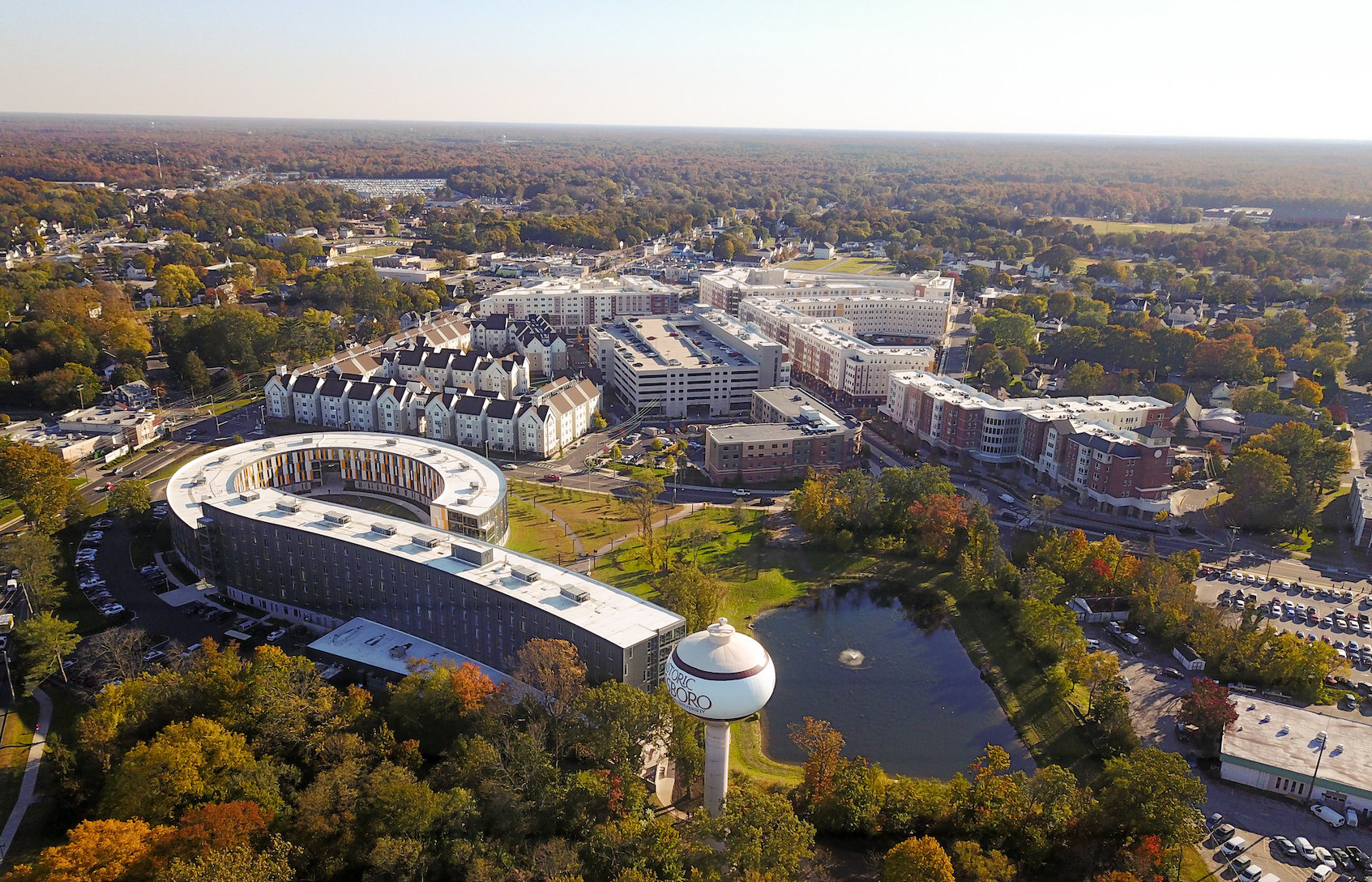
Life at Rowan is described as a "vibrant" community where students pursue fulfillment through a wide range of opportunities. The campus culture is heavily centered on student involvement, with the university encouraging participation in philanthropic, cultural, leadership, and social activities through its Office of Student Involvement. Social life has a distinct Greek flavor; as one student notes, "Rowan very much does have a party scene. There's pretty much parties every week, but those are frat parties." The campus and surrounding Glassboro borough are undergoing redevelopment, featuring mixed-use buildings and smart growth initiatives that blend campus with downtown. Students praise the "diverse" environment, the wealth of clubs and activities, and the overall welcoming, beautiful campus. The proximity to Philadelphia (about a 30-minute drive) also provides easy access to major city culture and entertainment.
Rowan graduates enter the workforce with solid earning potential, particularly for a public university at its price point. The graduation rate within 150% of normal time is 67%. For comparison, approximately 58% of starting students nationally earn a bachelor's degree within six years. The median earnings for graduates 10 years after entry is $59,988. This outcome-focused profile aligns with the university's practical academic offerings and suggests a return on investment that meets or exceeds national averages for public institutions.
Rowan presents a mid-range public university cost structure, with a significant emphasis on and a notable program for lower-income families. The average after grants and scholarships is $22,408. The total is estimated at $32,539. Financial need is calculated by subtracting a student's Expected Family Contribution (EFC) from this total cost. The standout initiative is the Rowan Opportunity Program, which provides free tuition to admitted New Jersey students with a federal Adjusted Gross Income between $0 and $65,000. For families with an AGI between $65,001 and $80,000, the program caps tuition costs at no more than $7,500. This represents a significant commitment to accessibility. The university offers a standard mix of grants, scholarships (which do not need to be repaid), and federal loans, including unsubsidized loans for students who do not demonstrate financial need. There is no indication of a universal "no-loan" policy that meets full need for all admitted students.
Rowan University stands out for its dramatic evolution and its distinctly practical, student-centered model. It has successfully shed its former identity as a small teachers' college to become a fast-growing, comprehensive public research university without losing its focus on accessible, hands-on education. The combination of small class sizes (max 40 students, no lecture halls) within a large public institution is a rare and valuable feature, fostering direct faculty interaction. Its Rowan Opportunity Program is a powerful, concrete commitment to making college affordable for lower- and middle-income New Jersey families, setting it apart from many peers. Furthermore, the campus culture is self-directed and active—not overly curated—with a social scene driven by student organizations and Greek life, and a location that offers both a traditional college town feel and quick access to Philadelphia. It’s a university for students who want the resources and range of a state school without getting lost in the crowd, and who prioritize clear career pathways and return on investment.
Rowan University seal · sourceLocation | Admissions | Rowan University · sourceVisit Rowan University | Admissions | Rowan University · sourceDirections & Parking · source