Admit rate has ranged 14%–21% over the last 5 years. Source: IPEDS via Urban Institute.
Acceptance & SAT from Common Data Set / IPEDS; net price, earnings & graduation from the U.S. Dept. of Education College Scorecard. Figures lag ~1–2 years — verify with the school.
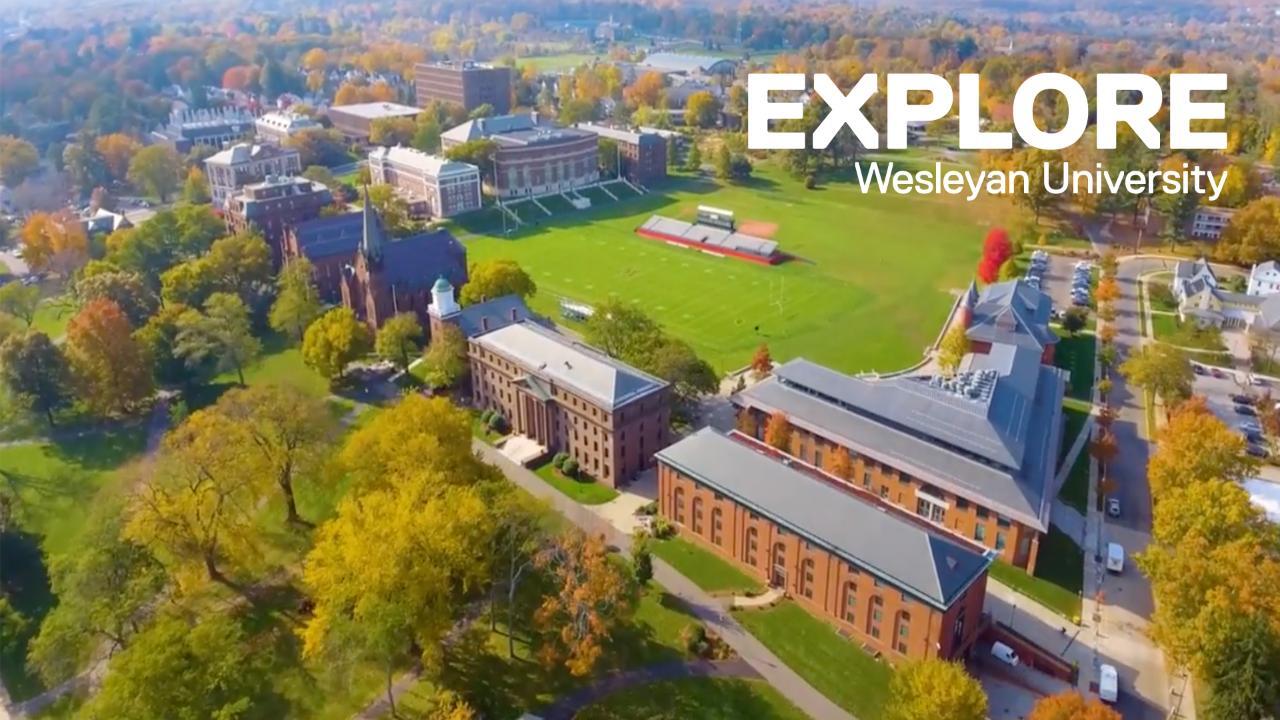
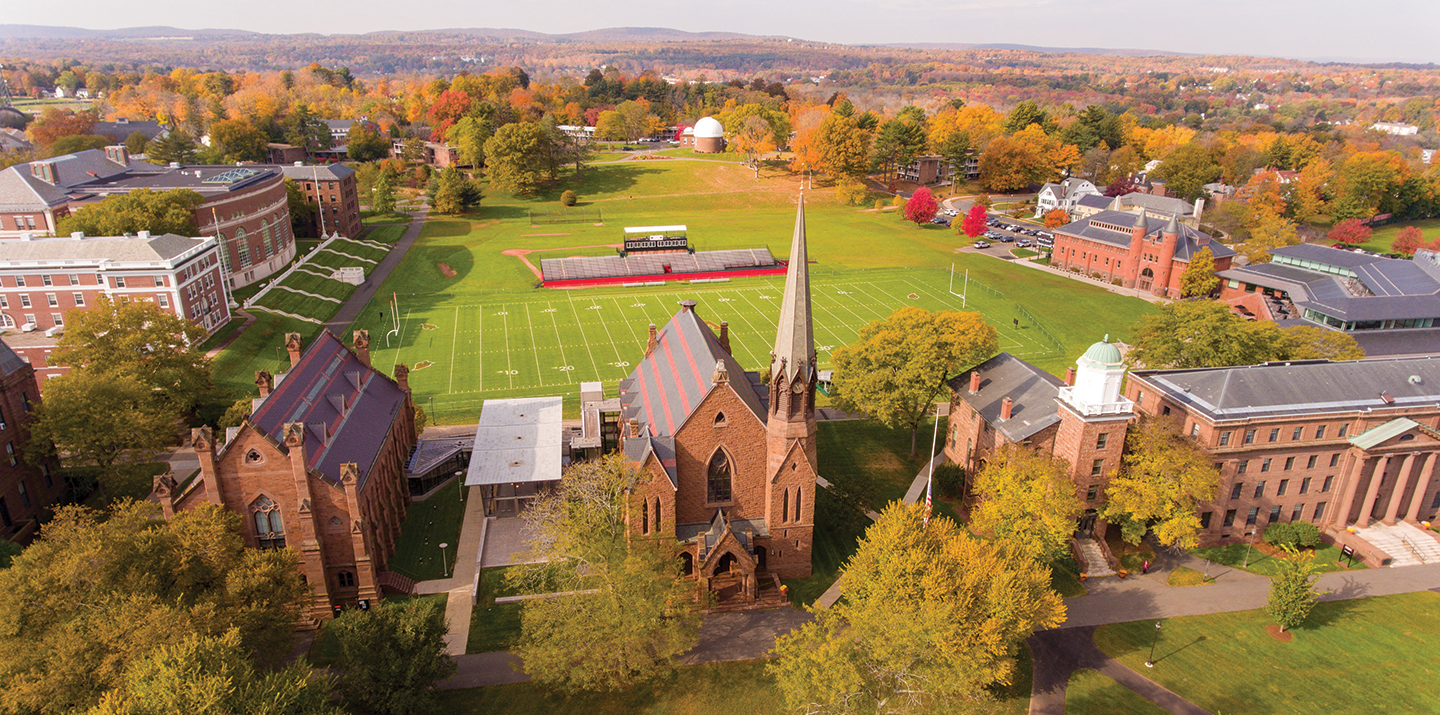
Wesleyan University is a small, fiercely intellectual liberal arts college with a famously progressive, creative, and independent-minded student body. Its open curriculum empowers students to design their own academic path, while its residential campus in Middletown, Connecticut, hums with artistic, activist, and intellectual energy. The school combines the academic rigor of a top-tier university with a distinctive countercultural spirit and a recent, significant commitment to making education affordable through a no-loan financial aid policy.
Admission requirements
Test-optional — scores considered if submitted
Required
High school transcript
Letters of recommendation
TOEFL (non-native English)
Considered (not required)
Grade point average
Class rank
Test scores (SAT/ACT)
College-prep program
Source: IPEDS Admissions survey (2022) via Urban Institute. Covers formal factors only — it does not reflect essays, extracurriculars, or other holistic criteria.
More details
Undergrad enrollment
3,067
In-state tuition
$70,342
Out-of-state tuition
$70,342
No-Loan Policy
Yes, for all aid packages starting 2024-25
Graduation Rate
93%
Meets Full Need
Yes
Median Earnings (10yr)
$73,897
Outcomes & value
Outcomes & value
Median earnings (10 yr)
$73,897
Value (earnings ÷ net price)
2.4×
Median debt at graduation
$17,000
Graduation rate
93%
First-year retention
95%
Reducing loan balance (3 yr)
88%
Pell (lower-income) share
14%
First-gen share (among federal-aid recipients)
20%
Financial health
3.0 / 3.0Meets the federal financial-responsibility standard
U.S. Dept. of Education Financial Responsibility Composite Score (FY2022-23). Scale −1.0 to 3.0; ≥1.5 meets the standard. Reported for private nonprofit & for-profit institutions only — public universities are state-backed and not scored, so this is a stability signal, not a ranking.
Top-earning majors
Median earnings by field of study (highest credential), ~2 years after completion.
Liberal Arts and Sciences, General Studies and Humanities$36,334
Source: U.S. Dept. of Education College Scorecard (field-of-study earnings). Figures cover graduates who received federal aid and lag ~2 years; not all programs report data.
Applicants here also applied to
The schools that most often appear alongside Wesleyan on applicants’ lists, from our self-reported outcomes corpus.
Co-application frequency from self-reported results — directional peer discovery, not a recommendation.
Campus & location
Campus safety
On-campus violent crimes (2024)
2
Per 1,000 students
0.61
On-campus criminal offenses classed as violent (murder/non-negligent manslaughter, rape, robbery, aggravated assault) for the most recent reported year. Source: U.S. Dept. of Education Campus Safety and Security (Clery Act). Counts reflect what’s reported to the school, and urban campuses often report more partly due to non-student incidents nearby — read alongside campus size and setting, not as a standalone safety verdict.
Climate
Pleasant days / yr
95
Summer high
81°F
Winter low
26°F
Annual rain
55.5"
Annual snow
25.6"
Pleasant days counts days per year with a mean temperature of 55–75°F, a high at or below 90°F, a low at or above 45°F, and little precipitation — a transparent comfort measure, not a weighting we invented. Computed from Open-Meteo ERA5 daily history (2019–2023).
Deep dive — research, future-scholar output & economic mobility▾
Research output
Institutional h-index
293
Scholarly works
14,985
Institutional research volume and impact from OpenAlex. The h-index reflects large research universities and will be low for teaching-focused liberal-arts colleges — not a measure of undergraduate quality.
Share of this school’s graduates who go on to earn research doctorates (2010–20), by national rank and per-capita yield (NSF institutional-yield ratio). A signal of a research-oriented student culture — not a causal promise, since it partly reflects who enrolls. Only top producers appear. Source: NSF NCSES, Baccalaureate Origins of U.S. Research Doctorate Recipients.
Economic mobility
Quick answers
What is the acceptance rate at Wesleyan University?
Wesleyan University's acceptance rate is approximately 16% (Middletown, CT), based on the most recent figures we compiled from public and primary sources.
What SAT score do you need for Wesleyan University?
Admitted students at Wesleyan University typically score 1415–1540 on the SAT (the middle-50% range). Scores outside this band are still admitted, especially with strong applications.
How much does Wesleyan University cost?
At Wesleyan University, the average net price (after aid) is about $30,177 per year. Actual cost varies with financial aid and residency.
How many undergraduates attend Wesleyan University?
Wesleyan University enrolls approximately 3,067 undergraduate students.
Where is Wesleyan University located?
Wesleyan University is located in Middletown, CT.
Admissions
Gaining admission to Wesleyan is highly competitive, with the university reporting an of 16% for recent classes. The applicant pool is substantial, averaging around 14,640 students over a recent five-year period. While the university is test-flexible, the academic profile of admitted students is exceptionally strong; the median SAT scores for admitted students are 710 for Evidence-Based Reading and Writing and 710 for Math, and the median ACT score is 34. Wesleyan offers Early Decision (ED) I and II plans, and the acceptance rate for ED applicants is significantly higher than the overall rate—historically around 38-41% for recent cycles. This results in a substantial portion of the incoming class being filled through Early Decision. The admissions process is need-blind for domestic students, and the university has a strong commitment to meeting 100% of demonstrated financial need.
Earnings = median of students working ~10 years after entry; debt = median of graduates. Value divides 10-yr earnings by one year’s net price — read it as earnings per dollar of annual cost, not a full lifetime ROI; it favors lower-cost schools. Source: U.S. Dept. of Education College Scorecard. Figures lag ~2 years and reflect all students, not your intended major.
Mobility rate
2.0%
Bottom → top quintile
47%
From bottom quintile
4%
Mobility rate = the share of students who both start in the bottom household-income quintile and reach the top quintile; bottom → top is that chance conditional on starting at the bottom. Source: Opportunity Insights Mobility Report Cards (Chetty, Friedman, Saez, Turner & Yagan). Reflects 1980–82 birth cohorts, so it’s directional, not current.
Wesleyan's academic identity is defined by its bold, open curriculum, which imposes no core requirements and grants students remarkable freedom to craft their own educational journey. This philosophy fosters intense intellectual curiosity and interdisciplinary exploration. The most popular majors cluster in the social sciences, psychology, and the visual and performing arts. Specific programs like English Language and Literature and Film/Cinema/Video Studies are among the top producers of graduates. The academic environment is characterized by small class sizes and close faculty attention, creating a rigorous, seminar-style learning experience. The university's official mission emphasizes a "bold, rigorous education in the liberal arts and sciences that values putting ideas into practice." This translates to a culture where theoretical study is frequently connected to hands-on research, creative projects, and real-world application.
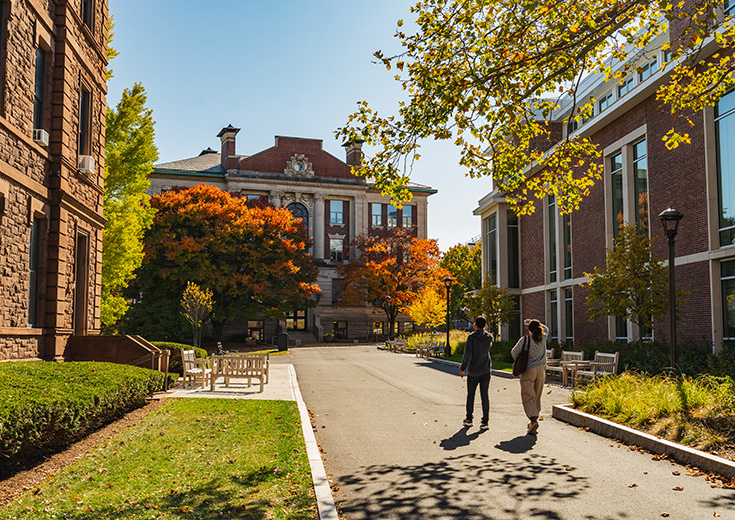
Life at Wesleyan is intensely residential and communal, with almost all students living on campus. This creates an "uncommonly close community" where the boundaries between academic, social, and personal life are fluid. The campus vibe is famously progressive, activist, and artistically vibrant. Student life is self-directed and rich with options, fueled by more than 300 student-run organizations. These groups span a wide spectrum, focusing on activism, identity, sports, publications, performance and visual arts, and community service. Students are deeply engaged in shaping their environment, running initiatives like gardens and food co-ops, and volunteering in the broader community. The overall atmosphere is one of creative, intellectual, and social energy, where students are as likely to be debating political theory in a dining hall as rehearsing for a student-written play or organizing a protest.
Wesleyan graduates are highly successful in their post-college pursuits, backed by a powerful alumni network and a degree that carries significant weight in graduate admissions and professional circles. The university boasts a strong record of placing graduates into top law schools, with an 88% to U.S. law schools for recent graduates. The overall graduation rate is exceptionally high, placing Wesleyan in the top tier of national institutions. While early-career earnings are solid, the financial return grows substantially over time, reflecting the long-term value of a Wesleyan liberal arts education. The combination of a flexible, intellectually demanding curriculum and a culture that prizes initiative prepares graduates not for a single career track, but for leadership and innovation across a wide array of fields.
Wesleyan has made a major, recent commitment to affordability and access. Beginning in the 2024-25 academic year, the university eliminated loans from all financial aid packages, replacing them with institutional grants. This "no-loan" policy is a cornerstone of its pledge to meet 100% of a student's demonstrated financial need for all eligible applicants. The university is need-blind in its admissions process for domestic students, meaning a family's financial circumstances are not considered when evaluating an application. To help families plan, Wesleyan provides a Calculator and other online tools to estimate the actual after accounting for grants and scholarships. The goal is to remove financial barriers and ensure that an admitted student's decision to attend is not constrained by debt.
Wesleyan stands out for its potent and rare combination of top-tier academic rigor and a genuinely countercultural, creative ethos. It's a place where intellectual intensity isn't confined to the classroom but spills out into every aspect of campus life, driven by a student body prized for its independence and activism. The open curriculum is more than a policy; it's a philosophy that treats students as co-authors of their education, fostering a level of intellectual maturity and self-direction uncommon at the undergraduate level. This is not a pre-professional factory, but a incubator for original thinkers, artists, and change-makers. Furthermore, its decisive move to a no-loan financial aid model signals a serious commitment to socioeconomic diversity and access, aligning its resources with its progressive values. The result is a singular environment: as academically demanding as any Ivy, but with a vibe that is distinctly more eclectic, artistic, and defiantly its own.
Wesleyan University seal · sourceVisit Campus | Wesleyan University · sourceAbout Wesleyan University · sourceVisit Campus | Wesleyan University · source