Admit rate has ranged 56%–73% over the last 5 years — notably volatile. Source: IPEDS via Urban Institute.
Acceptance & SAT from Common Data Set / IPEDS; net price, earnings & graduation from the U.S. Dept. of Education College Scorecard. Figures lag ~1–2 years — verify with the school.
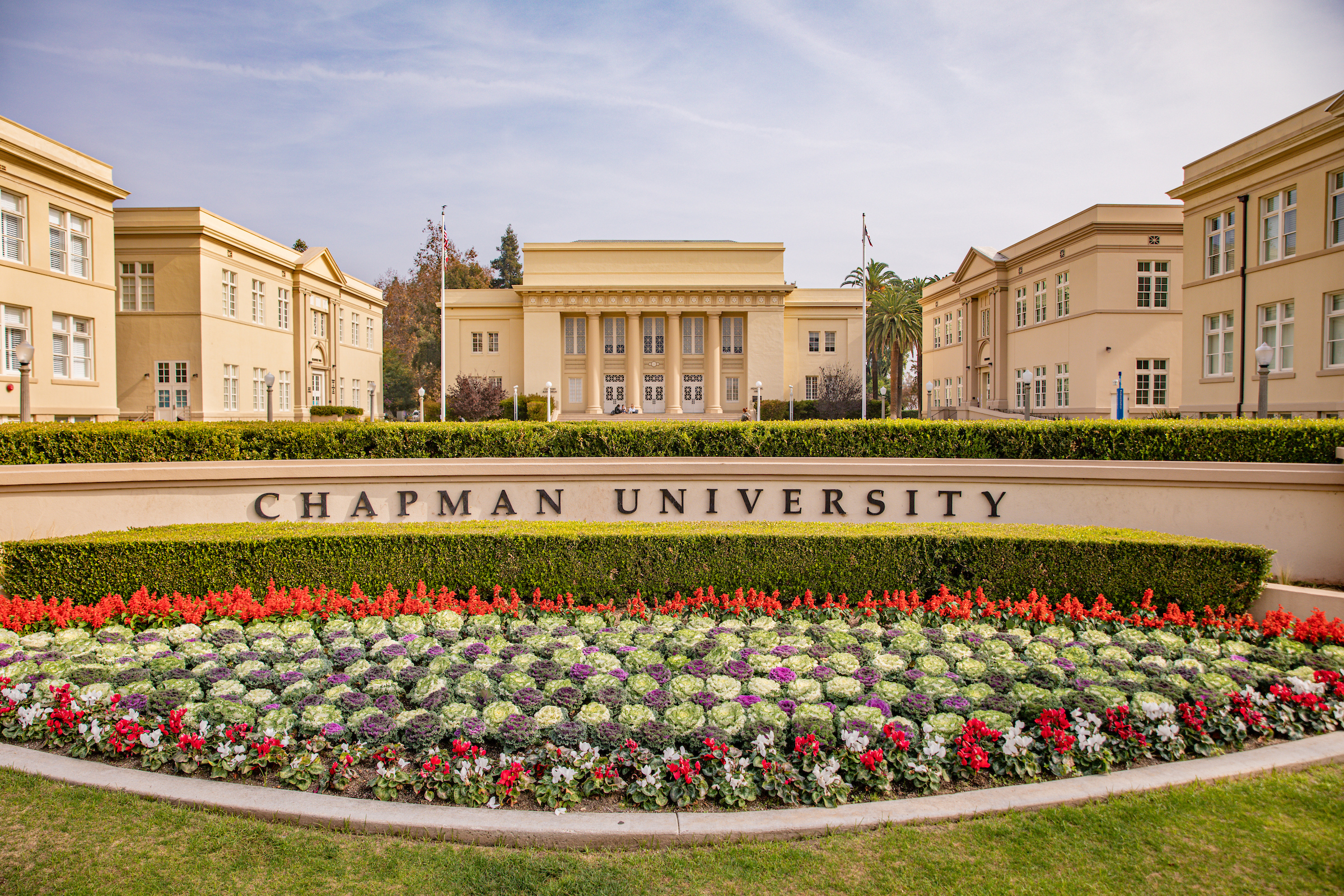
Chapman University is a private, mid-sized institution in Orange, California, that has carved out a distinct identity as a creative, professionally-oriented campus with a strong entrepreneurial streak. It’s a place where film production, business administration, and communications majors mingle on a compact, palm-lined campus that feels more like a high-end corporate retreat than a traditional college, offering a polished, sun-drenched alternative to its larger, more research-intensive neighbors. The vibe is affluent, ambitious, and heavily involved, with a significant portion of the student body drawn by its proximity to Southern California's industries and a curriculum that emphasizes practical, hands-on experience.
Admission requirements
Test-optional — scores considered if submitted
Required
High school transcript
Grade point average
Letters of recommendation
College-prep program
Demonstrated competencies
TOEFL (non-native English)
Considered (not required)
Class rank
Test scores (SAT/ACT)
Source: IPEDS Admissions survey (2022) via Urban Institute. Covers formal factors only — it does not reflect essays, extracurriculars, or other holistic criteria.
More details
Undergrad enrollment
7,478
In-state tuition
$64,984
Out-of-state tuition
$64,984
No-Loan Policy
No
Popular Majors
Business, Film Production
Graduation Rate
82%
Meets Full Need
No
On-Campus Housing
49% of students
First-Year Retention
Not in sources
Demonstrated Interest
Not considered
Employed at Graduation
68%
Median Earnings (10yr)
$70,070
Outcomes & value
Outcomes & value
Median earnings (10 yr)
$70,070
Value (earnings ÷ net price)
1.5×
Median debt at graduation
$20,500
Graduation rate
82%
First-year retention
92%
Reducing loan balance (3 yr)
68%
Pell (lower-income) share
19%
First-gen share (among federal-aid recipients)
18%
Financial health
3.0 / 3.0Meets the federal financial-responsibility standard
U.S. Dept. of Education Financial Responsibility Composite Score (FY2022-23). Scale −1.0 to 3.0; ≥1.5 meets the standard. Reported for private nonprofit & for-profit institutions only — public universities are state-backed and not scored, so this is a stability signal, not a ranking.
Top-earning majors
Median earnings by field of study (highest credential), ~2 years after completion.
Computer Science$69,338
Accounting and Related Services$65,651
Design and Applied Arts$52,107
Business/Managerial Economics$52,107
Business Administration, Management and Operations$50,856
Public Relations, Advertising, and Applied Communication
Applicants here also applied to
The schools that most often appear alongside Chapman University on applicants’ lists, from our self-reported outcomes corpus.
Co-application frequency from self-reported results — directional peer discovery, not a recommendation.
Campus & location
Campus safety
On-campus violent crimes (2024)
9
Per 1,000 students
0.94
On-campus criminal offenses classed as violent (murder/non-negligent manslaughter, rape, robbery, aggravated assault) for the most recent reported year. Source: U.S. Dept. of Education Campus Safety and Security (Clery Act). Counts reflect what’s reported to the school, and urban campuses often report more partly due to non-student incidents nearby — read alongside campus size and setting, not as a standalone safety verdict.
Climate
Pleasant days / yr
263
Summer high
83°F
Winter low
48°F
Annual rain
15"
Natural-hazard risk
Very High
Pleasant days counts days per year with a mean temperature of 55–75°F, a high at or below 90°F, a low at or above 45°F, and little precipitation — a transparent comfort measure, not a weighting we invented. Computed from Open-Meteo ERA5 daily history (2019–2023). Natural-hazard risk is the county’s composite rating from the FEMA National Risk Index.
Deep dive — research, future-scholar output & economic mobility▾
Research output
Institutional h-index
225
Scholarly works
14,035
Institutional research volume and impact from OpenAlex. The h-index reflects large research universities and will be low for teaching-focused liberal-arts colleges — not a measure of undergraduate quality.
Economic mobility
Mobility rate
1.7%
Bottom → top quintile
32%
From bottom quintile
5%
Mobility rate = the share of students who both start in the bottom household-income quintile and reach the top quintile; bottom → top is that chance conditional on starting at the bottom. Source: Opportunity Insights Mobility Report Cards (Chetty, Friedman, Saez, Turner & Yagan). Reflects 1980–82 birth cohorts, so it’s directional, not current.
Quick answers
What is the acceptance rate at Chapman University?
Chapman University's acceptance rate is approximately 65% (Orange, CA), based on the most recent figures we compiled from public and primary sources.
What SAT score do you need for Chapman University?
Admitted students at Chapman University typically score 1260–1440 on the SAT (the middle-50% range). Scores outside this band are still admitted, especially with strong applications.
How much does Chapman University cost?
At Chapman University, the average net price (after aid) is about $46,555 per year. Actual cost varies with financial aid and residency.
How many undergraduates attend Chapman University?
Chapman University enrolls approximately 7,478 undergraduate students.
Where is Chapman University located?
Chapman University is located in Orange, CA.
Admissions
Chapman's admissions process is moderately selective, with a clear advantage for those who apply early. The overall is 65%, but the early decision (ED) acceptance rate is significantly higher—reported to be around 51-62%—compared to the regular decision pool. Early Action is a non-binding option with decisions sent in late December, while Early Decision is binding. The university is overwhelmingly ; for the most recent cycle, 76% of applicants and 75% of admitted students chose not to submit SAT or ACT scores. For those who do submit, the middle 50% SAT range is 1260–1440. The admissions office considers a student's academic record (including GPA and rigor of coursework) as very important factors, while the level of an applicant's interest (demonstrated interest) is not considered in the evaluation process, as indicated in the . This means campus visits, interviews, and contact with admissions officers are not factored into decisions.
Earnings = median of students working ~10 years after entry; debt = median of graduates. Value divides 10-yr earnings by one year’s net price — read it as earnings per dollar of annual cost, not a full lifetime ROI; it favors lower-cost schools. Source: U.S. Dept. of Education College Scorecard. Figures lag ~2 years and reflect all students, not your intended major.
$45,767
Business/Corporate Communications$42,682
Journalism$39,153
Source: U.S. Dept. of Education College Scorecard (field-of-study earnings). Figures cover graduates who received federal aid and lag ~2 years; not all programs report data.
Chapman offers around 50 undergraduate majors, with a curriculum that starts with a broad liberal arts foundation—requiring coursework in sciences, foreign language, and the arts—before students dive into more specialized, often pre-professional programs. The academic culture is defined by access to faculty and hands-on learning. The university boasts that its programs are "taught by distinguished, world-class faculty, including Nobel Prize winners, MacArthur fellows, published authors and Academy Award winners." The most popular majors reflect its professional and creative orientation: Business Administration and Management, General, and Cinematography and Film/Video Production. The atmosphere is less about cutthroat theoretical competition and more about applied, project-based work, a perception noted in student discussions where some characterize it as a school for those seeking a more direct path to industry than a purely academic one. The Dodge College of Film and Media Arts is a particular draw and point of pride, acting as a central hub of campus energy and identity.
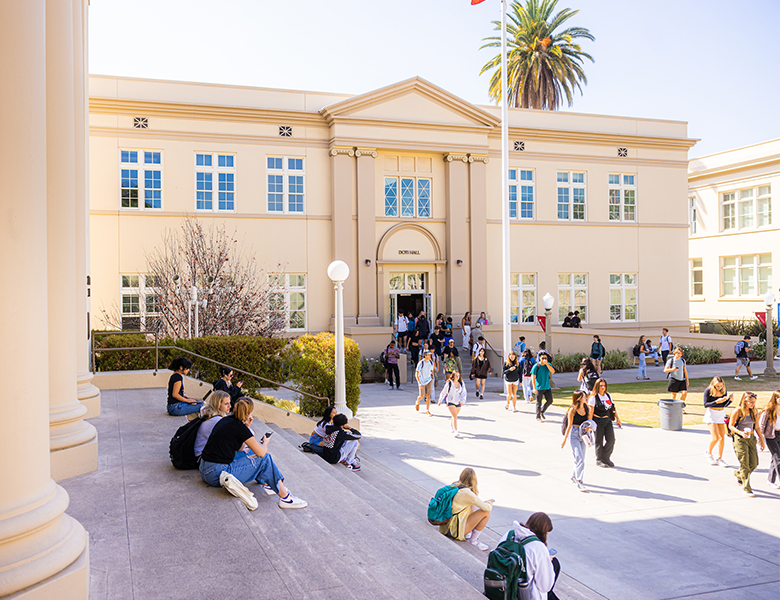
Life at Chapman is active, social, and heavily centered on campus involvement. The residential experience is split, with about 49% of students living in college-owned or affiliated housing and 51% living off-campus. The campus itself hosts a constant stream of activities, from Broadway-style performances and NCAA Division III athletics to a wide array of student clubs, Greek life, and recreational programs. Students describe a social scene where "everyone is involved in something," whether it's a club, a production, or a business venture. The Student Union serves as a central hangout. The overall vibe is often described as welcoming and inclusive, with a student body that is engaged and collaborative rather than distant. Its location in Orange, a safe and affluent suburb, provides a contained campus feel with easy access to the beaches, entertainment, and professional opportunities of greater Los Angeles and Orange County.
Chapman's focus on professional preparation yields strong short-term employment results. According to university data, 68% of graduates are employed at graduation, a figure that jumps to 84% within 90 days. The average salary for recent graduates is reported at $71,382, with the class of 2025 noting an average of $67,500. The university states that 97% of employers are satisfied with Chapman interns. The six-year graduation rate is 82%. These figures paint a picture of a university that successfully launches a majority of its graduates directly into the workforce, particularly in fields like business, communications, and entertainment.
Chapman is an expensive private university, but it uses institutional aid aggressively to offset the sticker price. The average after aid and scholarships is $46,555. A significant majority of students receive grant aid, with one source indicating 88% of students receive some form of it. The average institutional grant is around $31,889, and the average award package for incoming first-year students is approximately $34,600, with merit scholarships that can reach up to $42,000 per year. It is important to note that Chapman does not have a "no-loan" policy that meets 100% of demonstrated financial need without loans. Financial aid packages for students with need typically include federal Direct Loans, both subsidized and unsubsidized, as part of the offer. Students are encouraged to use the university's Net Price Calculator for a personalized estimate.
Chapman stands out for its potent combination of location, professional focus, and accessible scale. It’s not trying to be a massive research university; instead, it operates as a sleek, industry-connected feeder into Southern California's creative and business economies. The Dodge College of Film and Media Arts is its crown jewel, providing a legitimate, top-tier film school experience that defines the campus culture and attracts a certain type of ambitious, artistically-inclined student. Beyond film, the entire university embraces an entrepreneurial, 'doer' mentality. The campus is small enough to feel cohesive and supportive, with professors who are often working professionals, yet it's placed in the heart of one of the world's most dynamic economic regions. For students who want a private college experience with sunny weather, direct pathways to internships and jobs, and a community that values production over pure theory, Chapman offers a compelling and distinct alternative to both large public universities and more introspective liberal arts colleges.
Chapman University seal · sourceMaps & Directions | Chapman University · sourceCampus Life at Chapman University | Chapman University · sourceChapman University | A Top Private University in California | Chapman University · source