Admit rate has ranged 24%–37% over the last 5 years — notably volatile. Source: IPEDS via Urban Institute.
Acceptance & SAT from Common Data Set / IPEDS; net price, earnings & graduation from the U.S. Dept. of Education College Scorecard. Figures lag ~1–2 years — verify with the school.
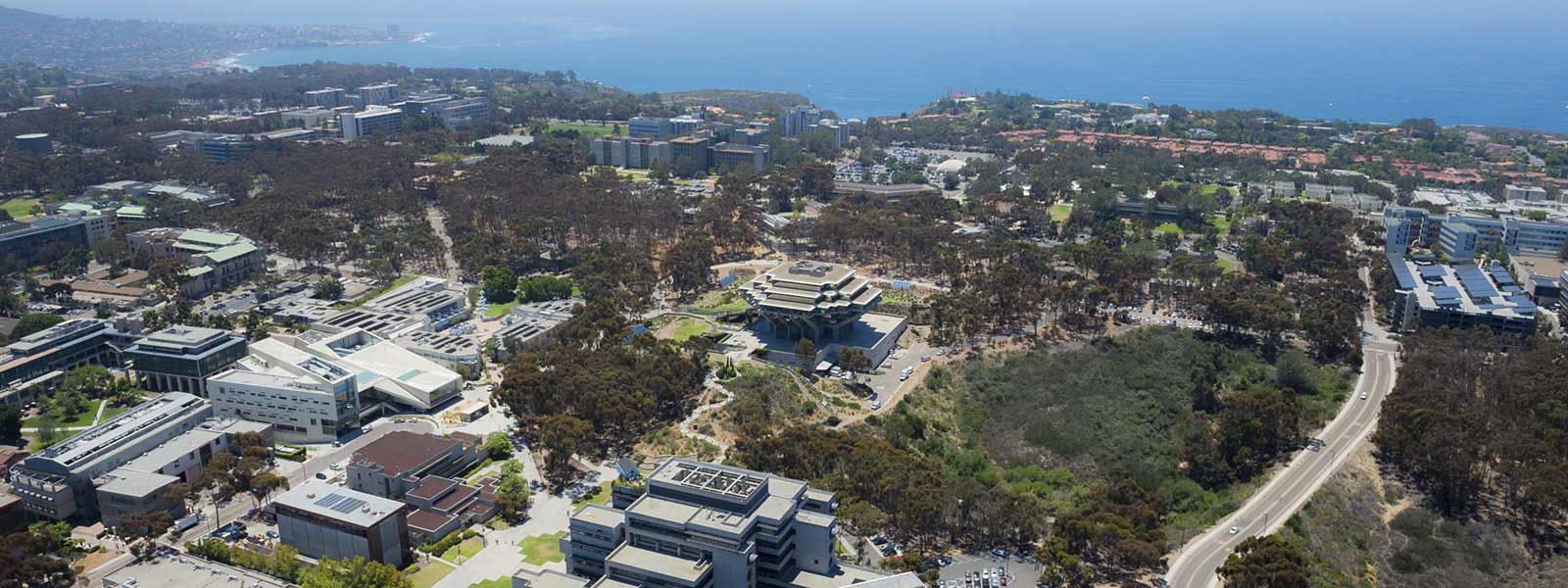
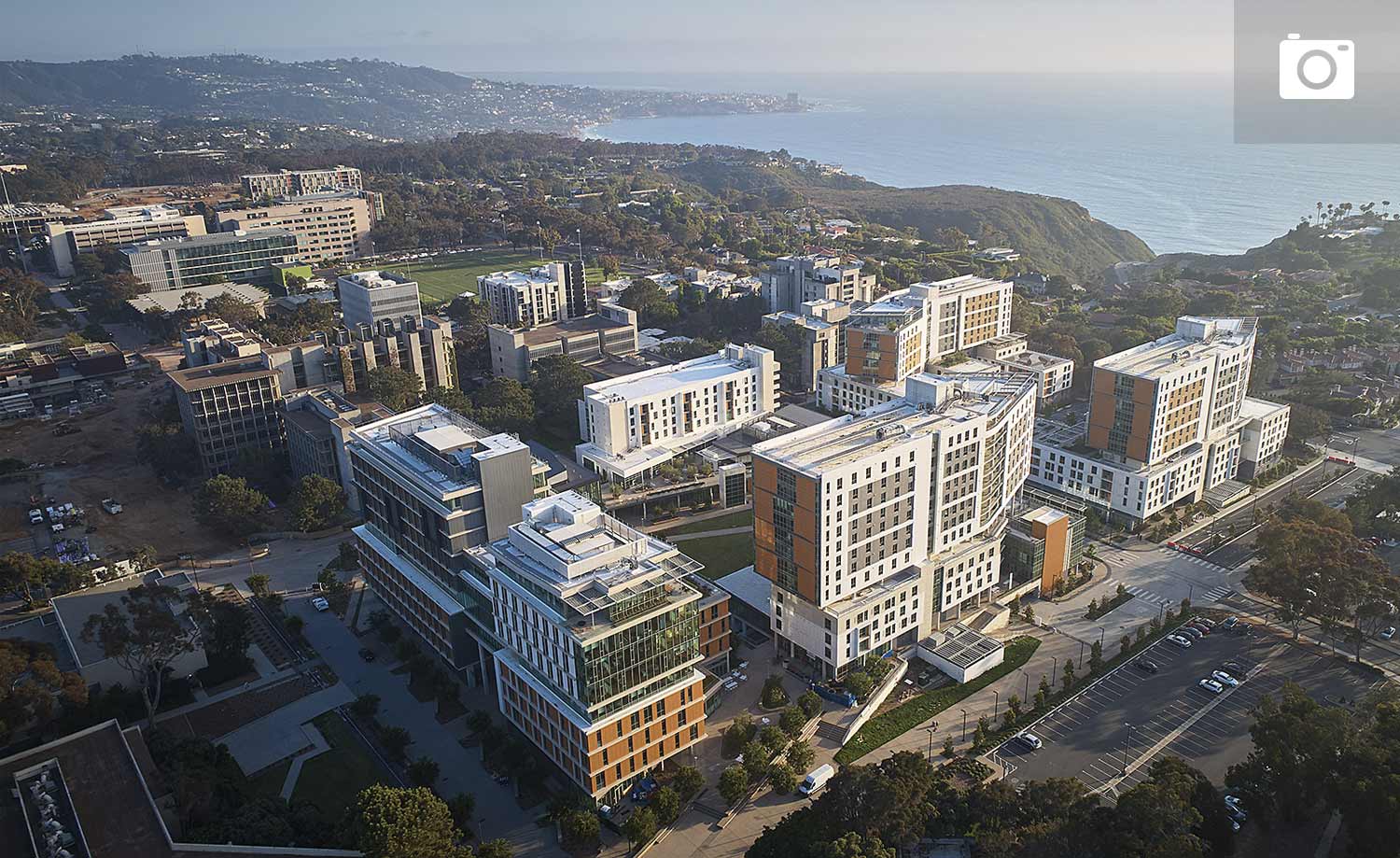
UC San Diego is a powerhouse of public research perched on the bluffs of La Jolla, where the Pacific Ocean serves as the campus's dramatic backyard. It's a place where academic intensity—particularly in STEM fields—collides with a famously decentralized and sometimes subdued social scene, organized around eight distinct residential colleges. Think of it as a collection of brilliant, focused villages, more likely to bond over a robotics competition or a late-night lab session than a raucous frat party, all set against an almost unfairly beautiful Southern California coastline.
Admission requirements
Test-blind — scores not considered
Required
High school transcript
Grade point average
College-prep program
TOEFL (non-native English)
Source: IPEDS Admissions survey (2022) via Urban Institute. Covers formal factors only — it does not reflect essays, extracurriculars, or other holistic criteria.
More details
Undergrad enrollment
34,948
In-state tuition
$16,758
Out-of-state tuition
$50,958
Graduation Rate
86%
Demonstrated Interest
Not considered
Median Earnings (10yr)
$84,943
Outcomes & value
Outcomes & value
Median earnings (10 yr)
$84,943
Value (earnings ÷ net price)
6.8×
Median debt at graduation
$15,500
Graduation rate
86%
First-year retention
94%
Reducing loan balance (3 yr)
82%
Pell (lower-income) share
34%
First-gen share (among federal-aid recipients)
40%
Top-earning majors
Median earnings by field of study (highest credential), ~2 years after completion.
Computer Science$86,972
Computer Engineering$79,688
Biomathematics, Bioinformatics, and Computational Biology$71,015
Electrical, Electronics, and Communications Engineering$69,606
Mechanical Engineering$67,846
Aerospace, Aeronautical, and Astronautical/Space Engineering
Applicants here also applied to
The schools that most often appear alongside UC San Diego on applicants’ lists, from our self-reported outcomes corpus.
On-campus criminal offenses classed as violent (murder/non-negligent manslaughter, rape, robbery, aggravated assault) for the most recent reported year. Source: U.S. Dept. of Education Campus Safety and Security (Clery Act). Counts reflect what’s reported to the school, and urban campuses often report more partly due to non-student incidents nearby — read alongside campus size and setting, not as a standalone safety verdict.
Climate
Pleasant days / yr
272
Summer high
75°F
Winter low
48°F
Annual rain
14.8"
Natural-hazard risk
Very High
Pleasant days counts days per year with a mean temperature of 55–75°F, a high at or below 90°F, a low at or above 45°F, and little precipitation — a transparent comfort measure, not a weighting we invented. Computed from Open-Meteo ERA5 daily history (2019–2023). Natural-hazard risk is the county’s composite rating from the FEMA National Risk Index.
Deep dive — research, future-scholar output & economic mobility▾
Research output
Institutional h-index
1,736
Scholarly works
354,693
Institutional research volume and impact from OpenAlex. The h-index reflects large research universities and will be low for teaching-focused liberal-arts colleges — not a measure of undergraduate quality.
Future-scholar output
Science & engineering PhDstop 11 nationally
Humanities & social-science PhDstop 41 nationally
Share of this school’s graduates who go on to earn research doctorates (2010–20), by national rank and per-capita yield (NSF institutional-yield ratio). A signal of a research-oriented student culture — not a causal promise, since it partly reflects who enrolls. Only top producers appear. Source: NSF NCSES, Baccalaureate Origins of U.S. Research Doctorate Recipients.
Economic mobility
Mobility rate
Quick answers
What is the acceptance rate at University of California-San Diego?
University of California-San Diego's acceptance rate is approximately 27% (La Jolla, CA), based on the most recent figures we compiled from public and primary sources.
How much does University of California-San Diego cost?
At University of California-San Diego, the average net price (after aid) is about $12,470 per year. Actual cost varies with financial aid and residency.
How many undergraduates attend University of California-San Diego?
University of California-San Diego enrolls approximately 34,948 undergraduate students.
Where is University of California-San Diego located?
University of California-San Diego is located in La Jolla, CA.
Admissions
Gaining admission to UC San Diego is a fiercely competitive numbers game, with over 136,000 first-year applications flooding in for a recent cycle. The university's published admit rate hovers around 28%, though the canonical is 27%. The middle 50% of admitted freshmen boast staggering high school GPAs between 4.12 and 4.29, reflecting the university's heavy emphasis on academic achievement within the UC application review. Unlike many private peers, UC San Diego does not consider SAT or ACT scores for admission, nor does it factor in demonstrated interest—what matters is the strength of your coursework, grades, and personal insight essays. The rate—the percentage of admitted students who enroll—is a telling 21%, indicating that many high-achieving applicants are also admitted to other top-tier UC campuses and private institutions, making UCSD a popular but not always final choice.
Earnings = median of students working ~10 years after entry; debt = median of graduates. Value divides 10-yr earnings by one year’s net price — read it as earnings per dollar of annual cost, not a full lifetime ROI; it favors lower-cost schools. Source: U.S. Dept. of Education College Scorecard. Figures lag ~2 years and reflect all students, not your intended major.
$61,218
Civil Engineering$58,221
Biomedical/Medical Engineering$55,964
Source: U.S. Dept. of Education College Scorecard (field-of-study earnings). Figures cover graduates who received federal aid and lag ~2 years; not all programs report data.
Co-application frequency from self-reported results — directional peer discovery, not a recommendation.
4.8%
Bottom → top quintile
55%
From bottom quintile
9%
Mobility rate = the share of students who both start in the bottom household-income quintile and reach the top quintile; bottom → top is that chance conditional on starting at the bottom. Source: Opportunity Insights Mobility Report Cards (Chetty, Friedman, Saez, Turner & Yagan). Reflects 1980–82 birth cohorts, so it’s directional, not current.
UC San Diego's academic identity is forged in the labs and research institutes that dot its campus. It offers a vast array of over 100 undergraduate majors, but its reputation is cemented in the sciences, technology, engineering, and quantitative social sciences. The most popular majors for recent graduates tell the story: Cognitive Science, Anatomy, Management Sciences and Quantitative Methods, and Computer Science dominate. This isn't a liberal arts college with a science wing; it's a research university where undergraduate education is deeply infused with the spirit of inquiry. The academic culture is rigorous and expects a high degree of student initiative. While the breadth of programs is wide, the intellectual energy is unmistakably tilted toward innovation, data, and discovery, preparing students not just with knowledge but with the tools to generate new knowledge.
Life at UC San Diego is famously fragmented, organized around its eight undergraduate residential colleges, each with its own general education requirements, housing, and dining. This structure creates smaller communities within the massive university, but it can also lead to a sense of social siloing. The campus vibe is often described as quiet, studious, and at times isolating—a common observation from visitors who note the lack of a centralized, bustling quad. Students actively build their own social worlds through over 65 student organizations dedicated to culture, performance, robotics, social justice, and of course, surfing. The beach is a major part of the lifestyle, offering a stark contrast to the academic grind. Official programming like Triton Weeks of Welcome (TWOW) seeks to knit the community together, but the dominant culture is one of self-directed engagement rather than traditional, rah-rah campus spirit.
A UC San Diego degree is a powerful launchpad. The four-year graduation rate is a strong 86%, a figure that speaks to both the caliber of the students and the university's support structures. While specific career outcomes data for UCSD is not provided in the sources, University of California alumni data shows that graduates typically earn between $50,000 and $60,000 directly after graduation and more than double their earnings within ten years. The canonical median earnings figure for UCSD graduates ten years after entry is $84,943. The university's consistent recognition on lists like Money's 5-Star Colleges is based in part on these strong outcomes, marrying academic quality with a return on investment. Graduates enter the workforce with the deep technical and analytical skills that are the university's hallmark.
As a public university, UC San Diego's sticker price is lower than private peers, but the cost for out-of-state students is significant. The university provides a Calculator to help families estimate their true cost after factoring in grants and scholarships. The canonical average net price after aid is $12,470. The university's financial aid packages are primarily need-based, drawing from federal, state, and institutional funds. The sources do not indicate that UC San Diego has a universal "no-loan" policy or that it meets 100% of demonstrated financial need for all admitted students without loans; aid packages typically include a mix of grants, work-study, and federal student loans. Prospective students are encouraged to use the official estimator tools to understand their specific financial picture.
UC San Diego stands out for its potent, almost paradoxical blend of world-class research intensity and Southern California casualness. It's a place where Nobel laureates walk the same brutalist pathways as students in flip-flops heading to the beach. Its identity is not wrapped up in centuries-old traditions or football glory, but in the relentless pursuit of what's next in science, medicine, and technology. The eight-college system is unique among public universities, offering a deliberate attempt to provide scale with intimacy, even if the social payoff is uneven. Ultimately, UCSD is for the self-driven student who wants to be at the forefront of discovery, doesn't need hand-holding, and is perfectly happy trading a vibrant traditional campus social scene for unparalleled academic resources and a sunset over the Pacific. It's a university of staggering capability, not cozy charm.
University of California-San Diego seal · sourceCampus Profile · sourceCollege Profile: Tell Me More About University of California-San Diego (UCSD) – Doing College · sourceCelebrating 10 Years of UC San Diego's Physical, Cultural and Intellectual Transformation · source