Admit rate has ranged 33%–47% over the last 5 years — notably volatile, though the latest figure above (51%) falls outside that window. Source: IPEDS via Urban Institute.
Acceptance & SAT from Common Data Set / IPEDS; net price, earnings & graduation from the U.S. Dept. of Education College Scorecard. Figures lag ~1–2 years — verify with the school.
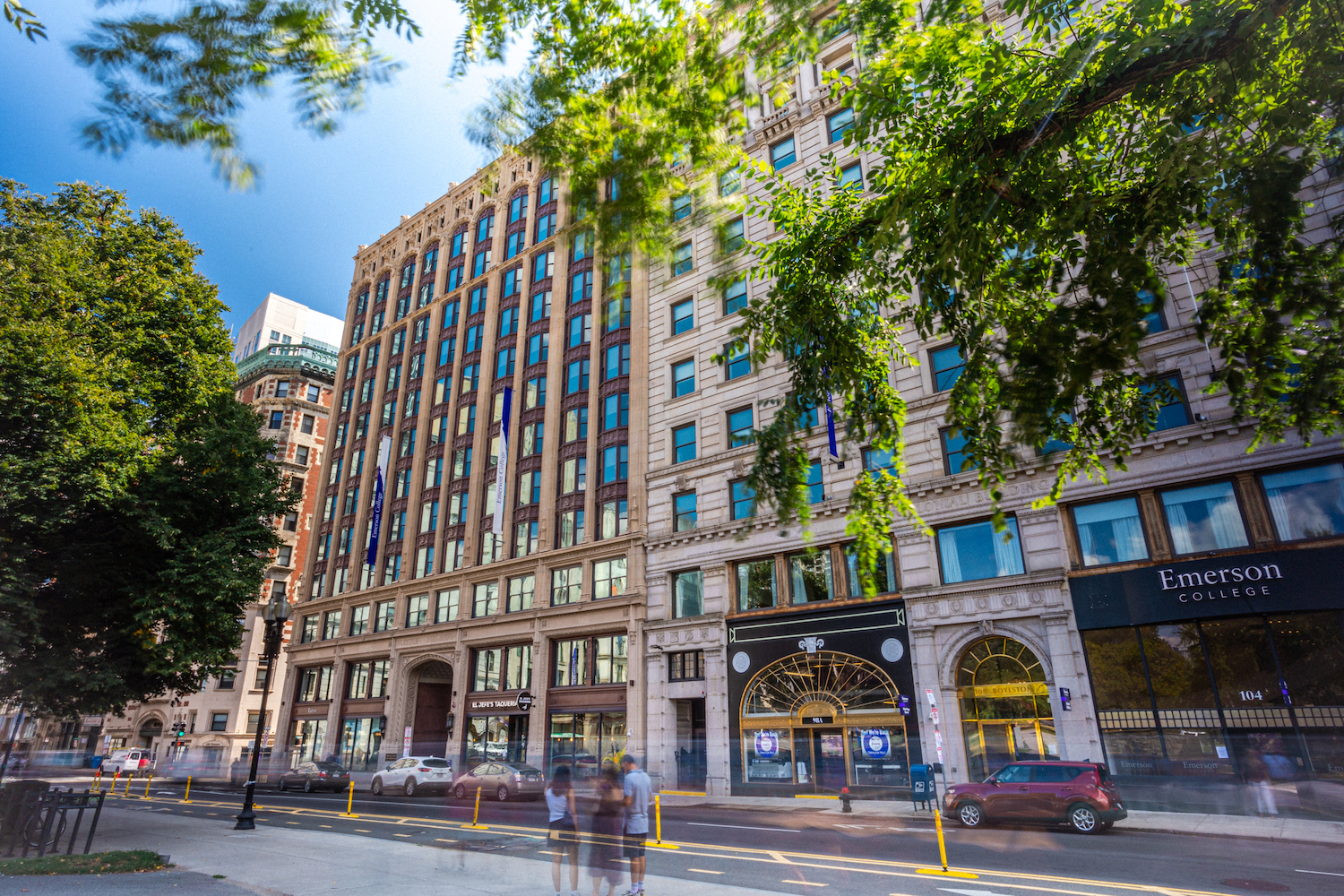
Emerson College is not a typical liberal arts school; it’s a high-voltage, hyper-focused conservatory for the communication age, planted squarely in the heart of Boston’s theater district. The campus hums with the energy of aspiring filmmakers, journalists, marketers, and performers who come not for a broad survey of disciplines but for an immersive, pre-professional deep dive into the arts and media. It’s a place where the student newspaper feels like a wire service, the film sets are student-run productions, and the ‘liberal arts foundation’ is the script from which all other creative work is launched.
Admission requirements
Test-optional — scores considered if submitted
Required
High school transcript
Grade point average
Letters of recommendation
College-prep program
TOEFL (non-native English)
Considered (not required)
Class rank
Test scores (SAT/ACT)
Source: IPEDS Admissions survey (2022) via Urban Institute. Covers formal factors only — it does not reflect essays, extracurriculars, or other holistic criteria.
More details
Undergrad enrollment
3,870
In-state tuition
$57,056
Out-of-state tuition
$57,056
Graduation Rate
77%
Demonstrated Interest
Considered
Student-Faculty Ratio
13:1
Median Earnings (10yr)
$62,832
Classes Under 20 Students
74.1%
First-Year Retention Rate
87%
Average Financial Aid Package
$37,801
Students Receiving Financial Aid
48.6%
Outcomes & value
Outcomes & value
Median earnings (10 yr)
$62,832
Value (earnings ÷ net price)
1.3×
Median debt at graduation
$23,000
Graduation rate
77%
First-year retention
87%
Reducing loan balance (3 yr)
78%
Pell (lower-income) share
16%
First-gen share (among federal-aid recipients)
13%
Financial health
3.0 / 3.0Meets the federal financial-responsibility standard
U.S. Dept. of Education Financial Responsibility Composite Score (FY2022-23). Scale −1.0 to 3.0; ≥1.5 meets the standard. Reported for private nonprofit & for-profit institutions only — public universities are state-backed and not scored, so this is a stability signal, not a ranking.
Top-earning majors
Median earnings by field of study (highest credential), ~2 years after completion.
Marketing$44,327
Journalism$38,953
Public Relations, Advertising, and Applied Communication$38,289
Teacher Education and Professional Development, Specific Subject Areas$35,600
Radio, Television, and Digital Communication$32,264
Rhetoric and Composition/Writing Studies
Applicants here also applied to
The schools that most often appear alongside Emerson College on applicants’ lists, from our self-reported outcomes corpus.
Co-application frequency from self-reported results — directional peer discovery, not a recommendation.
Campus & location
Campus safety
On-campus violent crimes (2024)
1
Per 1,000 students
0.19
On-campus criminal offenses classed as violent (murder/non-negligent manslaughter, rape, robbery, aggravated assault) for the most recent reported year. Source: U.S. Dept. of Education Campus Safety and Security (Clery Act). Counts reflect what’s reported to the school, and urban campuses often report more partly due to non-student incidents nearby — read alongside campus size and setting, not as a standalone safety verdict.
Climate
Pleasant days / yr
91
Summer high
81°F
Winter low
25°F
Annual rain
49"
Annual snow
31.4"
Natural-hazard risk
Relatively Moderate
Pleasant days counts days per year with a mean temperature of 55–75°F, a high at or below 90°F, a low at or above 45°F, and little precipitation — a transparent comfort measure, not a weighting we invented. Computed from Open-Meteo ERA5 daily history (2019–2023). Natural-hazard risk is the county’s composite rating from the FEMA National Risk Index.
Deep dive — research, future-scholar output & economic mobility▾
Research output
Institutional h-index
105
Scholarly works
2,114
Institutional research volume and impact from OpenAlex. The h-index reflects large research universities and will be low for teaching-focused liberal-arts colleges — not a measure of undergraduate quality.
Economic mobility
Mobility rate
1.1%
Bottom → top quintile
27%
From bottom quintile
4%
Mobility rate = the share of students who both start in the bottom household-income quintile and reach the top quintile; bottom → top is that chance conditional on starting at the bottom. Source: Opportunity Insights Mobility Report Cards (Chetty, Friedman, Saez, Turner & Yagan). Reflects 1980–82 birth cohorts, so it’s directional, not current.
Quick answers
What is the acceptance rate at Emerson College?
Emerson College's acceptance rate is approximately 51% (Boston, MA), based on the most recent figures we compiled from public and primary sources.
What SAT score do you need for Emerson College?
Admitted students at Emerson College typically score 1270–1420 on the SAT (the middle-50% range). Scores outside this band are still admitted, especially with strong applications.
How much does Emerson College cost?
At Emerson College, the average net price (after aid) is about $49,180 per year. Actual cost varies with financial aid and residency.
How many undergraduates attend Emerson College?
Emerson College enrolls approximately 3,870 undergraduate students.
Where is Emerson College located?
Emerson College is located in Boston, MA.
Admissions
Gaining admission to Emerson is a selective but not statistically improbable endeavor, with the college admitting roughly half of its applicants. The most recent institutional figures show that of 842 applicants in a given cycle, 480 were accepted and 187 enrolled, indicating a of about 39% from that pool. The admitted student profile is academically solid, with an average high school GPA of 3.53 on a 4.0 scale. For those submitting test scores, the middle 50% SAT range for admitted students falls between 1270 and 1420. The college offers an Early Decision (ED) option, and the admission rate for ED applicants is typically higher than in the regular round, reflecting the college's interest in enrolling students for whom Emerson is a clear first choice. One notable aspect of Emerson's process is its consideration of demonstrated interest, a factor it reports in its . The regular decision deadline is January 16.
Earnings = median of students working ~10 years after entry; debt = median of graduates. Value divides 10-yr earnings by one year’s net price — read it as earnings per dollar of annual cost, not a full lifetime ROI; it favors lower-cost schools. Source: U.S. Dept. of Education College Scorecard. Figures lag ~2 years and reflect all students, not your intended major.
$32,021
Film/Video and Photographic Arts$29,081
Communication and Media Studies$28,212
Source: U.S. Dept. of Education College Scorecard (field-of-study earnings). Figures cover graduates who received federal aid and lag ~2 years; not all programs report data.
Emerson’s academic identity is unequivocal: every program, whether a BA, BFA, or BS, orbits the core disciplines of communication and the arts, with the liberal arts serving as the foundational cornerstone. The curriculum is taught by practitioners and experts in their fields, emphasizing hands-on, experiential learning over theoretical abstraction. The college maintains a student-faculty ratio of 13:1, and 74.1% of its classes have fewer than 20 students, fostering close mentorship and collaboration. While the college offers a range of undergraduate majors and minors, the most popular programs consistently draw from its signature strengths in media creation, performance, and storytelling. The environment is intensely collaborative and project-based; a marketing student might analyze a campaign for a film produced by a classmate in the visual and media arts program, while a journalism student covers the launch of a new theatrical production.
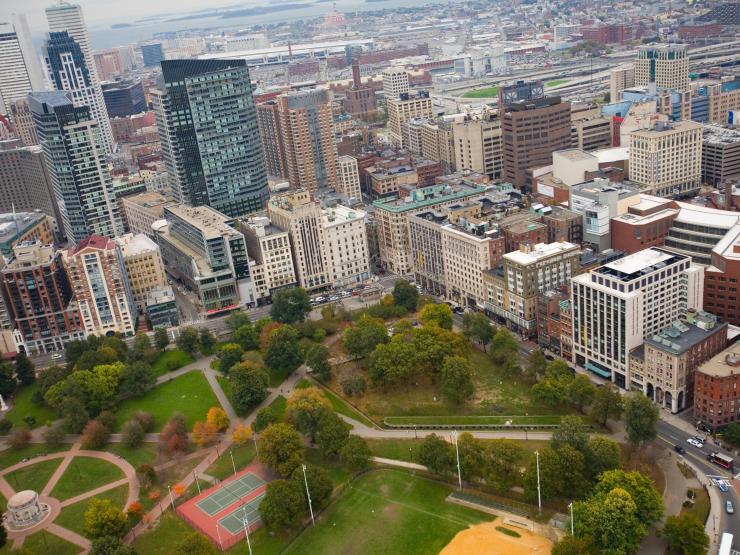
Life at Emerson is an extension of its academic mission—a 24/7 creative workshop set against the backdrop of downtown Boston. The campus itself is an urban, integrated collection of buildings in the city's Theatre District, meaning the line between campus and professional world is deliberately blurred. Students are strongly encouraged to live on-campus to build their networks, with college life organized around housing, a wide array of student activities and organizations, athletics and fitness, and health and wellness services. The Division of Student Affairs explicitly aims to enrich campus life and ensure students feel safe, secure, and welcome. The social scene is often described as tight-knit and supportive, centered on collaborative projects and shared artistic passions. It’s a community where a conversation in the dining hall is as likely to be about lighting design or podcast editing as it is about anything else.
Emerson’s pre-professional focus pays tangible dividends after graduation. The college reports a strong 90% of its 2023 graduate students were employed following graduation, with only 10% still seeking employment and 0.5% not seeking. For undergraduates, the graduation rate is robust. Outcomes data shows that graduates see significant earnings growth over time. While early-career earnings may start around expectations for liberal arts graduates, the median earnings ten years after entry show a substantial climb, reflecting the value of Emerson’s specialized network and training in the creative industries. The college’s Career Development Center actively supports this transition, leveraging its Boston location and industry connections.
Attending Emerson commands a premium price, reflective of its private, specialized status and prime Boston location. The total annual , including tuition, fees, and living expenses, is significant. However, the college provides substantial financial aid to offset this cost for many students. Approximately 48.6% of students receive financial aid, with the average aid package amounting to $37,801. This brings the average —the actual cost after grants and scholarships—down considerably. Emerson awards federal and institutional aid based on demonstrated financial need and academic achievement. It is important to note that while Emerson meets demonstrated need for eligible students, its policies indicate that students without financial need, or whose need is met by other means, may still be offered loans as part of their package. The college encourages all prospective students to use its official net price calculator for a personalized estimate.
Emerson College stands out for its unapologetic, singular focus. It doesn’t try to be all things to all students; it is a dedicated training ground for the creators and communicators of tomorrow. This clarity of purpose creates an ecosystem unlike any other: a campus where the student body is self-selected for creative ambition, where the line between coursework and professional practice is intentionally thin, and where the city of Boston serves as both campus and career lab. The result is a deeply immersive experience—students don’t just study film, they make films with equipment and rigor that rival professional sets; they don’t just study journalism, they report for award-winning, professionally-regarded outlets. This environment fosters a unique blend of artistic passion and pragmatic hustle, producing graduates who not only have a portfolio but also understand the industry they are entering. For a student certain of their path in the arts, media, or communication, Emerson offers a concentrated, network-rich, and intensely practical education that few other institutions can match.
Emerson College seal · sourceDowntown Boston Campus, Emerson College · sourceAbout Community, Mission & Values, History, Emerson College · sourceHomepage · source


.jpg)