Admit rate has ranged 46%–79% over the last 5 years — notably volatile, though the latest figure above (42%) falls outside that window. Source: IPEDS via Urban Institute.
Acceptance & SAT from Common Data Set / IPEDS; net price, earnings & graduation from the U.S. Dept. of Education College Scorecard. Figures lag ~1–2 years — verify with the school.
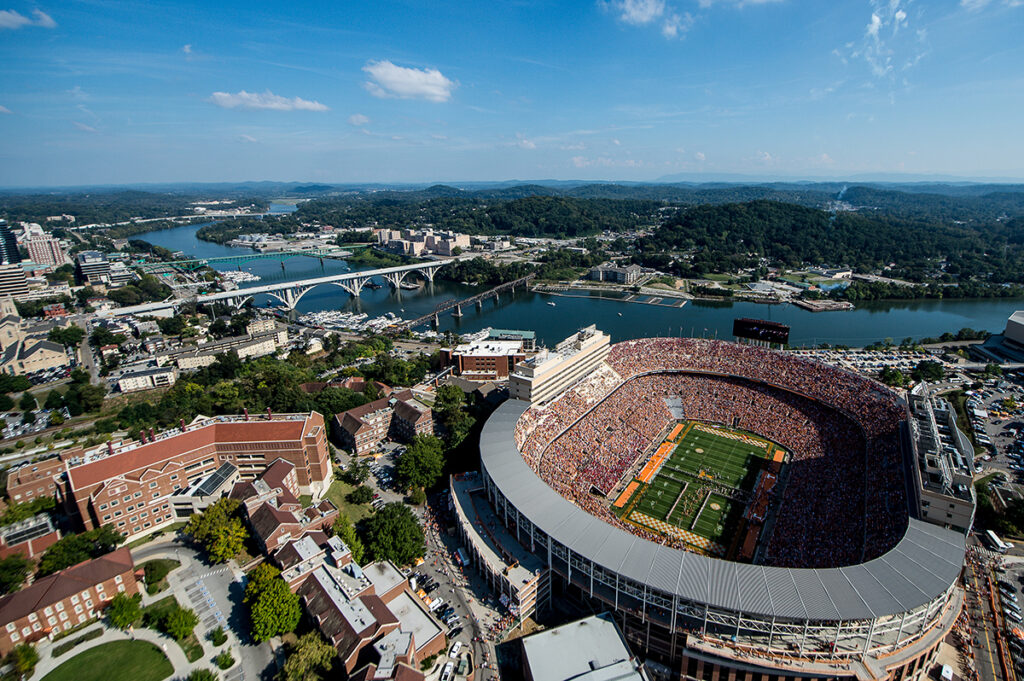
The University of Tennessee-Knoxville is a flagship public university where Southern charm meets serious research muscle. With a 42% acceptance rate, UTK attracts students drawn to its robust engineering programs, spirited campus life, and a solid 74% graduation rate. Its 'Vol is a Verb' ethos underscores a culture of engagement, from Smoky Mountain hikes to career outcomes where median earnings hit $60,249 a decade after starting.
Admission requirements
Test scores required
Required
High school transcript
Grade point average
Test scores (SAT/ACT)
TOEFL (non-native English)
Considered (not required)
Letters of recommendation
Demonstrated competencies
Source: IPEDS Admissions survey (2022) via Urban Institute. Covers formal factors only — it does not reflect essays, extracurriculars, or other holistic criteria.
More details
Undergrad enrollment
30,418
In-state tuition
$13,812
Out-of-state tuition
$33,256
Signature Programs
Logistics, Engineering, Psychology
Career Outcomes Rate
91.4%
Six-Year Graduation Rate
73%
Total Cost (Out-of-State)
$49,672
Outcomes & value
Outcomes & value
Median earnings (10 yr)
$60,249
Value (earnings ÷ net price)
3.2×
Median debt at graduation
$20,500
Graduation rate
74%
First-year retention
92%
Reducing loan balance (3 yr)
68%
Pell (lower-income) share
19%
First-gen share (among federal-aid recipients)
25%
Top-earning majors
Median earnings by field of study (highest credential), ~2 years after completion.
Nuclear Engineering$75,204
Electrical, Electronics, and Communications Engineering$69,338
Industrial Engineering$69,338
Chemical Engineering$66,653
Mechanical Engineering$66,377
Computer Science$65,387
Applicants here also applied to
The schools that most often appear alongside The University of Tennessee-Knoxville on applicants’ lists, from our self-reported outcomes corpus.
On-campus criminal offenses classed as violent (murder/non-negligent manslaughter, rape, robbery, aggravated assault) for the most recent reported year. Source: U.S. Dept. of Education Campus Safety and Security (Clery Act). Counts reflect what’s reported to the school, and urban campuses often report more partly due to non-student incidents nearby — read alongside campus size and setting, not as a standalone safety verdict.
Climate
Pleasant days / yr
86
Summer high
87°F
Winter low
35°F
Annual rain
53"
Annual snow
5.3"
Natural-hazard risk
Relatively Moderate
Pleasant days counts days per year with a mean temperature of 55–75°F, a high at or below 90°F, a low at or above 45°F, and little precipitation — a transparent comfort measure, not a weighting we invented. Computed from Open-Meteo ERA5 daily history (2019–2023). Natural-hazard risk is the county’s composite rating from the FEMA National Risk Index.
Quick answers
What is the acceptance rate at The University of Tennessee-Knoxville?
The University of Tennessee-Knoxville's acceptance rate is approximately 42% (Knoxville, TN), based on the most recent figures we compiled from public and primary sources.
What SAT score do you need for The University of Tennessee-Knoxville?
Admitted students at The University of Tennessee-Knoxville typically score 1200–1370 on the SAT (the middle-50% range). Scores outside this band are still admitted, especially with strong applications.
How much does The University of Tennessee-Knoxville cost?
At The University of Tennessee-Knoxville, the average net price (after aid) is about $18,976 per year. Actual cost varies with financial aid and residency.
How many undergraduates attend The University of Tennessee-Knoxville?
The University of Tennessee-Knoxville enrolls approximately 30,418 undergraduate students.
Where is The University of Tennessee-Knoxville located?
The University of Tennessee-Knoxville is located in Knoxville, TN.
Admissions
UTK's admissions process reveals a stark divide between in-state and out-of-state applicants, with Tennessees enjoying a 66% compared to just 24% for non-residents. The mid-50% range for admitted students falls between a 28-32 ACT (1300-1440 SAT equivalent) and a 4.08-4.50 UT Core Weighted GPA. Notably, engineering hopefuls face stricter benchmarks—those falling short are redirected to general admission. The university emphasizes character and status alongside academics, with February 15 as the regular decision deadline.
Earnings = median of students working ~10 years after entry; debt = median of graduates. Value divides 10-yr earnings by one year’s net price — read it as earnings per dollar of annual cost, not a full lifetime ROI; it favors lower-cost schools. Source: U.S. Dept. of Education College Scorecard. Figures lag ~2 years and reflect all students, not your intended major.
Computer Engineering
$58,390
Materials Engineering$58,221
Source: U.S. Dept. of Education College Scorecard (field-of-study earnings). Figures cover graduates who received federal aid and lag ~2 years; not all programs report data.
Co-application frequency from self-reported results — directional peer discovery, not a recommendation.
Academics
UTK thrives on interdisciplinary grit, particularly in logistics and supply chain management (a top major) and engineering through its CECS college, which pushes 'cross-cutting degrees' in emerging tech. The curriculum balances tradition with pragmatism—only 33% of programs emphasize writing-intensive courses, but undergrads can tap into research projects (6% participation) and service learning (7%). The university’s 'collaborative, interdisciplinary approach' shines in hands-on labs and co-ops, especially for Vols pursuing marketing or psychology, two other popular majors.
Orange isn’t just a color here—it’s a lifestyle. The Office for Campus Culture & Community curates events where 'Vol is a Verb,' from Rocky Top tailgates to Instagram-worthy hikes in the Smokies (tag #VolLife for features). Student Life promotes 'globally engaged leaders' through 500+ clubs, though only 12% join learning communities. The vibe is distinctly Southern: think porch swings on fraternity row, mentorship programs, and a Facebook feed brimming with family weekends showcasing 'rich traditions.'
UTK’s six-year graduation rate hit a record 73% in 2024, with four-year completions climbing to 62%—both well above national averages. Career outcomes are even stronger: 91.4% of 2023 grads secured jobs or further education within six months, while only 5.5% were still searching. The university is pushing toward an 80% six-year graduation rate, leveraging outcomes-based funding to boost degree production. For logistics majors, that means near-guaranteed placements with Fortune 500 companies like FedEx and Amazon.
At $49,672 total annual cost for out-of-state students (tuition: $33,336; room/board: $14,738), UTK leans on scholarships to bridge gaps. The average after aid drops to $21,880, though in-state students pay far less. The Net Price Calculator hints at full-ride opportunities, but most aid comes as merit awards—think 3.8+ GPAs and 30+ ACTs. Work-study and state grants help, but the real value play is for Tennessees: auto-admission with a 24 ACT and in-state tuition under $14K.
UTK masters the balance between big-school spirit and intimate learning—where else can you tour Dolly Parton’s alma mater, then intern at Oak Ridge National Lab? Its 91.4% career outcome rate rivals privates, while the 'Vol Network' ensures grads stay connected from Nashville to Tokyo. The kicker? That 24 ACT in-state guarantee, making it a stealth safety for Tennessees with Ivy-level outcomes in supply chain and engineering.
The University of Tennessee-Knoxville logo · sourceVisit Campus - University of Tennessee, Knoxville · sourceThe University of Tennessee, Knoxville | Knoxville, TN · sourceKnoxville - University of Tennessee, Knoxville · source