Admit rate has ranged 63%–70% over the last 5 years, though the latest figure above (74%) falls outside that window. Source: IPEDS via Urban Institute.
Acceptance & SAT from Common Data Set / IPEDS; net price, earnings & graduation from the U.S. Dept. of Education College Scorecard. Figures lag ~1–2 years — verify with the school.
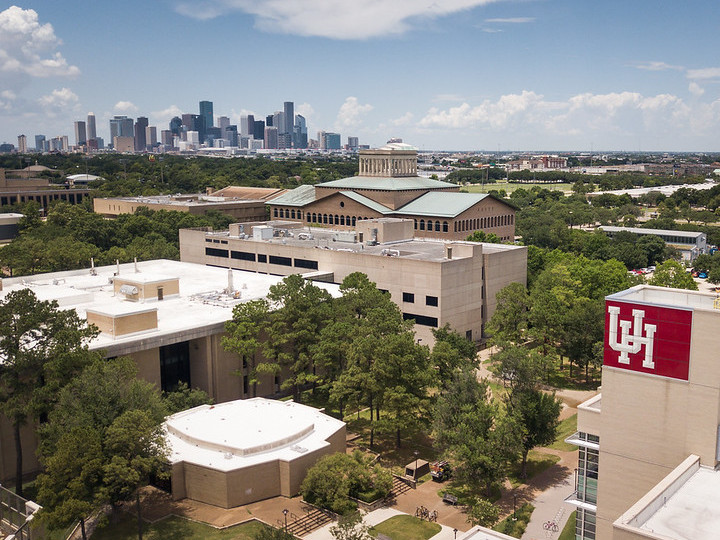
The University of Houston is a sprawling, diverse public research university where ambition meets opportunity. With a 74% acceptance rate and strong ties to Houston's corporate and energy sectors, UH attracts pragmatic strivers—particularly in business, engineering, and computer science—who want big-city career connections without Ivy League pretensions. Its 65% graduation rate outpaces state and national averages, and graduates earn median salaries double those of high school graduates.
Admission requirements
Test-optional — scores considered if submitted
Required
High school transcript
Grade point average
Class rank
College-prep program
TOEFL (non-native English)
Considered (not required)
Letters of recommendation
Test scores (SAT/ACT)
Demonstrated competencies
Source: IPEDS Admissions survey (2022) via Urban Institute. Covers formal factors only — it does not reflect essays, extracurriculars, or other holistic criteria.
More details
Undergrad enrollment
38,380
In-state tuition
$9,717
Out-of-state tuition
$22,547
Most Popular Majors
Business (30%), Computer Science (10%), Psychology (9%)
6-Year Graduation Rate
65%
Students Receiving Aid
63.59%
Median Early Career Earnings
$36,427
Outcomes & value
Outcomes & value
Median earnings (10 yr)
$62,377
Value (earnings ÷ net price)
4.4×
Median debt at graduation
$18,194
Graduation rate
65%
First-year retention
87%
Reducing loan balance (3 yr)
62%
Pell (lower-income) share
42%
First-gen share (among federal-aid recipients)
40%
Top-earning majors
Median earnings by field of study (highest credential), ~2 years after completion.
Electrical, Electronics, and Communications Engineering$74,576
Industrial Engineering$73,530
Mechanical Engineering$71,202
Registered Nursing, Nursing Administration, Nursing Research and Clinical Nursing$68,858
Co-application frequency from self-reported results — directional peer discovery, not a recommendation.
Campus & location
Campus safety
On-campus violent crimes (2024)
30
Per 1,000 students
0.64
On-campus criminal offenses classed as violent (murder/non-negligent manslaughter, rape, robbery, aggravated assault) for the most recent reported year. Source: U.S. Dept. of Education Campus Safety and Security (Clery Act). Counts reflect what’s reported to the school, and urban campuses often report more partly due to non-student incidents nearby — read alongside campus size and setting, not as a standalone safety verdict.
Climate
Pleasant days / yr
97
Summer high
91°F
Winter low
49°F
Annual rain
75.6"
Natural-hazard risk
Very High
Pleasant days counts days per year with a mean temperature of 55–75°F, a high at or below 90°F, a low at or above 45°F, and little precipitation — a transparent comfort measure, not a weighting we invented. Computed from Open-Meteo ERA5 daily history (2019–2023). Natural-hazard risk is the county’s composite rating from the FEMA National Risk Index.
Deep dive — research, future-scholar output & economic mobility▾
Research output
Institutional h-index
657
Scholarly works
104,314
Institutional research volume and impact from OpenAlex. The h-index reflects large research universities and will be low for teaching-focused liberal-arts colleges — not a measure of undergraduate quality.
Quick answers
What is the acceptance rate at University of Houston?
University of Houston's acceptance rate is approximately 74% (Houston, TX), based on the most recent figures we compiled from public and primary sources.
What SAT score do you need for University of Houston?
Admitted students at University of Houston typically score 1160–1340 on the SAT (the middle-50% range). Scores outside this band are still admitted, especially with strong applications.
How much does University of Houston cost?
At University of Houston, the average net price (after aid) is about $14,276 per year. Actual cost varies with financial aid and residency.
How many undergraduates attend University of Houston?
University of Houston enrolls approximately 38,380 undergraduate students.
Where is University of Houston located?
University of Houston is located in Houston, TX.
Admissions
UH maintains a moderately selective admissions process with a 73.9% , though Reddit threads suggest selectivity is increasing ([7], [9], [10], [11]). Automatic admission is granted to Texas students meeting one of three pathways: top 10% of their class, a 3.5+ GPA, or assured pathway criteria ([8]). The middle 50% of admitted students score between 1170-1330 on the SAT (Critical Reading 590-670, Math 570-670) or 23-29 on the ACT ([7], [12]). Average admitted GPA is 3.49, with business and engineering programs typically requiring higher marks ([10], [11]).
UH offers 110+ undergraduate majors and 250+ total degree programs, with business (30% of students), computer science (10%), psychology (9%), and engineering (7%) being the most popular ([13], [15], [16]). Standout programs include architecture, pharmacy, political science, and speech-language pathology, while psychology majors lament increasing online course requirements ([17], [18]). All undergraduates complete a core curriculum emphasizing broad skills development, and the university emphasizes its research capabilities as Houston's largest public research institution ([14], [13]).
Earnings = median of students working ~10 years after entry; debt = median of graduates. Value divides 10-yr earnings by one year’s net price — read it as earnings per dollar of annual cost, not a full lifetime ROI; it favors lower-cost schools. Source: U.S. Dept. of Education College Scorecard. Figures lag ~2 years and reflect all students, not your intended major.
$67,660
Petroleum Engineering$67,380
Construction Engineering Technology/Technician$66,060
Source: U.S. Dept. of Education College Scorecard (field-of-study earnings). Figures cover graduates who received federal aid and lag ~2 years; not all programs report data.
UH's student body reflects Houston's diversity, creating what students describe as 'whatever-you-want-it-to-be' college experience ([19], [21]). With no dominant social scene, involvement ranges from 400+ student organizations to commuter lifestyles—the Division of Student Affairs actively encourages extracurricular participation ([20], [22]). The urban campus provides access to Houston's museums, restaurants, and professional sports, while university events like Frontier Fiesta (a 80-year-old campus tradition) foster school spirit ([23]).
UH boasts a 65% six-year graduation rate—above Texas and national averages—with accelerating time-to-degree rates ([25], [26], [28]). Alumni median earnings ($36,427 one year post-graduation) more than double high school graduates' wages nationally ($32,842) and in Texas ([24], [29]). Forbes ranks UH highly for upward mobility, attributable to strong industry connections in energy, healthcare, and technology ([26]). The College Scorecard shows 63% graduation rate with average annual costs ($14,276) well below national midpoint for four-year schools ([28]).
The average after aid is $13,738-$14,339 annually, with 63.59% of students receiving financial aid averaging $16,450 ([33], [34], [35]). Tuition varies by program, but official calculators help estimate costs for Texas residents and out-of-state students ([30], [31]). UH emphasizes affordability through scholarships, grants, and work-study programs, with costs significantly below the $20,077 national average for four-year institutions ([28], [32]).
UH delivers exceptional value as an urban powerhouse where industry connections trump ivy-covered walls. Its strengths are unmistakably Texan: no-nonsense professional programs (particularly business and engineering) that feed into Houston's energy and healthcare sectors, celebrated diversity that mirrors the city itself, and outcomes-focused affordability. Unlike more insular college towns, UH treats Houston as its campus—giving students early exposure to Fortune 500 companies and a global city's cultural assets. For career-minded students who want big opportunities without elite institution sticker shock, it's a compelling choice.
University of Houston logo · sourceUniversity of Houston One of the Best Colleges in the U.S. · sourceTop 10 Spots on Campus at UH · sourceOJB is set to reimagine the University of Houston's historic campus · source