Admit rate has ranged 8%–11% over the last 5 years. Source: IPEDS via Urban Institute.
Acceptance & SAT from Common Data Set / IPEDS; net price, earnings & graduation from the U.S. Dept. of Education College Scorecard. Figures lag ~1–2 years — verify with the school.
Rice University is a private research powerhouse in Houston that operates like a high-stakes academic cooperative. Its defining features are a fiercely collaborative, non-competitive culture anchored by an intimate residential college system, a 6:1 student-faculty ratio that facilitates genuine mentorship, and a groundbreaking, no-loan financial aid policy that meets 100% of demonstrated need. This combination creates an unusually happy, intellectually intense, and socially cohesive undergraduate experience distinct from its Ivy and peer competitors.
Admission requirements
Test-optional — scores considered if submitted
Required
High school transcript
Letters of recommendation
TOEFL (non-native English)
Considered (not required)
Grade point average
Class rank
Test scores (SAT/ACT)
College-prep program
Demonstrated competencies
Source: IPEDS Admissions survey (2022) via Urban Institute. Covers formal factors only — it does not reflect essays, extracurriculars, or other holistic criteria.
More details
Undergrad enrollment
4,776
In-state tuition
$64,144
Out-of-state tuition
$64,144
No-Loan Policy
Yes, for all students
Graduation Rate
95%
Meets Full Need
Yes
Demonstrated Interest
Not considered
Student-Faculty Ratio
6:1
Median Earnings (10yr)
$89,718
Outcomes & value
Outcomes & value
Median earnings (10 yr)
$89,718
Value (earnings ÷ net price)
6.7×
Median debt at graduation
$11,000
Graduation rate
95%
First-year retention
97%
Reducing loan balance (3 yr)
87%
Pell (lower-income) share
17%
First-gen share (among federal-aid recipients)
14%
Top-earning majors
Median earnings by field of study (highest credential), ~2 years after completion.
Computer and Information Sciences, General$129,481
Mathematics$97,071
Business Administration, Management and Operations$89,530
Chemical Engineering$83,915
Statistics$79,450
Economics$72,884
Civil Engineering
Applicants here also applied to
The schools that most often appear alongside Rice on applicants’ lists, from our self-reported outcomes corpus.
Co-application frequency from self-reported results — directional peer discovery, not a recommendation.
Campus & location
Campus safety
On-campus violent crimes (2024)
16
Per 1,000 students
1.79
On-campus criminal offenses classed as violent (murder/non-negligent manslaughter, rape, robbery, aggravated assault) for the most recent reported year. Source: U.S. Dept. of Education Campus Safety and Security (Clery Act). Counts reflect what’s reported to the school, and urban campuses often report more partly due to non-student incidents nearby — read alongside campus size and setting, not as a standalone safety verdict.
Climate
Pleasant days / yr
98
Summer high
92°F
Winter low
48°F
Annual rain
73.1"
Natural-hazard risk
Very High
Pleasant days counts days per year with a mean temperature of 55–75°F, a high at or below 90°F, a low at or above 45°F, and little precipitation — a transparent comfort measure, not a weighting we invented. Computed from Open-Meteo ERA5 daily history (2019–2023). Natural-hazard risk is the county’s composite rating from the FEMA National Risk Index.
Deep dive — research, future-scholar output & economic mobility▾
Research output
Institutional h-index
931
Scholarly works
82,395
Institutional research volume and impact from OpenAlex. The h-index reflects large research universities and will be low for teaching-focused liberal-arts colleges — not a measure of undergraduate quality.
Future-scholar output
Science & engineering PhDsper-capita yield 10.9
Share of this school’s graduates who go on to earn research doctorates (2010–20), by national rank and per-capita yield (NSF institutional-yield ratio). A signal of a research-oriented student culture — not a causal promise, since it partly reflects who enrolls. Only top producers appear. Source: NSF NCSES, Baccalaureate Origins of U.S. Research Doctorate Recipients.
Economic mobility
Mobility rate
1.6%
Bottom → top quintile
Quick answers
What is the acceptance rate at Rice University?
Rice University's acceptance rate is approximately 8% (Houston, TX), based on the most recent figures we compiled from public and primary sources.
What SAT score do you need for Rice University?
Admitted students at Rice University typically score 1510–1570 on the SAT (the middle-50% range). Scores outside this band are still admitted, especially with strong applications.
How much does Rice University cost?
At Rice University, the average net price (after aid) is about $13,370 per year. Actual cost varies with financial aid and residency.
How many undergraduates attend Rice University?
Rice University enrolls approximately 4,776 undergraduate students.
Where is Rice University located?
Rice University is located in Houston, TX.
Admissions
Gaining admission to Rice is a feat of academic and personal distinction, with an of 8% for the most recent class. The university received 36,791 applications for the class of 2028 and enrolled 1,263 students. The middle 50% SAT range for enrolled students is 1510–1570. Rice employs a process, and while it considers standardized test scores (both SAT and ACT are accepted), it places the highest importance on the rigor of a student's secondary school record, class rank, GPA, and application essay. Letters of recommendation and extracurricular activities are also "important" factors. Notably, Rice does not consider demonstrated interest as part of its admissions evaluation. The university offers two binding Early Decision rounds, which can be a strategic advantage for committed applicants; for the Class of 2029, the combined ED acceptance rate was reported at 11.84%, with ED II being particularly selective at a 6% acceptance rate. The admissions office seeks students who embody intellectual curiosity and a collaborative spirit, looking beyond mere metrics to those who will thrive in and contribute to Rice's unique residential and academic community.
Earnings = median of students working ~10 years after entry; debt = median of graduates. Value divides 10-yr earnings by one year’s net price — read it as earnings per dollar of annual cost, not a full lifetime ROI; it favors lower-cost schools. Source: U.S. Dept. of Education College Scorecard. Figures lag ~2 years and reflect all students, not your intended major.
$71,957
Mechanical Engineering$68,219
Source: U.S. Dept. of Education College Scorecard (field-of-study earnings). Figures cover graduates who received federal aid and lag ~2 years; not all programs report data.
Mobility rate = the share of students who both start in the bottom household-income quintile and reach the top quintile; bottom → top is that chance conditional on starting at the bottom. Source: Opportunity Insights Mobility Report Cards (Chetty, Friedman, Saez, Turner & Yagan). Reflects 1980–82 birth cohorts, so it’s directional, not current.
Rice's academic model is defined by intense collaboration and accessibility to faculty, facilitated by a remarkable 6:1 student-to-faculty ratio. The university offers more than 50 undergraduate majors across seven divisions: architecture, engineering, business, humanities, music, natural sciences, and social sciences. This structure encourages interdisciplinary exploration, supported by a wealth of minors and pre-professional programs. The culture is famously cooperative rather than cutthroat; students are known to study together, share notes, and support each other's success. Small class sizes with world-class professors are the norm, not the exception. While strong across disciplines, Rice is particularly renowned for its programs in engineering, architecture, and the natural sciences. The Princeton Review notes Rice's greatest strengths are its "academic integrity and quality." This environment fosters deep intellectual engagement, where undergraduate research opportunities and close mentorship are standard components of the educational experience.
Life at Rice revolves around its eleven residential colleges, a system that forms the heart of campus culture. Each college is a self-contained community where students live, dine, and socialize, creating an immediate sense of belonging and a network of support that lasts throughout a student's time at Rice and beyond. This system is credited with fostering the collaborative, caring atmosphere for which the university is known. Students describe the social life as vibrant and inclusive, with a strong emphasis on college-specific and campus-wide traditions, from Willy Week (a week of festivities) to Baker 13 (a midnight run). A Niche survey indicates 99% of students feel extremely safe and secure on campus. The university itself promotes a "culture of care," emphasizing collaboration, mutual support, and empathy over competition. This environment has led to Rice students being frequently described as some of the happiest in the country. Located in Houston, the nation's fourth-largest city, students have access to unparalleled internships, cultural institutions, and professional opportunities, blending a tight-knit campus experience with the advantages of a major metropolitan center.
A Rice education is a powerful launchpad. The university reports a 95% graduation rate, a figure significantly above the national midpoint for four-year colleges. Career outcomes are robust, with the Center for Career Development reporting that 3,077 bachelor's graduates from the Classes of 2023–2025 had a median salary of $4,360 (likely a monthly figure, translating to over $52,000 annually). Other sources indicate strong earning potential, with median earnings for recent graduates reported at $71,544, and Money.com notes that 86% of Rice graduates earn more than a high school graduate. The U.S. News outcomes score for Rice is 88 out of 100, heavily weighted by its high graduation rates (94% six-year rate) and the success of Pell Grant recipients. These figures underscore the value of the Rice degree in the marketplace and the effectiveness of its academic and career support infrastructure.
Rice has made a transformative commitment to affordability through its pioneering "Rice Investment" program. The policy guarantees that the university will meet 100% of demonstrated financial need for all admitted students without requiring loans. This is a true no-loan policy; aid packages are composed entirely of grants and scholarships, not debt. The university's stated for 2024-2025 is $92,800. However, the average after aid—what families actually pay—is $13,370. The average freshman aid package is substantial, reported at $75,643. This aggressive financial aid model dramatically expands access, ensuring that students from middle-income families ($75,000-$200,000 annual income) pay no more than half tuition, and those with family incomes under $75,000 pay no tuition, mandatory fees, or room and board. This commitment removes financial barriers and allows students to pursue their passions without the burden of crippling debt.
Rice distinguishes itself through a rare and powerful trifecta: elite academics delivered with a collaborative, supportive ethos; a deeply immersive and communal residential life system; and one of the most generous and accessible financial aid promises in higher education. Unlike many of its peers, Rice actively cultivates a culture where students are allies, not adversaries. The residential colleges aren't just dormitories; they are the foundational social and support units that prevent the anonymity and loneliness common at larger universities. Academically, the 6:1 ratio means students aren't competing for professor attention; it's built into the structure. Finally, the "Rice Investment" is not just a marketing slogan—it's a game-changer that aligns the university's values with its economics, allowing talent from all backgrounds to engage fully in the Rice experience without financial fear. This combination creates an environment where intellectual intensity coexists with genuine well-being, producing graduates who are not only highly accomplished but also notably happy and socially grounded.
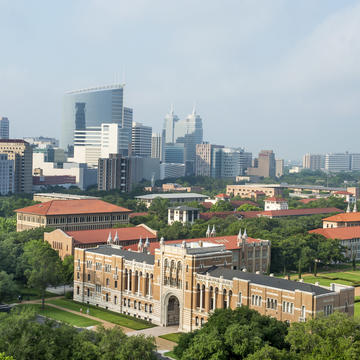
Rice University seal · source5 Must Do Things on Rice University Campus | 365 Houston · sourceRice unveils redesigned Academic Quad | Rice News | News and Media Relations | Rice University · sourceThe Rice Campus - Rice Business · source