Admit rate has ranged 62%–80% over the last 5 years — notably volatile, though the latest figure above (53%) falls outside that window. Source: IPEDS via Urban Institute.
Acceptance & SAT from Common Data Set / IPEDS; net price, earnings & graduation from the U.S. Dept. of Education College Scorecard. Figures lag ~1–2 years — verify with the school.
The University of North Florida is a public institution in Jacksonville that has carved out a distinct niche as a mid-sized, accessible state university with a surprisingly strong practical bent. It’s a place where health sciences and business dominate, classes are kept deliberately small, and the campus vibe is more about getting down to business than rah-rah spirit—a commuter-heavy school that’s actively trying to build a more residential community. For students seeking a straightforward, career-focused education in Florida without the frenzy of the state’s giant flagship universities, UNF offers a compelling, no-frills alternative.
Admission requirements
Test scores required
Required
High school transcript
Grade point average
Test scores (SAT/ACT)
TOEFL (non-native English)
Considered (not required)
Class rank
Letters of recommendation
College-prep program
Source: IPEDS Admissions survey (2022) via Urban Institute. Covers formal factors only — it does not reflect essays, extracurriculars, or other holistic criteria.
More details
Undergrad enrollment
13,359
In-state tuition
$6,389
Out-of-state tuition
$20,793
Graduation Rate
69%
Application Platform
Common Application
Demonstrated Interest
Not considered
Median Earnings (10yr)
$56,343
On-Campus Housing Percentage
23%
Outcomes & value
Outcomes & value
Median earnings (10 yr)
$56,343
Value (earnings ÷ net price)
5.5×
Median debt at graduation
$15,531
Graduation rate
69%
First-year retention
85%
Reducing loan balance (3 yr)
59%
Pell (lower-income) share
31%
First-gen share (among federal-aid recipients)
32%
Top-earning majors
Median earnings by field of study (highest credential), ~2 years after completion.
Electrical, Electronics, and Communications Engineering$66,897
Construction Engineering Technology/Technician$64,990
Mechanical Engineering$61,516
Civil Engineering$58,673
Registered Nursing, Nursing Administration, Nursing Research and Clinical Nursing$58,057
Computer and Information Sciences, General
Applicants here also applied to
The schools that most often appear alongside University of North Florida on applicants’ lists, from our self-reported outcomes corpus.
Co-application frequency from self-reported results — directional peer discovery, not a recommendation.
Campus & location
Campus safety
On-campus violent crimes (2024)
2
Per 1,000 students
0.13
On-campus criminal offenses classed as violent (murder/non-negligent manslaughter, rape, robbery, aggravated assault) for the most recent reported year. Source: U.S. Dept. of Education Campus Safety and Security (Clery Act). Counts reflect what’s reported to the school, and urban campuses often report more partly due to non-student incidents nearby — read alongside campus size and setting, not as a standalone safety verdict.
Climate
Pleasant days / yr
137
Summer high
88°F
Winter low
52°F
Annual rain
51.5"
Natural-hazard risk
Relatively High
Pleasant days counts days per year with a mean temperature of 55–75°F, a high at or below 90°F, a low at or above 45°F, and little precipitation — a transparent comfort measure, not a weighting we invented. Computed from Open-Meteo ERA5 daily history (2019–2023). Natural-hazard risk is the county’s composite rating from the FEMA National Risk Index.
Deep dive — research, future-scholar output & economic mobility▾
Research output
Institutional h-index
189
Scholarly works
11,822
Institutional research volume and impact from OpenAlex. The h-index reflects large research universities and will be low for teaching-focused liberal-arts colleges — not a measure of undergraduate quality.
Economic mobility
Mobility rate
1.7%
Bottom → top quintile
27%
From bottom quintile
6%
Mobility rate = the share of students who both start in the bottom household-income quintile and reach the top quintile; bottom → top is that chance conditional on starting at the bottom. Source: Opportunity Insights Mobility Report Cards (Chetty, Friedman, Saez, Turner & Yagan). Reflects 1980–82 birth cohorts, so it’s directional, not current.
Quick answers
What is the acceptance rate at University of North Florida?
University of North Florida's acceptance rate is approximately 53% (Jacksonville, FL), based on the most recent figures we compiled from public and primary sources.
What SAT score do you need for University of North Florida?
Admitted students at University of North Florida typically score 1070–1270 on the SAT (the middle-50% range). Scores outside this band are still admitted, especially with strong applications.
How much does University of North Florida cost?
At University of North Florida, the average net price (after aid) is about $10,154 per year. Actual cost varies with financial aid and residency.
How many undergraduates attend University of North Florida?
University of North Florida enrolls approximately 13,359 undergraduate students.
Where is University of North Florida located?
University of North Florida is located in Jacksonville, FL.
Admissions
UNF occupies a middle ground in Florida’s public university system: more selective than some open-access schools but far more accessible than the state’s flagship institutions. The admissions process is straightforward, accepting the Common Application and requiring either SAT, ACT, or CLT scores (though the essay section is not required). The university does not consider demonstrated interest as a factor in admissions decisions. For the incoming Class of 2029, the academic profile was notably strong, with an average high school GPA of 3.96, an average SAT score of 1125, and an average ACT score of 22. While the university welcomes a large freshman class, the admissions office still evaluates a holistic range of factors beyond just grades and test scores.
Earnings = median of students working ~10 years after entry; debt = median of graduates. Value divides 10-yr earnings by one year’s net price — read it as earnings per dollar of annual cost, not a full lifetime ROI; it favors lower-cost schools. Source: U.S. Dept. of Education College Scorecard. Figures lag ~2 years and reflect all students, not your intended major.
$56,415
Finance and Financial Management Services$48,539
Accounting and Related Services$48,432
Source: U.S. Dept. of Education College Scorecard (field-of-study earnings). Figures cover graduates who received federal aid and lag ~2 years; not all programs report data.
The academic identity of UNF is sharply defined by professional and pre-professional programs. Health professions and business are overwhelmingly the most popular areas of study, a trend reflected in both official listings and student enrollment data. The university offers a full range of academic majors across its colleges, including the College of Arts and Sciences, but the focus is unmistakably on fields with clear career pathways: Health Science (with interdisciplinary health studies and public health tracks), Healthcare Management, Criminal Justice/Safety Studies, and Biology/Biological Sciences are among the top producers of graduates. The university promotes small classes and personalized attention as key features of its educational model. This practical orientation shapes the campus culture, attracting students who are often more focused on degree completion and career preparation than on traditional collegiate exploration.
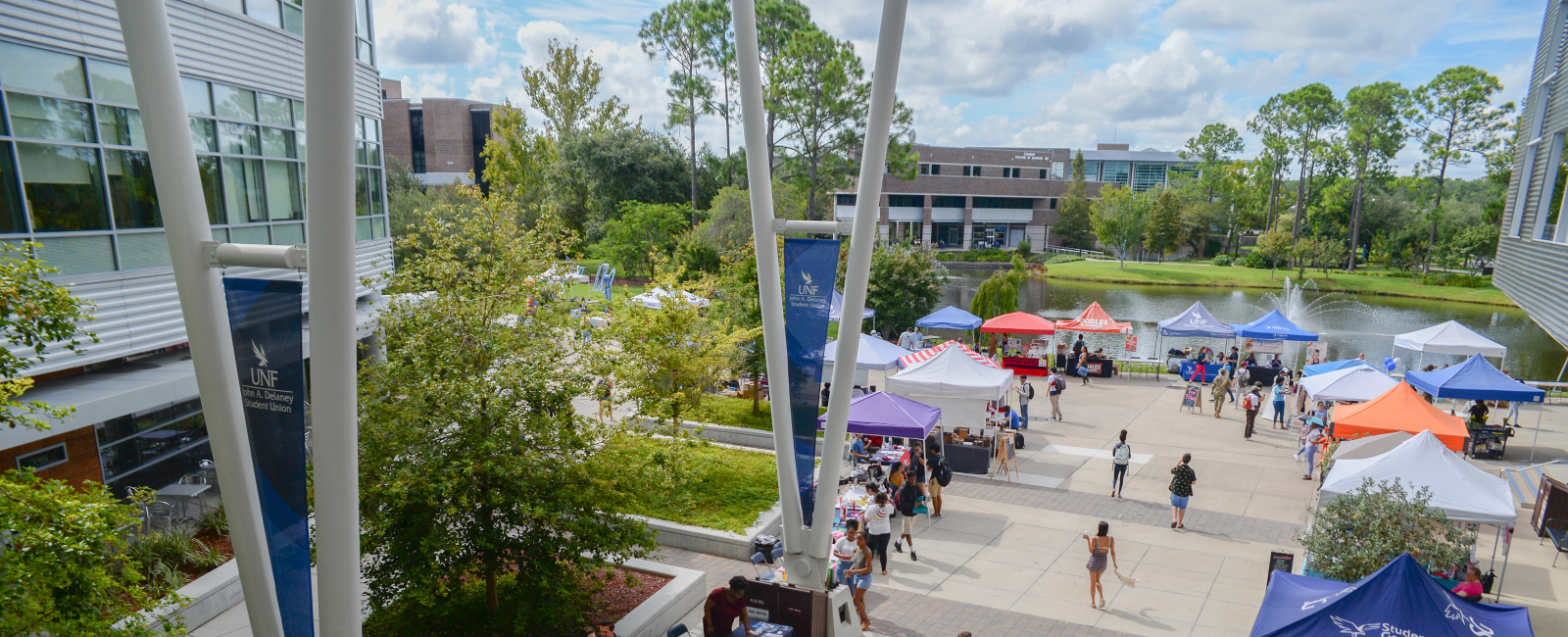
Life at UNF is characterized by its commuter-school roots and its beautiful, nature-focused campus. Only about 23% of students live in college-owned, -operated, or -affiliated housing, with the overwhelming majority—77%—living off-campus. The university describes its campus as "supportive and welcoming," offering numerous clubs and activities for involvement, and strives to foster an engaging environment outside the classroom. The campus itself is a major selling point, often highlighted in student tours and profiles. The student body tends to be pragmatic, with many students balancing academics with work and other off-campus commitments. This creates a quieter, more studious atmosphere during the week, with social life often happening away from university grounds.
UNF's outcomes reflect its mission as a regional public university focused on employability. The four-year graduation rate has been a point of emphasis and improvement, with one report noting an increase to 50.6%. Post-graduation earnings data shows a positive trajectory; median wages for bachelor's graduates were reported at specific intervals: $41,000 after one year, $42,900 after two years, $45,500 after three years, and $48,100 after four years. Other sources report typical earnings for graduates at different points, such as $44,241 one year after graduation and $55,626 five years after graduation. Success varies significantly by major, with business fields like Accountancy and Business Analytics reporting higher starting salaries. The university tracks these metrics closely as part of its accountability and student achievement reporting.
Affordability is a central pillar of UNF's value proposition. The university provides a comprehensive financial aid program based on individual need, educational costs, and the availability of funds, with awards consisting of grants, scholarships, work-study, and loans. Notably, the Financial Aid office actively encourages conservative borrowing by students, promoting scholarships and Federal Work Study in lieu of loans as part of its default management strategy. While UNF does not advertise a formal "no-loan" policy for all students who qualify, its aid philosophy is geared toward minimizing debt. Prospective students are directed to use the official Calculator to get the best estimate of their individual costs, as the average net price can vary widely based on family circumstances.
UNF stands out for its unwavering commitment to a specific type of student: the career-minded, practical learner who wants a quality public education without the overwhelming size and intensity of Florida's largest universities. Its identity is not built on sprawling graduate research or a vast liberal arts core, but on delivering focused, undergraduate-professional programs in high-demand fields like health and business. The campus—a nature preserve in Jacksonville—offers a serene, concentrated environment that contrasts with the commuter reality for most of its students. Financially, it positions itself as a responsible choice, with a transparent and an aid office that explicitly discourages excessive student debt. In a state known for mega-universities, UNF is the purposeful, manageable alternative.
University of North Florida seal · sourceUniversity of North Florida - State University System of Florida · sourceUNF: Specialty Tours · sourceUNF Campus" · source