Admit rate has ranged 41%–49% over the last 5 years — notably volatile. Source: IPEDS via Urban Institute.
Acceptance & SAT from Common Data Set / IPEDS; net price, earnings & graduation from the U.S. Dept. of Education College Scorecard. Figures lag ~1–2 years — verify with the school.
The University of South Florida is a massive, ascendant public research university in Tampa that has transformed from a commuter school into a powerhouse with serious momentum. It combines the scale and opportunity of a major state flagship—over 240 undergraduate majors, a sprawling research enterprise—with a surprisingly collaborative, sun-drenched campus culture where Greek life is optional and finding your niche is the norm. USF’s story is one of dramatic improvement: graduation rates have soared, research dollars have climbed, and it now sits as a top-tier 'R1' institution, offering a high-value, career-focused education in one of America's fastest-growing metro areas.
Admission requirements
Test scores required
Required
High school transcript
Grade point average
Test scores (SAT/ACT)
TOEFL (non-native English)
Considered (not required)
Class rank
College-prep program
Source: IPEDS Admissions survey (2022) via Urban Institute. Covers formal factors only — it does not reflect essays, extracurriculars, or other holistic criteria.
More details
Undergrad enrollment
37,207
In-state tuition
$6,410
Out-of-state tuition
$17,324
Campus Housing
20% of students live on-campus
Graduation Rate
77%
Median Earnings (10yr)
$57,743
First-Year Retention Rate
Climbed significantly (exact % not in sources)
Six-Year Grad Rate (2009)
48%
Six-Year Grad Rate (Recent)
Nearly 70%
Students Receiving Grant/Scholarship Aid
83% of full-time beginners
Outcomes & value
Outcomes & value
Median earnings (10 yr)
$57,743
Value (earnings ÷ net price)
5.9×
Median debt at graduation
$17,988
Graduation rate
77%
First-year retention
91%
Reducing loan balance (3 yr)
57%
Pell (lower-income) share
29%
First-gen share (among federal-aid recipients)
36%
Top-earning majors
Median earnings by field of study (highest credential), ~2 years after completion.
Computer Engineering$68,727
Electrical, Electronics, and Communications Engineering$67,772
Registered Nursing, Nursing Administration, Nursing Research and Clinical Nursing$61,603
Mechanical Engineering$60,025
Chemical Engineering$58,898
Industrial Engineering
Applicants here also applied to
The schools that most often appear alongside University of South Florida on applicants’ lists, from our self-reported outcomes corpus.
On-campus criminal offenses classed as violent (murder/non-negligent manslaughter, rape, robbery, aggravated assault) for the most recent reported year. Source: U.S. Dept. of Education Campus Safety and Security (Clery Act). Counts reflect what’s reported to the school, and urban campuses often report more partly due to non-student incidents nearby — read alongside campus size and setting, not as a standalone safety verdict.
Climate
Pleasant days / yr
129
Summer high
89°F
Winter low
54°F
Annual rain
61"
Natural-hazard risk
Relatively High
Pleasant days counts days per year with a mean temperature of 55–75°F, a high at or below 90°F, a low at or above 45°F, and little precipitation — a transparent comfort measure, not a weighting we invented. Computed from Open-Meteo ERA5 daily history (2019–2023). Natural-hazard risk is the county’s composite rating from the FEMA National Risk Index.
Deep dive — research, future-scholar output & economic mobility▾
Research output
Institutional h-index
741
Scholarly works
130,448
Institutional research volume and impact from OpenAlex. The h-index reflects large research universities and will be low for teaching-focused liberal-arts colleges — not a measure of undergraduate quality.
Economic mobility
Mobility rate
2.7%
Bottom → top quintile
29%
From bottom quintile
10%
Mobility rate = the share of students who both start in the bottom household-income quintile and reach the top quintile; bottom → top is that chance conditional on starting at the bottom. Source: Opportunity Insights Mobility Report Cards (Chetty, Friedman, Saez, Turner & Yagan). Reflects 1980–82 birth cohorts, so it’s directional, not current.
Quick answers
What is the acceptance rate at University of South Florida?
University of South Florida's acceptance rate is approximately 43% (Tampa, FL), based on the most recent figures we compiled from public and primary sources.
What SAT score do you need for University of South Florida?
Admitted students at University of South Florida typically score 1130–1320 on the SAT (the middle-50% range). Scores outside this band are still admitted, especially with strong applications.
How much does University of South Florida cost?
At University of South Florida, the average net price (after aid) is about $9,812 per year. Actual cost varies with financial aid and residency.
How many undergraduates attend University of South Florida?
University of South Florida enrolls approximately 37,207 undergraduate students.
Where is University of South Florida located?
University of South Florida is located in Tampa, FL.
Admissions
USF operates as a selective public university, where admission is far from guaranteed but also not the hyper-competitive gauntlet of elite privates. The process is primarily a numbers game, heavily focused on academic preparation. For the most recent admitted class, the middle 50% SAT range was 1160–1340, with an average weighted GPA of 4.06. The university received 71,722 applications for a freshman class and accepted 29,196, resulting in a selectivity rate that has tightened considerably over the years. Fall is the most competitive term for admission. While the university provides a , the provided sources do not specify whether USF considers 'demonstrated interest' (like campus visits or contact with admissions) as a factor in its decisions. There is also no information in the provided sources about an Early Decision program or its associated ; admissions appears to operate on a regular decision timeline.
Applicants should note that the profile is academically rigorous: the average admitted student carries a transcript packed with honors and AP/IB courses. The process evaluates the strength of the high school curriculum, grades, and standardized test scores above all else.
Earnings = median of students working ~10 years after entry; debt = median of graduates. Value divides 10-yr earnings by one year’s net price — read it as earnings per dollar of annual cost, not a full lifetime ROI; it favors lower-cost schools. Source: U.S. Dept. of Education College Scorecard. Figures lag ~2 years and reflect all students, not your intended major.
$57,318
Computer and Information Sciences, General$56,847
Civil Engineering$55,964
Source: U.S. Dept. of Education College Scorecard (field-of-study earnings). Figures cover graduates who received federal aid and lag ~2 years; not all programs report data.
Scale and choice define the academic experience at USF. Students choose from over 240 undergraduate majors and degree programs, with additional offerings at the graduate, specialist, and doctoral levels, including a doctor of medicine program. This vast catalog ensures that nearly any academic interest can be pursued, from the traditional liberal arts to pre-professional tracks. The university is classified as an R1 institution, denoting 'very high research activity,' which means undergraduates have opportunities to engage in meaningful research alongside faculty. While the sources do not list specific 'signature' majors, the breadth of programs in health sciences, engineering, business, and the arts is a major draw. The academic structure supports exploration, with dedicated offices for undergraduate studies, academic advocacy, and initiatives like the First Year Experience and Second Year Success programs designed to guide students through the transition to university life and toward timely graduation.
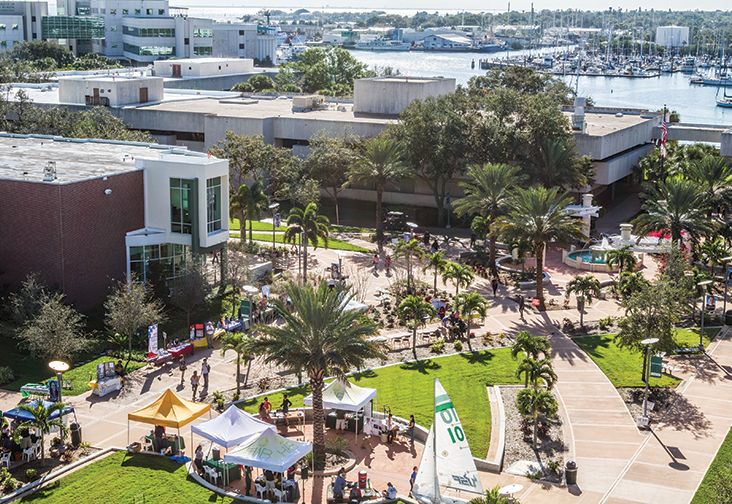
With a total enrollment pushing 50,000 students across its campuses, USF’s social scene is what you make of it—a classic 'big university' experience. Only about 20% of students live in college-owned, -operated, or -affiliated housing, meaning the vast majority (80%) live off-campus in the surrounding Tampa area. This creates a commuter-influenced dynamic, but the university actively works to foster community for those who seek it. The Campus Life office and student organizations provide a constant stream of events: athletic events, performances, lectures, movie nights, and campus traditions. There are numerous cultural clubs and inclusive activities aimed at creating an interculturally mature environment. As one student noted online, with so many people, you must 'stick to clubs and actively seek out people' to find your crowd. The vibe is described as vibrant and multicultural, with endless ways to get involved, but it requires initiative from the student to build a tight-knit social circle.
USF’s most compelling narrative in recent years is its dramatic improvement in student success metrics, a point of institutional pride. The six-year graduation rate skyrocketed from 48% in 2009 to nearly 70% in more recent data, a testament to focused retention efforts. First-year student retention rates have also climbed significantly. For graduates, the outcomes are strong. According to federal data, the median earnings ten years after entry are solid for a public university. The university provides detailed Program Outcomes dashboards that offer comprehensive data on earnings and placement for each degree program, allowing students to make informed choices about their majors. This data-driven approach to student success and career readiness is a cornerstone of the USF experience, linking academic work directly to post-graduation prospects.
As a public institution, USF offers a notably low for in-state students, representing a high-value proposition. A significant majority of full-time beginning undergraduates—83%—receive grant or scholarship aid. The university provides a Net Price Calculator and a Personal Budget Calculator to help families estimate their actual cost after accounting for financial aid, which includes tuition, fees, books, and supplies. The Office of Financial Aid manages the distribution of this aid, and students must complete the FAFSA to be considered for federal and institutional funds. The provided sources do not indicate that USF has a policy of meeting 100% of demonstrated financial need for all admitted students, nor do they describe a 'no-loan' policy where loans are eliminated from aid packages for certain income brackets. Financial aid is approved based on enrollment and eligibility, and students must maintain satisfactory academic progress to retain their awards.
USF stands out as a university caught in the act of becoming. It’s not resting on ; it’s building it. The staggering rise in its graduation rate—a 20+ point jump in little over a decade—is almost unheard of in higher education and signals an institution relentlessly focused on student success, not just enrollment. This is paired with its status as a top-tier R1 research university, offering undergraduates a level of scientific and scholarly opportunity typically found at older, more established flagships. Its location in Tampa is another massive advantage, providing a dynamic, growing metropolitan backdrop for internships, clinical placements, and post-graduate employment in industries from finance to healthcare. Unlike many large state schools with a dominant Greek or football culture, USF’s vibe is more diffuse and self-directed—you can find or build your own community within the giant, sunny, and increasingly impressive whole. It’s a place for students who want the resources of a major research university, the value of a public education, and the chance to be part of a success story that’s still being written.
University of South Florida seal · sourceUniversity of South Florida - Profile, Rankings and Data | US News Best Colleges · sourceUSF preparing for a full return to in-person courses and on-campus activities in fall 2021 · sourceWhere We Are | ECORE | College of Arts and Sciences | University of South Florida · source