Admit rate has ranged 36%–45% over the last 5 years — notably volatile. Source: IPEDS via Urban Institute.
Acceptance & SAT from Common Data Set / IPEDS; net price, earnings & graduation from the U.S. Dept. of Education College Scorecard. Figures lag ~1–2 years — verify with the school.
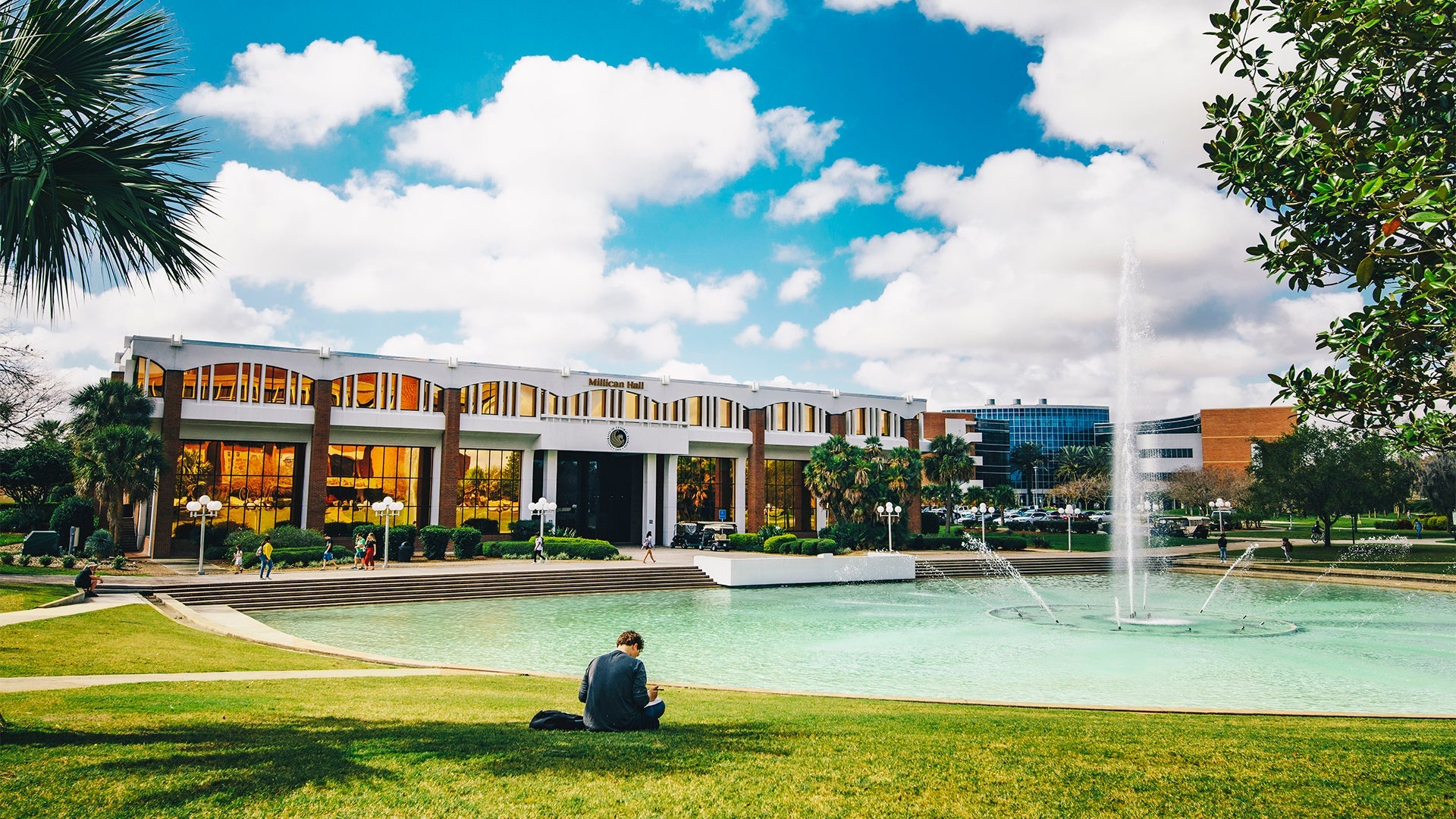
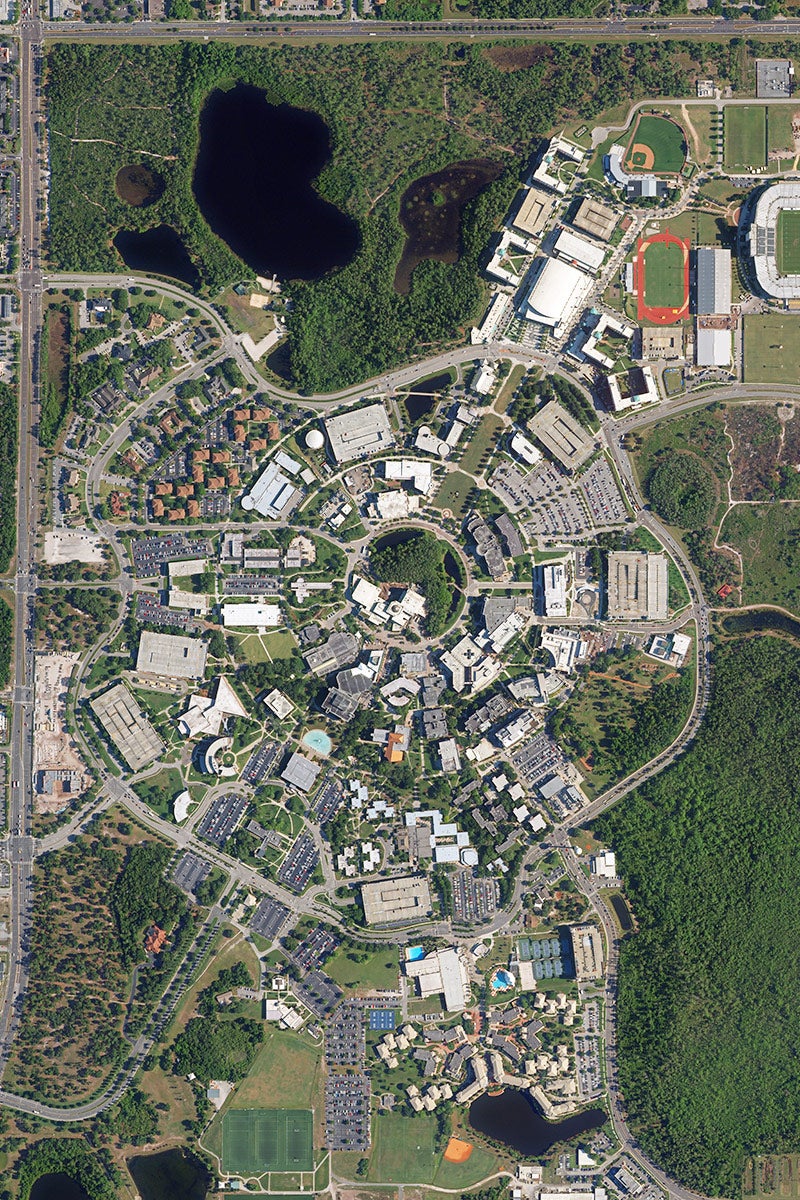
The University of Central Florida is a massive, kinetic public research university that feels less like a traditional campus and more like a city-state embedded in the heart of Orlando's tech and tourism corridor. It's defined by scale and opportunity: as Florida's largest university by enrollment, it channels its size into powerhouse programs in engineering, computer science, business, and hospitality, all fueled by relentless career pragmatism and a sprawling, commuter-heavy social scene. This isn't a cloistered liberal arts college; it's a high-volume talent pipeline where students navigate a vast ecosystem to carve out their own niche, often graduating with impressive job prospects and remarkably little debt.
Admission requirements
Test scores required
Required
High school transcript
Grade point average
Test scores (SAT/ACT)
College-prep program
Considered (not required)
Class rank
Source: IPEDS Admissions survey (2022) via Urban Institute. Covers formal factors only — it does not reflect essays, extracurriculars, or other holistic criteria.
More details
Undergrad enrollment
59,146
In-state tuition
$6,368
Out-of-state tuition
$22,467
Graduation Rate
78%
On-Campus Housing
12% of students
Demonstrated Interest
Not considered
Median Earnings (10yr)
$58,308
Early Action Applications (Year 2)
37,639
First-Time Students Graduating Debt-Free
70%
Outcomes & value
Outcomes & value
Median earnings (10 yr)
$58,308
Value (earnings ÷ net price)
5.6×
Median debt at graduation
$18,190
Graduation rate
78%
First-year retention
92%
Reducing loan balance (3 yr)
59%
Pell (lower-income) share
32%
First-gen share (among federal-aid recipients)
35%
Top-earning majors
Median earnings by field of study (highest credential), ~2 years after completion.
Electrical, Electronics, and Communications Engineering$63,817
Computer Engineering$63,749
Mechanical Engineering$61,516
Aerospace, Aeronautical, and Astronautical/Space Engineering$59,485
Civil Engineering$58,092
Registered Nursing, Nursing Administration, Nursing Research and Clinical Nursing
Applicants here also applied to
The schools that most often appear alongside University of Central Florida on applicants’ lists, from our self-reported outcomes corpus.
On-campus criminal offenses classed as violent (murder/non-negligent manslaughter, rape, robbery, aggravated assault) for the most recent reported year. Source: U.S. Dept. of Education Campus Safety and Security (Clery Act). Counts reflect what’s reported to the school, and urban campuses often report more partly due to non-student incidents nearby — read alongside campus size and setting, not as a standalone safety verdict.
Climate
Pleasant days / yr
132
Summer high
89°F
Winter low
55°F
Annual rain
70.1"
Natural-hazard risk
Relatively High
Pleasant days counts days per year with a mean temperature of 55–75°F, a high at or below 90°F, a low at or above 45°F, and little precipitation — a transparent comfort measure, not a weighting we invented. Computed from Open-Meteo ERA5 daily history (2019–2023). Natural-hazard risk is the county’s composite rating from the FEMA National Risk Index.
Deep dive — research, future-scholar output & economic mobility▾
Research output
Institutional h-index
576
Scholarly works
86,954
Institutional research volume and impact from OpenAlex. The h-index reflects large research universities and will be low for teaching-focused liberal-arts colleges — not a measure of undergraduate quality.
Economic mobility
Mobility rate
2.6%
Bottom → top quintile
36%
From bottom quintile
7%
Mobility rate = the share of students who both start in the bottom household-income quintile and reach the top quintile; bottom → top is that chance conditional on starting at the bottom. Source: Opportunity Insights Mobility Report Cards (Chetty, Friedman, Saez, Turner & Yagan). Reflects 1980–82 birth cohorts, so it’s directional, not current.
Quick answers
What is the acceptance rate at University of Central Florida?
University of Central Florida's acceptance rate is approximately 40% (Orlando, FL), based on the most recent figures we compiled from public and primary sources.
What SAT score do you need for University of Central Florida?
Admitted students at University of Central Florida typically score 1200–1350 on the SAT (the middle-50% range). Scores outside this band are still admitted, especially with strong applications.
How much does University of Central Florida cost?
At University of Central Florida, the average net price (after aid) is about $10,411 per year. Actual cost varies with financial aid and residency.
How many undergraduates attend University of Central Florida?
University of Central Florida enrolls approximately 59,146 undergraduate students.
Where is University of Central Florida located?
University of Central Florida is located in Orlando, FL.
Admissions
UCF operates a selective, high-volume admissions process that has grown increasingly competitive, drawing over 70,000 applications for a recent freshman class. The university uses a , with academic factors carrying the most weight. For the admitted Class of 2030, the mid-range high school GPA was a formidable 4.11–4.57, and the mid-range SAT score was 1310–1420, indicating a strong academic core. The process includes an Early Action option, which saw 37,639 applications in its second year—a 16% increase—though UCF does not appear to offer a binding Early Decision plan. Notably, demonstrated interest is not considered in admissions decisions, per guidelines, meaning campus visits or contact with admissions officers won't tip the scales. The sheer scale means admissions is a numbers game, but one where high-achieving students from Florida and beyond compete for spots in a class known for its strong academic profile.
Earnings = median of students working ~10 years after entry; debt = median of graduates. Value divides 10-yr earnings by one year’s net price — read it as earnings per dollar of annual cost, not a full lifetime ROI; it favors lower-cost schools. Source: U.S. Dept. of Education College Scorecard. Figures lag ~2 years and reflect all students, not your intended major.
$57,507
Computer and Information Sciences, General$56,867
Industrial Engineering$55,964
Source: U.S. Dept. of Education College Scorecard (field-of-study earnings). Figures cover graduates who received federal aid and lag ~2 years; not all programs report data.
Academically, UCF is a comprehensive powerhouse built for scale and industry alignment. Its academic structure is a direct reflection of the Central Florida economy, with particularly strong components in engineering, business, film, health, nursing, and the crown jewel: hospitality management, thanks to its proximity to the global tourism capital. The most popular majors cluster in business, management, and marketing; health professions; and engineering. A look at the top declared majors reveals a pragmatic, career-oriented student body: Psychology, Mechanical Engineering, Computer Science, Health Sciences, Nursing, Biology, Finance, and Biomedical Sciences consistently lead the list. The university emphasizes real-world experience alongside academic study, a philosophy baked into its degree programs. A striking statistic underscores the focus on value: seventy percent of first-time-in-college students graduate without any educational debt from UCF, suggesting a combination of strong financial aid, in-state affordability, and a culture of fiscal pragmatism.
Life at UCF is defined by self-directed energy and the challenge and opportunity of its enormous scale. With only about 12% of students living on campus, it is overwhelmingly a commuter school, creating a social landscape where involvement is intentional, not automatic. The campus buzzes with a self-generated pulse of events, concerts, art shows, sports, and a vast array of student clubs and organizations—more than 40 are officially listed, but the real number is far higher, covering every imaginable interest. Students describe the need to 'put yourself out there' to build a community, often finding their tribe through clubs, intramural sports, or study groups. The location in Orlando means 'you're in the middle of everything'—classes, dining, outdoor activities, and off-campus entertainment are all within reach. This isn't a traditional, residential quad-centric life; it's a dynamic, decentralized urban experience where students weave together academic, social, and professional networks across a sprawling metropolitan canvas.
The UCF narrative culminates in strong, value-driven outcomes. The university touts that a bachelor's degree leads to lifelong benefits, including significantly higher earnings and a high employment rate. Federal data shows a graduation rate that outpaces the national midpoint for four-year colleges. Most compelling is the post-graduation financial picture: alumni see a substantial earnings premium. According to federal scorecard data, the median earnings for students working ten years after entry are robust, and studies suggest bachelor's degree holders can earn an average of $2.1 million over a lifetime. This combination of a solid graduation rate and strong median earnings forms the core of UCF's value proposition—delivering a career-launching degree at a public university price point.
UCF's financial proposition is one of its most powerful draws, especially for in-state students. The average after aid is strikingly low compared to national averages. Financial aid packages are common, with the average aid package awarded totaling $13,440; need-based scholarships or grants average $8,202. The university provides a net price calculator for families to estimate their actual cost, which includes tuition, fees, and living expenses. While UCF offers substantial need-based institutional grants (as noted in its College of Medicine policies), it is not among the elite group of institutions that advertise a universal 'no-loan' policy for undergraduates, where 100% of need is met with grants. Instead, its aid strategy combines state support, scholarships, and grants to keep net costs manageable, contributing directly to its high percentage of debt-free graduates.
UCF stands out not for ivy-covered tradition, but for its sheer, audacious scale and its strategic fusion with a major economic engine. It is the largest university in Florida by enrollment, a fact that defines every aspect of the experience. This size is leveraged into academic breadth and deep industry connections, particularly in engineering, computer science, and the world-class Rosen College of Hospitality Management, which has an unfair advantage being located in Orlando. The culture is pragmatic and future-focused: students are here to get a reputable, affordable degree that leads directly to a job, often in Florida's booming tech, healthcare, or tourism sectors. The 70% debt-free graduation rate for first-time students is a testament to its commitment to value. UCF is a university of opportunity in the most concrete sense—a vast, sometimes impersonal system that rewards proactive students with serious academics, endless clubs, major sports, and a direct pathway into the workforce, all under the sunny, entrepreneurial skies of Orlando.
University of Central Florida seal · sourceGet to Know UCF's Campus | UCF Undergraduate Admissions · sourcePlanning UCF's New Downtown Campus | CannonDesign | CannonDesign · sourceLocations & Campuses | University of Central Florida · source