Admit rate has ranged 23%–35% over the last 5 years — notably volatile. Source: IPEDS via Urban Institute.
Acceptance & SAT from Common Data Set / IPEDS; net price, earnings & graduation from the U.S. Dept. of Education College Scorecard. Figures lag ~1–2 years — verify with the school.
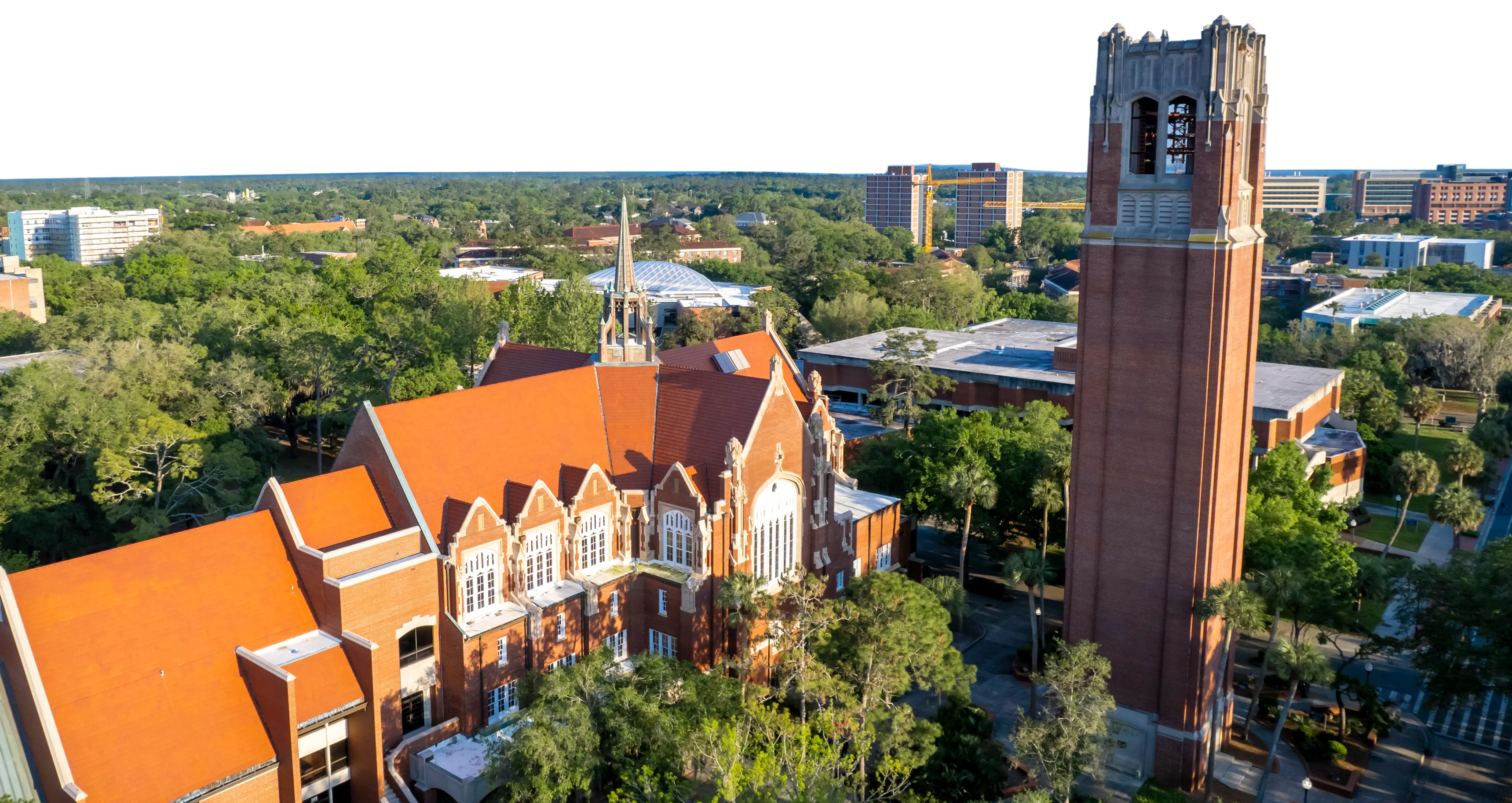
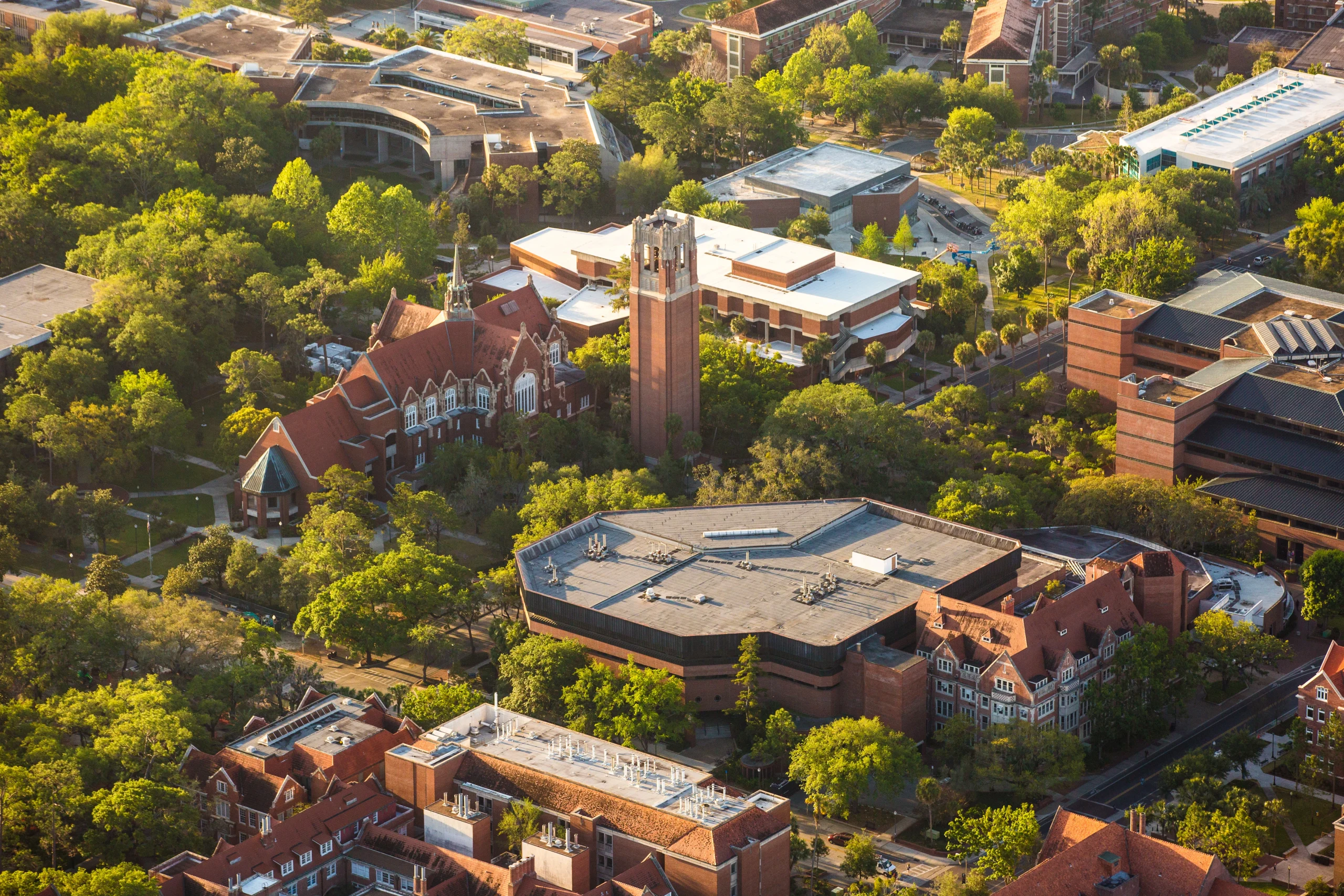
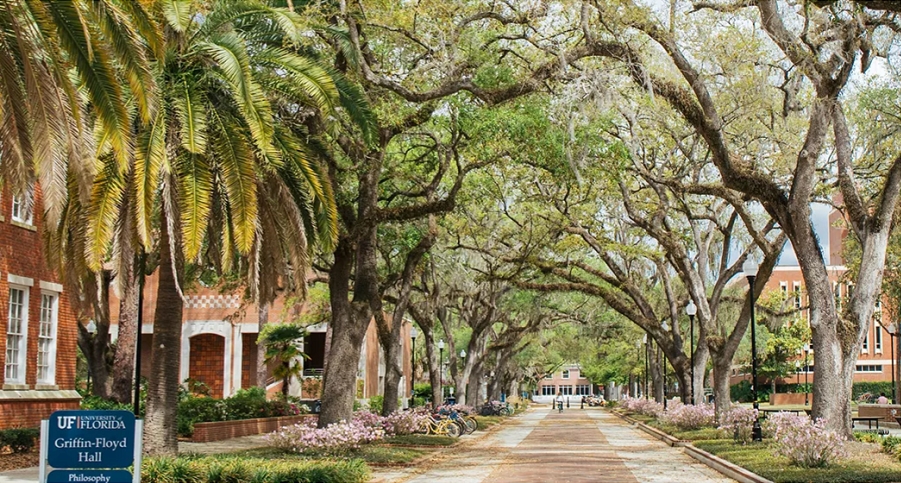
The University of Florida isn't just a state flagship—it's a powerhouse of public higher education that has transformed itself into one of the most selective and high-achieving public universities in the country. With a sprawling campus in Gainesville, UF combines the vibrant, sports-obsessed culture of a classic SEC school with the academic intensity and research output of a top-tier institution, all at a public-university price tag. It's where students chase top-ranked business and engineering degrees under the Florida sun, fueled by Gatorade and a relentless drive to win, both on the field and in the job market.
Admission requirements
Test scores required
Required
High school transcript
Grade point average
Test scores (SAT/ACT)
College-prep program
Source: IPEDS Admissions survey (2022) via Urban Institute. Covers formal factors only — it does not reflect essays, extracurriculars, or other holistic criteria.
More details
Undergrad enrollment
35,629
In-state tuition
$6,381
Out-of-state tuition
$28,659
No-Loan Policy
Not stated in sources
Graduation Rate
91%
Meets Full Need
Not stated as a no-loan policy in sources
ED Share of Class
Not applicable (Early Action only)
Early Action Plan
Non-binding, Nov. 1 deadline
First-Year Retention
Not stated in sources
Demonstrated Interest
Not considered
Median Earnings (10yr)
$71,588
Outcomes & value
Outcomes & value
Median earnings (10 yr)
$71,588
Value (earnings ÷ net price)
10.9×
Median debt at graduation
$15,000
Graduation rate
91%
First-year retention
98%
Reducing loan balance (3 yr)
69%
Pell (lower-income) share
22%
First-gen share (among federal-aid recipients)
31%
Top-earning majors
Median earnings by field of study (highest credential), ~2 years after completion.
Computer and Information Sciences, General$79,037
Computer Engineering$77,715
Electrical, Electronics, and Communications Engineering$75,405
Systems Engineering$74,279
Chemical Engineering$73,145
Construction Engineering Technology/Technician$71,644
Applicants here also applied to
The schools that most often appear alongside Florida on applicants’ lists, from our self-reported outcomes corpus.
On-campus criminal offenses classed as violent (murder/non-negligent manslaughter, rape, robbery, aggravated assault) for the most recent reported year. Source: U.S. Dept. of Education Campus Safety and Security (Clery Act). Counts reflect what’s reported to the school, and urban campuses often report more partly due to non-student incidents nearby — read alongside campus size and setting, not as a standalone safety verdict.
Climate
Pleasant days / yr
129
Summer high
90°F
Winter low
50°F
Annual rain
49.2"
Natural-hazard risk
Relatively Moderate
Pleasant days counts days per year with a mean temperature of 55–75°F, a high at or below 90°F, a low at or above 45°F, and little precipitation — a transparent comfort measure, not a weighting we invented. Computed from Open-Meteo ERA5 daily history (2019–2023). Natural-hazard risk is the county’s composite rating from the FEMA National Risk Index.
Deep dive — research, future-scholar output & economic mobility▾
Research output
Institutional h-index
1,247
Scholarly works
360,302
Institutional research volume and impact from OpenAlex. The h-index reflects large research universities and will be low for teaching-focused liberal-arts colleges — not a measure of undergraduate quality.
Future-scholar output
Science & engineering PhDstop 6 nationally
Humanities & social-science PhDstop 7 nationally
Share of this school’s graduates who go on to earn research doctorates (2010–20), by national rank and per-capita yield (NSF institutional-yield ratio). A signal of a research-oriented student culture — not a causal promise, since it partly reflects who enrolls. Only top producers appear. Source: NSF NCSES, Baccalaureate Origins of U.S. Research Doctorate Recipients.
Economic mobility
Mobility rate
Quick answers
What is the acceptance rate at University of Florida?
University of Florida's acceptance rate is approximately 24% (Gainesville, FL), based on the most recent figures we compiled from public and primary sources.
What SAT score do you need for University of Florida?
Admitted students at University of Florida typically score 1320–1480 on the SAT (the middle-50% range). Scores outside this band are still admitted, especially with strong applications.
How much does University of Florida cost?
At University of Florida, the average net price (after aid) is about $6,541 per year. Actual cost varies with financial aid and residency.
How many undergraduates attend University of Florida?
University of Florida enrolls approximately 35,629 undergraduate students.
Where is University of Florida located?
University of Florida is located in Gainesville, FL.
Admissions
Getting into the University of Florida has become a fiercely competitive endeavor, a dramatic shift from its recent past. The has plummeted from about 47% in Fall 2013 to the current rate of 24%, reflecting its ascent into the ranks of the most selective public universities. For the most recent admitted class, the academic profile is staggering: the middle 50% of admitted students boasted a GPA in the 4.5-4.7 range (on a weighted scale), SAT scores between 1380 and 1510, and ACT scores between 31 and 34. Admission to the elite Honors College is even more exclusive, with admitted students typically showing a GPA of 4.7-4.8 and SAT scores from 1470 to 1550.
The university received a staggering 91,896 applications for a recent freshman class. UF employs an Early Action (EA) program, which is non-binding and allows students to apply by November 1st. While the university has not publicly released specific EA acceptance rates, the introduction of this plan has contributed to a significant 22.4% increase in applications. Critically, UF's admissions office does not consider demonstrated interest as a factor in its decisions—your visits, emails, and contact with the school have no bearing on your application. The process is focused squarely on academic achievement and rigor.
Earnings = median of students working ~10 years after entry; debt = median of graduates. Value divides 10-yr earnings by one year’s net price — read it as earnings per dollar of annual cost, not a full lifetime ROI; it favors lower-cost schools. Source: U.S. Dept. of Education College Scorecard. Figures lag ~2 years and reflect all students, not your intended major.
Aerospace, Aeronautical, and Astronautical/Space Engineering$68,965
Materials Engineering$67,660
Source: U.S. Dept. of Education College Scorecard (field-of-study earnings). Figures cover graduates who received federal aid and lag ~2 years; not all programs report data.
Co-application frequency from self-reported results — directional peer discovery, not a recommendation.
2.6%
Bottom → top quintile
43%
From bottom quintile
6%
Mobility rate = the share of students who both start in the bottom household-income quintile and reach the top quintile; bottom → top is that chance conditional on starting at the bottom. Source: Opportunity Insights Mobility Report Cards (Chetty, Friedman, Saez, Turner & Yagan). Reflects 1980–82 birth cohorts, so it’s directional, not current.
UF offers a vast academic landscape with more than 300 undergraduate and graduate degree options spanning the sciences, arts, humanities, business, and engineering. The intellectual environment is one of scale and depth, where students can dive into highly ranked professional programs or explore a comprehensive liberal arts curriculum. The most popular majors cluster in high-impact fields: Business, Management, Marketing, and Related Support Services; Engineering; and Biological and Biomedical Sciences.
The university's strength lies in its breadth of strong, career-oriented programs. While specific "best" or "strongest" programs are often debated by students online, the university's catalog and national recognition point to robust colleges of Business and Engineering as major draws. The academic experience is structured around a student's chosen major, which represents their principal interest and the majority of their academic effort. This focus on the major, combined with the resources of a massive research university—including extensive libraries, laboratories, and a distinguished faculty—creates an environment where ambitious undergraduates can find significant opportunities for research and specialized study.
Life at UF is defined by a potent mix of intense school spirit, abundant sunshine, and a massive, self-contained student community. The campus is a city unto itself, with a vibrant student life that officially revolves around recreation, holistic wellness, and community connection through more than 25 dedicated student life areas and units. However, the heartbeat of UF is unmistakably its athletic culture. As the original home of Gatorade, the university lives and breathes Florida Gators sports, creating a unifying, high-energy atmosphere on game days and beyond.
Housing patterns reflect a campus-based but independent student body: only about 25% of students live in college-owned, -operated, or -affiliated housing, while the overwhelming majority—75%—live off campus. This creates a dynamic where the campus is the daytime hub for classes and activities, while student life spills over into the surrounding Gainesville community. Students describe a generally friendly and engaging atmosphere, with interactions spanning diverse backgrounds but typically avoiding over-partisan or aggressively hostile debates. The offering is vast, from intramural sports to thousands of student clubs, ensuring that even within a population of over 36,000 undergraduates, students can find their niche.
The University of Florida delivers on the promise of a high-return public education, with outcomes that rival those of many elite private institutions. The most powerful signal is its exceptional six-year graduation rate of 91%, a figure that holds steady at 89% even for Pell Grant recipients. This indicates an unusually effective support system that helps students from all backgrounds cross the finish line.
For graduates, the financial payoff is substantial. While first-year earnings for bachelor's graduates from Florida's public universities vary, UF's outcomes are consistently at the top of the range. The long-term financial picture is even more compelling: one study reported that the average salary of UF graduates ten years after enrolling is $95,689. The university itself is recognized as a top performer on student outcomes, turning "education and discovery into outcomes" that propel graduates into successful careers. The Career Connections Center provides dedicated dashboards and resources for students to explore graduate salary and employment data, underscoring the institution's focus on tangible post-graduate success.
The University of Florida's value proposition is arguably its single most compelling feature: a world-class education at a public-university price, especially for in-state students. The university provides extensive financial tools, including a Calculator, to help families estimate costs. Financial aid packages often include grants, which are gift aid that does not require repayment and are awarded based on financial need; these grants can range from $740 to $7,395.
It is important to note that UF also awards academic merit or no-need assistance based on academic standing, achievement test scores, or ability. However, based on available policy sources, the University of Florida is not classified among the group of "no-loan" colleges that meet 100% of a student's demonstrated financial need entirely with grants and work-study, excluding loans. Families should use the official UF Net Price Calculator and consult directly with the Office of Student Financial Aid and Scholarships for the most accurate and personalized assessment of cost, which can vary significantly based on residency status and financial circumstances.
The University of Florida stands out because it masterfully executes a rare triple play: elite academic selectivity, a thrilling and immersive traditional college experience, and unparalleled value. It's not just a good state school; it's a public Ivy competitor with SEC spirit. While many universities excel in one or two of these areas, UF delivers all three at a scale that is almost unmatched. Its metamorphosis from a moderately selective flagship to an institution that rejects over 75% of its applicants—many with near-perfect grades and test scores—speaks to a dramatic rise in prestige and demand.
This academic intensity exists within the classic, sunny, and sports-crazed ecosystem of a major land-grant university. The result is a student body that is both fiercely smart and fiercely loyal, studying in top-ranked programs by day and painting themselves orange and blue for football games on Saturdays. Furthermore, with a 91% graduation rate and median earnings for graduates that compete with far more expensive private universities, UF proves that a public education can be a direct pipeline to high achievement and financial success. It’s the definitive choice for students who refuse to choose between a top-tier education, a vibrant campus life, and financial sensibility.
University of Florida seal · sourceVisiting Campus | University of Florida · sourceUniversity of Florida secures land and capital support for campus in Jacksonville News | University of Florida · sourceUniversity of Florida – ACE · source