Admit rate has ranged 21%–43% over the last 5 years — notably volatile, though the latest figure above (18%) falls outside that window. Source: IPEDS via Urban Institute.
Acceptance & SAT from Common Data Set / IPEDS; net price, earnings & graduation from the U.S. Dept. of Education College Scorecard. Figures lag ~1–2 years — verify with the school.
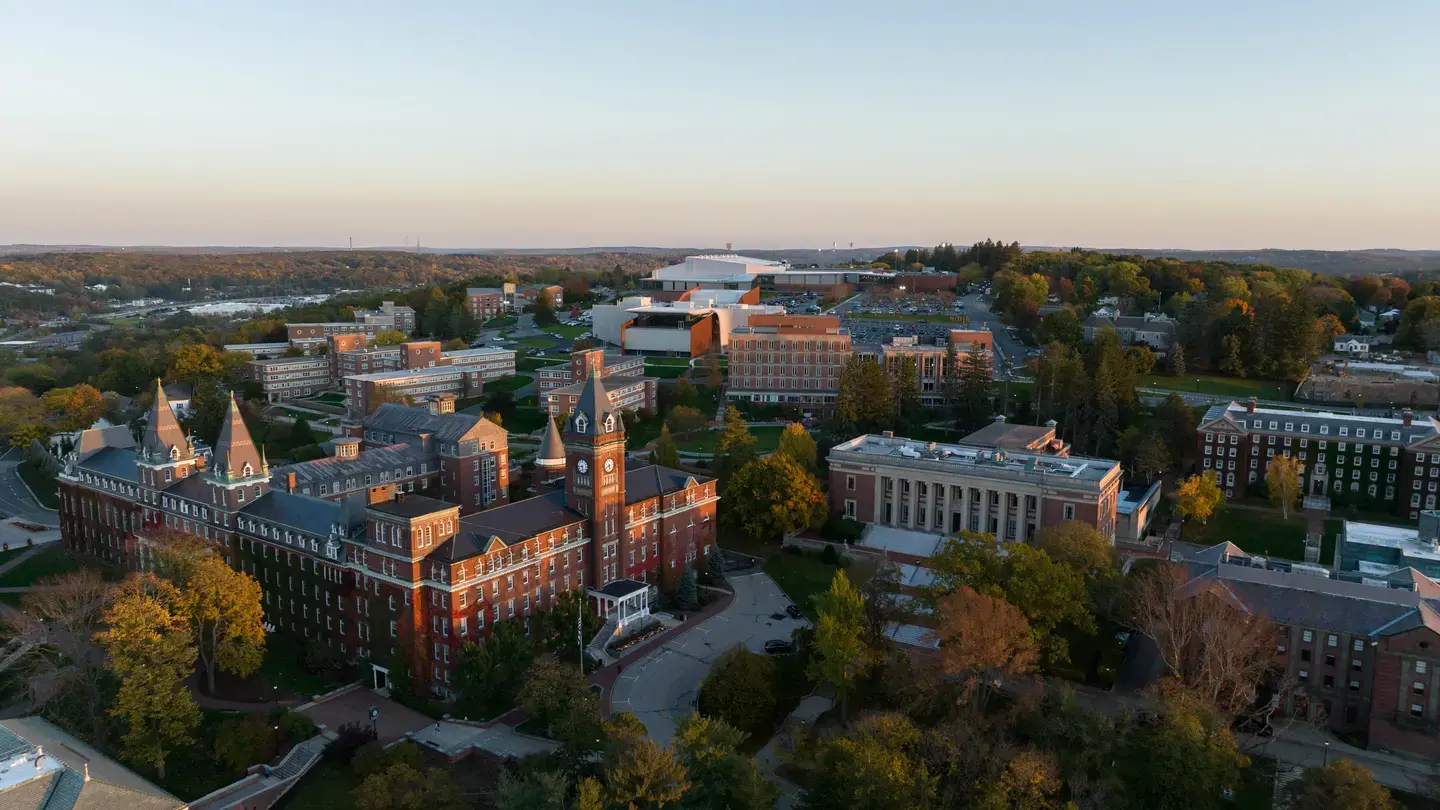
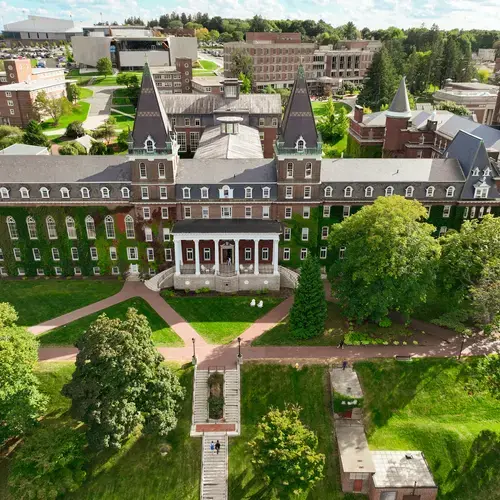
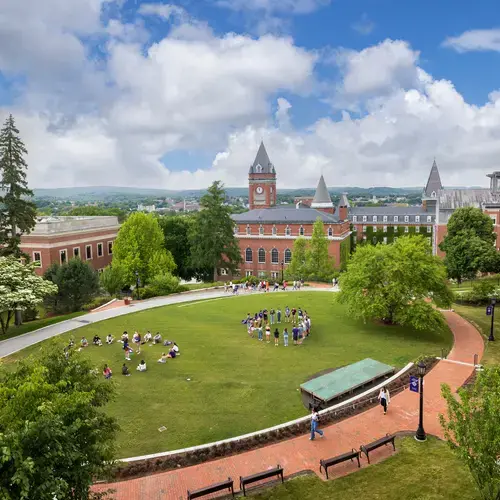
College of the Holy Cross is a singular Jesuit liberal arts college perched on a hill in Worcester, Massachusetts, where intellectual rigor and a tight-knit, residential community are forged in equal measure. It’s a place where the social sciences dominate the curriculum, nearly everyone lives on campus, and the admissions process rewards those who make their commitment clear. With a steadfast promise to meet 100% of demonstrated financial need, Holy Cross delivers a high-stakes, high-reward education that reliably launches graduates into successful careers and graduate schools.
Admission requirements
Test-optional — scores considered if submitted
Required
High school transcript
Letters of recommendation
TOEFL (non-native English)
Considered (not required)
Grade point average
Class rank
Test scores (SAT/ACT)
College-prep program
Demonstrated competencies
Source: IPEDS Admissions survey (2022) via Urban Institute. Covers formal factors only — it does not reflect essays, extracurriculars, or other holistic criteria.
More details
Undergrad enrollment
3,106
In-state tuition
$64,500
Out-of-state tuition
$64,500
Graduation Rate
87%
Meets Full Need
Yes
On-Campus Living
~90%
Demonstrated Interest
Considered
Median Earnings (10yr)
$90,543
Outcomes & value
Outcomes & value
Median earnings (10 yr)
$90,543
Value (earnings ÷ net price)
2.3×
Median debt at graduation
$27,000
Graduation rate
87%
First-year retention
95%
Reducing loan balance (3 yr)
87%
Pell (lower-income) share
15%
First-gen share (among federal-aid recipients)
17%
Financial health
3.0 / 3.0Meets the federal financial-responsibility standard
U.S. Dept. of Education Financial Responsibility Composite Score (FY2022-23). Scale −1.0 to 3.0; ≥1.5 meets the standard. Reported for private nonprofit & for-profit institutions only — public universities are state-backed and not scored, so this is a stability signal, not a ranking.
Top-earning majors
Median earnings by field of study (highest credential), ~2 years after completion.
Economics$66,519
Physics$59,417
Mathematics$52,733
Political Science and Government$46,357
Chemistry$45,175
English Language and Literature, General$44,590
Romance Languages, Literatures, and Linguistics
Applicants here also applied to
The schools that most often appear alongside College of the Holy Cross on applicants’ lists, from our self-reported outcomes corpus.
Co-application frequency from self-reported results — directional peer discovery, not a recommendation.
Campus & location
Campus safety
On-campus violent crimes (2024)
3
On-campus criminal offenses classed as violent (murder/non-negligent manslaughter, rape, robbery, aggravated assault) for the most recent reported year. Source: U.S. Dept. of Education Campus Safety and Security (Clery Act). Counts reflect what’s reported to the school, and urban campuses often report more partly due to non-student incidents nearby — read alongside campus size and setting, not as a standalone safety verdict.
Climate
Pleasant days / yr
90
Summer high
80°F
Winter low
23°F
Annual rain
51.5"
Annual snow
41.7"
Natural-hazard risk
Relatively Moderate
Pleasant days counts days per year with a mean temperature of 55–75°F, a high at or below 90°F, a low at or above 45°F, and little precipitation — a transparent comfort measure, not a weighting we invented. Computed from Open-Meteo ERA5 daily history (2019–2023). Natural-hazard risk is the county’s composite rating from the FEMA National Risk Index.
Deep dive — research, future-scholar output & economic mobility▾
Research output
Institutional h-index
160
Scholarly works
6,583
Institutional research volume and impact from OpenAlex. The h-index reflects large research universities and will be low for teaching-focused liberal-arts colleges — not a measure of undergraduate quality.
Economic mobility
Mobility rate
1.0%
Bottom → top quintile
49%
From bottom quintile
2%
Mobility rate = the share of students who both start in the bottom household-income quintile and reach the top quintile; bottom → top is that chance conditional on starting at the bottom. Source: Opportunity Insights Mobility Report Cards (Chetty, Friedman, Saez, Turner & Yagan). Reflects 1980–82 birth cohorts, so it’s directional, not current.
Quick answers
What is the acceptance rate at College of the Holy Cross?
College of the Holy Cross's acceptance rate is approximately 18% (Worcester, MA), based on the most recent figures we compiled from public and primary sources.
What SAT score do you need for College of the Holy Cross?
Admitted students at College of the Holy Cross typically score 1240–1410 on the SAT (the middle-50% range). Scores outside this band are still admitted, especially with strong applications.
How much does College of the Holy Cross cost?
At College of the Holy Cross, the average net price (after aid) is about $38,782 per year. Actual cost varies with financial aid and residency.
How many undergraduates attend College of the Holy Cross?
College of the Holy Cross enrolls approximately 3,106 undergraduate students.
Where is College of the Holy Cross located?
College of the Holy Cross is located in Worcester, MA.
Admissions
Getting into Holy Cross has become a fiercely competitive proposition, with the tightening dramatically in recent years. The college is very selective, with an overall acceptance rate of 18%. However, the Early Decision (ED) pathway offers a significantly higher probability of admission; data indicates that well over 50% of ED applicants are admitted in a given year, with one source citing a 67.15% acceptance rate for a recent ED cycle and another noting a 60% ED acceptance rate compared to the overall 18%. This creates a clear strategic advantage for committed applicants. The middle 50% SAT range for admitted students is 1240–1410. Demonstrated interest is a factor Holy Cross considers in its admissions process, as indicated in its . Of the admitted students who enroll, the rate—the percentage who choose to attend—is a healthy 49.5%, suggesting Holy Cross is a first-choice destination for many. The admitted class draws from a mix of secondary schools, with 47% coming from public high schools and 45% from private or Catholic high schools.
Earnings = median of students working ~10 years after entry; debt = median of graduates. Value divides 10-yr earnings by one year’s net price — read it as earnings per dollar of annual cost, not a full lifetime ROI; it favors lower-cost schools. Source: U.S. Dept. of Education College Scorecard. Figures lag ~2 years and reflect all students, not your intended major.
$42,682
Philosophy$42,682
Source: U.S. Dept. of Education College Scorecard (field-of-study earnings). Figures cover graduates who received federal aid and lag ~2 years; not all programs report data.
Holy Cross offers a classic, broad-based liberal arts education designed to create "surprising connections" across disciplines. The curriculum provides substantial academic breadth with 40 majors, 29 minors, 6 concentrations, and 5 career programs spanning the arts, humanities, sciences, and social sciences. The social sciences are overwhelmingly the most popular area of study; for the 2024 graduating class, 33% of degrees were conferred in social sciences. Other top majors include Psychology (13%), Biological and Biomedical Sciences (10%), Multi/Interdisciplinary Studies (6%), and English. Economics is consistently the single most popular major, with about 116 degrees granted annually. This focus on the liberal arts is intentional and holistic, aimed at empowering students with skills, expertise, and a passion for learning rather than narrow vocational training.
Life at Holy Cross is intensely residential and communal, with almost 90% of students living on campus—a statistic that defines the student experience. This creates an active, supportive environment centered on relationships, where the campus, a registered arboretum, becomes the focal point for almost all social and intellectual activity. The college lacks Greek life, but a vibrant social scene persists through off-campus house parties and bars. Students describe it as both a "bar school and a house party school." With such a high percentage of students living on "The Hill," leadership opportunities, clubs, and activities are abundant and form the backbone of campus life. The environment is often described as vibrant, with the physical beauty of the campus and low student-to-faculty ratios frequently highlighted as key assets.
A Holy Cross education is a reliable investment with strong returns. The college boasts one of the highest four-year graduation rates in the nation, reported at 89.9%, which saves families significant money compared to institutions where students take five or six years to finish. Recent First Destination reports for graduates show robust post-graduate success: 91% of a recent class had a known outcome within six months of graduation. Of those, 60% were employed full-time, 20% were continuing their education (in graduate or professional school), and 6% were traveling. Salary ranges for employed graduates start at $40,000. Longer-term data shows that six years after graduation, the median salary for alumni is $69,984, and 93% of graduates earn more than a typical high school graduate.
Holy Cross is expensive, but the college mitigates the sticker shock with a powerful and principled financial aid policy. The institution is committed to meeting 100% of the demonstrated financial need for all accepted students at the time of admission. This often comes in the form of grants and scholarships that do not need to be repaid. For example, among accepted students in the Class of 2027 with family incomes between $150,000 and $175,000, 94% received a median scholarship/grant offer ranging from $42,500 to $53,400. The average after aid—what families actually pay—is $38,782. The college encourages families to use its Net Price Calculator for a personalized estimate. This comprehensive, need-based approach is central to Holy Cross's mission of accessibility.
Holy Cross stands out for the potent combination of its Jesuit liberal arts mission, its exceptionally residential character, and its unwavering commitment to financial accessibility. It’s not just a liberal arts college; it’s one where the community is forged by the fact that nearly everyone lives on campus, creating an all-in, immersive experience. Academically, it leans heavily into the social sciences but within the context of a broad, connection-seeking curriculum. In admissions, it sends a clear signal: applying Early Decision dramatically increases your chances, and showing your interest matters. Most importantly, it puts its money behind its values, promising to meet the full demonstrated need of every admitted student. This creates an environment where high academic achievement, defined by a top-tier graduation rate, meets a deeply communal student life, producing graduates who are both successful and well-supported.
College of the Holy Cross seal · sourceAbout Holy Cross | College of the Holy Cross · sourceCollege of the Holy Cross · sourceCommunity | College of the Holy Cross · source