Admit rate has ranged 12%–17% over the last 5 years. Source: IPEDS via Urban Institute.
Acceptance & SAT from Common Data Set / IPEDS; net price, earnings & graduation from the U.S. Dept. of Education College Scorecard. Figures lag ~1–2 years — verify with the school.
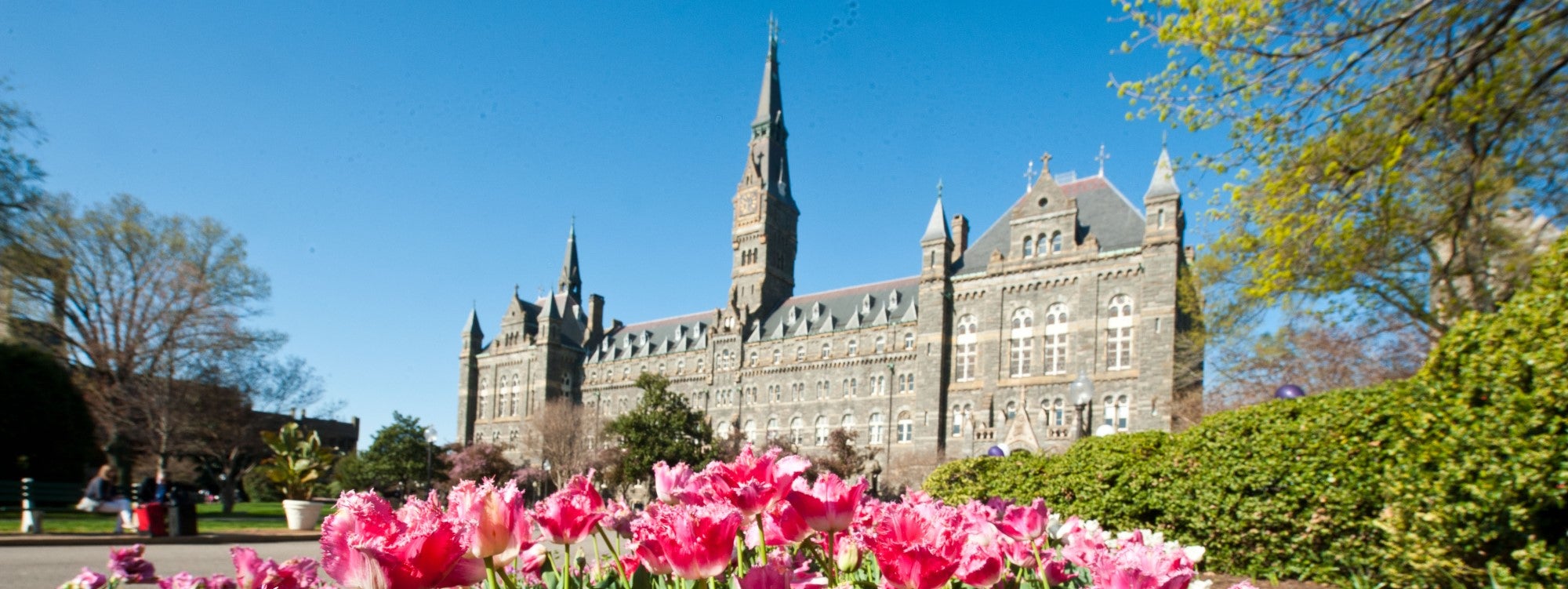
Georgetown University is a powerhouse of political ambition and global influence, perched on a historic hilltop campus that feels more like a cloistered, collegiate enclave than a slice of the nation's capital. Its identity is forged at the intersection of rigorous Jesuit intellectual tradition and relentless pre-professional drive, producing graduates who navigate the corridors of power with a distinct blend of ethical conviction and sharp-elbowed savvy. This is a place where the seminar room debate spills directly into a Capitol Hill internship, and where the social scene is defined more by competitive club culture than by Greek life.
Admission requirements
Test scores required
Required
High school transcript
Grade point average
Letters of recommendation
Test scores (SAT/ACT)
Considered (not required)
Class rank
College-prep program
Demonstrated competencies
TOEFL (non-native English)
Source: IPEDS Admissions survey (2022) via Urban Institute. Covers formal factors only — it does not reflect essays, extracurriculars, or other holistic criteria.
More details
Undergrad enrollment
7,569
In-state tuition
$68,017
Out-of-state tuition
$68,017
Graduation Rate
95%
Meets Full Need
Yes
First-Year Retention
97%
Demonstrated Interest
Considered
Median Earnings (10yr)
$103,494
Outcomes & value
Outcomes & value
Median earnings (10 yr)
$103,494
Value (earnings ÷ net price)
2.5×
Median debt at graduation
$15,500
Graduation rate
95%
First-year retention
97%
Reducing loan balance (3 yr)
88%
Pell (lower-income) share
10%
First-gen share (among federal-aid recipients)
16%
Financial health
2.4 / 3.0Meets the federal financial-responsibility standard
U.S. Dept. of Education Financial Responsibility Composite Score (FY2022-23). Scale −1.0 to 3.0; ≥1.5 meets the standard. Reported for private nonprofit & for-profit institutions only — public universities are state-backed and not scored, so this is a stability signal, not a ranking.
Top-earning majors
Median earnings by field of study (highest credential), ~2 years after completion.
Computer Science$88,639
Finance and Financial Management Services$85,538
Accounting and Related Services$77,715
Management Information Systems and Services$75,989
Economics$74,702
International Business$74,576
Applicants here also applied to
The schools that most often appear alongside Georgetown on applicants’ lists, from our self-reported outcomes corpus.
Co-application frequency from self-reported results — directional peer discovery, not a recommendation.
Campus & location
Campus safety
On-campus violent crimes (2024)
8
Per 1,000 students
0.40
On-campus criminal offenses classed as violent (murder/non-negligent manslaughter, rape, robbery, aggravated assault) for the most recent reported year. Source: U.S. Dept. of Education Campus Safety and Security (Clery Act). Counts reflect what’s reported to the school, and urban campuses often report more partly due to non-student incidents nearby — read alongside campus size and setting, not as a standalone safety verdict.
Climate
Pleasant days / yr
86
Summer high
86°F
Winter low
31°F
Annual rain
55.6"
Annual snow
10.9"
Natural-hazard risk
Relatively High
Pleasant days counts days per year with a mean temperature of 55–75°F, a high at or below 90°F, a low at or above 45°F, and little precipitation — a transparent comfort measure, not a weighting we invented. Computed from Open-Meteo ERA5 daily history (2019–2023). Natural-hazard risk is the county’s composite rating from the FEMA National Risk Index.
Deep dive — research, future-scholar output & economic mobility▾
Research output
Institutional h-index
857
Scholarly works
116,638
Institutional research volume and impact from OpenAlex. The h-index reflects large research universities and will be low for teaching-focused liberal-arts colleges — not a measure of undergraduate quality.
Economic mobility
Mobility rate
1.9%
Bottom → top quintile
61%
From bottom quintile
3%
Mobility rate = the share of students who both start in the bottom household-income quintile and reach the top quintile; bottom → top is that chance conditional on starting at the bottom. Source: Opportunity Insights Mobility Report Cards (Chetty, Friedman, Saez, Turner & Yagan). Reflects 1980–82 birth cohorts, so it’s directional, not current.
Quick answers
What is the acceptance rate at Georgetown University?
Georgetown University's acceptance rate is approximately 13% (Washington, DC), based on the most recent figures we compiled from public and primary sources.
What SAT score do you need for Georgetown University?
Admitted students at Georgetown University typically score 1390–1550 on the SAT (the middle-50% range). Scores outside this band are still admitted, especially with strong applications.
How much does Georgetown University cost?
At Georgetown University, the average net price (after aid) is about $40,815 per year. Actual cost varies with financial aid and residency.
How many undergraduates attend Georgetown University?
Georgetown University enrolls approximately 7,569 undergraduate students.
Where is Georgetown University located?
Georgetown University is located in Washington, DC.
Admissions
Getting into Georgetown is a high-stakes game of academic distinction and strategic positioning. The university is fiercely selective, with an of 13% and an Early Action acceptance rate that has been even lower, reported at 11.11% for one recent cycle. The admitted student profile is exceptionally strong: the middle 50% SAT range for the Class of 2029 showed Evidence-Based Reading and Writing scores around 735 and Math around 750, with ACT scores averaging 33.5. Unlike many peers, Georgetown's Early Action program is non-binding and restrictive, meaning applicants cannot apply early to other private institutions. Notably, the university does consider demonstrated interest as part of its , alongside factors like alumni relation and geographical residence. Typically, only about 15% of students deferred from Early Action are later admitted during the regular decision round, making the early round highly competitive but not necessarily a statistical advantage.
Earnings = median of students working ~10 years after entry; debt = median of graduates. Value divides 10-yr earnings by one year’s net price — read it as earnings per dollar of annual cost, not a full lifetime ROI; it favors lower-cost schools. Source: U.S. Dept. of Education College Scorecard. Figures lag ~2 years and reflect all students, not your intended major.
Registered Nursing, Nursing Administration, Nursing Research and Clinical Nursing
$71,686
Health and Medical Administrative Services$70,176
Source: U.S. Dept. of Education College Scorecard (field-of-study earnings). Figures cover graduates who received federal aid and lag ~2 years; not all programs report data.
Academics at Georgetown are defined by a commitment to rigorous inquiry within a distinctly humanistic and global framework. The core of the undergraduate experience is the College of Arts & Sciences, which offers over 50 majors and interdisciplinary programs ranging from American Studies and Anthropology to Biological Physics and Black Studies. The curriculum emphasizes small class sizes and a respect for educational rigor. The university's unique positioning in Washington, D.C., infuses its programs—particularly in foreign service, government, and international affairs—with an unparalleled sense of immediacy and real-world application. This environment fosters a student body intensely focused on pre-professional outcomes, where academic inquiry is often directly linked to career pathways in policy, business, and law.
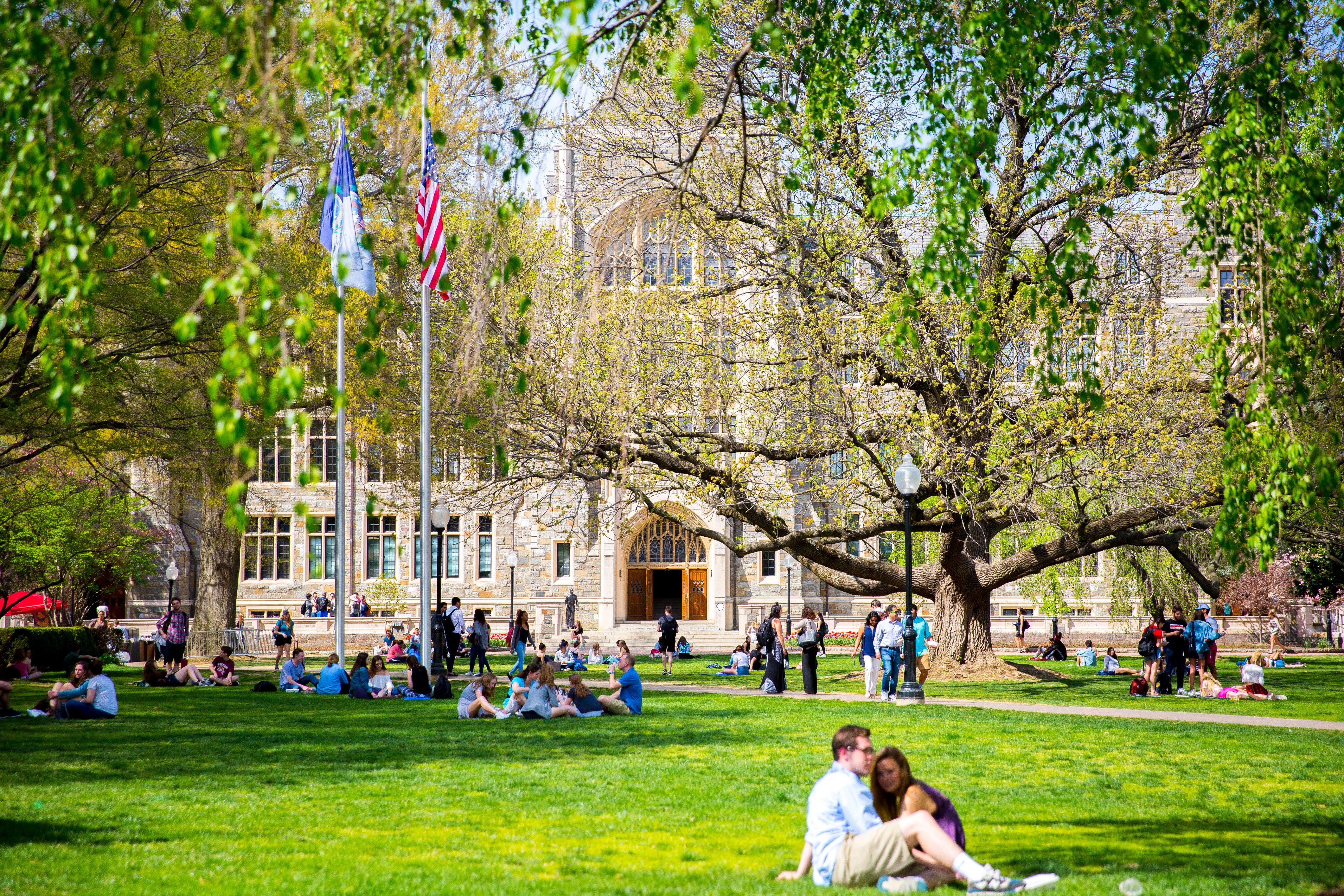
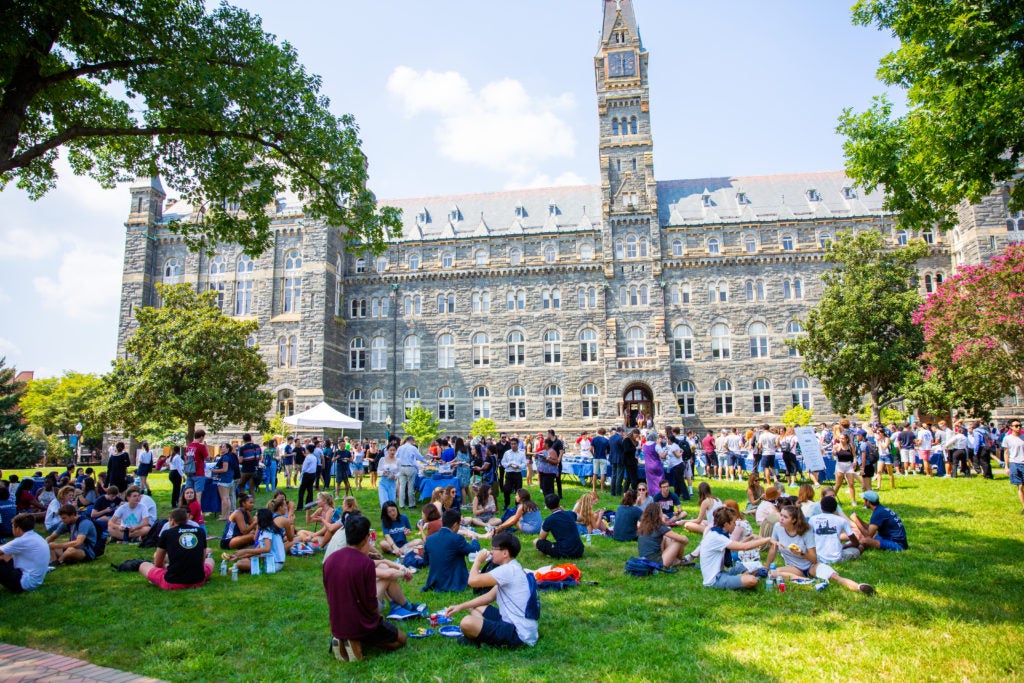
Life on the Hilltop blends the feel of a classic, self-contained campus with the boundless opportunities of Washington, D.C. The campus itself is characterized by stately buildings and green lawns, providing a traditional collegiate backdrop. Without a prominent Greek life scene, the social and professional fabric is woven through a vibrant and highly competitive club culture. Students can choose from over 300 clubs and organizations, with a strong emphasis on pre-professional, debate, volunteer, and cultural groups. This creates a dynamic but often intense atmosphere where networking and resume-building are common social pursuits. Students are famously busy, constantly running between campus activities and internships or cultural experiences in the city, nurturing ideas and passions that extend far beyond the classroom.
Georgetown delivers on its promise of launching graduates into high-impact, high-earning careers. The university's graduation rate is an exceptional 95%, with a first-year retention rate of 97%. Financially, the payoff is significant. Early-career alumni are among the highest-paid college graduates in the country. Specific school data is impressive: recent undergraduates from the McDonough School of Business reported record average full-time salaries of $102,780, with signing bonuses averaging $9,000. More broadly, Georgetown alumni who received federal aid earn a median salary of $120,000 just four years after graduating. This strong outcomes data underscores the value of the Georgetown network and the direct pipeline its D.C. location provides to lucrative fields in consulting, finance, law, and public policy.
Attending Georgetown requires a significant financial investment, but the university maintains a strong commitment to . Georgetown meets the full demonstrated financial need of all admitted undergraduate students and was one of the first top-tier universities to adopt such a policy. It does not offer merit-based scholarships. The financial aid package for eligible students typically includes a combination of grants, federal student loans (ranging from $3,500 to $5,500 depending on year), and Federal Work-Study (ranging from $3,000 to $3,600). The average aid package is substantial, reported at over $60,931, which brings the average down significantly for those who qualify. Prospective students are encouraged to use the university's Net Price Calculator for a personalized estimate.
Georgetown's singularity lies in its potent, almost alchemical fusion of elements found nowhere else. It combines the deep intellectual tradition and ethical focus of a Jesuit education with the cutthroat, realpolitik energy of its Washington, D.C., doorstep. This creates a unique culture: students debate moral philosophy in the morning and lobby on Capitol Hill in the afternoon. The campus offers a traditional "hilltop" retreat, yet the social and professional engine is a fiercely competitive club scene that replaces Greek life with a focus on career-building. The outcome is a graduate who is both idealistic and intensely pragmatic, armed with a world-class education and a network that literally runs the world. It's not just a university near power; it is an institution designed to understand, navigate, and wield it.
Georgetown University seal · sourceVisit Georgetown | Office of Undergraduate Admissions | Georgetown University · sourceCampuses of Georgetown University - Wikipedia · sourceVisit the Hilltop Campus - Georgetown University · source