Admit rate has ranged 58%–64% over the last 5 years, though the latest figure above (55%) falls outside that window. Source: IPEDS via Urban Institute.
Acceptance & SAT from Common Data Set / IPEDS; net price, earnings & graduation from the U.S. Dept. of Education College Scorecard. Figures lag ~1–2 years — verify with the school.
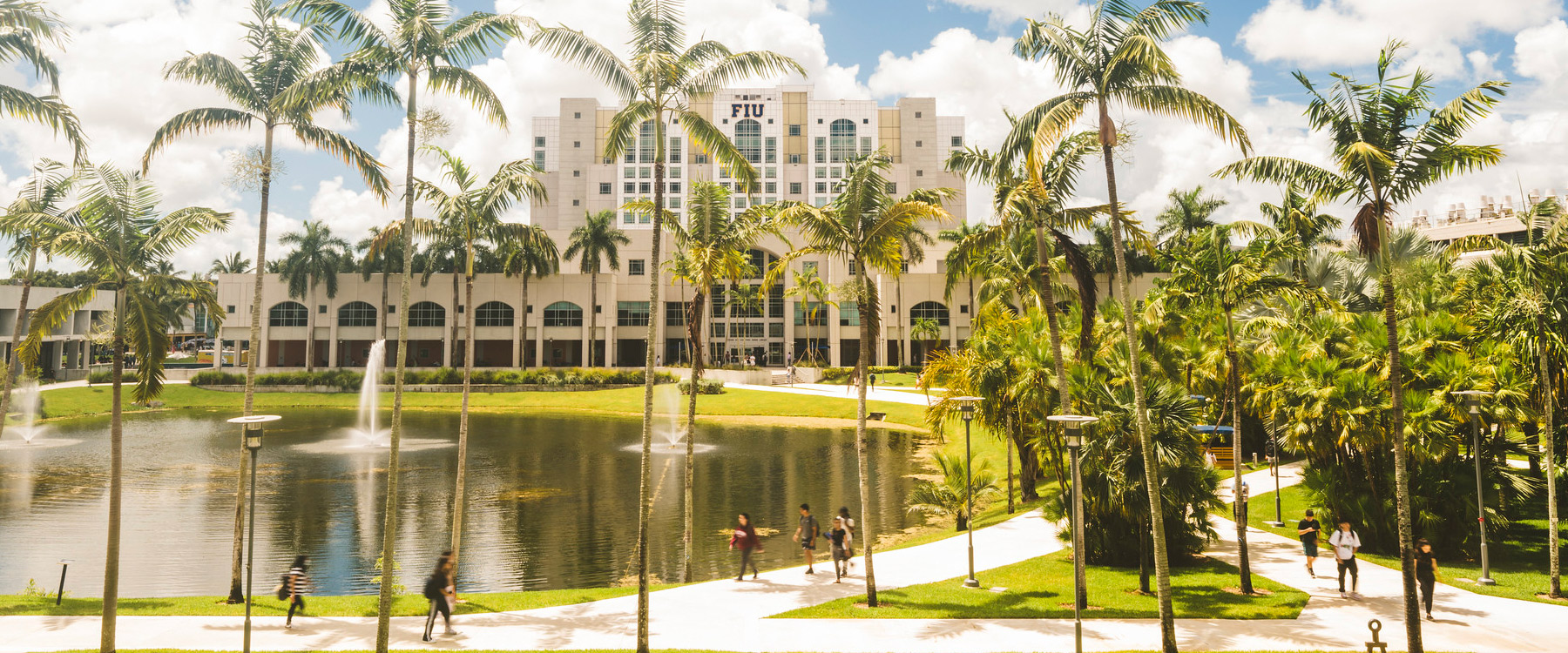
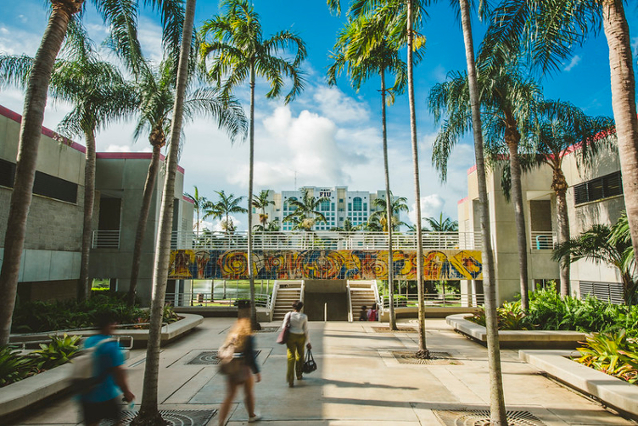
Florida International University is a massive, kinetic public research university that feels more like a global city than a traditional campus, anchored in the heart of Miami. With over 190 degree programs, a student body exceeding 56,000, and a relentless focus on upward mobility, FIU operates as a powerful engine for first-generation and immigrant families, blending rigorous academics with the vibrant, polyglot energy of South Florida. It’s a place where business, hospitality, and international studies aren't just majors—they're lived experiences, fueled by a practical, career-focused ethos and a stunningly affordable price tag.
Admission requirements
Test scores required
Required
High school transcript
Grade point average
Test scores (SAT/ACT)
College-prep program
TOEFL (non-native English)
Considered (not required)
Class rank
Demonstrated competencies
Source: IPEDS Admissions survey (2022) via Urban Institute. Covers formal factors only — it does not reflect essays, extracurriculars, or other holistic criteria.
More details
Undergrad enrollment
39,508
In-state tuition
$6,565
Out-of-state tuition
$18,964
Graduation Rate
74%
Total Degree Programs
190+
Golden Promise Program
Covers 100% tuition & fees for eligible FL residents
Median Earnings (10yr)
$60,249
First-Year Retention Rate
89–92%
Four-Year Graduation Rate
59%
Financial Aid Awarded Annually
>$180 million
Outcomes & value
Outcomes & value
Median earnings (10 yr)
$60,249
Value (earnings ÷ net price)
6.5×
Median debt at graduation
$16,500
Graduation rate
74%
First-year retention
92%
Reducing loan balance (3 yr)
54%
Pell (lower-income) share
41%
First-gen share (among federal-aid recipients)
41%
Top-earning majors
Median earnings by field of study (highest credential), ~2 years after completion.
Computer Engineering$72,274
Construction Engineering Technology/Technician$67,101
Mechanical Engineering$66,897
Electrical, Electronics, and Communications Engineering$66,653
Registered Nursing, Nursing Administration, Nursing Research and Clinical Nursing$63,071
Civil Engineering
Applicants here also applied to
The schools that most often appear alongside Florida International University on applicants’ lists, from our self-reported outcomes corpus.
Co-application frequency from self-reported results — directional peer discovery, not a recommendation.
Campus & location
Campus safety
On-campus violent crimes (2024)
11
Per 1,000 students
0.22
On-campus criminal offenses classed as violent (murder/non-negligent manslaughter, rape, robbery, aggravated assault) for the most recent reported year. Source: U.S. Dept. of Education Campus Safety and Security (Clery Act). Counts reflect what’s reported to the school, and urban campuses often report more partly due to non-student incidents nearby — read alongside campus size and setting, not as a standalone safety verdict.
Climate
Pleasant days / yr
104
Summer high
88°F
Winter low
62°F
Annual rain
71"
Natural-hazard risk
Very High
Pleasant days counts days per year with a mean temperature of 55–75°F, a high at or below 90°F, a low at or above 45°F, and little precipitation — a transparent comfort measure, not a weighting we invented. Computed from Open-Meteo ERA5 daily history (2019–2023). Natural-hazard risk is the county’s composite rating from the FEMA National Risk Index.
Deep dive — research, future-scholar output & economic mobility▾
Research output
Institutional h-index
506
Scholarly works
79,323
Institutional research volume and impact from OpenAlex. The h-index reflects large research universities and will be low for teaching-focused liberal-arts colleges — not a measure of undergraduate quality.
Economic mobility
Mobility rate
5.2%
Bottom → top quintile
35%
From bottom quintile
15%
Mobility rate = the share of students who both start in the bottom household-income quintile and reach the top quintile; bottom → top is that chance conditional on starting at the bottom. Source: Opportunity Insights Mobility Report Cards (Chetty, Friedman, Saez, Turner & Yagan). Reflects 1980–82 birth cohorts, so it’s directional, not current.
Quick answers
What is the acceptance rate at Florida International University?
Florida International University's acceptance rate is approximately 55% (Miami, FL), based on the most recent figures we compiled from public and primary sources.
What SAT score do you need for Florida International University?
Admitted students at Florida International University typically score 1070–1260 on the SAT (the middle-50% range). Scores outside this band are still admitted, especially with strong applications.
How much does Florida International University cost?
At Florida International University, the average net price (after aid) is about $9,288 per year. Actual cost varies with financial aid and residency.
How many undergraduates attend Florida International University?
Florida International University enrolls approximately 39,508 undergraduate students.
Where is Florida International University located?
Florida International University is located in Miami, FL.
Admissions
FIU's admissions process is selective but accessible, designed to identify students prepared for its rigorous pace. With a freshman around 50%, the university evaluates a holistic picture, though test scores carry significant weight. For first-time-in-college (FTIC) applicants, SAT, ACT, or CLT scores are required, with a minimum SAT score of 1060 or ACT score of 21 serving as a baseline threshold for one admission pathway; however, meeting these minimums does not guarantee admission. The middle 50% SAT range for admitted students is 1070–1260, with the ACT range being 21–27. All admitted FTIC students must also take a math placement test. The university utilizes the to report its admissions procedures and . While specific factors like demonstrated interest are detailed in the CDS, the process emphasizes academic readiness for a large, fast-moving public institution.
Earnings = median of students working ~10 years after entry; debt = median of graduates. Value divides 10-yr earnings by one year’s net price — read it as earnings per dollar of annual cost, not a full lifetime ROI; it favors lower-cost schools. Source: U.S. Dept. of Education College Scorecard. Figures lag ~2 years and reflect all students, not your intended major.
$59,485
Computer and Information Sciences, General$58,077
Biomedical/Medical Engineering$56,776
Source: U.S. Dept. of Education College Scorecard (field-of-study earnings). Figures cover graduates who received federal aid and lag ~2 years; not all programs report data.
Academic life at FIU is defined by staggering breadth and a distinctly career-oriented, global perspective. The university offers more than 190 degree options across bachelor's, master's, and doctoral programs, including top-ranked online offerings. This vast catalog ensures students can find a niche, but the curriculum is unmistakably geared toward the practical demands of the South Florida economy and beyond. The most popular majors reflect this: for 2024 graduates, 24% majored in Business, Management, Marketing, and Related Support Services, followed by Psychology (13%) and Multi/Interdisciplinary Studies. Other frequently cited popular majors include Biology, and Liberal Arts and Humanities. The academic structure spans from the humanities to STEM, with notable strength in areas like Hospitality Management, Engineering, and International Affairs, leveraging its Miami location as a living laboratory. The scale is massive, but it facilitates a wide array of specialized programs and research opportunities, contributing to its reputation as a top-tier research institution.
Life at FIU is a study in vibrant, decentralized energy. With a student population over 56,000, the campus buzzes with activity, yet students describe a community that is diverse, friendly, and respectful. The social scene isn't handed to you—it's built. As one student noted, the school is 'large enough there's always new faces to meet but it's small enough to run into someone you are avoiding.' The Graham Center serves as a central hub for joining one of countless student clubs, while the sprawling lawns might host a spontaneous yoga class. The Department of Student Experiences aims to engage students in holistic learning through diversity, leadership, and personal development programs. This isn't a stereotypical residential college experience; it's an urban, commuter-influenced ecosystem where you carve out your own space. The campus itself offers 'infinite possibilities,' from professional opportunities to cultural events, all infused with the international flair of Miami. Videos and tours showcase a dynamic environment where academic life blends seamlessly with sports, dorm life, and outdoor activities.
FIU's raison d'être is student success and economic mobility, and the data shows it delivers. The university's overall graduation rate is 74%, placing it in the top 20% nationally. Its four-year graduation rate for full-time, first-time students is 59%, a figure that has shown significant improvement, increasing from 42.8% to 49.3% in recent years and cited as part of a 10% jump in performance metrics. First-year retention rates are strong, reported between 88.8% and 91.5% in recent cohorts. For the fourth consecutive year, FIU has topped Florida's public universities in state performance-based metrics, which evaluate graduation rates, earnings of recent graduates, outcomes for transfer students, and retention rates. The median earnings for graduates ten years after entry is $60,249. This combination of improving graduation rates and solid post-graduate earnings underscores FIU's effectiveness as an engine of advancement, particularly for its large population of and Pell-eligible students.
FIU's most compelling argument is its value proposition: a high-quality, research-intensive education at a public university price. The average after aid is $9,288. The financial aid office awards more than $180 million in aid annually, with the average aid package totaling $11,685. Need-based scholarship or grant awards average $8,514. For Florida residents with the highest financial need, the Golden Promise program guarantees 100% coverage of tuition and fees for first-time-in-college students with a Student Aid Index (SAI) of 0 or less. Students are encouraged to use the official Net Price Calculator to get a personalized estimate of costs and aid. The total annual for estimation purposes can be around $29,804, but the actual net price is dramatically lower for most students thanks to substantial state support and institutional aid. This commitment to affordability is central to FIU's mission of accessibility.
FIU stands out not for ivy-covered Gothic halls, but for its raw, transformative power. It is the epitome of the modern, urban public university—a sprawling, diverse, and unapologetically pragmatic institution that serves as a primary gateway to the American dream for tens of thousands in South Florida and beyond. Its identity is inextricably linked to Miami, making it a global hub for studies in international business, hospitality, logistics, and environmental science. The scale is immense (190+ degrees, 56,000+ students), but this scale fuels its top-tier research designation and creates unparalleled opportunity. What truly distinguishes FIU is its outcomes-focused culture: it consistently leads Florida's public universities in performance metrics, driving rapid improvements in graduation rates while maintaining an astonishingly low . It’s a university built on motion and momentum, where the energy of a world city meets the concrete mission of elevating students into the professional class. For students seeking a dynamic, career-ready education without crippling debt, FIU isn't just an option—it's a strategic powerhouse.
Florida International University seal · sourceFlorida International University - State University System of Florida · sourceLocations | Florida International University in Miami, FL · sourceFIU LOCATIONS & PROGRAMS · source