Admit rate has ranged 63%–81% over the last 5 years — notably volatile. Source: IPEDS via Urban Institute.
Acceptance & SAT from Common Data Set / IPEDS; net price, earnings & graduation from the U.S. Dept. of Education College Scorecard. Figures lag ~1–2 years — verify with the school.
Florida Atlantic University is a sprawling public research institution in Boca Raton that has transformed from a commuter school into a dynamic, upwardly mobile university with a serious focus on student success. Its identity is split between a traditional campus life and its South Florida commuter reality, but it leverages its location to offer robust programs in business, health, and engineering. FAU’s most compelling story is its dramatic, data-driven push to boost graduation rates, particularly for Pell-eligible and underrepresented students, making it a notable engine of economic mobility.
Admission requirements
Test scores required
Required
High school transcript
Grade point average
Test scores (SAT/ACT)
College-prep program
TOEFL (non-native English)
Considered (not required)
Class rank
Letters of recommendation
Source: IPEDS Admissions survey (2022) via Urban Institute. Covers formal factors only — it does not reflect essays, extracurriculars, or other holistic criteria.
More details
Undergrad enrollment
23,757
In-state tuition
$4,879
Out-of-state tuition
$17,324
No-Loan Policy
Not in sources
Graduation Rate
63%
Meets Full Need
Not in sources
ED Share of Class
Not in sources
First-Year Retention
Not in sources
Demonstrated Interest
Not in sources
Median Earnings (10yr)
$56,746
Outcomes & value
Outcomes & value
Median earnings (10 yr)
$56,746
Value (earnings ÷ net price)
6.5×
Median debt at graduation
$17,236
Graduation rate
63%
First-year retention
84%
Reducing loan balance (3 yr)
55%
Pell (lower-income) share
34%
First-gen share (among federal-aid recipients)
39%
Top-earning majors
Median earnings by field of study (highest credential), ~2 years after completion.
Registered Nursing, Nursing Administration, Nursing Research and Clinical Nursing$64,415
Electrical, Electronics, and Communications Engineering$63,600
Mechanical Engineering$63,463
Ocean Engineering$63,377
Computer Engineering$58,221
Environmental Design
Applicants here also applied to
The schools that most often appear alongside Florida Atlantic University on applicants’ lists, from our self-reported outcomes corpus.
On-campus criminal offenses classed as violent (murder/non-negligent manslaughter, rape, robbery, aggravated assault) for the most recent reported year. Source: U.S. Dept. of Education Campus Safety and Security (Clery Act). Counts reflect what’s reported to the school, and urban campuses often report more partly due to non-student incidents nearby — read alongside campus size and setting, not as a standalone safety verdict.
Climate
Pleasant days / yr
97
Summer high
87°F
Winter low
64°F
Annual rain
68.3"
Natural-hazard risk
Relatively High
Pleasant days counts days per year with a mean temperature of 55–75°F, a high at or below 90°F, a low at or above 45°F, and little precipitation — a transparent comfort measure, not a weighting we invented. Computed from Open-Meteo ERA5 daily history (2019–2023). Natural-hazard risk is the county’s composite rating from the FEMA National Risk Index.
Deep dive — research, future-scholar output & economic mobility▾
Research output
Institutional h-index
399
Scholarly works
39,815
Institutional research volume and impact from OpenAlex. The h-index reflects large research universities and will be low for teaching-focused liberal-arts colleges — not a measure of undergraduate quality.
Economic mobility
Mobility rate
3.1%
Bottom → top quintile
26%
From bottom quintile
12%
Mobility rate = the share of students who both start in the bottom household-income quintile and reach the top quintile; bottom → top is that chance conditional on starting at the bottom. Source: Opportunity Insights Mobility Report Cards (Chetty, Friedman, Saez, Turner & Yagan). Reflects 1980–82 birth cohorts, so it’s directional, not current.
Quick answers
What is the acceptance rate at Florida Atlantic University?
Florida Atlantic University's acceptance rate is approximately 66% (Boca Raton, FL), based on the most recent figures we compiled from public and primary sources.
What SAT score do you need for Florida Atlantic University?
Admitted students at Florida Atlantic University typically score 1040–1200 on the SAT (the middle-50% range). Scores outside this band are still admitted, especially with strong applications.
How much does Florida Atlantic University cost?
At Florida Atlantic University, the average net price (after aid) is about $8,752 per year. Actual cost varies with financial aid and residency.
How many undergraduates attend Florida Atlantic University?
Florida Atlantic University enrolls approximately 23,757 undergraduate students.
Where is Florida Atlantic University located?
Florida Atlantic University is located in Boca Raton, FL.
Admissions
FAU describes itself as 'selective,' though with a two-thirds , it occupies a space as a realistic target or safety school for many applicants, particularly from Florida. The university evaluates applicants holistically, with standardized test scores (SAT, ACT, or CLT) forming a key part of the review. For the admitted class of 2026, the middle 50% range for high school GPA was 3.66–4.29. The university offers an Early Action plan, with decisions released in early December. Notably, the rate—the percentage of admitted students who enroll—is reported as 16%, which is considered medium. Demonstrated interest is a factor that colleges can rank in their , but FAU's specific stance on its importance is not detailed in the provided sources. The process can feel competitive, especially for out-of-state applicants, as reflected in online discussions where parents noted FAU was 'a major safe school' that became unexpectedly difficult for OOS students to gain admission.
Earnings = median of students working ~10 years after entry; debt = median of graduates. Value divides 10-yr earnings by one year’s net price — read it as earnings per dollar of annual cost, not a full lifetime ROI; it favors lower-cost schools. Source: U.S. Dept. of Education College Scorecard. Figures lag ~2 years and reflect all students, not your intended major.
$55,964
Civil Engineering$54,252
Computer and Information Sciences, General$51,794
Source: U.S. Dept. of Education College Scorecard (field-of-study earnings). Figures cover graduates who received federal aid and lag ~2 years; not all programs report data.
FAU offers a broad, comprehensive curriculum with more than 170 undergraduate and graduate degree programs spread across ten colleges. The academic portfolio is designed to be transformative and is rooted in a belief that 'creativity and dedication fuel academic excellence.' The most popular majors cluster in professionally oriented fields: Business, Management, Marketing, and Related Support Services; Health Professions and Related Programs; Psychology; Biological and Biomedical Sciences; and Engineering. This aligns with the university's identity as a career-launching pad. The core curriculum requires foundational work in English, Mathematics, Social Science, and Science (including Biological Sciences, Chemistry, and Physics), and students must maintain a minimum 2.0 overall FAU GPA. The scale and variety of programs allow students to find a niche, from the sciences to the arts, within a large public university framework.
Campus life at FAU is a mixed bag, heavily influenced by its commuter-school origins. The university promotes 'a total living and learning experience' with over 400 student clubs and organizations, recreational sports, Greek life, and volunteer opportunities. However, the residential experience is not the norm; only 21% of students live in college-owned, -operated, or -affiliated housing, while 79% live off campus. This dynamic leads to a common student critique: the campus can feel quiet or 'not that lively' outside of class hours, especially on weekends. Students actively seek and create social connections through clubs and events to combat this. The university itself markets a 'vibrant campus environment that embraces South Florida through both research and campus culture,' suggesting an active effort to build community beyond the classroom. The social scene is what you make it, often requiring more initiative than at a heavily residential college.
FAU’s outcomes narrative is one of remarkable, data-driven improvement and a strong focus on equity. The university has executed a dramatic turnaround in graduation rates, more than doubling its four-year rate from 19.3% in 2014 to 47.5% in 2020, reaching 50% in 2021. Crucially, this success has been inclusive: in 2021, Pell-eligible students graduated at a rate of 51.4%, and students who identify as Black, Hispanic, or from low-income backgrounds have seen significant gains, effectively eliminating equity gaps. This 'Atlantic Effect' is a point of institutional pride. For graduates, the university is a powerful engine of economic mobility. According to a sponsored report, 83% of low-income students move up at least one income bracket within a year of graduating, and FAU ranks highly nationally for promoting upward mobility for graduates from low-income backgrounds. The median salary six years after graduation is reported as $45,647.
As a public university, FAU offers a relatively affordable , especially for in-state students. A significant majority (86%) of full-time beginning undergraduates receive some form of grant or scholarship aid. The university provides financial assistance based on both merit and demonstrated financial need, using a combination of grants, work-study awards, and loans. Subsidized Federal Direct Loans are available to undergraduate students who demonstrate financial need. It is important to note that the provided sources do not indicate that FAU has a 'no-loan' policy or that it meets 100% of demonstrated financial need without loans. The net price calculator is a key tool for prospective students to estimate their out-of-pocket costs, which vary significantly for Florida residents versus non-residents.
FAU stands out not for ancient traditions or cutthroat selectivity, but for its palpable momentum as an institution fiercely committed to student success and social mobility. Its defining characteristic is the 'Atlantic Effect'—a targeted, analytics-based initiative that has radically improved graduation rates while closing equity gaps for Pell-eligible, Black, and Hispanic students. This isn't just marketing; it's a documented case study in public university transformation. The campus vibe is distinctly South Floridian: more professional and commuter-oriented than rah-rah, set in Boca Raton rather than a classic college town. This reality shapes a student experience that rewards independence and proactivity. For students seeking a practical, career-focused education at an affordable price from a university that is demonstrably improving and focused on getting them across the finish line, FAU represents a compelling and increasingly respected choice.
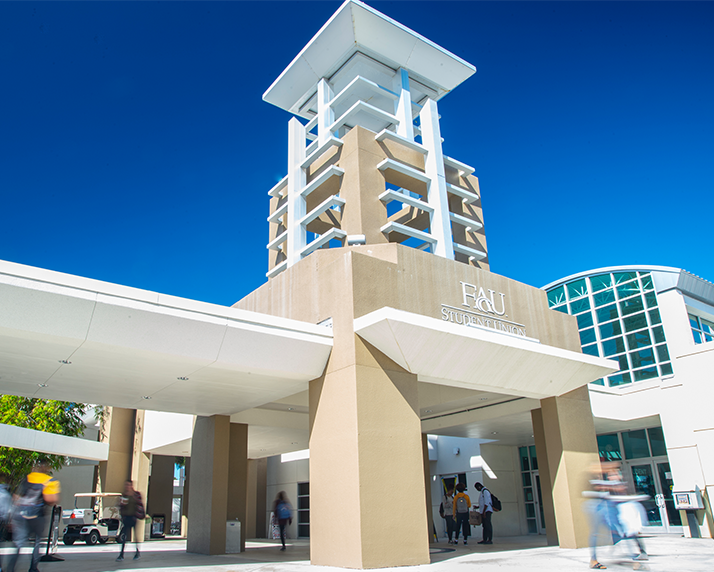
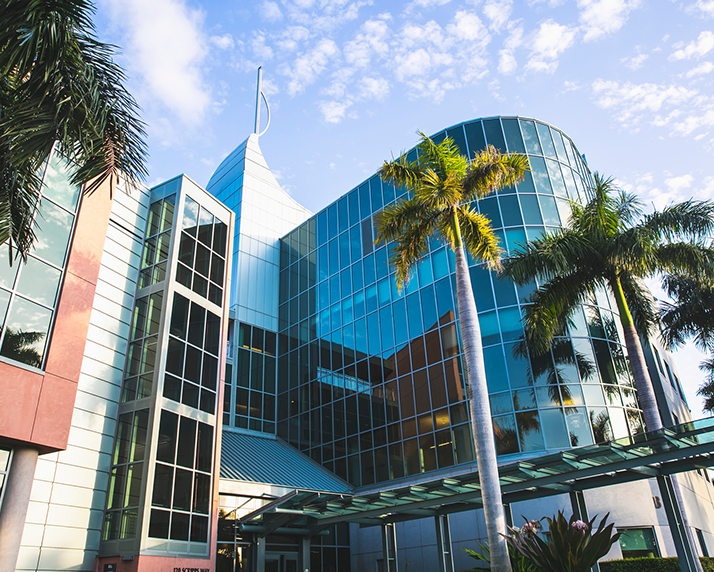
Florida Atlantic University seal · sourceLocations | Florida Atlantic University · sourceLocations | Florida Atlantic University · sourceLocation | Florida Atlantic University · source