Admit rate has ranged 56%–91% over the last 5 years — notably volatile. Source: IPEDS via Urban Institute.
Acceptance & SAT from Common Data Set / IPEDS; net price, earnings & graduation from the U.S. Dept. of Education College Scorecard. Figures lag ~1–2 years — verify with the school.
Manchester University is a small, private liberal arts school in rural Indiana where the defining feature isn't prestige or selectivity, but a palpable sense of community and hands-on, practical education. With an acceptance rate of 71%, it's an accessible institution where the real challenge lies not in getting in, but in graduating—the six-year graduation rate is 46%. The campus vibe is close-knit and activity-driven, centered around a wide array of clubs and service projects, while academics focus on over 70 majors, with Kinesiology and Business Administration leading the pack.
Admission requirements
Test-blind — scores not considered
Required
High school transcript
Grade point average
TOEFL (non-native English)
Considered (not required)
Class rank
Letters of recommendation
College-prep program
Demonstrated competencies
Source: IPEDS Admissions survey (2022) via Urban Institute. Covers formal factors only — it does not reflect essays, extracurriculars, or other holistic criteria.
More details
Undergrad enrollment
936
In-state tuition
$37,135
Out-of-state tuition
$37,135
No-Loan Policy
No
Graduation Rate
46%
Meets Full Need
No
First-Year Retention
66%
Demonstrated Interest
Not considered
Median Earnings (10yr)
$51,504
Outcomes & value
Outcomes & value
Median earnings (10 yr)
$51,504
Value (earnings ÷ net price)
2.7×
Median debt at graduation
$26,854
Graduation rate
46%
First-year retention
66%
Reducing loan balance (3 yr)
70%
Pell (lower-income) share
45%
First-gen share (among federal-aid recipients)
34%
Financial health
2.2 / 3.0Meets the federal financial-responsibility standard
U.S. Dept. of Education Financial Responsibility Composite Score (FY2022-23). Scale −1.0 to 3.0; ≥1.5 meets the standard. Reported for private nonprofit & for-profit institutions only — public universities are state-backed and not scored, so this is a stability signal, not a ranking.
Top-earning majors
Median earnings by field of study (highest credential), ~2 years after completion.
Accounting and Related Services$50,856
Marketing$39,369
Business Administration, Management and Operations$36,848
Sports, Kinesiology, and Physical Education/Fitness$28,816
Source: U.S. Dept. of Education College Scorecard (field-of-study earnings). Figures cover graduates who received federal aid and lag ~2 years; not all programs report data.
On-campus criminal offenses classed as violent (murder/non-negligent manslaughter, rape, robbery, aggravated assault) for the most recent reported year. Source: U.S. Dept. of Education Campus Safety and Security (Clery Act). Counts reflect what’s reported to the school, and urban campuses often report more partly due to non-student incidents nearby — read alongside campus size and setting, not as a standalone safety verdict.
Climate
Pleasant days / yr
89
Summer high
82°F
Winter low
24°F
Annual rain
38.4"
Annual snow
25"
Natural-hazard risk
Very Low
Pleasant days counts days per year with a mean temperature of 55–75°F, a high at or below 90°F, a low at or above 45°F, and little precipitation — a transparent comfort measure, not a weighting we invented. Computed from Open-Meteo ERA5 daily history (2019–2023). Natural-hazard risk is the county’s composite rating from the FEMA National Risk Index.
Deep dive — research, future-scholar output & economic mobility▾
Research output
Institutional h-index
238
Scholarly works
12,598
Institutional research volume and impact from OpenAlex. The h-index reflects large research universities and will be low for teaching-focused liberal-arts colleges — not a measure of undergraduate quality.
Economic mobility
Mobility rate
0.4%
Bottom → top quintile
10%
From bottom quintile
4%
Mobility rate = the share of students who both start in the bottom household-income quintile and reach the top quintile; bottom → top is that chance conditional on starting at the bottom. Source: Opportunity Insights Mobility Report Cards (Chetty, Friedman, Saez, Turner & Yagan). Reflects 1980–82 birth cohorts, so it’s directional, not current.
Quick answers
What is the acceptance rate at Manchester University?
Manchester University's acceptance rate is approximately 71% (North Manchester, IN), based on the most recent figures we compiled from public and primary sources.
How much does Manchester University cost?
At Manchester University, the average net price (after aid) is about $18,805 per year. Actual cost varies with financial aid and residency.
How many undergraduates attend Manchester University?
Manchester University enrolls approximately 936 undergraduate students.
Where is Manchester University located?
Manchester University is located in North Manchester, IN.
Admissions
Manchester's admissions process is notably accessible, with a 71% . The university accepts applications via the Common Application and advises applicants to submit at least 30 days before their intended start term. While specific SAT/ACT ranges are not consistently reported across sources, one source indicates an average SAT composite score of 950, with a 75th percentile score of 1170, and an ACT range of 18 to 30. The university does not consider demonstrated interest as a factor in admissions decisions, as indicated by its . There is no mention of an Early Decision program or policy in the provided sources, suggesting admissions operates on a regular decision timeline.
Earnings = median of students working ~10 years after entry; debt = median of graduates. Value divides 10-yr earnings by one year’s net price — read it as earnings per dollar of annual cost, not a full lifetime ROI; it favors lower-cost schools. Source: U.S. Dept. of Education College Scorecard. Figures lag ~2 years and reflect all students, not your intended major.
Co-application frequency from self-reported results — directional peer discovery, not a recommendation.
Academics at Manchester are defined by breadth and a hands-on, practical approach. The university offers over 70 areas of study, with programs designed to match student passions and career goals. The most popular majors are Kinesiology and Exercise Science, followed by Business Administration and Management. The Princeton Review notes the school is known for 'prestigious programs and dedicated faculty in a private liberal arts college that works hard.' Beyond the classroom, the university emphasizes personalized support and career exploration, with a dedicated Career and Professional Development team to help students research majors and job opportunities.
Life at Manchester is described as a 'vibrant, close-knit community' where connection is central. The campus culture fosters a sense of belonging through more than 30 student clubs, music ensembles, and service projects. Niche.com characterizes the student body as 'welcoming and diverse, with many clubs and organizations that celebrate different cultures and backgrounds.' The overall atmosphere is one where student life 'goes beyond the classroom' and is 'all about connection,' supported by various campus offices.
Student outcomes present a mixed picture. The six-year graduation rate is 46%. Post-graduation, median alumni earnings are reported at $51,504 ten years after entry. Other sources cite a median salary of $38,243 or average median earnings of approximately $49,852. The first-year retention rate is 66%. These figures suggest that while a degree from Manchester can lead to solid mid-career earnings, a significant portion of students do not persist to graduation.
The average after grants and scholarships is $18,805. One source notes that 100% of Manchester's full-time beginning undergraduates receive grant or scholarship aid. The university provides a Net Price Calculator to help families estimate their educational costs and encourages its use alongside the financial aid offer letter. Financial aid applications are due by March 1. The university offers both subsidized and unsubsidized loans to undergraduate students, with no requirement to demonstrate financial need for unsubsidized loans. There is no indication in the provided sources that Manchester University meets full demonstrated financial need or has a no-loan policy for qualifying students.
Manchester University stands out not for elite rankings or cutthroat admissions, but for its deliberate focus on creating a supportive, hands-on educational environment in a tight-knit community. Its identity is built on accessibility—with a high —and a curricular philosophy that pushes learning 'beyond the classroom' across its 70+ programs. The campus culture is actively constructed around connection through clubs, service, and the arts. The trade-off is visible in the outcomes: while mid-career earnings are respectable, the graduation rate indicates that the institutional challenge is supporting students through to completion. For students who thrive on personal attention, practical learning, and a strong sense of belonging, Manchester offers a distinct path that prioritizes community and applied experience over selectivity.
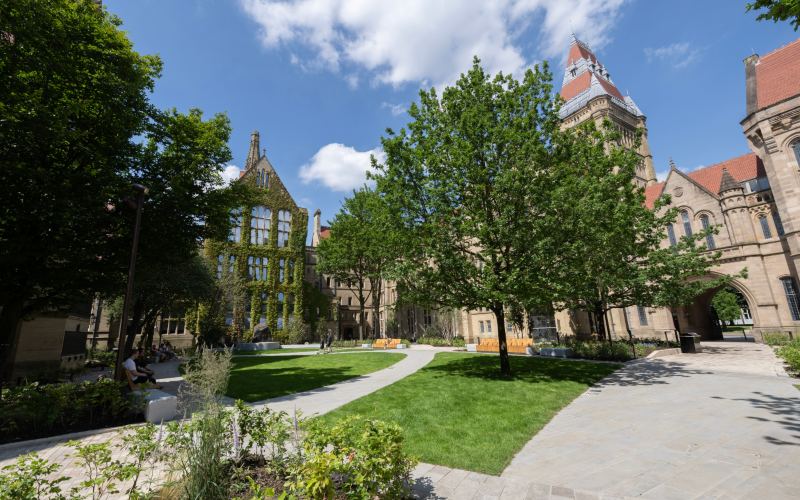
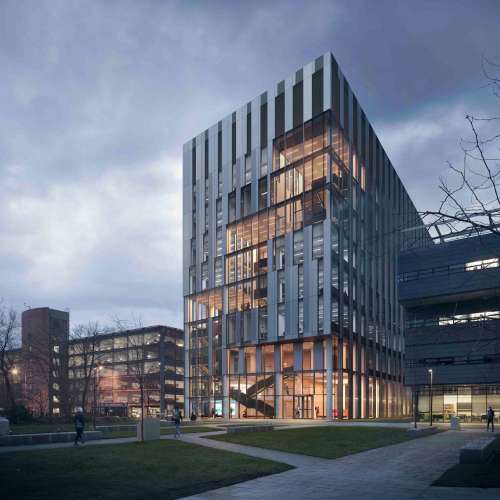
Manchester University seal · sourceOur campus | The University of Manchester · sourceOur campus | The University of Manchester · sourceCampus spaces | Student life at The University of Manchester · source