Admit rate has ranged 57%–69% over the last 5 years — notably volatile, though the latest figure above (76%) falls outside that window. Source: IPEDS via Urban Institute.
Acceptance & SAT from Common Data Set / IPEDS; net price, earnings & graduation from the U.S. Dept. of Education College Scorecard. Figures lag ~1–2 years — verify with the school.
The University of California, Riverside is the scrappy, accessible, and increasingly high-achieving underdog of the UC system. It’s a large public research university where a diverse student body finds a welcoming, sun-drenched campus, a rigorous academic culture, and a surprisingly strong return on investment. While its acceptance rate is high, its graduation rate and mid-career earnings punch well above their weight, making it a powerhouse for upward mobility.
Admission requirements
Test-blind — scores not considered
Required
High school transcript
Grade point average
College-prep program
TOEFL (non-native English)
Source: IPEDS Admissions survey (2022) via Urban Institute. Covers formal factors only — it does not reflect essays, extracurriculars, or other holistic criteria.
More details
Undergrad enrollment
22,593
In-state tuition
$15,606
Out-of-state tuition
$49,806
No-Loan Policy
Not stated in sources
Graduation Rate
76%
Meets Full Need
Not stated in sources
ED Share of Class
Not applicable (No Early Decision program)
First-Year Retention
Not stated in sources
Demonstrated Interest
Not considered
Median Earnings (10yr)
$67,699
Outcomes & value
Outcomes & value
Median earnings (10 yr)
$67,699
Value (earnings ÷ net price)
4.7×
Median debt at graduation
$17,500
Graduation rate
76%
First-year retention
88%
Reducing loan balance (3 yr)
67%
Pell (lower-income) share
47%
First-gen share (among federal-aid recipients)
48%
Top-earning majors
Median earnings by field of study (highest credential), ~2 years after completion.
Computer Engineering$69,617
Electrical, Electronics, and Communications Engineering$66,076
Mechanical Engineering$59,912
Chemical Engineering$49,464
Biomedical/Medical Engineering$49,214
Environmental/Environmental Health Engineering$42,682
Applicants here also applied to
The schools that most often appear alongside UC Riverside on applicants’ lists, from our self-reported outcomes corpus.
On-campus criminal offenses classed as violent (murder/non-negligent manslaughter, rape, robbery, aggravated assault) for the most recent reported year. Source: U.S. Dept. of Education Campus Safety and Security (Clery Act). Counts reflect what’s reported to the school, and urban campuses often report more partly due to non-student incidents nearby — read alongside campus size and setting, not as a standalone safety verdict.
Climate
Pleasant days / yr
154
Summer high
92°F
Winter low
43°F
Annual rain
16.2"
Annual snow
0.9"
Natural-hazard risk
Very High
Pleasant days counts days per year with a mean temperature of 55–75°F, a high at or below 90°F, a low at or above 45°F, and little precipitation — a transparent comfort measure, not a weighting we invented. Computed from Open-Meteo ERA5 daily history (2019–2023). Natural-hazard risk is the county’s composite rating from the FEMA National Risk Index.
Deep dive — research, future-scholar output & economic mobility▾
Research output
Institutional h-index
851
Scholarly works
104,027
Institutional research volume and impact from OpenAlex. The h-index reflects large research universities and will be low for teaching-focused liberal-arts colleges — not a measure of undergraduate quality.
Economic mobility
Mobility rate
6.0%
Bottom → top quintile
41%
From bottom quintile
15%
Mobility rate = the share of students who both start in the bottom household-income quintile and reach the top quintile; bottom → top is that chance conditional on starting at the bottom. Source: Opportunity Insights Mobility Report Cards (Chetty, Friedman, Saez, Turner & Yagan). Reflects 1980–82 birth cohorts, so it’s directional, not current.
Quick answers
What is the acceptance rate at University of California-Riverside?
University of California-Riverside's acceptance rate is approximately 76% (Riverside, CA), based on the most recent figures we compiled from public and primary sources.
How much does University of California-Riverside cost?
At University of California-Riverside, the average net price (after aid) is about $14,304 per year. Actual cost varies with financial aid and residency.
How many undergraduates attend University of California-Riverside?
University of California-Riverside enrolls approximately 22,593 undergraduate students.
Where is University of California-Riverside located?
University of California-Riverside is located in Riverside, CA.
Admissions
UC Riverside stands out in the UC system as the most accessible campus, with an admissions process that is significantly less selective than its siblings. The university's admit rate is notably high, with recent data showing rates as high as 88.2% overall and 69.6% for specific applicant groups. For the Fall 2025 cycle, the was reported at 87.5%, and the admission rate for California residents increased to 78.3% in 2026. This places Riverside's selectivity far above other UCs like Davis (44.6%) and Santa Cruz (72.9%). The rate—the percentage of admitted students who enroll—is 53%. The middle 50% range for admitted freshmen shows a high school GPA between 3.69 and 4.11, and an ACT Composite Score between 21 and 29. Notably, 61% of admitted students have a GPA of 3.75 or higher. The university does not offer an Early Decision program, and demonstrated interest is not considered in admissions decisions. The application deadline for first-year students is December 2.
Earnings = median of students working ~10 years after entry; debt = median of graduates. Value divides 10-yr earnings by one year’s net price — read it as earnings per dollar of annual cost, not a full lifetime ROI; it favors lower-cost schools. Source: U.S. Dept. of Education College Scorecard. Figures lag ~2 years and reflect all students, not your intended major.
Business Administration, Management and Operations$39,087
Economics$38,937
Source: U.S. Dept. of Education College Scorecard (field-of-study earnings). Figures cover graduates who received federal aid and lag ~2 years; not all programs report data.
UC Riverside offers a comprehensive public research university education across dozens of majors, with a particular strength in STEM and professional fields. The curriculum is described as academically rigorous and designed to meet accreditation standards. The most popular majors reflect a blend of practical and scientific interests:
Business (812 graduates)
Research and Experimental Psychology (599 graduates)
Biology (583 graduates)
Economics (315 graduates)
Computer Science (217 graduates)
Mechanical Engineering (354 undergraduates)
Other significant areas of study include Computer and Information Sciences and Support Services (7% of degrees), Visual and Performing Arts (5%), Education (3%), and English Language and Literature/Letters (3%). The university is also ranked 5th nationally in Environmental Health. Faculty are noted as being "very intelligent" and dedicated to supporting and empowering students.
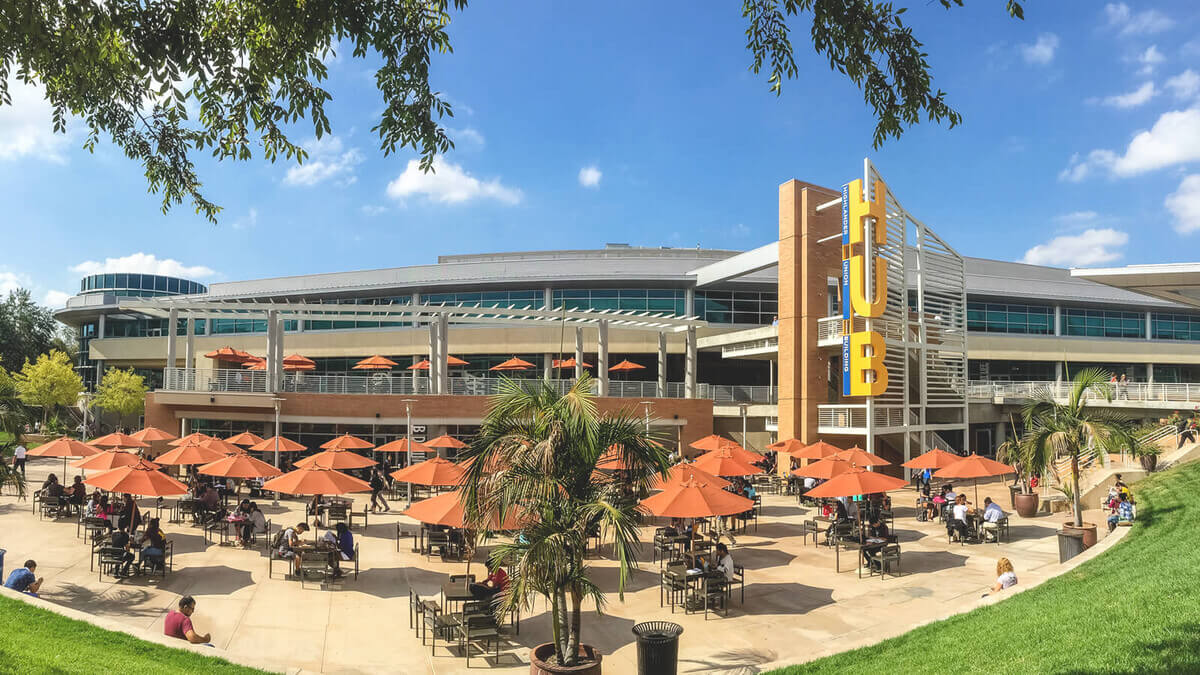
Life at UCR is defined by a vibrant, inclusive, and active campus community in sunny Southern California. Students describe the campus as "huge" with "tons of stuff to do," noting friendly and chill people, good nearby restaurants, and excellent weather. The Office of Student Life is dedicated to providing the "total UCR experience" through opportunities for learning, leadership, and community building. A central feature of campus life is the vast array of over 450 student organizations, spanning social, cultural, activist, service, academic, and professional interests. The campus fosters belonging, community, and connection, with a diverse student body where students from various backgrounds feel welcomed and supported. Students can enjoy a full calendar of music, dance, theater, and other events.
UC Riverside delivers strong and tangible outcomes for its graduates, consistently outperforming expectations for a university with its admission profile. The graduation rate is a robust 79%, placing it in the top 15% of institutions nationally. The four-year graduation rate is 65%. Financially, the payoff is significant: a quarter of UCR alumni earn over $200,000 per year by their mid-career, and almost 20% begin their careers in high-paying fields. The university's value was recognized by Money Magazine, which gave it 4.5 out of 5 stars, highlighting its graduation rate and the average salary of $64,000 a decade after enrollment. The rate for admitted students is 12.2%.
UC Riverside is committed to affordability within the UC system, with a significant majority of its students receiving financial assistance. Nearly 80% of undergraduates are awarded financial aid, and of those, 99% receive need-based scholarships and/or grants. The average —the cost after grants and scholarships—is reported from various sources as $14,487, $18,109, and $13,533. The university's own data states that 76% of full-time beginning undergraduates receive grant or scholarship aid. While the university provides substantial , its policies regarding meeting full demonstrated need and offering no-loan packages are not explicitly detailed in the provided sources; students must demonstrate financial need to qualify for federal subsidized loans.
UC Riverside stands out as the UC system's engine of opportunity. It combines the prestige and rigorous academics of a University of California education with an unusually high level of access. This creates a distinctive environment where a highly diverse student body—many of whom are the first in their families to attend college—can thrive on a supportive, sprawling campus. Its standout features aren't exclusivity, but impact: it graduates students at a rate far above the national average and propels them into careers with strong earning potential. The campus culture is authentically Californian—relaxed, sunny, and collaborative—but underpinned by serious research and pre-professional programs in high-demand fields like engineering, computer science, and business. In a state and a system often defined by fierce competition, UCR offers a compelling alternative: a top-tier public university education where admission is likely, success is supported, and the outcomes are genuinely transformative.
University of California-Riverside seal · sourceUC Riverside / University of California, Riverside · sourceCollege Profile: Take a Closer Look at UC-Riverside – Doing College · sourceUniversity of California-Riverside — Admissions, Tuition & Acceptance Rate | Appily · source