Admit rate has ranged 14%–22% over the last 5 years. Source: IPEDS via Urban Institute.
Acceptance & SAT from Common Data Set / IPEDS; net price, earnings & graduation from the U.S. Dept. of Education College Scorecard. Figures lag ~1–2 years — verify with the school.
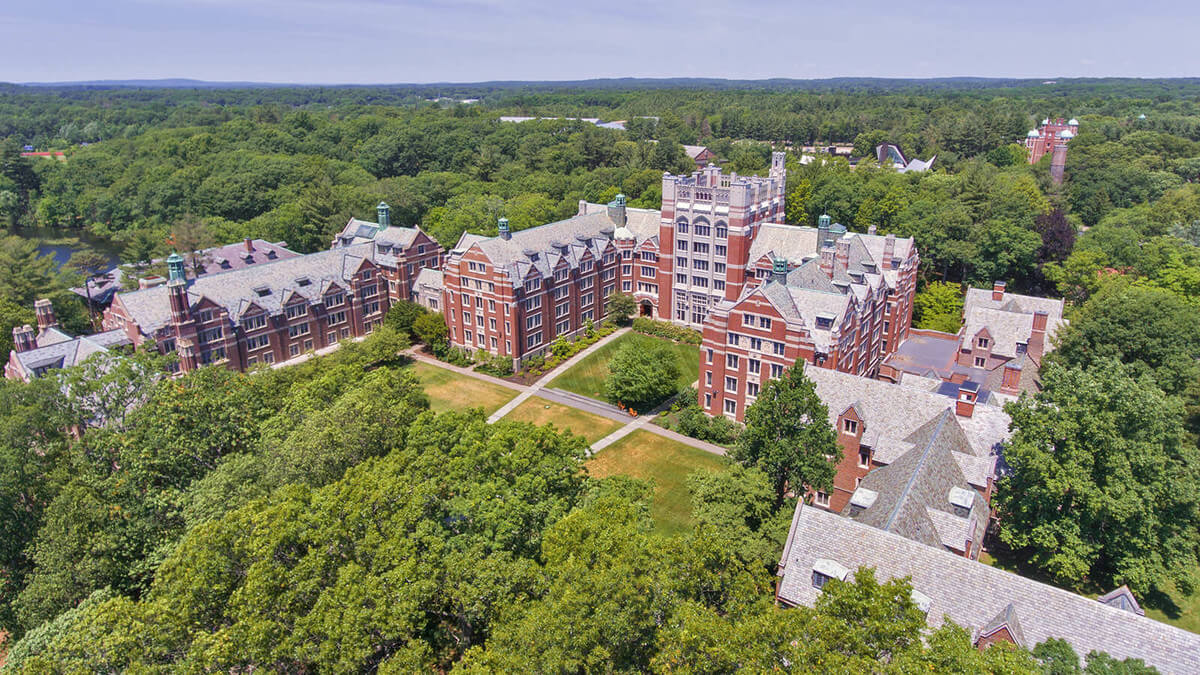
Wellesley College isn't just a top-tier liberal arts college; it's a self-contained ecosystem of intellectual ambition and female leadership, set on a stunning 500-acre campus just outside Boston. Renowned for its academic rigor, fiercely supportive community, and a network of powerful alumnae, it offers an education that is both intensely personal and globally connected. The vibe is one of driven, independent women who are as likely to be found debating in a seminar of 17 as they are collaborating in one of over 180 student organizations.
Admission requirements
Test-optional — scores considered if submitted
Required
High school transcript
Letters of recommendation
Considered (not required)
Grade point average
Class rank
Test scores (SAT/ACT)
College-prep program
Demonstrated competencies
TOEFL (non-native English)
Source: IPEDS Admissions survey (2022) via Urban Institute. Covers formal factors only — it does not reflect essays, extracurriculars, or other holistic criteria.
More details
Undergrad enrollment
2,300
In-state tuition
$67,176
Out-of-state tuition
$67,176
No-Loan Policy
Yes, for qualifying students
Graduation Rate
92%
Meets Full Need
Yes
Consortium Access
MIT, Olin, Brandeis
ED Share of Class
High (est. ~72% per source)
On-Campus Housing
91% of students
Typical Class Size
17–20 students
Demonstrated Interest
Considered
Median Earnings (10yr)
$84,803
Outcomes & value
Outcomes & value
Median earnings (10 yr)
$84,803
Value (earnings ÷ net price)
3.3×
Median debt at graduation
$10,000
Graduation rate
92%
First-year retention
97%
Reducing loan balance (3 yr)
90%
Pell (lower-income) share
21%
First-gen share (among federal-aid recipients)
17%
Earnings = median of students working ~10 years after entry; debt = median of graduates. divides 10-yr earnings by net price — read it as earnings per dollar of annual cost, not a full lifetime ROI; it favors lower-cost schools. Source: U.S. Dept. of Education College Scorecard. Figures lag ~2 years and reflect all students, not your intended major.
Financial health
3.0 / 3.0Meets the federal financial-responsibility standard
U.S. Dept. of Education Financial Responsibility Composite Score (FY2022-23). Scale −1.0 to 3.0; ≥1.5 meets the standard. Reported for private nonprofit & for-profit institutions only — public universities are state-backed and not scored, so this is a stability signal, not a ranking.
Top-earning majors
Median earnings by field of study (highest credential), ~2 years after completion.
Computer and Information Sciences, General$86,867
Economics$76,460
History$41,937
Neurobiology and Neurosciences$38,289
Political Science and Government$36,852
Fine and Studio Arts$36,312
Area Studies
Applicants here also applied to
The schools that most often appear alongside Wellesley on applicants’ lists, from our self-reported outcomes corpus.
Co-application frequency from self-reported results — directional peer discovery, not a recommendation.
Campus & location
Campus safety
On-campus violent crimes (2024)
0
On-campus criminal offenses classed as violent (murder/non-negligent manslaughter, rape, robbery, aggravated assault) for the most recent reported year. Source: U.S. Dept. of Education Campus Safety and Security (Clery Act). Counts reflect what’s reported to the school, and urban campuses often report more partly due to non-student incidents nearby — read alongside campus size and setting, not as a standalone safety verdict.
Climate
Pleasant days / yr
91
Summer high
82°F
Winter low
25°F
Annual rain
50"
Annual snow
33.1"
Natural-hazard risk
Relatively Moderate
Pleasant days counts days per year with a mean temperature of 55–75°F, a high at or below 90°F, a low at or above 45°F, and little precipitation — a transparent comfort measure, not a weighting we invented. Computed from Open-Meteo ERA5 daily history (2019–2023). Natural-hazard risk is the county’s composite rating from the FEMA National Risk Index.
Deep dive — research, future-scholar output & economic mobility▾
Research output
Institutional h-index
287
Scholarly works
12,350
Institutional research volume and impact from OpenAlex. The h-index reflects large research universities and will be low for teaching-focused liberal-arts colleges — not a measure of undergraduate quality.
Share of this school’s graduates who go on to earn research doctorates (2010–20), by national rank and per-capita yield (NSF institutional-yield ratio). A signal of a research-oriented student culture — not a causal promise, since it partly reflects who enrolls. Only top producers appear. Source: NSF NCSES, Baccalaureate Origins of U.S. Research Doctorate Recipients.
Economic mobility
Quick answers
What is the acceptance rate at Wellesley College?
Wellesley College's acceptance rate is approximately 14% (Wellesley, MA), based on the most recent figures we compiled from public and primary sources.
What SAT score do you need for Wellesley College?
Admitted students at Wellesley College typically score 1460–1560 on the SAT (the middle-50% range). Scores outside this band are still admitted, especially with strong applications.
How much does Wellesley College cost?
At Wellesley College, the average net price (after aid) is about $25,496 per year. Actual cost varies with financial aid and residency.
How many undergraduates attend Wellesley College?
Wellesley College enrolls approximately 2,300 undergraduate students.
Where is Wellesley College located?
Wellesley College is located in Wellesley, MA.
Admissions
Gaining admission to Wellesley is a highly selective endeavor, with the college admitting only a small fraction of its ambitious applicant pool. The admissions process is holistic, evaluating far more than just test scores and grades. For the enrolling class, 58% submitted test scores for consideration, with the middle 50% SAT range for admitted students who submitted scores being 730-770 for Evidence-Based Reading and Writing. The college reports that among admitted students, 25% ranked in the top tenth of their high school class. Wellesley offers an Early Decision (ED) program, which is a significant pathway for admission; sources indicate the ED can be substantially higher than the Regular Decision rate, with one analysis noting an ED rate around 40% compared to a much lower RD rate, and that Wellesley fills a large portion of its class through ED. According to the , demonstrated interest is considered in the admissions process. The admitted class of 2029 hailed from 47 states plus Washington, D.C., and several countries.
Ethnic, Cultural Minority, Gender, and Group Studies$33,993
Source: U.S. Dept. of Education College Scorecard (field-of-study earnings). Figures cover graduates who received federal aid and lag ~2 years; not all programs report data.
Mobility rate = the share of students who both start in the bottom household-income quintile and reach the top quintile; bottom → top is that chance conditional on starting at the bottom. Source: Opportunity Insights Mobility Report Cards (Chetty, Friedman, Saez, Turner & Yagan). Reflects 1980–82 birth cohorts, so it’s directional, not current.
Academics
Wellesley's academic reputation is built on intense rigor within a collaborative, intimate setting. The college describes itself as "one of the most academically challenging institutions of higher education in the country." This challenge unfolds in remarkably small classes, with a typical class size of 17 to 20 students, fostering deep connections between students and faculty and a dynamic exchange of ideas. The curriculum is exclusively undergraduate and centered on the liberal arts and sciences, with over 50 departmental and interdisciplinary majors. The academic culture is known for being both supportive and fiercely ambitious, producing graduates who are exceptionally prepared for advanced study and leadership roles. A distinctive feature is the cross-registration consortium with MIT, Olin College of Engineering, and Brandeis University, allowing students to access courses and resources beyond Wellesley's own extensive offerings.
Life on Wellesley's 500-acre campus is vibrant and largely residential, creating a tight-knit community. A full 91% of students live in college-owned, -operated, or -affiliated housing. The campus itself is frequently described as stunningly beautiful, with a mix of historic architecture and modern facilities, including a private lake. Student life is self-directed and rich with activity, powered by over 180 student organizations that host hundreds of events each semester. These range from cultural groups and political clubs to performing arts and publications. While the social scene is largely campus-centric, Boston's vast academic and cultural resources are a major draw, accessible via a short 30-minute bus ride. The overall culture is often characterized as ambitious, supportive, and grounded in a strong sense of community, where students are driven but also look out for one another.
A Wellesley degree is a powerful launchpad. The college's graduation rate is exceptionally high. Beyond timely graduation, Wellesley alumni achieve outsized success in graduate programs and their careers. Institutional research highlights that Wellesley graduates earn Ph.D.s in science and engineering at higher rates than women graduates from peer institutions and are better represented in medical school and MBA programs. Career outcomes are tracked closely; for the Class of 2020, a First Destination Survey conducted within six months of graduation achieved an 84.80% knowledge rate of outcomes. The financial return is strong, with the College Scorecard reporting a high median earnings figure for graduates ten years after entry. This combination of high completion rates and strong postgraduate outcomes underscores the value of the Wellesley network and education.
Wellesley is committed to making its education accessible through a robust, need-based financial aid program. The college promises to meet 100% of the demonstrated financial need for all admitted students. This commitment is a cornerstone of its aid policy. Wellesley also maintains a no-loan policy for many students, meaning financial aid packages for qualifying students are composed entirely of grants and work-study, without requiring loans. The college provides tools like the MyinTuition cost estimator and a Calculator to help families anticipate costs. For those who receive aid, the average net price—the actual cost after grants and scholarships—is significantly below the sticker price. Reports indicate that a large majority of Wellesley students graduate without federal student loan debt.
Wellesley stands out for the potent alchemy of its three defining traits: unparalleled academic intensity in a supportive, women-centered environment; a breathtaking, residential campus that fosters profound community; and a legendary alumnae network that actively propels graduates into positions of influence. It’s not just the small seminars or the MIT cross-registration; it’s the culture that produces a disproportionate number of female PhDs, CEOs, and public servants. The college’s commitment to meeting full financial need with a no-loan policy for many families removes a major barrier, allowing talent to flourish regardless of background. This creates a student body that is both exceptionally driven and remarkably collaborative. The result is an institution that doesn't just educate women—it forges leaders with the intellectual confidence, resilience, and network to change their fields and the world.