Admit rate has ranged 36%–64% over the last 5 years — notably volatile. Source: IPEDS via Urban Institute.
Acceptance & SAT from Common Data Set / IPEDS; net price, earnings & graduation from the U.S. Dept. of Education College Scorecard. Figures lag ~1–2 years — verify with the school.
American University is a politically charged, globally minded campus where future policymakers and international relations wonks thrive. With its prime D.C. location, AU offers unparalleled access to internships and a curriculum steeped in real-world applications—though its suburban campus and lack of big-time sports give it a quieter, more studious vibe than its urban neighbors.
Admission requirements
Test-optional — scores considered if submitted
Required
High school transcript
Grade point average
Letters of recommendation
College-prep program
TOEFL (non-native English)
Considered (not required)
Test scores (SAT/ACT)
Source: IPEDS Admissions survey (2022) via Urban Institute. Covers formal factors only — it does not reflect essays, extracurriculars, or other holistic criteria.
More details
Undergrad enrollment
7,266
In-state tuition
$58,771
Out-of-state tuition
$58,771
Location
Residential NW D.C. (Tenleytown)
Top Majors
Social Sciences, Business, Communications
Notable Fact
42% of admits submitted test scores (test-optional)
Total Cost (2024)
$78,320
4-Year Graduation Rate
79%
Avg Early-Career Salary
$62,512
Outcomes & value
Outcomes & value
Median earnings (10 yr)
$77,370
Value (earnings ÷ net price)
1.8×
Median debt at graduation
$22,750
Graduation rate
75%
First-year retention
88%
Reducing loan balance (3 yr)
79%
Pell (lower-income) share
14%
First-gen share (among federal-aid recipients)
16%
Top-earning majors
Median earnings by field of study (highest credential), ~2 years after completion.
Computer Science$73,635
Accounting and Related Services$66,014
Finance and Financial Management Services$55,512
Teacher Education and Professional Development, Specific Levels and Methods$49,136
Business Administration, Management and Operations$48,725
Public Relations, Advertising, and Applied Communication
Applicants here also applied to
The schools that most often appear alongside American on applicants’ lists, from our self-reported outcomes corpus.
Co-application frequency from self-reported results — directional peer discovery, not a recommendation.
Campus & location
Campus safety
On-campus violent crimes (2024)
5
Per 1,000 students
0.41
On-campus criminal offenses classed as violent (murder/non-negligent manslaughter, rape, robbery, aggravated assault) for the most recent reported year. Source: U.S. Dept. of Education Campus Safety and Security (Clery Act). Counts reflect what’s reported to the school, and urban campuses often report more partly due to non-student incidents nearby — read alongside campus size and setting, not as a standalone safety verdict.
Climate
Pleasant days / yr
86
Summer high
86°F
Winter low
31°F
Annual rain
55.6"
Annual snow
10.9"
Natural-hazard risk
Relatively High
Pleasant days counts days per year with a mean temperature of 55–75°F, a high at or below 90°F, a low at or above 45°F, and little precipitation — a transparent comfort measure, not a weighting we invented. Computed from Open-Meteo ERA5 daily history (2019–2023). Natural-hazard risk is the county’s composite rating from the FEMA National Risk Index.
Deep dive — research, future-scholar output & economic mobility▾
Research output
Institutional h-index
367
Scholarly works
30,919
Institutional research volume and impact from OpenAlex. The h-index reflects large research universities and will be low for teaching-focused liberal-arts colleges — not a measure of undergraduate quality.
Economic mobility
Mobility rate
1.3%
Bottom → top quintile
36%
From bottom quintile
4%
Mobility rate = the share of students who both start in the bottom household-income quintile and reach the top quintile; bottom → top is that chance conditional on starting at the bottom. Source: Opportunity Insights Mobility Report Cards (Chetty, Friedman, Saez, Turner & Yagan). Reflects 1980–82 birth cohorts, so it’s directional, not current.
Quick answers
What is the acceptance rate at American University?
American University's acceptance rate is approximately 62% (Washington, DC), based on the most recent figures we compiled from public and primary sources.
What SAT score do you need for American University?
Admitted students at American University typically score 1280–1460 on the SAT (the middle-50% range). Scores outside this band are still admitted, especially with strong applications.
How much does American University cost?
At American University, the average net price (after aid) is about $41,943 per year. Actual cost varies with financial aid and residency.
How many undergraduates attend American University?
American University enrolls approximately 7,266 undergraduate students.
Where is American University located?
American University is located in Washington, DC.
Admissions
American University admits about 62% of applicants, making it somewhat selective but not elite. The middle 50% of admitted students for the Class of 2029 had GPAs between 3.57–4.02, SAT scores of 1330–1440, and ACT scores of 29–32. Only 42% of admitted students submitted test scores, reflecting AU's policy. Reddit anecdotes suggest strong AP scores (5+ exams with 4s or 5s) can compensate for a modest GPA (e.g., 3.2 UW). Transfer admission is competitive but not quantified in the .
AU’s academic identity orbits around , with the School of International Service (SIS) as its crown jewel. The liberal arts core ensures breadth, but students dive deep into D.C.-adjacent fields: social sciences (the most popular major category), business, and media dominate. Reddit users note AU isn’t as rigorous as UVA but punches above its weight in policy-focused programs. Experiential learning—internships on Capitol Hill, research with think tanks—is baked into the curriculum, and faculty are praised for blending theory with D.C. practicality.
Earnings = median of students working ~10 years after entry; debt = median of graduates. Value divides 10-yr earnings by one year’s net price — read it as earnings per dollar of annual cost, not a full lifetime ROI; it favors lower-cost schools. Source: U.S. Dept. of Education College Scorecard. Figures lag ~2 years and reflect all students, not your intended major.
$48,432
Economics$47,494
Communication and Media Studies$45,980
Source: U.S. Dept. of Education College Scorecard (field-of-study earnings). Figures cover graduates who received federal aid and lag ~2 years; not all programs report data.
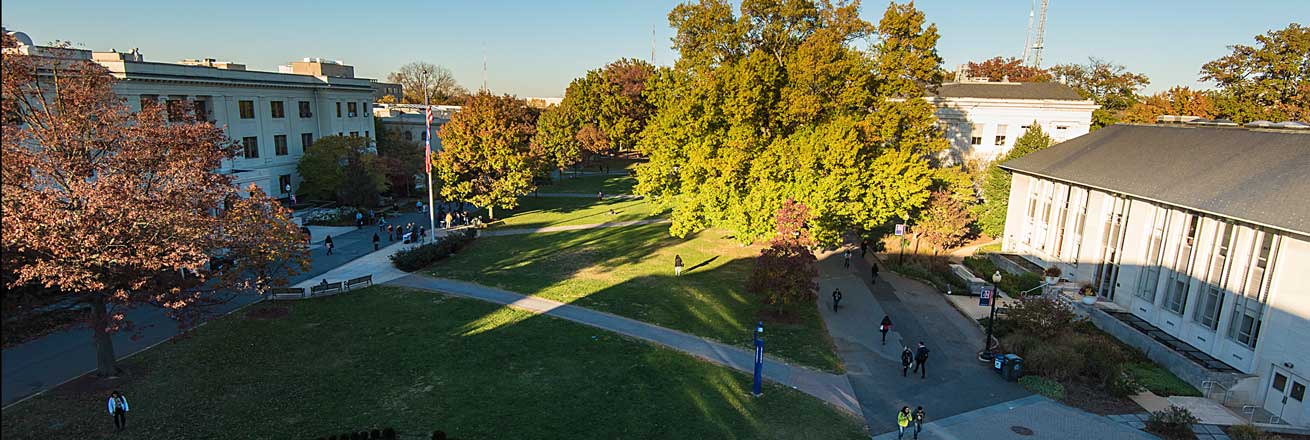
Don’t expect Big Ten tailgates: AU’s social scene is club-heavy, politically engaged, and low-key. With no football team to rally around, students flock to 200+ organizations (model UN, activism groups) or D.C.’s bars and museums. The campus, often called an underrated 'oasis,' mixes Collegiate Gothic architecture with leafy walkability. Greek life exists but isn’t dominant. Instagram highlights identity-focused orientation programs, while Reddit confirms the vibe is 'not a party school'—more likely to debate UN resolutions than shotgun beers.
AU’s 79% graduation rate (well above the national median) reflects its supportive, career-focused culture. Within six months, 2023–24 grads earned an average salary of $62,512—likely inflated by D.C.’s high-paying policy jobs. Long-term earnings jump to $72,598 after five years (per Niche), suggesting AU alumni climb quickly in gov/NGO sectors. Notably, women graduate at higher rates (81%) than men. The ‘We Know Success’ campaign touts placements at State Department affiliates, NPR, and Deloitte, though liberal arts grads may earn less initially.
Sticker shock is real: $78,320 total cost (tuition, room, etc.) places AU among the priciest D.C. schools. But 46% of students receive aid, slashing the average to $40,189. Merit scholarships—often tied to GPA/test scores—and need-based grants drive this down, though the Net Price Calculator warns estimates can vary. For context, AU’s aid packages average $47,908, but middle-income families may still face heavy loan burdens. The financial aid office emphasizes early FAFSA filing to maximize eligibility.
AU is the ultimate feeder for D.C. careers, offering unmatched access to internships (think: White House, World Bank) and a faculty roster peppered with former diplomats. Its niche isn’t Ivy-level prestige but hyper-specialized training for policy wonks—SIS grads flood Foggy Bottom. The campus’s suburban-DC hybrid vibe appeals to students who want greenery without sacrificing metro access. Just know: If you’re apolitical or crave rah-rah school spirit, AU might feel like a mismatch.
American University logo · sourceOur Campus | American University, Washington, DC · sourceVisiting Campus | American University, Washington, DC · sourceOn-Campus Overview | American University, Washington, DC · source