Loading…
← All schools
Arizona State University Digital Immersion
Scottsdale, AZpublicwww.asu.edu/
Acceptance
67%
Earnings (10 yr)
$62,668
Graduation rate
—
Admit rate has ranged 64%–73% over the last 5 years — notably volatile. Source: IPEDS via Urban Institute.
Acceptance & SAT from Common Data Set / IPEDS; net price, earnings & graduation from the U.S. Dept. of Education College Scorecard. Figures lag ~1–2 years — verify with the school.
Arizona State University Digital Immersion is the sprawling, ambitious online arm of a public research giant, built for scale and accessibility rather than selectivity. It operates as a high-volume, high-flexibility portal to hundreds of accredited online degrees, where the admissions gate is wide open but the academic infrastructure is robust. This is not a traditional residential college experience; it's a digital ecosystem designed for working adults, career-changers, and anyone seeking a reputable degree on their own schedule, with outcomes that punch well above the weight of its open-door policy.
Admission requirements
Test-blind — scores not considered
Required
- High school transcript
- TOEFL (non-native English)
Considered (not required)
- Grade point average
- Class rank
- College-prep program
Source: IPEDS Admissions survey (2022) via Urban Institute. Covers formal factors only — it does not reflect essays, extracurriculars, or other holistic criteria.
More details
- Undergrad enrollment
- 53,782
- Popular Majors
- Psychology, Organizational Leadership, Business
- Graduation Rate
- 0%
- ED Share of Class
- Not offered
- Demonstrated Interest
- Not considered
- Median Earnings (10yr)
- $62,668
Outcomes & value
Outcomes & value
- Median earnings (10 yr)
- $62,668
- Median debt at graduation
- $19,500
- Graduation rate
- —
- First-year retention
- 100%
- Reducing loan balance (3 yr)
- 58%
- Pell (lower-income) share
- 40%
- First-gen share (among federal-aid recipients)
- 38%
- Endowment / student
- $3,731
Top-earning majors
Median earnings by field of study (highest credential), ~2 years after completion.
- Computer Science$77,618
- Computer Engineering$75,804
- Electrical, Electronics, and Communications Engineering$69,505
- Mechanical Engineering$66,342
- Engineering-Related Fields$65,797
- Registered Nursing, Nursing Administration, Nursing Research and Clinical Nursing
Applicants here also applied to
The schools that most often appear alongside Arizona State University Digital Immersion on applicants’ lists, from our self-reported outcomes corpus.
Campus & location
Climate
- Pleasant days / yr
- 100
- Summer high
- 105°F
- Winter low
- 44°F
- Annual rain
- 12.8"
- Natural-hazard risk
- Very High
Pleasant days counts days per year with a mean temperature of 55–75°F, a high at or below 90°F, a low at or above 45°F, and little precipitation — a transparent comfort measure, not a weighting we invented. Computed from Open-Meteo ERA5 daily history (2019–2023). Natural-hazard risk is the county’s composite rating from the FEMA National Risk Index.
Quick answers
- What is the acceptance rate at Arizona State University Digital Immersion?
- Arizona State University Digital Immersion's acceptance rate is approximately 67% (Scottsdale, AZ), based on the most recent figures we compiled from public and primary sources.
- How many undergraduates attend Arizona State University Digital Immersion?
- Arizona State University Digital Immersion enrolls approximately 53,782 undergraduate students.
- Where is Arizona State University Digital Immersion located?
- Arizona State University Digital Immersion is located in Scottsdale, AZ.
Admissions
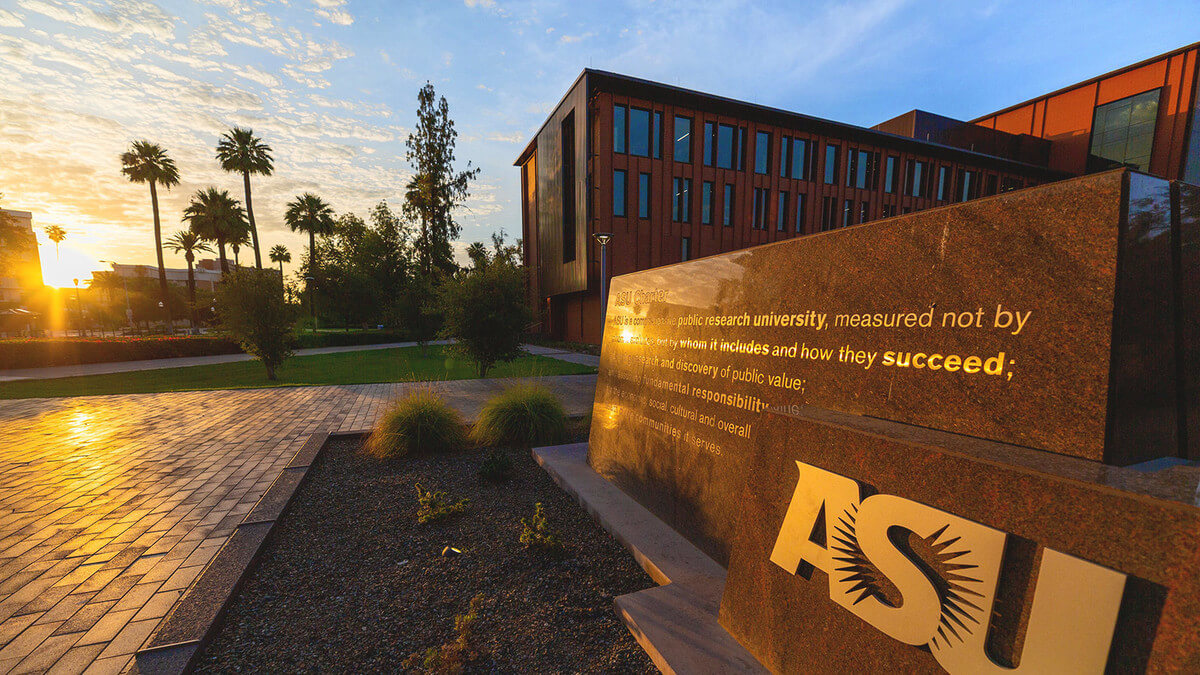
The defining characteristic of ASU Digital Immersion is its radically accessible admissions process. The university is a high-volume operation, admitting a significant majority of applicants. While sources vary slightly, the consensus hovers in the mid-to-high 60s percent, a figure that aligns with the institution's mission of broad access. According to the canonical figures, the acceptance rate is 67%. One analysis notes that between 2023 and 2024, the number of applicants grew by 6.4%, while admissions grew by 10.7%, indicating expanding capacity. The process is ; while ASU publishes benchmark scores (SAT: 1120 for residents, 1180 for nonresidents; ACT: 22 for residents, 24 for nonresidents), these are for course placement, not admission. The university does not offer an Early Decision plan, and per conventions, demonstrated interest is typically not a considered factor. The rate—the percentage of admitted students who enroll—is reported as 54.07% for the 2024-25 academic year. The vibe is straightforward: if you meet the core requirements, you're likely in. This is a deliberate strategy, not a lack of rigor, reflecting ASU's charter commitment to measure itself "by whom it includes and how they succeed."
Compare Arizona State University Digital Immersion
vs Kennesaw State Universityvs Oregon State Universityvs University of Nevada-Renovs University of Houston
See colleges similar to Arizona State University Digital Immersion →Sources
- [PDF] Arizona State University Campus Immersion Common Data Set ...
- Common data set - Institutional Analysis - Arizona State University
- Arizona State University 2026 Common Data Set - GradGPT
- Arizona State University Digital Immersion - IPEDS
- Common Data Set: Home
- [PDF] CDS_2015-2016 Tempe - Office of the University Provost
- Arizona State University Digital Immersion Acceptance Rate
- Arizona State University Admissions - US News Best Colleges
- First-year student college admission requirements
- Arizona State University Digital Immersion Acceptance Rates ...