Admit rate has ranged 45%–68% over the last 5 years — notably volatile. Source: IPEDS via Urban Institute.
Acceptance & SAT from Common Data Set / IPEDS; net price, earnings & graduation from the U.S. Dept. of Education College Scorecard. Figures lag ~1–2 years — verify with the school.
Baylor University carves out a distinct identity as a large, spirited, and increasingly selective Christian research university in the heart of Texas. It blends a robust Baptist tradition with a serious commitment to climbing the academic ranks, offering students a deeply communal, tradition-rich campus life alongside nationally recognized programs in business, nursing, and entrepreneurship. Think of it as the intersection of Southern warmth, Big 12 athletic fervor, and a determined drive for top-tier scholarly recognition.
Admission requirements
Test-optional — scores considered if submitted
Required
High school transcript
Grade point average
TOEFL (non-native English)
Considered (not required)
Class rank
Letters of recommendation
Test scores (SAT/ACT)
College-prep program
Demonstrated competencies
Source: IPEDS Admissions survey (2022) via Urban Institute. Covers formal factors only — it does not reflect essays, extracurriculars, or other holistic criteria.
More details
Undergrad enrollment
14,785
In-state tuition
$58,100
Out-of-state tuition
$58,100
Graduation Rate
80%
Demonstrated Interest
Considered
Student Organizations
350+
Median Earnings (10yr)
$65,793
Student-to-Faculty Ratio
15:1
Outcomes & value
Outcomes & value
Median earnings (10 yr)
$65,793
Value (earnings ÷ net price)
1.6×
Median debt at graduation
$23,000
Graduation rate
80%
First-year retention
91%
Reducing loan balance (3 yr)
72%
Pell (lower-income) share
12%
First-gen share (among federal-aid recipients)
17%
Financial health
3.0 / 3.0Meets the federal financial-responsibility standard
U.S. Dept. of Education Financial Responsibility Composite Score (FY2022-23). Scale −1.0 to 3.0; ≥1.5 meets the standard. Reported for private nonprofit & for-profit institutions only — public universities are state-backed and not scored, so this is a stability signal, not a ranking.
Top-earning majors
Median earnings by field of study (highest credential), ~2 years after completion.
General Sales, Merchandising and Related Marketing Operations$84,653
Electrical, Electronics, and Communications Engineering$75,047
Computer Science$71,015
Mechanical Engineering$66,897
Management Information Systems and Services$65,320
Registered Nursing, Nursing Administration, Nursing Research and Clinical Nursing
Applicants here also applied to
The schools that most often appear alongside Baylor on applicants’ lists, from our self-reported outcomes corpus.
Co-application frequency from self-reported results — directional peer discovery, not a recommendation.
Campus & location
Campus safety
On-campus violent crimes (2024)
10
Per 1,000 students
0.49
On-campus criminal offenses classed as violent (murder/non-negligent manslaughter, rape, robbery, aggravated assault) for the most recent reported year. Source: U.S. Dept. of Education Campus Safety and Security (Clery Act). Counts reflect what’s reported to the school, and urban campuses often report more partly due to non-student incidents nearby — read alongside campus size and setting, not as a standalone safety verdict.
Climate
Pleasant days / yr
97
Summer high
96°F
Winter low
43°F
Annual rain
42.5"
Annual snow
2"
Natural-hazard risk
Relatively Moderate
Pleasant days counts days per year with a mean temperature of 55–75°F, a high at or below 90°F, a low at or above 45°F, and little precipitation — a transparent comfort measure, not a weighting we invented. Computed from Open-Meteo ERA5 daily history (2019–2023). Natural-hazard risk is the county’s composite rating from the FEMA National Risk Index.
Deep dive — research, future-scholar output & economic mobility▾
Research output
Institutional h-index
511
Scholarly works
40,637
Institutional research volume and impact from OpenAlex. The h-index reflects large research universities and will be low for teaching-focused liberal-arts colleges — not a measure of undergraduate quality.
Future-scholar output
Humanities & social-science PhDstop 50 nationally
Share of this school’s graduates who go on to earn research doctorates (2010–20), by national rank and per-capita yield (NSF institutional-yield ratio). A signal of a research-oriented student culture — not a causal promise, since it partly reflects who enrolls. Only top producers appear. Source: NSF NCSES, Baccalaureate Origins of U.S. Research Doctorate Recipients.
Economic mobility
Mobility rate
1.4%
Bottom → top quintile
Quick answers
What is the acceptance rate at Baylor University?
Baylor University's acceptance rate is approximately 51% (Waco, TX), based on the most recent figures we compiled from public and primary sources.
What SAT score do you need for Baylor University?
Admitted students at Baylor University typically score 1200–1400 on the SAT (the middle-50% range). Scores outside this band are still admitted, especially with strong applications.
How much does Baylor University cost?
At Baylor University, the average net price (after aid) is about $41,104 per year. Actual cost varies with financial aid and residency.
How many undergraduates attend Baylor University?
Baylor University enrolls approximately 14,785 undergraduate students.
Where is Baylor University located?
Baylor University is located in Waco, TX.
Admissions
Baylor's admissions process reflects its trajectory toward greater selectivity, operating with a clear early advantage for committed applicants. The overall sits at 51%, but the landscape shifts dramatically for those applying Early Decision. Sources indicate Early Decision acceptance rates are significantly higher, with one report citing 77% and another detailing a cycle where 485 of 567 ED applicants were accepted—an 85.5% rate. This creates a strategic pathway for students certain Baylor is their first choice.
The middle 50% SAT range for admitted students is 1200–1400, though the university is . Academic factors reign supreme in the evaluation. The outlines that the rigor of secondary school record, GPA, and standardized test scores (if submitted) are all rated as "very important." Character/personal qualities and extracurricular activities are "important," while talent/ability and volunteer work are "considered." Notably, for first-year applicants, the level of an applicant's interest is also marked as "considered," suggesting demonstrated engagement can be a factor in the process. The university enrolls a sizable freshman class, with recent figures showing 3,549 new students.
Earnings = median of students working ~10 years after entry; debt = median of graduates. Value divides 10-yr earnings by one year’s net price — read it as earnings per dollar of annual cost, not a full lifetime ROI; it favors lower-cost schools. Source: U.S. Dept. of Education College Scorecard. Figures lag ~2 years and reflect all students, not your intended major.
$64,216
Business Administration, Management and Operations$59,854
Finance and Financial Management Services$59,425
Source: U.S. Dept. of Education College Scorecard (field-of-study earnings). Figures cover graduates who received federal aid and lag ~2 years; not all programs report data.
Mobility rate = the share of students who both start in the bottom household-income quintile and reach the top quintile; bottom → top is that chance conditional on starting at the bottom. Source: Opportunity Insights Mobility Report Cards (Chetty, Friedman, Saez, Turner & Yagan). Reflects 1980–82 birth cohorts, so it’s directional, not current.
Baylor offers a comprehensive academic portfolio through its twelve degree-granting schools and colleges, providing over 125 undergraduate majors and programs. The curriculum is built around a nationally recognized academic core, and the university boasts a favorable 15:1 student-to-faculty ratio with an average class size of 26. This structure supports its identity as a Christian research university, where undergraduate education is a priority.
Popular majors consistently include Registered Nursing, Biology, Accounting, Finance, and Marketing. The university takes particular pride in its entrepreneurship program, which is consistently ranked in the top 10 nationally by U.S. News & World Report. Beyond the baccalaureate, Baylor confers a wide range of graduate degrees, including 80 master's, 47 doctoral, a Juris Doctor, and two education specialist programs. The academic community is also recognized for attracting high-achieving students, ranking in the top 7 percent nationally for National Merit Scholars.
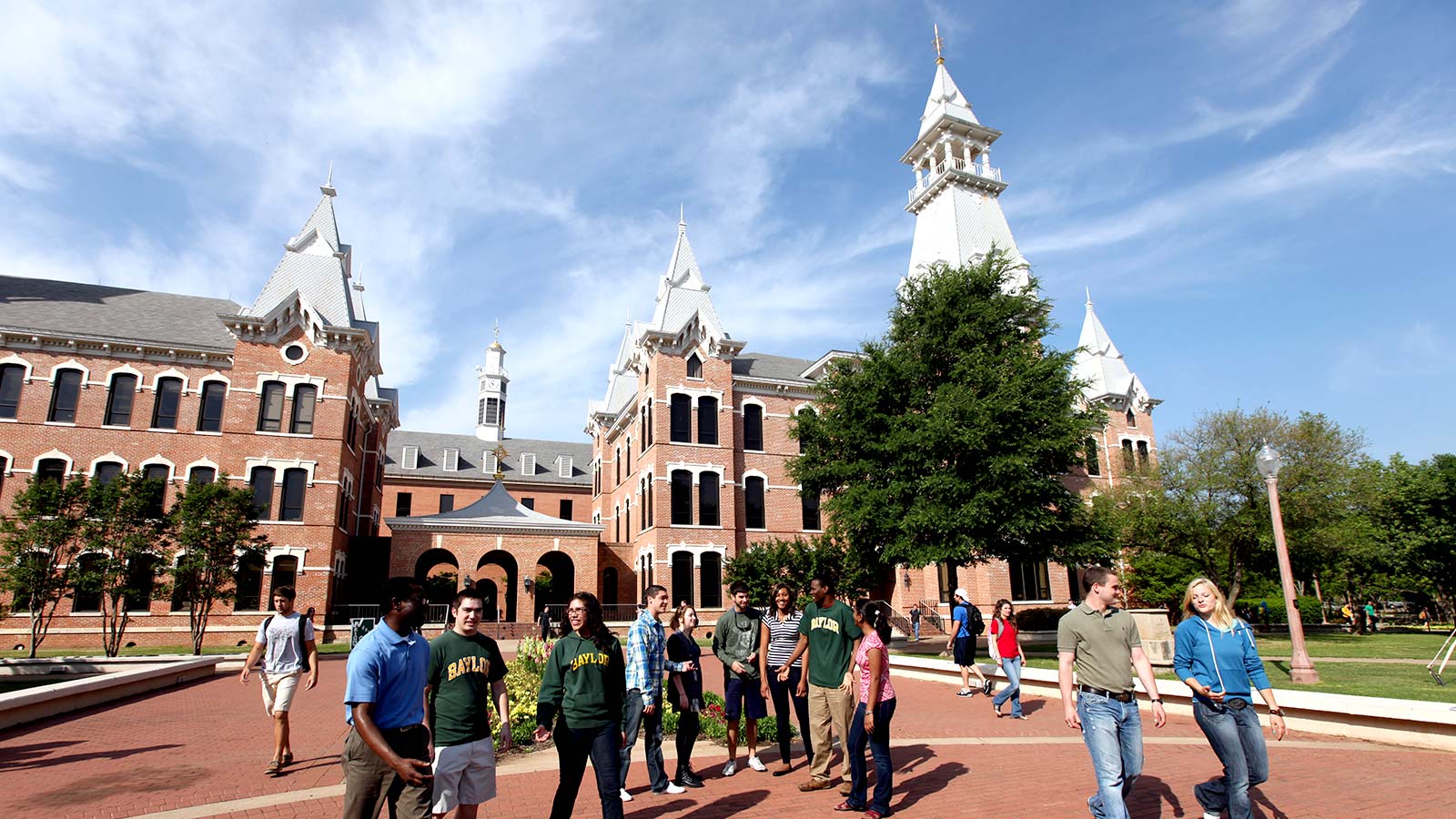
Life at Baylor is defined by profound school spirit, a dense web of traditions, and a highly engaged student body. The campus culture is actively shaped by its Christian mission, fostering a close-knit community. Students have access to over 350–400 student organizations, ensuring there's a niche for every interest. Signature events anchor the social and spiritual calendar, including Homecoming ('Hoco'), the spectacular Christmas on Fifth celebration, Line Camp for incoming freshmen, and Welcome Week.
As a member of the Big 12 Conference, athletics—particularly football and basketball—are a major unifying force. The campus is frequently described as vibrant and active, where students easily find things to do with others. The university consciously cultivates this environment, aiming to help students grow "intellectually, spiritually and emotionally" through a rich campus life. This blend of faith, tradition, and spirited community creates an experience that students and alumni describe as "special" and "unmatched."
Baylor demonstrates strong and improving student outcomes, with a particular focus on timely graduation. The university's four-year graduation rate has been on a steady upward climb, reaching a record high of 77.3% for the cohort that entered in Fall 2021. This exceeds the institution's own targets and reflects a concerted institutional effort. The overall graduation rate is 80%, which places Baylor in the top 15% of institutions nationally.
For career outcomes, the university surveys graduating students each semester about their post-graduation plans. While specific placement rates for the most recent class are not detailed in the provided sources, earnings data shows positive trajectories. Alumni median earnings ten years after entry are $65,793. Earlier career data indicates earnings of approximately $50,754 one year after graduation, rising to around $66,167 after five years.
Attending Baylor requires a significant financial investment, with an average after aid of $41,104. The university employs a need-aware financial aid process for most students entering prior to Fall 2027, where aid is based on demonstrated need calculated from the FAFSA and CSS Profile. However, submission of the CSS Profile does not guarantee that Baylor will meet a student's full demonstrated financial need.
All undergraduate applicants are automatically considered for merit-based scholarships upon application, and many additional scholarship opportunities exist. for eligible students includes federal Pell Grants and, for Texas residents, the state's TEXAS Grant program. The university provides net price calculators and cost estimation worksheets to help families project expenses. Notably, Baylor's financial aid policies for entering students do not include a universal "no-loan" guarantee where 100% of need is met with grants; loans are typically part of aid packages for those who qualify for need-based assistance.
Baylor stands out for its unique and potent synthesis of scale, faith, and ambition. It is not merely a large private university in Texas; it is a purpose-driven institution on a deliberate ascent. While firmly rooted in its Baptist heritage and the communal, tradition-heavy culture that defines the student experience, Baylor is simultaneously executing a long-term plan to solidify its status as a top-tier Christian research university. This dual identity means students can expect the spirited football Saturdays, profound sense of belonging, and value-centered environment of a classic Southern college, alongside increasingly competitive academics, a growing research profile, and record-setting graduation rates.
The university's standout entrepreneurship program exemplifies this blend, applying innovative thinking within an ethical framework. It's a place where faith and ambition are not in tension but are intertwined, aiming to prepare students for impactful careers and lives. For students seeking a comprehensive, Division I athletic experience within a supportive Christian community that also prizes academic achievement and post-graduate success, Baylor offers a distinctive and compelling package.