Admit rate has ranged 41%–51% over the last 5 years — notably volatile. Source: IPEDS via Urban Institute.
Acceptance & SAT from Common Data Set / IPEDS; net price, earnings & graduation from the U.S. Dept. of Education College Scorecard. Figures lag ~1–2 years — verify with the school.
CUNY Bernard M. Baruch College is a powerhouse of upward mobility, a public institution in the heart of Manhattan that delivers a high-octane, career-focused education at a price that feels like a typo. Anchored by its nationally ranked business programs, Baruch operates with the pragmatic, fast-paced energy of New York City itself, funneling a remarkably diverse student body into the city's financial and professional corridors. It's where the American Dream gets a spreadsheet and a subway pass, producing graduates with some of the highest early-career earnings of any public college in the nation.
Admission requirements
Test-blind — scores not considered
Required
High school transcript
Grade point average
College-prep program
TOEFL (non-native English)
Considered (not required)
Letters of recommendation
Source: IPEDS Admissions survey (2022) via Urban Institute. Covers formal factors only — it does not reflect essays, extracurriculars, or other holistic criteria.
More details
Undergrad enrollment
16,154
In-state tuition
$7,464
Out-of-state tuition
$15,414
Graduation Rate
72%
Demonstrated Interest
Not considered
Median Earnings (10yr)
$75,971
Student Clubs & Organizations
120+
Outcomes & value
Outcomes & value
Median earnings (10 yr)
$75,971
Value (earnings ÷ net price)
25.0×
Median debt at graduation
$11,512
Graduation rate
72%
First-year retention
89%
Reducing loan balance (3 yr)
65%
Pell (lower-income) share
57%
First-gen share (among federal-aid recipients)
51%
Top-earning majors
Median earnings by field of study (highest credential), ~2 years after completion.
Mathematics$61,064
Accounting and Related Services$50,105
Information Science/Studies$49,571
Finance and Financial Management Services$49,501
Economics$48,432
International Business$47,260
Applicants here also applied to
The schools that most often appear alongside CUNY Bernard M Baruch College on applicants’ lists, from our self-reported outcomes corpus.
Co-application frequency from self-reported results — directional peer discovery, not a recommendation.
Campus & location
Campus safety
On-campus violent crimes (2024)
1
Per 1,000 students
0.05
On-campus criminal offenses classed as violent (murder/non-negligent manslaughter, rape, robbery, aggravated assault) for the most recent reported year. Source: U.S. Dept. of Education Campus Safety and Security (Clery Act). Counts reflect what’s reported to the school, and urban campuses often report more partly due to non-student incidents nearby — read alongside campus size and setting, not as a standalone safety verdict.
Climate
Pleasant days / yr
90
Summer high
83°F
Winter low
29°F
Annual rain
54.4"
Annual snow
18.3"
Natural-hazard risk
Relatively High
Pleasant days counts days per year with a mean temperature of 55–75°F, a high at or below 90°F, a low at or above 45°F, and little precipitation — a transparent comfort measure, not a weighting we invented. Computed from Open-Meteo ERA5 daily history (2019–2023). Natural-hazard risk is the county’s composite rating from the FEMA National Risk Index.
Deep dive — research, future-scholar output & economic mobility▾
Economic mobility
Mobility rate
12.9%
Bottom → top quintile
47%
From bottom quintile
28%
Mobility rate = the share of students who both start in the bottom household-income quintile and reach the top quintile; bottom → top is that chance conditional on starting at the bottom. Source: Opportunity Insights Mobility Report Cards (Chetty, Friedman, Saez, Turner & Yagan). Reflects 1980–82 birth cohorts, so it’s directional, not current.
Quick answers
What is the acceptance rate at CUNY Bernard M Baruch College?
CUNY Bernard M Baruch College's acceptance rate is approximately 48% (New York, NY), based on the most recent figures we compiled from public and primary sources.
What SAT score do you need for CUNY Bernard M Baruch College?
Admitted students at CUNY Bernard M Baruch College typically score 1100–1400 on the SAT (the middle-50% range). Scores outside this band are still admitted, especially with strong applications.
How much does CUNY Bernard M Baruch College cost?
At CUNY Bernard M Baruch College, the average net price (after aid) is about $3,033 per year. Actual cost varies with financial aid and residency.
How many undergraduates attend CUNY Bernard M Baruch College?
CUNY Bernard M Baruch College enrolls approximately 16,154 undergraduate students.
Where is CUNY Bernard M Baruch College located?
CUNY Bernard M Baruch College is located in New York, NY.
Admissions
Baruch is selective for a public institution, admitting roughly half of its applicants, but its process is notably streamlined and pragmatic. For the Fall 2023 through Spring 2027 admission cycles, SAT and ACT test scores are not required nor considered in the application review process. The admissions office emphasizes academic rigor, looking closely at a student's high school transcript. The college receives a high volume of applications, and while the has fluctuated, it remains a competitive destination within the CUNY system. Once admitted, a significant portion of students choose to enroll, resulting in a rate that reflects its strong local and regional appeal. Demonstrated interest, such as campus visits or contact with admissions, is not a formal factor in the evaluation process.
Test-Optional Policy: SAT/ACT scores are not required or considered for applicants from Fall 2023 through Spring 2027.
Primary Factors: The academic record, including the rigor of high school coursework and GPA, is the central component of the application review.
Application Volume: The college processes tens of thousands of freshman applications annually, contributing to its selective profile.
Earnings = median of students working ~10 years after entry; debt = median of graduates. Value divides 10-yr earnings by one year’s net price — read it as earnings per dollar of annual cost, not a full lifetime ROI; it favors lower-cost schools. Source: U.S. Dept. of Education College Scorecard. Figures lag ~2 years and reflect all students, not your intended major.
Business Administration, Management and Operations
$46,820
Management Sciences and Quantitative Methods$45,852
Source: U.S. Dept. of Education College Scorecard (field-of-study earnings). Figures cover graduates who received federal aid and lag ~2 years; not all programs report data.
Academics at Baruch are organized into three distinct schools, creating a unique blend of professional training and liberal arts foundation. The Zicklin School of Business is the engine of the college's reputation, one of the largest and most respected business schools in the nation. The Weissman School of Arts and Sciences provides the core liberal arts curriculum and houses majors in the humanities, social sciences, and sciences. The Marxe School of Public and International Affairs rounds out the trio, focusing on policy, administration, and global affairs. This structure means every student, whether a finance major or a political science student, gets a grounding in a broad education while having direct access to specialized, high-level professional schools.
The most popular majors overwhelmingly cluster in business and related fields, with Finance being the single largest degree program. However, the college also grants a significant number of degrees in computer and information sciences, reflecting the growing demand for tech skills in the New York market. The academic environment is described as engaged and rigorous, with a clear focus on developing professional competence and intellectual exploration. The curriculum is designed to be a capacity-builder, aiming for professional achievement and personal growth.
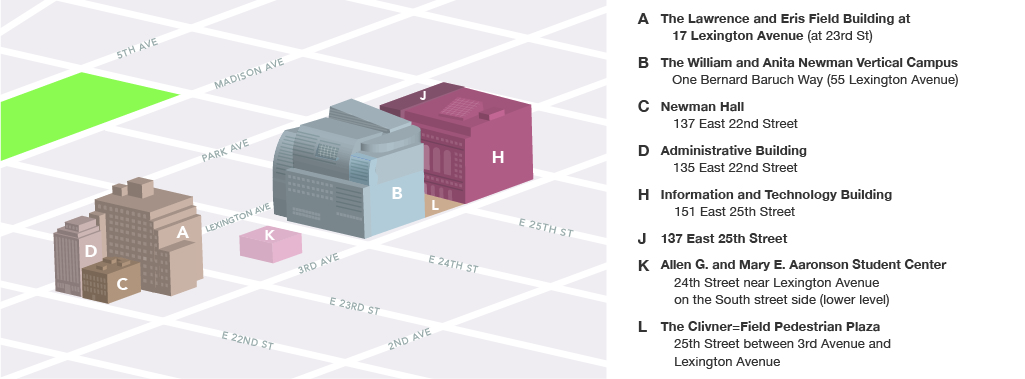
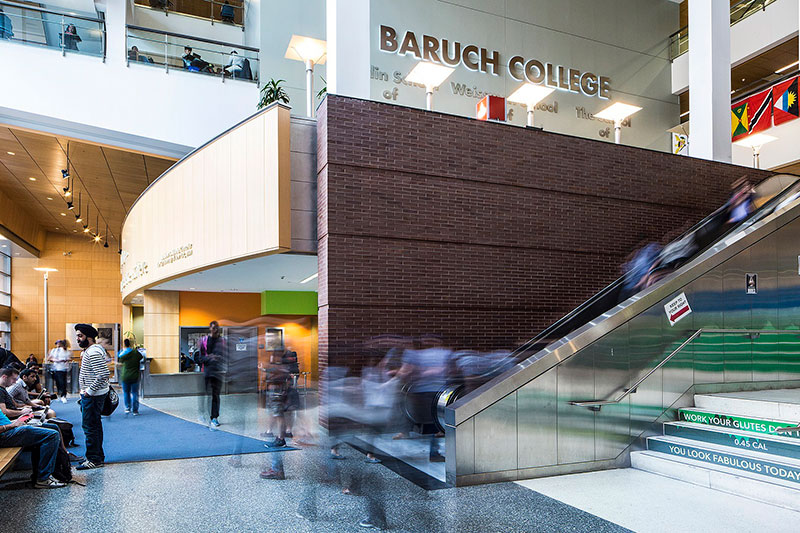
Baruch's student life is defined by its urban, commuter-campus reality and the incredible density of opportunity that creates. There is no traditional residential quad; the campus is primarily the vertical, glass-and-steel building at 55 Lexington Avenue and a few other buildings in the Flatiron district. This means student life is actively built through involvement, not passively absorbed in a dorm. The Office of Student Life oversees a vibrant ecosystem of more than 120 student clubs and organizations, ranging from cultural associations (like the Ecuadorian club celebrated as a 'Club of the Month') to professional business societies, theater groups, and everything in between.
Students report that Baruch offers an "insane amount of on-campus opportunities," including work-study jobs, paid tutoring or leadership roles, and internships that are literally a subway ride away in the global financial and media capitals. The social scene is what you make of it, often revolving around club meetings, campus events, and exploring New York City itself. Greek life exists but is not a dominant force. The vibe is ambitious, self-directed, and diverse, reflecting the myriad backgrounds of New Yorkers who attend. The campus is considered safe and is integrated into the daily flow of the city, with easy access to restaurants, bars, and all major subway lines.
This is where the Baruch value proposition becomes stunningly clear. The college's outcomes are exceptional, particularly for a public institution. Graduates boast median early-career earnings of nearly $83,000, a figure that significantly outpaces the national median and is a key reason Baruch was named the Northeast's only public "Five-Star College" by Money magazine. This earning power is a direct pipeline from its strong business, finance, and tech programs into the New York job market.
The graduation rate is also a standout, exceeding the national average for four-year colleges. A high graduation rate at a commuter school with many and working students signals effective support structures. Furthermore, the rate of students who borrow to attend is low, and the average debt at graduation is remarkably manageable compared to national averages. The data paints a picture of an institution that successfully launches graduates into financially secure careers without burying them in debt, a rare and powerful combination in modern higher education.
Baruch's sticker price for in-state students is a fraction of the cost of private New York City universities, but the real story is the after grants and scholarships. The average student pays only a few thousand dollars per year, thanks to a combination of federal, state, and institutional aid. The college utilizes the federal Student Aid Index (SAI) from the FAFSA to determine need-based awards, which can include Pell Grants, Federal Supplemental Educational Opportunity Grants (FSEOG), and other aid.
It is important to note that Baruch does not advertise a "no-loan" policy where loans are eliminated from financial aid packages for all qualifying students. Federal Direct Loans, both subsidized (need-based) and unsubsidized (non-need-based), are part of the aid landscape. However, the average debt at graduation remains low because the net price is so low to begin with, and grant aid covers a substantial portion of costs for students with financial need. The financial aid process is centralized through CUNY, and students are encouraged to use the official net price calculator for the best estimate of their individual cost.
Baruch College stands out as a singular model of high-return, low-cost urban public education. It is not a cozy, secluded liberal arts college; it is a professional launchpad embedded in the global economy. Its unique character is defined by several irreplicable factors:
1. The ROI Powerhouse: The combination of a ~$3,000 average and median graduate earnings approaching $83,000 creates a return on investment that rivals—and often surpasses—elite private institutions. This is its core appeal. 2. The Zicklin Anchor: Housing one of the country's largest and most respected business schools within a public university framework gives students access to a top-tier business education without the private-school price tag. 3. The New York City Advantage: The campus isn't just in New York City; it is of it. The curriculum, internships, job placements, and student body demographics are all deeply intertwined with the city's industries and culture. 4. The Commuter-Engine Culture: The lack of a residential campus fosters a culture of independence, ambition, and hustle. Student life is activity-rich and self-made, attracting driven individuals who are often balancing work, family, and school. 5. The Five-Star Public Designation: Being highlighted as the only public college in the Northeast to earn a five-star rating from Money magazine encapsulates its national reputation as a leader in combining quality, outcomes, and affordability.
Baruch is for the pragmatic striver. It's for the student who views college not as a four-year retreat, but as a direct investment in a professional future, and who wants that investment to make relentless financial sense. It delivers the skills, the network, and the credential to compete in top-tier fields, all while allowing graduates to start their careers unencumbered by crippling debt.
CUNY Bernard M Baruch College seal · sourceCampus Map and Directions - Baruch College · sourceDirections - Enrollment Management · sourceCUNY Baruch - Cost, Acceptance Rate, Outcomes · source