Admit rate has ranged 68%–71% over the last 5 years. Source: IPEDS via Urban Institute.
Acceptance & SAT from Common Data Set / IPEDS; net price, earnings & graduation from the U.S. Dept. of Education College Scorecard. Figures lag ~1–2 years — verify with the school.
Hofstra University is a private university in Hempstead, New York, that operates like a high-functioning, suburban academic enterprise. With a broad portfolio of over 175 undergraduate programs, its identity is split between a strong professional focus—particularly in business and health professions—and a sprawling, club-heavy campus life on its 240-acre grounds. It's a school where the admissions process is notably accessible, but the onus is on the student to carve out their own path, both socially and academically, from a vast menu of options.
Admission requirements
Test-optional — scores considered if submitted
Required
High school transcript
Grade point average
Letters of recommendation
College-prep program
TOEFL (non-native English)
Considered (not required)
Class rank
Test scores (SAT/ACT)
Demonstrated competencies
Source: IPEDS Admissions survey (2022) via Urban Institute. Covers formal factors only — it does not reflect essays, extracurriculars, or other holistic criteria.
More details
Undergrad enrollment
6,488
In-state tuition
$57,660
Out-of-state tuition
$57,660
Student Clubs
More than 200
Graduation Rate
69%
Most Popular Majors
Business, Management, Marketing; Health Professions
On-Campus Residents
~3,500 students
Demonstrated Interest
Considered
Median Earnings (10yr)
$69,039
Average Financial Aid Package
$38,924
Students Receiving Financial Aid
~97%
Outcomes & value
Outcomes & value
Median earnings (10 yr)
$69,039
Value (earnings ÷ net price)
2.0×
Median debt at graduation
$23,621
Graduation rate
69%
First-year retention
84%
Reducing loan balance (3 yr)
71%
Pell (lower-income) share
25%
First-gen share (among federal-aid recipients)
24%
Financial health
2.2 / 3.0Meets the federal financial-responsibility standard
U.S. Dept. of Education Financial Responsibility Composite Score (FY2022-23). Scale −1.0 to 3.0; ≥1.5 meets the standard. Reported for private nonprofit & for-profit institutions only — public universities are state-backed and not scored, so this is a stability signal, not a ranking.
Top-earning majors
Median earnings by field of study (highest credential), ~2 years after completion.
Mechanical Engineering$63,005
Engineering Science$62,409
Computer Science$62,012
Finance and Financial Management Services$56,234
Accounting and Related Services$55,422
Management Sciences and Quantitative Methods$50,439
Applicants here also applied to
The schools that most often appear alongside Hofstra University on applicants’ lists, from our self-reported outcomes corpus.
Co-application frequency from self-reported results — directional peer discovery, not a recommendation.
Campus & location
Campus safety
On-campus violent crimes (2024)
6
Per 1,000 students
0.57
On-campus criminal offenses classed as violent (murder/non-negligent manslaughter, rape, robbery, aggravated assault) for the most recent reported year. Source: U.S. Dept. of Education Campus Safety and Security (Clery Act). Counts reflect what’s reported to the school, and urban campuses often report more partly due to non-student incidents nearby — read alongside campus size and setting, not as a standalone safety verdict.
Climate
Pleasant days / yr
95
Summer high
81°F
Winter low
29°F
Annual rain
55.8"
Annual snow
18"
Natural-hazard risk
Relatively High
Pleasant days counts days per year with a mean temperature of 55–75°F, a high at or below 90°F, a low at or above 45°F, and little precipitation — a transparent comfort measure, not a weighting we invented. Computed from Open-Meteo ERA5 daily history (2019–2023). Natural-hazard risk is the county’s composite rating from the FEMA National Risk Index.
Deep dive — research, future-scholar output & economic mobility▾
Research output
Institutional h-index
298
Scholarly works
22,451
Institutional research volume and impact from OpenAlex. The h-index reflects large research universities and will be low for teaching-focused liberal-arts colleges — not a measure of undergraduate quality.
Economic mobility
Mobility rate
3.0%
Bottom → top quintile
42%
From bottom quintile
7%
Mobility rate = the share of students who both start in the bottom household-income quintile and reach the top quintile; bottom → top is that chance conditional on starting at the bottom. Source: Opportunity Insights Mobility Report Cards (Chetty, Friedman, Saez, Turner & Yagan). Reflects 1980–82 birth cohorts, so it’s directional, not current.
Quick answers
What is the acceptance rate at Hofstra University?
Hofstra University's acceptance rate is approximately 68% (Hempstead, NY), based on the most recent figures we compiled from public and primary sources.
What SAT score do you need for Hofstra University?
Admitted students at Hofstra University typically score 1230–1400 on the SAT (the middle-50% range). Scores outside this band are still admitted, especially with strong applications.
How much does Hofstra University cost?
At Hofstra University, the average net price (after aid) is about $34,176 per year. Actual cost varies with financial aid and residency.
How many undergraduates attend Hofstra University?
Hofstra University enrolls approximately 6,488 undergraduate students.
Where is Hofstra University located?
Hofstra University is located in Hempstead, NY.
Admissions
Hofstra's admissions process is characterized by its accessibility, with a significantly higher for early applicants. The university admits a majority of its applicants overall, but those who apply via Early Decision have a distinct advantage. While the overall acceptance rate is 68%, the early acceptance rate is notably higher at 81.4%. This suggests a strong preference for students who commit to Hofstra as their first choice. The rate—the percentage of admitted students who enroll—is 10.30%, which is below the average for schools with similar acceptance rates. The middle 50% SAT range for admitted students is 1230–1400. The university employs a rolling admissions policy for regular decision, meaning there is no fixed deadline and applications are reviewed as they are received. Demonstrated interest—actions taken by a prospective student to show their engagement with the university—is a factor considered in the admissions process, as indicated by its inclusion in the .
Earnings = median of students working ~10 years after entry; debt = median of graduates. Value divides 10-yr earnings by one year’s net price — read it as earnings per dollar of annual cost, not a full lifetime ROI; it favors lower-cost schools. Source: U.S. Dept. of Education College Scorecard. Figures lag ~2 years and reflect all students, not your intended major.
International Business$48,041
Teacher Education and Professional Development, Specific Subject Areas$45,852
Source: U.S. Dept. of Education College Scorecard (field-of-study earnings). Figures cover graduates who received federal aid and lag ~2 years; not all programs report data.
Hofstra offers a vast and flexible academic landscape built around professional preparation and interdisciplinary study. Students can choose from over 175 undergraduate and 200 graduate areas of study. The curriculum emphasizes hands-on learning experiences and is designed to foster new approaches to problem-solving. The most popular majors cluster in professional fields: Business, Management, Marketing, and Related Support Services; and Health Professions and Related Programs. Other frequently pursued majors include Psychology, Finance, and Business Administration and Management. This focus on career-ready degrees defines the academic culture, with programs structured to provide work experience and leverage advanced facilities. The breadth of offerings allows students to tailor their education, but the driving force is overwhelmingly practical and geared toward post-graduate employment.
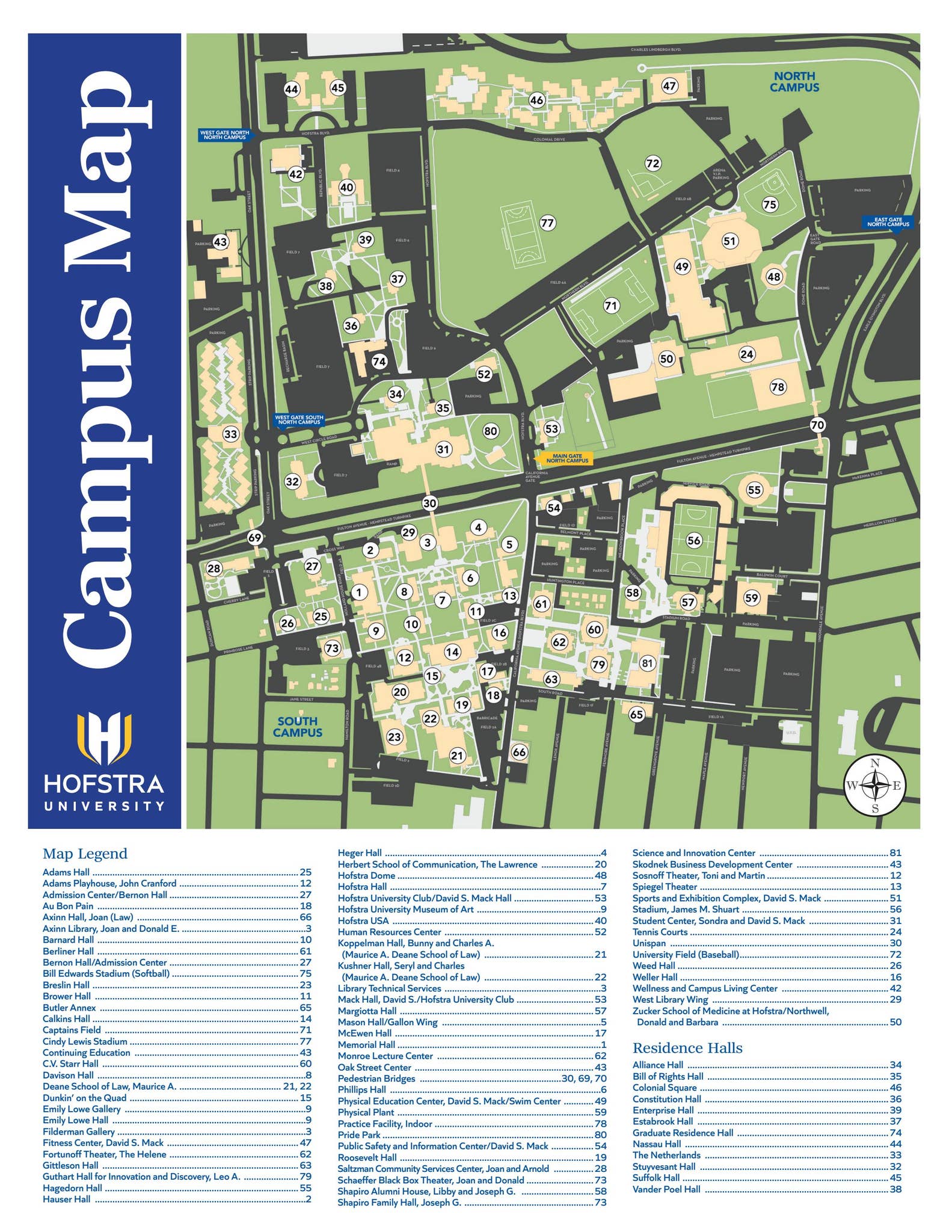
Life at Hofstra is a self-directed endeavor on a large, well-appointed campus. With more than 200 student clubs spanning cultural, academic, creative, and social interests, the onus is on the student to seek out their community. The campus is frequently described as beautiful, and social life is largely dependent on participation in these clubs or Greek life (sororities and fraternities). The residential system is substantial, with 35 residence halls housing approximately 3,500 students, though a majority of the student body (62%) lives off-campus. The vibe is what you make of it: opportunities for involvement are endless, but the scale of the campus and the high commuter population mean students must be proactive to build their social networks. The university promotes a vibrant and diverse environment, with the proximity to New York City offering additional cultural and internship opportunities.
Hofstra's outcomes data paints a picture of strong postgraduate employment, particularly for undergraduates seeking jobs. For job-seeking undergraduates from the 2015-2016 cohort, the career outcomes rate was 99%. The median annual salary for those undergraduate alumni was $48,000. More recent federal data reports median earnings of $72,921 four years after graduation. The six-year graduation rate is 69%, though there is a notable gap between Pell Grant recipients (59%) and non-Pell recipients (77%). Outcomes for graduate programs are also tracked; for example, the Zarb School of Business reported an 85% outcomes rate for its 2017-2018 graduate alumni, and the School of Education reported a 69% outcomes rate for its 2022-2023 graduate alumni. The data underscores the university's central mission: translating its professional-focused academics into employment.
Hofstra is a private university with a significant sticker price, but it attempts to bridge the gap with widespread financial aid. Approximately 97% of Hofstra students qualify for some form of financial aid. The average financial aid package is $38,924. The —the average cost after aid and scholarships—is a critical figure, though sources report different numbers: one reports $47,894, while another reports $35,687. The university provides a Net Price Calculator for prospective students to get a personalized estimate. Aid comes in the form of scholarships and grants from Hofstra (with academic scholarships up to $32,000), athletic scholarships, and federal loans. The university's financial aid materials clearly state that loans must be paid back and are used to cover costs not met by scholarships or grants. There is no indication in the provided sources of a "no-loan" policy or a guarantee to meet 100% of demonstrated financial need without loans.
Hofstra stands out for its specific, almost contradictory blend of scale and accessibility. It's a university with the physical plant and programmatic breadth of a much more selective institution—240 acres, 175+ majors, 200+ clubs—but it maintains an admissions gate that is open to a large majority of applicants, especially those who apply early. This creates a unique dynamic: it's a place where students with a clear professional focus (in business, health, or communications) can access robust, experiential programs without facing the brutal admissions odds of comparable urban peers. The campus, consistently praised for its beauty, feels like a traditional collegiate enclave, yet it's a short train ride from the hyper-competitive internship and job market of New York City. Ultimately, Hofstra's identity is that of a high-capacity facilitator: it provides the resources, the space, and the programmatic menu, expecting its students to supply the direction and drive. For a self-starter looking for a classic campus experience with a direct line to professional opportunity, it's a compelling and practical choice.
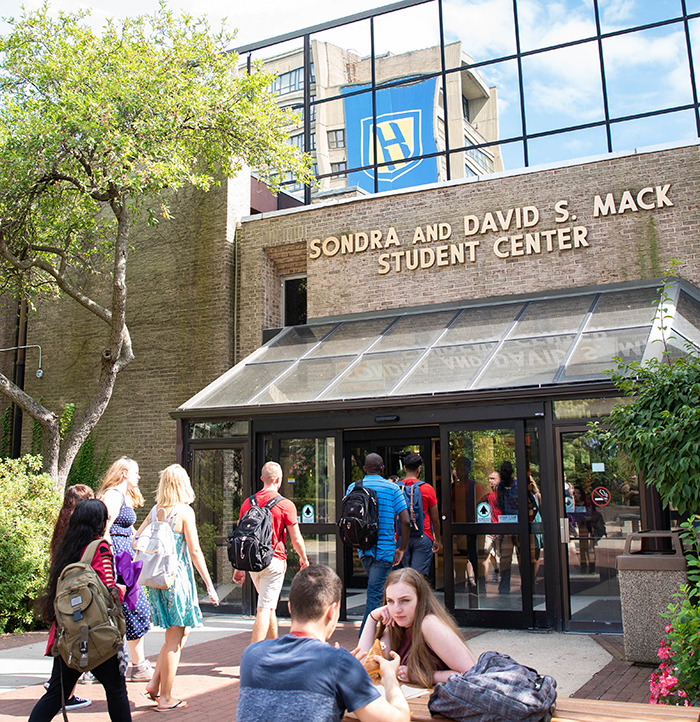
Hofstra University seal · sourceVisit - Hofstra University · sourceHofstra University Campus Map with Legend by Hofstra University - Issuu · sourceVisitors: Student Center | Hofstra University · source