Admit rate has ranged 28%–39% over the last 5 years — notably volatile. Source: IPEDS via Urban Institute.
Acceptance & SAT from Common Data Set / IPEDS; net price, earnings & graduation from the U.S. Dept. of Education College Scorecard. Figures lag ~1–2 years — verify with the school.
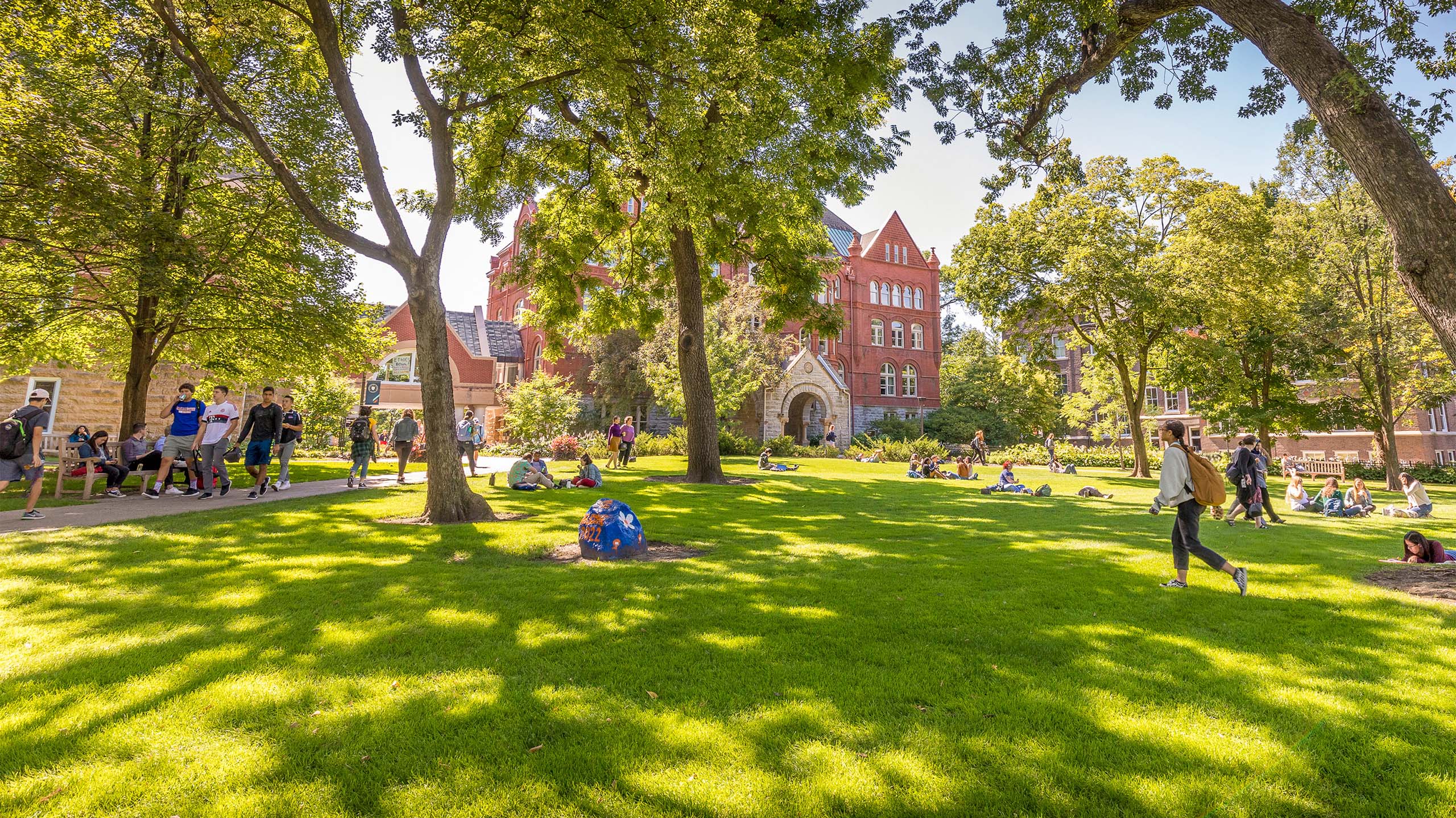
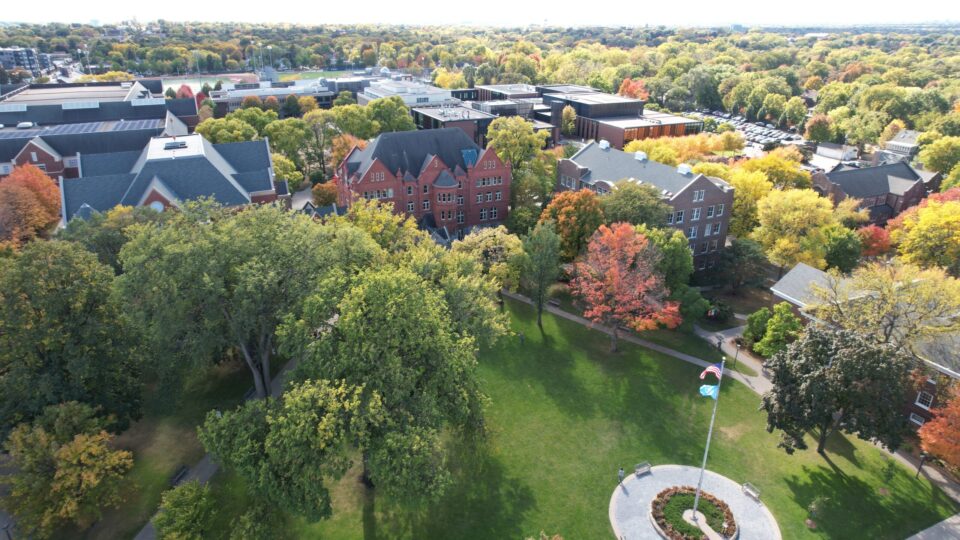
Macalester College is a small, globally-minded liberal arts powerhouse tucked into a quiet, tree-lined neighborhood of Saint Paul, Minnesota. It’s a place where intense intellectual curiosity meets a deep commitment to social justice, fueled by a student body that’s notably international and politically engaged. The vibe is progressive, collaborative, and slightly quirky—think heated debates in the campus coffee shop followed by a pickup soccer game with students from a dozen different countries.
Admission requirements
Test-optional — scores considered if submitted
Required
High school transcript
Letters of recommendation
TOEFL (non-native English)
Considered (not required)
Grade point average
Class rank
Test scores (SAT/ACT)
College-prep program
Source: IPEDS Admissions survey (2022) via Urban Institute. Covers formal factors only — it does not reflect essays, extracurriculars, or other holistic criteria.
More details
Undergrad enrollment
2,131
In-state tuition
$68,104
Out-of-state tuition
$68,104
Campus Housing
57% live on campus
No-Loan Policy
Yes, full tuition for incomes ≤ $100k with typical assets
Graduation Rate
87%
Meets Full Need
Yes, for all admitted students
ED Share of Class
Significant (data suggests a major portion)
Demonstrated Interest
Considered
Student-Faculty Ratio
10:1
Median Earnings (10yr)
$63,878
Outcomes & value
Outcomes & value
Median earnings (10 yr)
$63,878
Value (earnings ÷ net price)
2.0×
Median debt at graduation
$23,000
Graduation rate
87%
First-year retention
92%
Reducing loan balance (3 yr)
89%
Pell (lower-income) share
17%
First-gen share (among federal-aid recipients)
13%
Financial health
2.6 / 3.0Meets the federal financial-responsibility standard
U.S. Dept. of Education Financial Responsibility Composite Score (FY2022-23). Scale −1.0 to 3.0; ≥1.5 meets the standard. Reported for private nonprofit & for-profit institutions only — public universities are state-backed and not scored, so this is a stability signal, not a ranking.
Top-earning majors
Median earnings by field of study (highest credential), ~2 years after completion.
Computer and Information Sciences, General$71,575
Economics$64,493
Mathematics$52,107
Political Science and Government$35,274
International/Globalization Studies$34,526
Intercultural/Multicultural and Diversity Studies$33,993
Applicants here also applied to
The schools that most often appear alongside Macalester on applicants’ lists, from our self-reported outcomes corpus.
Co-application frequency from self-reported results — directional peer discovery, not a recommendation.
Campus & location
Campus safety
On-campus violent crimes (2024)
8
On-campus criminal offenses classed as violent (murder/non-negligent manslaughter, rape, robbery, aggravated assault) for the most recent reported year. Source: U.S. Dept. of Education Campus Safety and Security (Clery Act). Counts reflect what’s reported to the school, and urban campuses often report more partly due to non-student incidents nearby — read alongside campus size and setting, not as a standalone safety verdict.
Climate
Pleasant days / yr
85
Summer high
83°F
Winter low
8°F
Annual rain
36.6"
Annual snow
43.3"
Natural-hazard risk
Relatively High
Pleasant days counts days per year with a mean temperature of 55–75°F, a high at or below 90°F, a low at or above 45°F, and little precipitation — a transparent comfort measure, not a weighting we invented. Computed from Open-Meteo ERA5 daily history (2019–2023). Natural-hazard risk is the county’s composite rating from the FEMA National Risk Index.
Deep dive — research, future-scholar output & economic mobility▾
Research output
Institutional h-index
163
Scholarly works
5,759
Institutional research volume and impact from OpenAlex. The h-index reflects large research universities and will be low for teaching-focused liberal-arts colleges — not a measure of undergraduate quality.
Share of this school’s graduates who go on to earn research doctorates (2010–20), by national rank and per-capita yield (NSF institutional-yield ratio). A signal of a research-oriented student culture — not a causal promise, since it partly reflects who enrolls. Only top producers appear. Source: NSF NCSES, Baccalaureate Origins of U.S. Research Doctorate Recipients.
Economic mobility
Quick answers
What is the acceptance rate at Macalester College?
Macalester College's acceptance rate is approximately 29% (Saint Paul, MN), based on the most recent figures we compiled from public and primary sources.
What SAT score do you need for Macalester College?
Admitted students at Macalester College typically score 1350–1510 on the SAT (the middle-50% range). Scores outside this band are still admitted, especially with strong applications.
How much does Macalester College cost?
At Macalester College, the average net price (after aid) is about $32,149 per year. Actual cost varies with financial aid and residency.
How many undergraduates attend Macalester College?
Macalester College enrolls approximately 2,131 undergraduate students.
Where is Macalester College located?
Macalester College is located in Saint Paul, MN.
Admissions
Getting into Macalester is a selective but nuanced process. The college reports an overall of 29%, but applying Early Decision provides a significant advantage, with a two-year average ED acceptance rate of 41% compared to 27% for Regular Decision and Early Action pools. The admissions process is , and for those who submit scores, the middle 50% SAT range is 1350–1510, with a median of 740 in both Math and Evidence-Based Reading and Writing for admitted students who opted in. The ACT median is 33. Demonstrated interest is a factor Macalester considers in its admissions decisions, as indicated in the . The college accepts the Common Application.
A substantial portion of the incoming class is filled through binding Early Decision plans, highlighting the importance of Macalester as a first-choice school for many applicants. The admitted student profile is academically strong, with a high percentage coming from the top tenth of their high school class.
Earnings = median of students working ~10 years after entry; debt = median of graduates. Value divides 10-yr earnings by one year’s net price — read it as earnings per dollar of annual cost, not a full lifetime ROI; it favors lower-cost schools. Source: U.S. Dept. of Education College Scorecard. Figures lag ~2 years and reflect all students, not your intended major.
Education, General$33,281
Geography and Cartography$32,569
Source: U.S. Dept. of Education College Scorecard (field-of-study earnings). Figures cover graduates who received federal aid and lag ~2 years; not all programs report data.
Mobility rate = the share of students who both start in the bottom household-income quintile and reach the top quintile; bottom → top is that chance conditional on starting at the bottom. Source: Opportunity Insights Mobility Report Cards (Chetty, Friedman, Saez, Turner & Yagan). Reflects 1980–82 birth cohorts, so it’s directional, not current.
Macalester’s academic engine is its classic, rigorous liberal arts curriculum, delivered through an intimate 10:1 student-to-faculty ratio and more than 800 courses offered annually. There are 41 majors, with particular strength in international studies, economics, and the sciences. The most popular majors include Econometrics and Quantitative Economics; Research and Experimental Psychology; Computer and Information Sciences; Political Science and Government; and International/Global Studies. The academic culture is interdisciplinary and emphasizes depth, with programs encouraging students to draw tools and perspectives from across the natural sciences, social sciences, and humanities.
Small class sizes are a defining feature, fostering close mentorship and collaborative learning. The college is known for its ongoing commitment to international studies, which permeates the curriculum and campus life. This is not a pre-professional factory; it’s a place for students who want to grapple with complex global issues and develop a broad, critical understanding of the world.
Life at Macalester is active, inclusive, and firmly rooted in its unique urban-residential setting. The campus is nestled in a quiet, residential Saint Paul neighborhood with tree-lined streets, yet it’s just minutes from the cultural and professional opportunities of the Twin Cities. About 57% of students live in college-owned housing, with 43% living off-campus, often in the surrounding neighborhood. The community is famously supportive and inclusive, with a multitude of student organizations—over 100—catering to a vast array of interests, from badminton and rugby to comic books and anime, and including multiple clubs for various LGBTQ+ identities.
The Division of Student Affairs fosters holistic development and community engagement. There’s no Greek life, which shifts the social focus to campus-wide events, club activities, and exploring the vibrant local restaurant and arts scene. The student body is politically and socially engaged, creating a campus atmosphere that is both intellectually charged and warmly communal.
A Macalester education pays off in high satisfaction and strong early-career trajectories. An impressive 95% of graduates report being very satisfied or satisfied with their Macalester education. For full-time employed U.S. alumni, the average annual salary four years out is $66,900. The college reports a high graduation rate, and graduates enter a wide range of fields, with outcomes varying by major. For instance, mathematics graduates earn around $60,896 on average, while general studies graduates earn about $32,091. The median earnings for recent graduates have been reported at $34,157, reflecting the liberal arts mix of careers in public service, non-profits, and the private sector.
The data underscores that Macalester graduates are not only employable but also deeply value the transformative nature of their undergraduate experience, often pursuing paths aligned with the college’s ethos of global citizenship and ethical leadership.
Macalester is expensive on paper but aggressively affordable in practice due to one of the most generous financial aid policies in the country. The college meets 100% of the demonstrated financial need for all admitted students, a commitment it has legally promised for both domestic and international students. For admitted U.S. students with a family income of $100,000 or less and typical assets, Macalester provides a full-tuition scholarship. This is part of its Macalester Tuition Promise initiative.
The average after aid is substantial but reflects this significant investment. Students are encouraged to use the college's official Net Price Calculator to get a personalized estimate. About 59.45% of students receive financial aid, with an average aid package of $66,010. This policy makes a Macalester education accessible to a socioeconomically diverse student body and ensures that loans are not a burdensome necessity for most families.
Macalester stands out for its potent, almost paradoxical blend of the intimate and the global. It’s a small liberal arts college where the conversation is never small. The deeply embedded international focus—in its curriculum, its student body (roughly 15-20% international), and its ethos—creates a campus microcosm of the world, fostering a level of global awareness and cross-cultural fluency rare even among its peers. This happens not on an isolated campus, but in the midst of a major metropolitan area, giving students real-world context and opportunities.
Couple this with an unwavering, institutional commitment to meeting 100% of financial need for every single student it admits, domestic and international alike, and you have a school that puts its money squarely behind its values of equity and access. The result is a community that is both intellectually fierce and genuinely kind, populated by students who are as likely to be planning a Model UN conference as organizing a local community garden. It’s for the student who wants a classic liberal arts education that feels urgently contemporary and responsible.
Macalester College seal · sourceAbout Macalester - About - About - Macalester College · sourceMacalester College · sourceMaps and Directions - About - About - Macalester College · source