Admit rate has ranged 5%–7% over the last 5 years. Source: IPEDS via Urban Institute.
Acceptance & SAT from Common Data Set / IPEDS; net price, earnings & graduation from the U.S. Dept. of Education College Scorecard. Figures lag ~1–2 years — verify with the school.
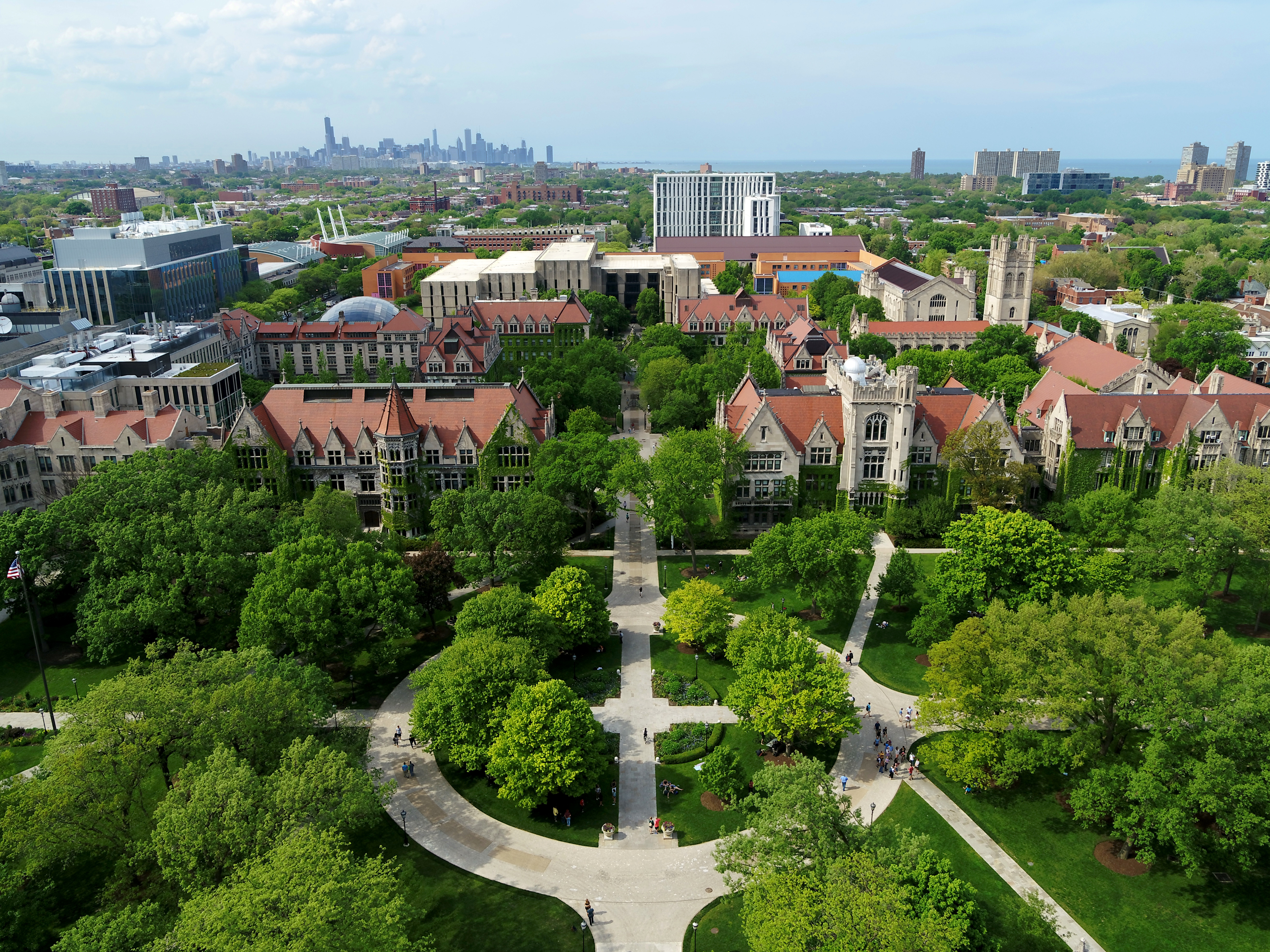
The University of Chicago is an intellectual pressure cooker on the South Side, a place where the life of the mind isn't just a slogan—it's the dominant social currency. Known for its fiercely rigorous Core curriculum, a student body that debates for fun, and a distinctive 'where fun comes to die' reputation that its most devoted students wear as a badge of honor, UChicago attracts a particular breed of intensely curious, argumentative undergraduate. Its outcomes are stellar, its financial aid policy is aggressively generous, and its identity is carved from a unique blend of Gothic architecture, economic orthodoxy, and a deep-seated belief that the best parties involve Socratic dialogue.
Admission requirements
Test-optional — scores considered if submitted
Required
High school transcript
Letters of recommendation
College-prep program
TOEFL (non-native English)
Considered (not required)
Grade point average
Class rank
Test scores (SAT/ACT)
Demonstrated competencies
Source: IPEDS Admissions survey (2022) via Urban Institute. Covers formal factors only — it does not reflect essays, extracurriculars, or other holistic criteria.
Co-application frequency from self-reported results — directional peer discovery, not a recommendation.
Campus & location
Campus safety
On-campus violent crimes (2024)
2
Per 1,000 students
0.11
On-campus criminal offenses classed as violent (murder/non-negligent manslaughter, rape, robbery, aggravated assault) for the most recent reported year. Source: U.S. Dept. of Education Campus Safety and Security (Clery Act). Counts reflect what’s reported to the school, and urban campuses often report more partly due to non-student incidents nearby — read alongside campus size and setting, not as a standalone safety verdict.
Climate
Pleasant days / yr
88
Summer high
81°F
Winter low
23°F
Annual rain
47.9"
Annual snow
29.9"
Natural-hazard risk
Very High
Pleasant days counts days per year with a mean temperature of 55–75°F, a high at or below 90°F, a low at or above 45°F, and little precipitation — a transparent comfort measure, not a weighting we invented. Computed from Open-Meteo ERA5 daily history (2019–2023). Natural-hazard risk is the county’s composite rating from the FEMA National Risk Index.
Deep dive — research, future-scholar output & economic mobility▾
Research output
Institutional h-index
1,626
Scholarly works
306,762
Institutional research volume and impact from OpenAlex. The h-index reflects large research universities and will be low for teaching-focused liberal-arts colleges — not a measure of undergraduate quality.
Share of this school’s graduates who go on to earn research doctorates (2010–20), by national rank and per-capita yield (NSF institutional-yield ratio). A signal of a research-oriented student culture — not a causal promise, since it partly reflects who enrolls. Only top producers appear. Source: NSF NCSES, Baccalaureate Origins of U.S. Research Doctorate Recipients.
Economic mobility
Quick answers
What is the acceptance rate at University of Chicago?
University of Chicago's acceptance rate is approximately 4% (Chicago, IL), based on the most recent figures we compiled from public and primary sources.
What SAT score do you need for University of Chicago?
Admitted students at University of Chicago typically score 1510–1580 on the SAT (the middle-50% range). Scores outside this band are still admitted, especially with strong applications.
How much does University of Chicago cost?
At University of Chicago, the average net price (after aid) is about $14,860 per year. Actual cost varies with financial aid and residency.
How many undergraduates attend University of Chicago?
University of Chicago enrolls approximately 7,569 undergraduate students.
Where is University of Chicago located?
University of Chicago is located in Chicago, IL.
Admissions
Gaining entry to the University of Chicago is an exercise in extreme selectivity, with an of 4%. The admitted class is academically formidable, with a middle 50% SAT range of 1510–1580 and an ACT range of 34–35. The university employs a distinct and highly influential early application strategy: it offers Early Decision I, Early Action, and Early Decision II rounds. Analysis suggests that a staggering 80% of the incoming class is filled through these early rounds, with early acceptance rates estimated to be significantly higher than the overall rate, potentially in the 20-30% range. This creates a stark reality for regular decision applicants, for whom the remaining spots are vanishingly few. The university also considers demonstrated interest as part of its admissions process, making engagement beyond the application potentially meaningful. The rate—the percentage of admitted students who choose to enroll—is exceptionally high, reported at 86-88%, the highest among top universities, indicating that those who are admitted are overwhelmingly convinced it's their top choice.
Earnings = median of students working ~10 years after entry; debt = median of graduates. Value divides 10-yr earnings by one year’s net price — read it as earnings per dollar of annual cost, not a full lifetime ROI; it favors lower-cost schools. Source: U.S. Dept. of Education College Scorecard. Figures lag ~2 years and reflect all students, not your intended major.
$48,432
Psychology, General$45,128
Source: U.S. Dept. of Education College Scorecard (field-of-study earnings). Figures cover graduates who received federal aid and lag ~2 years; not all programs report data.
Mobility rate = the share of students who both start in the bottom household-income quintile and reach the top quintile; bottom → top is that chance conditional on starting at the bottom. Source: Opportunity Insights Mobility Report Cards (Chetty, Friedman, Saez, Turner & Yagan). Reflects 1980–82 birth cohorts, so it’s directional, not current.
Academic life at UChicago is defined by its legendary Core curriculum, a structured series of courses designed to ensure every graduate, regardless of major, engages with a foundational canon of texts and ideas. This shared intellectual experience—spanning humanities, social sciences, biological and physical sciences, mathematics, and a foreign language—forges a common language and a famously argumentative, critical-thinking student body. The university offers 68 majors and 57 minors across its collegiate divisions. Its global academic reputation is particularly towering in economics and finance, where it is ranked #1 in the world, a testament to its historic ties to the Chicago School of economics. The intellectual culture is often described as "unparalleled" and intensely rigorous, attracting students for whom academic pursuit is the primary extracurricular. The workload is notorious, and the pedagogical emphasis is on critical analysis, debate, and original thought over rote learning.
Life outside the library at UChicago is more vibrant and varied than its studious stereotype suggests, though the intellectual vibe permeates everything. The campus itself is a 217-acre mix of Gothic architecture and modern facilities, located in the Hyde Park neighborhood with 31 miles of Lake Michigan lakefront nearby. Student life is self-directed and often quirky, with over 400 student organizations covering everything from Model UN to entrepreneurial ventures. There are 39 intramural sport clubs, but the lack of a high-profile, revenue-generating athletics program is a noted cultural difference from large state schools. The arts and culture scene is active, with student-run celebrations and performances. Campus safety is a priority for students, with 58% reporting they feel "extremely safe and secure on campus." The social scene is less defined by Greek life or massive tailgates than by house parties, coffee shop debates, and deep-dive conversations that start in class and never really end.
The investment in a UChicago education pays off in remarkable and measurable ways. The university boasts a near-perfect 99% first-year retention rate and a 96% graduation rate, indicating students not only survive but thrive within its demanding environment. Post-graduation, outcomes are exceptionally strong. The median earnings for graduates ten years after entry are $91,885. Career paths are diverse and high-achieving: 12% go into entrepreneurship or start-ups, 11% into corporate and other business roles, 5% into consulting, and 2% into financial services (with many economics graduates undoubtedly entering high-finance tracks). Alumni from fields like computer science and mathematics command significant average salaries, reflecting the value of the degree in the marketplace. The data underscores a clear trajectory from rigorous undergraduate training to high-impact professional and graduate school opportunities.
UChicago combats its high sticker price with one of the most generous and transparent financial aid policies in the country. Through its "No Barriers" policy, the university commits to meeting 100% of every admitted student's demonstrated financial need without requiring loans. This means aid packages are composed entirely of grants and work-study, not debt. For families with incomes under a certain threshold (the policy is often associated with incomes under $100k), this translates to a loan-free education. This commitment extends to international students as well. The result is a dramatically reduced for most students; the average net price after aid is $14,860. All applicants are automatically considered for merit-based scholarships, and the university provides a Net Price Calculator for families to estimate their actual cost. The policy is a cornerstone of the admissions office's messaging, designed to ensure economic diversity and access.
The University of Chicago stands out not merely for its elite rankings or outcomes, but for the sheer distinctiveness of its intellectual culture. It is a university utterly confident in its own identity—one built on rigorous argument, foundational texts, and a skepticism of intellectual trends. This produces graduates with a particular cast of mind: analytical, fearless in debate, and deeply literate across disciplines. Its powerhouse economics department (#1 globally) shapes financial and policy thought worldwide. The campus, a Gothic enclave in a vibrant global city, offers a unique blend of cloistered study and urban engagement. Crucially, it backs its demanding ethos with a radically supportive financial model, the "No Barriers" policy, which puts its world-class education within reach based on merit, not means. For the student who wants an education that is less a preparation for a career and more a transformation in how they think, UChicago offers a profoundly singular and uncompromising experience.
University of Chicago seal · sourceA Study in Quadrangles: The University of Chicago Campus — Julia Bachrach Consulting · sourceCampus Photos | University of Chicago News · sourceUniversity of Chicago - Wikipedia · source