Admit rate has ranged 82%–92% over the last 5 years — notably volatile, though the latest figure above (75%) falls outside that window. Source: IPEDS via Urban Institute.
Acceptance & SAT from Common Data Set / IPEDS; net price, earnings & graduation from the U.S. Dept. of Education College Scorecard. Figures lag ~1–2 years — verify with the school.
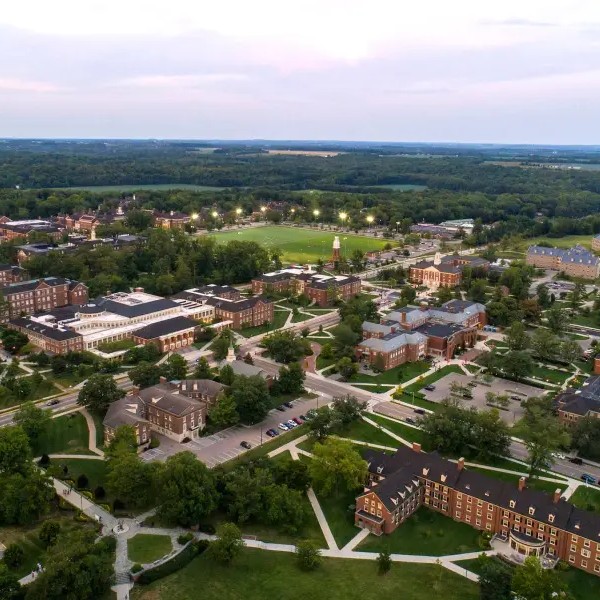
Miami University-Oxford is a public university that punches far above its weight, combining the academic seriousness and traditions of a private liberal arts college with the resources of a state school. Known for its exceptionally high four-year graduation rate and a laser focus on undergraduate teaching, it cultivates a polished, pre-professional student body within a classic, red-brick campus that feels like a self-contained collegiate village. The vibe is distinctly 'public ivy,' where business majors rub shoulders with aspiring diplomats, all united by a strong sense of school spirit and a clear path from classroom to career.
Admission requirements
Test-optional — scores considered if submitted
Required
High school transcript
Grade point average
Letters of recommendation
College-prep program
TOEFL (non-native English)
Considered (not required)
Class rank
Test scores (SAT/ACT)
Source: IPEDS Admissions survey (2022) via Urban Institute. Covers formal factors only — it does not reflect essays, extracurriculars, or other holistic criteria.
More details
Undergrad enrollment
16,656
In-state tuition
$18,161
Out-of-state tuition
$41,221
Graduation Rate
80%
Most Popular Major
Business (27% of grads)
Demonstrated Interest
Considered
Early Decision Offered
Yes
Median Earnings (10yr)
$55,076
Four-Year Grad Rate Rank
#12 nationally (public)
Post-Graduation Success Rate
98.2%
Outcomes & value
Outcomes & value
Median earnings (10 yr)
$55,076
Value (earnings ÷ net price)
1.9×
Median debt at graduation
$23,000
Graduation rate
80%
First-year retention
90%
Reducing loan balance (3 yr)
58%
Pell (lower-income) share
13%
First-gen share (among federal-aid recipients)
23%
Top-earning majors
Median earnings by field of study (highest credential), ~2 years after completion.
Computer Engineering$76,460
Engineering-Related Fields$74,576
Electrical, Electronics, and Communications Engineering$67,660
Co-application frequency from self-reported results — directional peer discovery, not a recommendation.
Campus & location
Campus safety
On-campus violent crimes (2024)
28
Per 1,000 students
1.50
On-campus criminal offenses classed as violent (murder/non-negligent manslaughter, rape, robbery, aggravated assault) for the most recent reported year. Source: U.S. Dept. of Education Campus Safety and Security (Clery Act). Counts reflect what’s reported to the school, and urban campuses often report more partly due to non-student incidents nearby — read alongside campus size and setting, not as a standalone safety verdict.
Climate
Pleasant days / yr
92
Summer high
82°F
Winter low
26°F
Annual rain
44.1"
Annual snow
18"
Natural-hazard risk
Relatively Moderate
Pleasant days counts days per year with a mean temperature of 55–75°F, a high at or below 90°F, a low at or above 45°F, and little precipitation — a transparent comfort measure, not a weighting we invented. Computed from Open-Meteo ERA5 daily history (2019–2023). Natural-hazard risk is the county’s composite rating from the FEMA National Risk Index.
Quick answers
What is the acceptance rate at Miami University-Oxford?
Miami University-Oxford's acceptance rate is approximately 75% (Oxford, OH), based on the most recent figures we compiled from public and primary sources.
What SAT score do you need for Miami University-Oxford?
Admitted students at Miami University-Oxford typically score 1220–1390 on the SAT (the middle-50% range). Scores outside this band are still admitted, especially with strong applications.
How much does Miami University-Oxford cost?
At Miami University-Oxford, the average net price (after aid) is about $28,384 per year. Actual cost varies with financial aid and residency.
How many undergraduates attend Miami University-Oxford?
Miami University-Oxford enrolls approximately 16,656 undergraduate students.
Where is Miami University-Oxford located?
Miami University-Oxford is located in Oxford, OH.
Admissions
Miami University-Oxford operates with a selective but accessible admissions process, accepting about three-quarters of its applicants. The academic profile of admitted students is solidly competitive, with the middle 50% SAT range falling between 1220 and 1390, and the middle 50% ACT Composite range between 25 and 30. Notably, just under half (49.7%) of admitted students opted to submit test scores for admission consideration. The university offers an Early Decision option, which it advertises as providing a higher and earlier notification, though specific Early Decision acceptance rates are not detailed in the provided sources. Demonstrated interest is a factor in admissions, as indicated by its inclusion in the 's factor importance grid (C7). The rate—the percentage of admitted students who enroll—has been reported at around 14-15% in recent cycles.
Earnings = median of students working ~10 years after entry; debt = median of graduates. Value divides 10-yr earnings by one year’s net price — read it as earnings per dollar of annual cost, not a full lifetime ROI; it favors lower-cost schools. Source: U.S. Dept. of Education College Scorecard. Figures lag ~2 years and reflect all students, not your intended major.
$66,461
Management Information Systems and Services$64,493
Finance and Financial Management Services$63,487
Source: U.S. Dept. of Education College Scorecard (field-of-study earnings). Figures cover graduates who received federal aid and lag ~2 years; not all programs report data.
Miami's academic identity is built on a strong liberal arts foundation with a pronounced tilt toward professional preparation, particularly in business. The university offers over 60 majors, 9 co-majors, and dozens of minors, fostering critical thinking, effective communication, and creative problem-solving. The most popular majors are overwhelmingly in business, management, marketing, and related support services, which accounted for 27% of 2024 graduates. Social sciences (8%) and communication/journalism programs follow. Its defining academic boast is a relentless focus on undergraduate education and timely graduation; it ranks among the top U.S. public universities for four-year graduation rate and touts itself as the #2 public university in the nation for teaching undergraduates. This creates an environment where the priority is on student progression and success within a traditional four-year timeline.
Life at Miami revolves around a classic, immersive residential college experience on its Oxford campus, which enrolls over 18,000 students. The Division of Student Life supports students in all aspects of life outside the classroom, coordinating housing, dining, campus services, arts, and culture. Described by students and observers as having a "tight-knit community" and "beautiful campus grounds," the university fosters a strong sense of school spirit and tradition. The campus is largely self-contained, with many students living on campus or in the surrounding Oxford community, creating a focused collegiate atmosphere. First-year experiences like "Make It Miami" orientation are designed to seamlessly integrate new students into this distinct culture, which many find to be a defining and positive aspect of their college choice.
Miami University's most compelling selling point is its outstanding record of student outcomes, which it aggressively markets under the "Miami Made" banner. The university claims a post-graduation success rate of 98.2%, with 99% of graduates employed or in further education within six months of graduation. Its four-year graduation rate is a major point of pride, ranking #1 in Ohio and #12 nationally among public universities. For recent graduates (0-5 years out), the median early-career salary is reported as $71,400. The average time to degree is an efficient 4.1 years, and the university emphasizes that graduating earlier than peers can translate to over $200,000 in additional lifetime earnings. These metrics paint a picture of an institution engineered for on-time completion and swift, successful entry into the workforce or graduate programs.
As a public university, Miami's cost structure is lower than many private peers, but it still represents a significant investment. The average after aid and scholarships is reported by various sources to be in the range of $23,031 to $28,567. A substantial majority (93%) of full-time beginning undergraduates receive some form of grant or scholarship aid, with the average aid package reported as $18,720. Miami offers a range of merit scholarships to qualified incoming students and provides need-based financial aid, including grants and loans. The university's financial aid materials describe a standard policy where aid packages (including loans, grants, work-study, and scholarships) are designed not to exceed the total . The provided sources do not indicate that Miami University has a "no-loan" policy for low-income students or a policy guaranteeing to meet 100% of demonstrated need without loans.
Miami University-Oxford stands out for mastering a specific, valuable niche in public higher education: delivering a highly reliable, high-return undergraduate experience. It's not the most selective public school, nor the largest research powerhouse. Instead, its distinction lies in a consistent, almost corporate-like efficiency in shepherding students from matriculation to graduation and into successful next steps. The combination of a top-ranked four-year graduation rate, a near-perfect post-graduation success rate, and a curriculum heavily skewed toward in-demand fields like business creates a clear value proposition for families. This happens within an environment that consciously mimics the traditions, community feel, and teaching focus of elite private liberal arts colleges—earning it the "public ivy" moniker—but at a public university price point. The result is a university with a confident, pre-professional culture where the path forward is clearly marked, and the institution's reputation is built on delivering on its promises of timely completion and career launch.
Miami University-Oxford seal · sourceThe Ultimate Guide to the Oxford Campus · sourceMaps, Parking, and Transit · sourceThe College Tour » at Miami University of Oxford, Ohio · source
.jpg?width=1600)