Admit rate has ranged 7%–9% over the last 5 years. Source: IPEDS via Urban Institute.
Acceptance & SAT from Common Data Set / IPEDS; net price, earnings & graduation from the U.S. Dept. of Education College Scorecard. Figures lag ~1–2 years — verify with the school.
Northwestern University is a powerhouse hybrid, fusing the intensity of a top-tier research institution with the collaborative, interdisciplinary spirit of a liberal arts college. Its stunning lakefront campus in Evanston serves as a launchpad for students who are as likely to be found in a cutting-edge McCormick engineering lab as they are at a student-run theater production or cheering at a Big Ten football game. This is a place for high-achievers who refuse to be pigeonholed, drawn by its distinctive quarter system, a culture of practical ambition, and unparalleled access to the professional and cultural vortex of Chicago.
Admission requirements
Test-optional — scores considered if submitted
Required
High school transcript
Letters of recommendation
College-prep program
TOEFL (non-native English)
Considered (not required)
Grade point average
Class rank
Test scores (SAT/ACT)
Source: IPEDS Admissions survey (2022) via Urban Institute. Covers formal factors only — it does not reflect essays, extracurriculars, or other holistic criteria.
Key deadlines (2026-2027)
Early Decision — Early Decision
November 1, 2026
Regular Decision — Regular Decision
January 3, 2027
Financial Aid — CSS Profile Priority Deadline
February 15, 2027
More details
Undergrad enrollment
9,201
In-state tuition
$68,322
Out-of-state tuition
$68,322
No-Loan Policy
Yes, for all aid applicants
Graduation Rate
95%
Meets Full Need
Yes
ED Share of Class
~50%
Demonstrated Interest
Considered
Median Earnings (10yr)
$89,363
Outcomes & value
Outcomes & value
Median earnings (10 yr)
$89,363
Value (earnings ÷ net price)
3.1×
Median debt at graduation
$15,000
Graduation rate
95%
First-year retention
98%
Reducing loan balance (3 yr)
87%
Pell (lower-income) share
19%
First-gen share (among federal-aid recipients)
15%
Financial health
2.2 / 3.0Meets the federal financial-responsibility standard
U.S. Dept. of Education Financial Responsibility Composite Score (FY2022-23). Scale −1.0 to 3.0; ≥1.5 meets the standard. Reported for private nonprofit & for-profit institutions only — public universities are state-backed and not scored, so this is a stability signal, not a ranking.
Top-earning majors
Median earnings by field of study (highest credential), ~2 years after completion.
Computer Science$98,403
Computer Engineering$85,918
Information Science/Studies$83,546
Industrial Engineering$79,849
Chemical Engineering$79,688
Human Resources Management and Services$76,995
Applicants here also applied to
The schools that most often appear alongside Northwestern on applicants’ lists, from our self-reported outcomes corpus.
Co-application frequency from self-reported results — directional peer discovery, not a recommendation.
Campus & location
Campus safety
On-campus violent crimes (2024)
6
Per 1,000 students
0.25
On-campus criminal offenses classed as violent (murder/non-negligent manslaughter, rape, robbery, aggravated assault) for the most recent reported year. Source: U.S. Dept. of Education Campus Safety and Security (Clery Act). Counts reflect what’s reported to the school, and urban campuses often report more partly due to non-student incidents nearby — read alongside campus size and setting, not as a standalone safety verdict.
Climate
Pleasant days / yr
90
Summer high
79°F
Winter low
22°F
Annual rain
43"
Annual snow
33.8"
Natural-hazard risk
Very High
Pleasant days counts days per year with a mean temperature of 55–75°F, a high at or below 90°F, a low at or above 45°F, and little precipitation — a transparent comfort measure, not a weighting we invented. Computed from Open-Meteo ERA5 daily history (2019–2023). Natural-hazard risk is the county’s composite rating from the FEMA National Risk Index.
Deep dive — research, future-scholar output & economic mobility▾
Research output
Institutional h-index
1,442
Scholarly works
260,599
Institutional research volume and impact from OpenAlex. The h-index reflects large research universities and will be low for teaching-focused liberal-arts colleges — not a measure of undergraduate quality.
Future-scholar output
Science & engineering PhDstop 47 nationally
Humanities & social-science PhDstop 30 nationally
Share of this school’s graduates who go on to earn research doctorates (2010–20), by national rank and per-capita yield (NSF institutional-yield ratio). A signal of a research-oriented student culture — not a causal promise, since it partly reflects who enrolls. Only top producers appear. Source: NSF NCSES, Baccalaureate Origins of U.S. Research Doctorate Recipients.
Economic mobility
Mobility rate
Quick answers
What is the acceptance rate at Northwestern University?
Northwestern University's acceptance rate is approximately 8% (Evanston, IL), based on the most recent figures we compiled from public and primary sources.
What SAT score do you need for Northwestern University?
Admitted students at Northwestern University typically score 1510–1570 on the SAT (the middle-50% range). Scores outside this band are still admitted, especially with strong applications.
How much does Northwestern University cost?
At Northwestern University, the average net price (after aid) is about $29,167 per year. Actual cost varies with financial aid and residency.
How many undergraduates attend Northwestern University?
Northwestern University enrolls approximately 9,201 undergraduate students.
Where is Northwestern University located?
Northwestern University is located in Evanston, IL.
Admissions
Getting into Northwestern is an exercise in extreme selectivity, with an that has plummeted from 34% in 2000 to a hyper-competitive single-digit figure. The university received roughly 49,000 to 52,000 applications for a freshman class of about 2,000 students. The Early Decision (ED) pathway offers a significantly higher chance of admission, with acceptance rates historically around 20-25%, compared to the much lower Regular Decision rate. Northwestern admits roughly half of its incoming class through ED, making a binding commitment a strategic advantage for sure-footed applicants. The middle 50% SAT range for admitted students is exceptionally high, and while the university is , a strong majority of enrolled students submit scores. Demonstrated interest is a factor Northwestern considers in its admissions process, so meaningful engagement with the university can matter. The most important academic factors are the rigor of a student's secondary school record, class rank, GPA, standardized test scores (if submitted), and the application essay.
Earnings = median of students working ~10 years after entry; debt = median of graduates. Value divides 10-yr earnings by one year’s net price — read it as earnings per dollar of annual cost, not a full lifetime ROI; it favors lower-cost schools. Source: U.S. Dept. of Education College Scorecard. Figures lag ~2 years and reflect all students, not your intended major.
Biomedical/Medical Engineering
$76,460
Mathematics$75,518
Source: U.S. Dept. of Education College Scorecard (field-of-study earnings). Figures cover graduates who received federal aid and lag ~2 years; not all programs report data.
Mobility rate = the share of students who both start in the bottom household-income quintile and reach the top quintile; bottom → top is that chance conditional on starting at the bottom. Source: Opportunity Insights Mobility Report Cards (Chetty, Friedman, Saez, Turner & Yagan). Reflects 1980–82 birth cohorts, so it’s directional, not current.
Northwestern's academic structure is defined by its six undergraduate schools, each a destination in itself: the liberal arts-focused Weinberg College of Arts and Sciences; the engineering-centric McCormick School of Engineering; the renowned Medill School of Journalism, Media, Integrated Marketing Communications; the highly selective School of Communication (encompassing theatre, radio/TV/film, and communication studies); the Bienen School of Music; and the School of Education and Social Policy. This setup encourages deep specialization but also facilitates prolific double-majoring and cross-school minors, a hallmark of the Northwestern experience. The university emphasizes a foundational liberal arts education for all undergraduates, requiring coursework across sciences, social sciences, mathematics, and humanities. The academic calendar runs on a fast-paced quarter system, allowing students to sample more courses but also intensifying the workload. Programs in journalism, theatre, engineering, and music are consistently cited as among the strongest and most distinctive, blending rigorous theory with intensive hands-on, pre-professional application. The culture is described as passionately hardworking, with students balancing a heavy academic load with ambitious extracurricular pursuits.
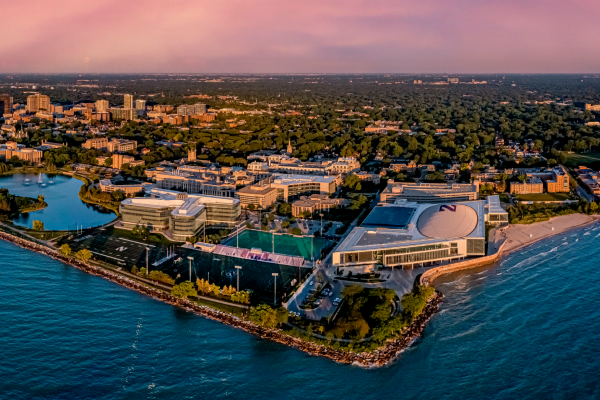
Life at Northwestern unfolds on a beautiful, self-contained campus perched on the shore of Lake Michigan in Evanston, a quiet, affluent suburb with its own charming downtown. The campus community is split roughly 50/50 between those who live in university housing and those who live off-campus. The student body is characterized as passionate, driven, and intensely involved, often juggling demanding academics with a full slate of clubs, research, and social activities. The social scene is multifaceted: it includes a robust Greek life presence, massive school spirit around Big Ten athletics (especially football), a thriving arts culture fueled by the theatre and music schools, and easy access via the 'L' train to the infinite possibilities of Chicago for internships, culture, and nightlife. Students describe a generally collaborative rather than cutthroat atmosphere, though the workload is significant. The quintessential Northwestern student might spend a morning in a lab, rehearse a play in the afternoon, and take the train into the city for a concert or dinner with friends in the evening.
Northwestern's investment yields exceptional returns for its graduates. The university boasts a remarkably high graduation rate, with figures reported between 95% and 97% within six years—placing it among the top institutions in the country for student completion. This success extends broadly, as the six-year graduation rate for recipients of Pell Grants is also an impressive 97%. Post-graduation outcomes are strong, with a significant majority of students employed or in graduate school within several months of receiving their degree. The median earnings for recent graduates are robust, reflecting the value of a Northwestern degree in the marketplace and the high-achieving career paths its alumni pursue.
With a sticker-price tuition of $69,375 for the 2025-26 academic year, Northwestern is undeniably expensive. However, the university maintains a robust, need-based financial aid program designed to make attendance feasible for admitted students. Crucially, Northwestern is among a small group of elite institutions that meets 100% of the demonstrated financial need for all admitted aid applicants. Furthermore, it has a no-loan policy, meaning the university-defined financial need is met entirely with grants, scholarships, and work-study—not federal student loans. This policy was fully implemented for the 2019-2020 academic year. Northwestern does not award merit-based scholarships; all aid is determined by financial need. For those who qualify, the average after grants and scholarships is significantly lower than the full cost, with a high percentage of students receiving financial aid.
Northwestern's unique identity lies in its powerful, almost paradoxical synthesis of opposites. It is a Big Ten school with Ivy-level academics, offering the spirited campus life of a major athletic conference alongside the intellectual intensity of a top research university. It champions both deep specialization and aggressive interdisciplinary exploration, thanks to its distinct undergraduate schools that actively encourage cross-registration. The culture balances pre-professional drive with creative passion—where future CEOs, journalists, and engineers routinely share classes with actors, musicians, and theatre directors. This blend is supercharged by its quarter system, which creates a rapid, intense pace that students describe as both exhausting and exhilarating, allowing for a remarkable breadth of academic sampling. Finally, its location is a masterstroke: the Evanston campus provides a traditional collegiate setting with a beautiful lakefront, while the city of Chicago—just a train ride away—acts as an unparalleled laboratory for internships, arts, and urban experience. For students who want top-tier rigor without a single, narrow identity, Northwestern is a singular and compelling choice.
Northwestern University seal · sourceExplore Northwestern's Great Location | University of Northwestern, St. Paul · sourceEvanston and Chicago: Northwestern University · sourceNorthwestern University - Wikipedia · source