Admit rate has ranged 79%–89% over the last 5 years — notably volatile, though the latest figure above (77%) falls outside that window. Source: IPEDS via Urban Institute.
Acceptance & SAT from Common Data Set / IPEDS; net price, earnings & graduation from the U.S. Dept. of Education College Scorecard. Figures lag ~1–2 years — verify with the school.
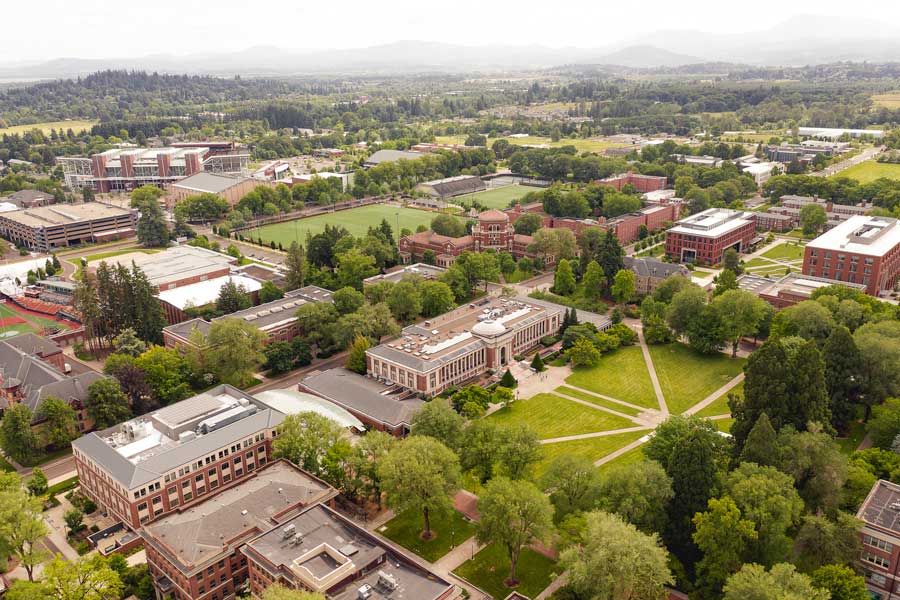
Oregon State University is a land-grant, sea-grant, and space-grant powerhouse that feels less like a selective ivory tower and more like an open, sprawling laboratory for the Pacific Northwest. Its identity is firmly rooted in science, engineering, and the applied arts, offering a pragmatic, hands-on education to a large and diverse student body in the college town of Corvallis. With an admissions policy that is notably accessible, OSU delivers strong outcomes in fields like computer science and engineering, backed by a graduation rate that outpaces the national average.
Admission requirements
Test-blind — scores not considered
Required
High school transcript
Grade point average
College-prep program
TOEFL (non-native English)
Considered (not required)
Class rank
Demonstrated competencies
Source: IPEDS Admissions survey (2022) via Urban Institute. Covers formal factors only — it does not reflect essays, extracurriculars, or other holistic criteria.
More details
Undergrad enrollment
30,743
In-state tuition
$14,400
Out-of-state tuition
$38,190
Popular Majors
Computer Science (16%), Psychology (7%), Business (6%), Mechanical Engineering
Graduation Rate
70%
First-Year Retention
87%
Demonstrated Interest
Not considered
Early Action Deadline
November 3 (Non-binding)
Median Earnings (10yr)
$64,010
Outcomes & value
Outcomes & value
Median earnings (10 yr)
$64,010
Value (earnings ÷ net price)
3.3×
Median debt at graduation
$21,221
Graduation rate
70%
First-year retention
88%
Reducing loan balance (3 yr)
67%
Pell (lower-income) share
23%
First-gen share (among federal-aid recipients)
31%
Top-earning majors
Median earnings by field of study (highest credential), ~2 years after completion.
Computer Science$73,446
Electrical, Electronics, and Communications Engineering$73,035
Construction Engineering$71,295
Manufacturing Engineering$69,338
Industrial Engineering$67,420
Engineering, Other$64,493
Applicants here also applied to
The schools that most often appear alongside Oregon State University on applicants’ lists, from our self-reported outcomes corpus.
On-campus criminal offenses classed as violent (murder/non-negligent manslaughter, rape, robbery, aggravated assault) for the most recent reported year. Source: U.S. Dept. of Education Campus Safety and Security (Clery Act). Counts reflect what’s reported to the school, and urban campuses often report more partly due to non-student incidents nearby — read alongside campus size and setting, not as a standalone safety verdict.
Climate
Pleasant days / yr
116
Summer high
81°F
Winter low
35°F
Annual rain
43.1"
Annual snow
9.2"
Natural-hazard risk
Relatively Moderate
Pleasant days counts days per year with a mean temperature of 55–75°F, a high at or below 90°F, a low at or above 45°F, and little precipitation — a transparent comfort measure, not a weighting we invented. Computed from Open-Meteo ERA5 daily history (2019–2023). Natural-hazard risk is the county’s composite rating from the FEMA National Risk Index.
Deep dive — research, future-scholar output & economic mobility▾
Research output
Institutional h-index
804
Scholarly works
117,353
Institutional research volume and impact from OpenAlex. The h-index reflects large research universities and will be low for teaching-focused liberal-arts colleges — not a measure of undergraduate quality.
Economic mobility
Mobility rate
1.6%
Bottom → top quintile
33%
From bottom quintile
5%
Mobility rate = the share of students who both start in the bottom household-income quintile and reach the top quintile; bottom → top is that chance conditional on starting at the bottom. Source: Opportunity Insights Mobility Report Cards (Chetty, Friedman, Saez, Turner & Yagan). Reflects 1980–82 birth cohorts, so it’s directional, not current.
Quick answers
What is the acceptance rate at Oregon State University?
Oregon State University's acceptance rate is approximately 77% (Corvallis, OR), based on the most recent figures we compiled from public and primary sources.
What SAT score do you need for Oregon State University?
Admitted students at Oregon State University typically score 1140–1400 on the SAT (the middle-50% range). Scores outside this band are still admitted, especially with strong applications.
How much does Oregon State University cost?
At Oregon State University, the average net price (after aid) is about $19,604 per year. Actual cost varies with financial aid and residency.
How many undergraduates attend Oregon State University?
Oregon State University enrolls approximately 30,743 undergraduate students.
Where is Oregon State University located?
Oregon State University is located in Corvallis, OR.
Admissions
Oregon State operates with a notably accessible admissions philosophy, accepting a significant majority of its applicants. The process is designed to be straightforward: the university is , meaning SAT or ACT scores are not required for most applicants, and it accepts both high school diplomas and GEDs. The admitted student profile shows a strong academic foundation, with nearly half (47%) of admitted students reporting an unweighted high school GPA of 3.75 or higher, and another 23% falling between 3.50 and 3.74. The university offers a non-binding Early Action deadline of November 3rd, which allows students to receive an early decision without the commitment of a binding Early Decision program. Demonstrated interest—such as campus visits or contact with admissions—is not a formal factor in the evaluation process, as indicated by its reporting. This approach aligns with OSU's mission as a public, land-grant institution focused on providing broad access to higher education.
Earnings = median of students working ~10 years after entry; debt = median of graduates. Value divides 10-yr earnings by one year’s net price — read it as earnings per dollar of annual cost, not a full lifetime ROI; it favors lower-cost schools. Source: U.S. Dept. of Education College Scorecard. Figures lag ~2 years and reflect all students, not your intended major.
Chemical Engineering
$63,600
Civil Engineering$63,430
Source: U.S. Dept. of Education College Scorecard (field-of-study earnings). Figures cover graduates who received federal aid and lag ~2 years; not all programs report data.
Co-application frequency from self-reported results — directional peer discovery, not a recommendation.
OSU's academic identity is defined by breadth and a pronounced strength in STEM fields. The university offers a vast array of over 200 undergraduate majors and degrees through its 11 colleges, plus the Graduate School and the Honors College. This translates to more than 300 distinct academic programs when counting majors, options, and double-degree combinations. The curriculum is heavily slanted toward science and engineering, a reputation acknowledged even by its own student community, which often contrasts OSU's technical focus with the more liberal arts-oriented University of Oregon. The most popular majors reflect this technical emphasis: for the 2024 graduating class, Computer Science dominated at 16% of graduates, followed by Psychology (7%), Business Administration and Management (6%), and Mechanical Engineering. This creates an environment where practical, career-oriented education is the norm, supported by the university's unique designations as a land-grant, sea-grant, and space-grant institution.
Life at OSU is characterized by an active, organized, and inclusive campus culture set against the backdrop of the classic college town of Corvallis. The university heavily promotes engagement for new students, with a wide array of events, clubs, and activities designed to foster connection. Students can choose from more than 400 student clubs and organizations, covering everything from hobbies and skills development to cultural and identity-based groups. A cornerstone of this inclusive environment is OSU's network of seven cultural centers and programs, which provide dedicated, welcoming spaces to celebrate diversity on campus. Living on-campus is encouraged and designed to be convenient, offering access to resources like free tutoring, recreation spaces, lounges, and laundry facilities. The overall vibe is one of a supportive, mid-sized city built around the university, where student life is intentionally curated but not overly pressured.
OSU graduates enter the workforce with solid earning potential and a degree from a university with a strong track record of seeing students through to completion. The six-year graduation rate is reported at 71%, which places Oregon State in the top 25% of institutions nationally for this metric. This success rate is a key indicator of the university's support systems and student satisfaction. For professional graduate programs, OSU boasts impressive pass rates: a 96% veterinary medicine licensure exam pass rate, a 96% pharmacy certification rate, and a 90% pass rate for engineering exams. Furthermore, the university reports a 74% medical school for its pre-med graduates. These figures underscore the effectiveness of its career-oriented, particularly in its signature STEM and health professions programs.
As a public institution, Oregon State offers a cost structure that is competitive, especially for in-state students, and provides substantial scholarship resources to offset expenses. The university encourages all students to complete the FAFSA or ORSAA by its priority deadline of February 28 to be considered for the full range of federal, state, and institutional aid. A significant pool of donor-funded scholarships is available; students can use the ScholarDollars platform to search and apply for over $15 million in these awards, part of more than $50 million in total institutional aid distributed annually. The financial aid office provides detailed cost estimates, budget worksheets, and a Calculator to help families plan. The aid packaging philosophy generally prioritizes reducing student loan amounts before adjusting other forms of awarded aid. However, OSU is not among the elite group of institutions that promise to meet 100% of demonstrated financial need without including loans in the package.
Oregon State University carves out a distinct niche as the workhorse of the Pacific Northwest's public higher education system. It rejects the model of hyper-selectivity in favor of broad access, then couples that access with a rigorous, practical education that yields strong results. Its identity is unapologetically tied to its land-grant mission and its triple designation as a land-grant, sea-grant, and space-grant university—a rare combination that fuels its research and teaching in fields from forestry and oceanography to engineering and computer science. The campus culture in Corvallis is less about cutthroat competition and more about collaborative, hands-on problem-solving, reflected in its high graduation rates and exceptional pass rates on professional licensure exams. For students who want a large university experience focused on tangible skills, surrounded by the natural beauty of Oregon, and led by a faculty engaged in real-world research, OSU represents a compelling and highly effective choice.
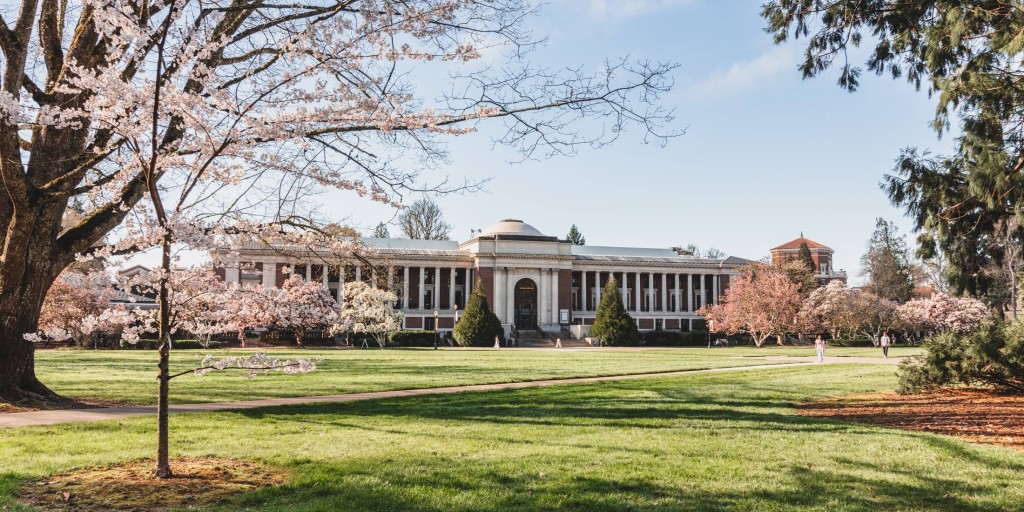
Oregon State University seal · sourceOregon State University · sourceOregon State University in Corvallis, Oregon · sourceOregon State University · source
_(14597991988)_(cropped).jpg?width=1600)