Admit rate has ranged 34%–39% over the last 5 years. Source: IPEDS via Urban Institute.
Acceptance & SAT from Common Data Set / IPEDS; net price, earnings & graduation from the U.S. Dept. of Education College Scorecard. Figures lag ~1–2 years — verify with the school.
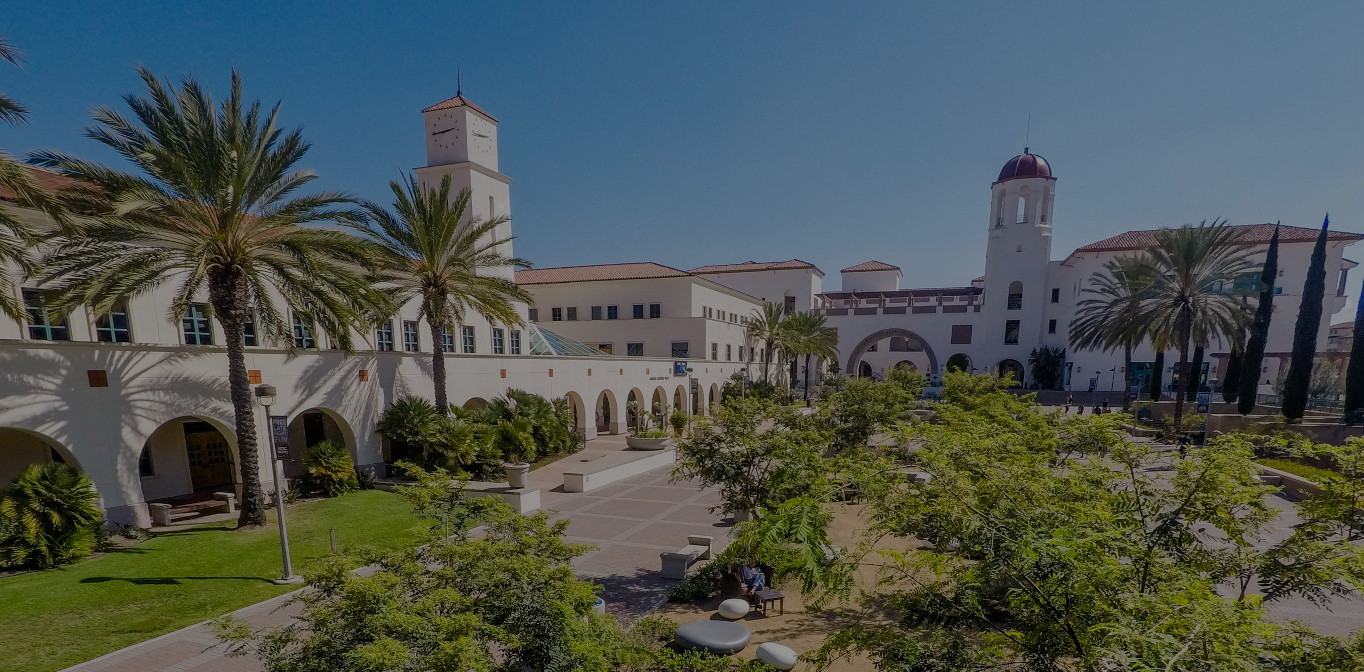
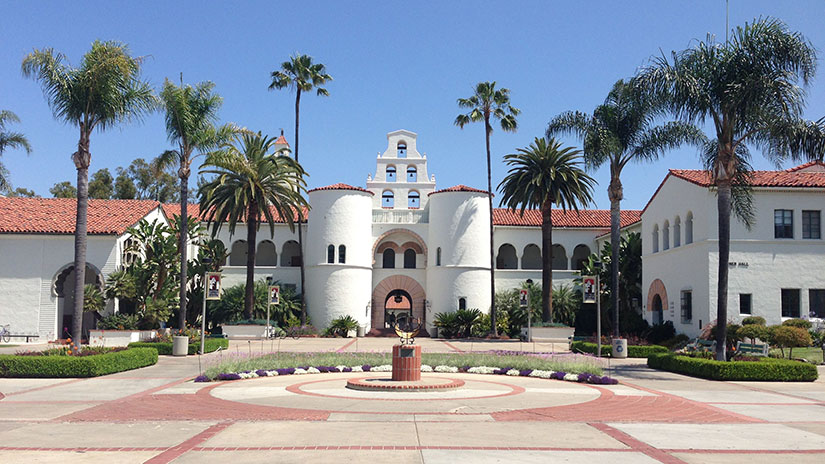
San Diego State University is a large, sun-drenched public research university where the California dream meets practical, high-value education. It's a place where students can chase a business degree or a psychology major by day and chase waves or explore a world-class city by night, all while graduating with a surprisingly strong return on investment. The vibe is energetic, social, and outdoorsy, anchored by a sprawling campus that feels more like a self-contained town than a college.
Admission requirements
Test-blind — scores not considered
Required
High school transcript
Grade point average
College-prep program
TOEFL (non-native English)
Source: IPEDS Admissions survey (2022) via Urban Institute. Covers formal factors only — it does not reflect essays, extracurriculars, or other holistic criteria.
More details
Undergrad enrollment
35,377
In-state tuition
$8,728
Out-of-state tuition
$21,328
Graduation Rate
76%
Academic Programs
200+
On-Campus Housing
24% of students
Demonstrated Interest
Not considered
Median Earnings (10yr)
$64,909
Mid-Career Salary (PayScale)
$127,700
Outcomes & value
Outcomes & value
Median earnings (10 yr)
$64,909
Value (earnings ÷ net price)
4.2×
Median debt at graduation
$15,000
Graduation rate
76%
First-year retention
91%
Reducing loan balance (3 yr)
66%
Pell (lower-income) share
32%
First-gen share (among federal-aid recipients)
41%
Top-earning majors
Median earnings by field of study (highest credential), ~2 years after completion.
Registered Nursing, Nursing Administration, Nursing Research and Clinical Nursing$87,377
Construction Engineering Technology/Technician$72,231
Computer Engineering$70,456
Electrical, Electronics, and Communications Engineering$69,757
Computer Science$66,318
Mechanical Engineering
Applicants here also applied to
The schools that most often appear alongside San Diego State University on applicants’ lists, from our self-reported outcomes corpus.
On-campus criminal offenses classed as violent (murder/non-negligent manslaughter, rape, robbery, aggravated assault) for the most recent reported year. Source: U.S. Dept. of Education Campus Safety and Security (Clery Act). Counts reflect what’s reported to the school, and urban campuses often report more partly due to non-student incidents nearby — read alongside campus size and setting, not as a standalone safety verdict.
Climate
Pleasant days / yr
243
Summer high
81°F
Winter low
46°F
Annual rain
15.7"
Natural-hazard risk
Very High
Pleasant days counts days per year with a mean temperature of 55–75°F, a high at or below 90°F, a low at or above 45°F, and little precipitation — a transparent comfort measure, not a weighting we invented. Computed from Open-Meteo ERA5 daily history (2019–2023). Natural-hazard risk is the county’s composite rating from the FEMA National Risk Index.
Deep dive — research, future-scholar output & economic mobility▾
Research output
Institutional h-index
584
Scholarly works
52,073
Institutional research volume and impact from OpenAlex. The h-index reflects large research universities and will be low for teaching-focused liberal-arts colleges — not a measure of undergraduate quality.
Economic mobility
Mobility rate
3.7%
Bottom → top quintile
41%
From bottom quintile
9%
Mobility rate = the share of students who both start in the bottom household-income quintile and reach the top quintile; bottom → top is that chance conditional on starting at the bottom. Source: Opportunity Insights Mobility Report Cards (Chetty, Friedman, Saez, Turner & Yagan). Reflects 1980–82 birth cohorts, so it’s directional, not current.
Quick answers
What is the acceptance rate at San Diego State University?
San Diego State University's acceptance rate is approximately 36% (San Diego, CA), based on the most recent figures we compiled from public and primary sources.
How much does San Diego State University cost?
At San Diego State University, the average net price (after aid) is about $15,364 per year. Actual cost varies with financial aid and residency.
How many undergraduates attend San Diego State University?
San Diego State University enrolls approximately 35,377 undergraduate students.
Where is San Diego State University located?
San Diego State University is located in San Diego, CA.
Admissions
Getting into SDSU is a competitive proposition, with the university admitting roughly one in three applicants. The process is firmly test-blind; SDSU no longer uses SAT or ACT exam scores from first-year applicants for determining admission eligibility. This places the full weight of the evaluation on academic performance in high school, with admitted students typically presenting strong GPAs. The university does not publish statistics on early decision or early action programs, and according to its , it does not consider demonstrated interest as a factor in admissions decisions. The rate—the percentage of admitted students who enroll—is notably lower than the , suggesting many admitted students have other attractive options.
Earnings = median of students working ~10 years after entry; debt = median of graduates. Value divides 10-yr earnings by one year’s net price — read it as earnings per dollar of annual cost, not a full lifetime ROI; it favors lower-cost schools. Source: U.S. Dept. of Education College Scorecard. Figures lag ~2 years and reflect all students, not your intended major.
$65,089
Aerospace, Aeronautical, and Astronautical/Space Engineering$63,005
Civil Engineering$62,317
Source: U.S. Dept. of Education College Scorecard (field-of-study earnings). Figures cover graduates who received federal aid and lag ~2 years; not all programs report data.
SDSU offers a vast academic menu across more than 200 programs, providing a comprehensive public university education with particular strengths in professional fields. Students can choose from bachelor's degrees in 97 areas, supported by 115 master's programs and 30 active doctoral degrees. The curriculum is recognized for its strong programs in business, engineering, nursing, psychology, and speech-language pathology. The scale means students must be proactive, but those who engage find the work academically challenging yet manageable. The university's value proposition is a major selling point, with external analyses highlighting a strong return on investment for the degree.
Life at SDSU is defined by its Southern California location and the vibrant, social energy of its large student body. The campus is a hub of activity, with events ranging from concerts and movie nights to food demonstrations. While only about a quarter of students live in college-owned or affiliated housing, on-campus living is strongly encouraged for first-years to foster connection. The social scene is famously vibrant and diverse, catering to the outgoing. A car is highly recommended, however, as the university is a gateway to the immense offerings of San Diego and its beaches. The overall culture is one of professionalism mixed with a quintessential California casualness.
SDSU graduates leave with a degree that carries serious economic weight. The university's graduation rate significantly outpaces national expectations, a key indicator of student support and success. Financially, the payoff is clear: alumni see strong salary growth, with mid-career earnings (10+ years of experience) reaching a substantial level. This combination of a solid graduation rate and strong earnings potential is why SDSU consistently ranks as a top value in national guides, earning high marks for the return on investment it provides to students.
As a public university, SDSU offers a cost structure that is markedly lower than many private institutions, though attending still represents a significant investment. The university provides various forms of financial aid, including grants, scholarships, and loans, and encourages all students to complete the FAFSA. It offers a calculator to help families estimate their true cost. It is important to note that SDSU, like many public universities, does not have a "no-loan" policy that meets full demonstrated need for all admitted students; federal and state aid may not cover the full cost, leaving a gap that families often fill with loans or other resources.
SDSU stands out for delivering a potent, one-two punch: a legitimately strong academic and career launchpad wrapped in an enviable Southern California lifestyle. It's not just a party school by the beach (though that element exists); it's a serious research university where the graduation rate beats predictions and the median alumni earnings validate the investment. The scale is massive, offering both opportunity and the need for self-direction. What you get is a classic, comprehensive American university experience—complete with football, a sprawling campus, and hundreds of clubs—but with perfect weather, Pacific Ocean access, and the cultural and professional networks of a major city right at your doorstep. It’s the practical choice that doesn’t ask you to sacrifice the fun.
San Diego State University seal · sourceHome | San Diego State University · sourceSan Diego State University Buildings and Campus | City of San Diego Official Website · sourceSan Diego State University - Santa Monica College · source