Admit rate has ranged 49%–56% over the last 5 years. Source: IPEDS via Urban Institute.
Acceptance & SAT from Common Data Set / IPEDS; net price, earnings & graduation from the U.S. Dept. of Education College Scorecard. Figures lag ~1–2 years — verify with the school.
The University of Connecticut isn't just Connecticut's flagship public university; it's a sprawling, spirited land-grant research institution where the academic intensity of a top-tier public school collides with the full-throated, basketball-obsessed culture of a major state university. Students here navigate a vast academic landscape of over 125 majors, from powerhouse business and health professions programs to nationally ranked research, all while living in a self-contained 'college town' atmosphere in Storrs. The vibe is high-achieving but deeply communal, where a 91% post-graduation success rate is celebrated as loudly as a Huskies victory.
Admission requirements
Test scores required
Required
High school transcript
Grade point average
Test scores (SAT/ACT)
College-prep program
TOEFL (non-native English)
Considered (not required)
Class rank
Letters of recommendation
Source: IPEDS Admissions survey (2022) via Urban Institute. Covers formal factors only — it does not reflect essays, extracurriculars, or other holistic criteria.
More details
Undergrad enrollment
19,835
In-state tuition
$21,044
Out-of-state tuition
$43,712
No-Loan Policy
Not in sources
Graduation Rate
83%
Meets Full Need
Not in sources
ED Share of Class
Not in sources
First-Year Retention
Not in sources
Demonstrated Interest
Not considered
Median Earnings (10yr)
$73,997
Outcomes & value
Outcomes & value
Median earnings (10 yr)
$73,997
Value (earnings ÷ net price)
2.9×
Median debt at graduation
$21,500
Graduation rate
83%
First-year retention
92%
Reducing loan balance (3 yr)
78%
Pell (lower-income) share
25%
First-gen share (among federal-aid recipients)
27%
Top-earning majors
Median earnings by field of study (highest credential), ~2 years after completion.
Industrial Engineering$82,440
Computer Science$79,473
Computer Engineering$74,262
Electrical, Electronics, and Communications Engineering$70,917
Registered Nursing, Nursing Administration, Nursing Research and Clinical Nursing$70,783
Applied Mathematics
Applicants here also applied to
The schools that most often appear alongside UConn on applicants’ lists, from our self-reported outcomes corpus.
Co-application frequency from self-reported results — directional peer discovery, not a recommendation.
Campus & location
Campus safety
On-campus violent crimes (2024)
10
Per 1,000 students
0.36
On-campus criminal offenses classed as violent (murder/non-negligent manslaughter, rape, robbery, aggravated assault) for the most recent reported year. Source: U.S. Dept. of Education Campus Safety and Security (Clery Act). Counts reflect what’s reported to the school, and urban campuses often report more partly due to non-student incidents nearby — read alongside campus size and setting, not as a standalone safety verdict.
Climate
Pleasant days / yr
93
Summer high
80°F
Winter low
24°F
Annual rain
54.8"
Annual snow
30.5"
Pleasant days counts days per year with a mean temperature of 55–75°F, a high at or below 90°F, a low at or above 45°F, and little precipitation — a transparent comfort measure, not a weighting we invented. Computed from Open-Meteo ERA5 daily history (2019–2023).
Deep dive — research, future-scholar output & economic mobility▾
Research output
Institutional h-index
688
Scholarly works
117,640
Institutional research volume and impact from OpenAlex. The h-index reflects large research universities and will be low for teaching-focused liberal-arts colleges — not a measure of undergraduate quality.
Economic mobility
Mobility rate
1.7%
Bottom → top quintile
47%
From bottom quintile
4%
Mobility rate = the share of students who both start in the bottom household-income quintile and reach the top quintile; bottom → top is that chance conditional on starting at the bottom. Source: Opportunity Insights Mobility Report Cards (Chetty, Friedman, Saez, Turner & Yagan). Reflects 1980–82 birth cohorts, so it’s directional, not current.
Quick answers
What is the acceptance rate at University of Connecticut?
University of Connecticut's acceptance rate is approximately 52% (Storrs, CT), based on the most recent figures we compiled from public and primary sources.
What SAT score do you need for University of Connecticut?
Admitted students at University of Connecticut typically score 1210–1440 on the SAT (the middle-50% range). Scores outside this band are still admitted, especially with strong applications.
How much does University of Connecticut cost?
At University of Connecticut, the average net price (after aid) is about $25,097 per year. Actual cost varies with financial aid and residency.
How many undergraduates attend University of Connecticut?
University of Connecticut enrolls approximately 19,835 undergraduate students.
Where is University of Connecticut located?
University of Connecticut is located in Storrs, CT.
Admissions
Gaining admission to UConn is a competitive proposition, with tens of thousands vying for a spot in each freshman class. The university received over 62,000 applications for first-year admission recently, reflecting its growing popularity. While the overall sits at 52%, applying Early Decision—a binding commitment—can significantly improve an applicant's odds; UConn's inaugural Early Decision round saw about 60% of the roughly 1,500 applicants admitted. The rate—the percentage of admitted students who enroll—is 15%, indicating that UConn competes for students with a wide range of other institutions.
Academic preparation is paramount. The middle 50% SAT range for admitted students who submitted scores is 1210–1440. While specific GPA data from the provided sources is limited, community discussion suggests many admitted students rank in the top 10% of their high school class with strong GPAs. Notably, UConn does not consider demonstrated interest in its admissions decisions, meaning campus visits, emails to admissions officers, or other forms of 'showing love' are not factored into the evaluation. The process is focused squarely on the applicant's academic record, rigor of coursework, and other traditional metrics.
Earnings = median of students working ~10 years after entry; debt = median of graduates. Value divides 10-yr earnings by one year’s net price — read it as earnings per dollar of annual cost, not a full lifetime ROI; it favors lower-cost schools. Source: U.S. Dept. of Education College Scorecard. Figures lag ~2 years and reflect all students, not your intended major.
$69,338
Mechanical Engineering$69,013
Computer and Information Sciences, General$67,846
Source: U.S. Dept. of Education College Scorecard (field-of-study earnings). Figures cover graduates who received federal aid and lag ~2 years; not all programs report data.
UConn's academic breadth is its defining feature, offering a classic large-university smorgasbord with several standout schools. Students can choose from over 125 majors and 120 minors, ensuring that nearly every academic interest has a home. The most popular fields reflect both student demand and strong career pathways: Business, Management, Marketing, and Related Support Services (13% of 2024 graduates), Social Sciences (12%), and Health Professions and Related Programs are among the top producers. Other popular majors include Psychology, Economics, Communications, and Finance.
The scale allows for deep specialization and significant undergraduate research opportunities, a point highlighted in student reviews. While the sources don't rank specific departments, the university's land-grant mission supports strong programs in agriculture, health sciences, and engineering. For the undecided, the university provides robust exploratory resources through initiatives like The Major Experience, which offers detailed profiles on every program to help students navigate their options. The academic culture is described as rigorous and supportive, with a stated institutional focus on ensuring 'every student is supported in order to be the most successful student possible.'
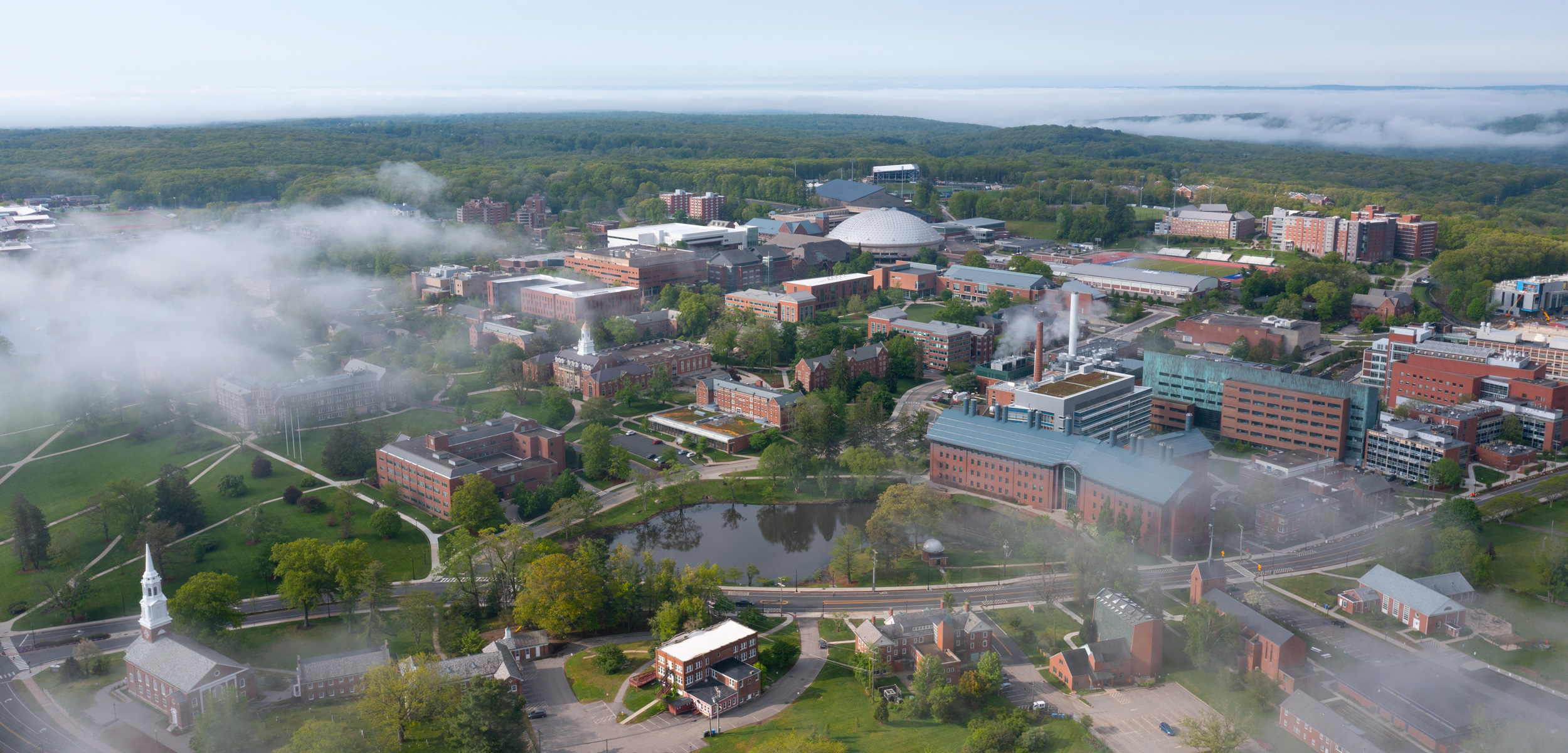
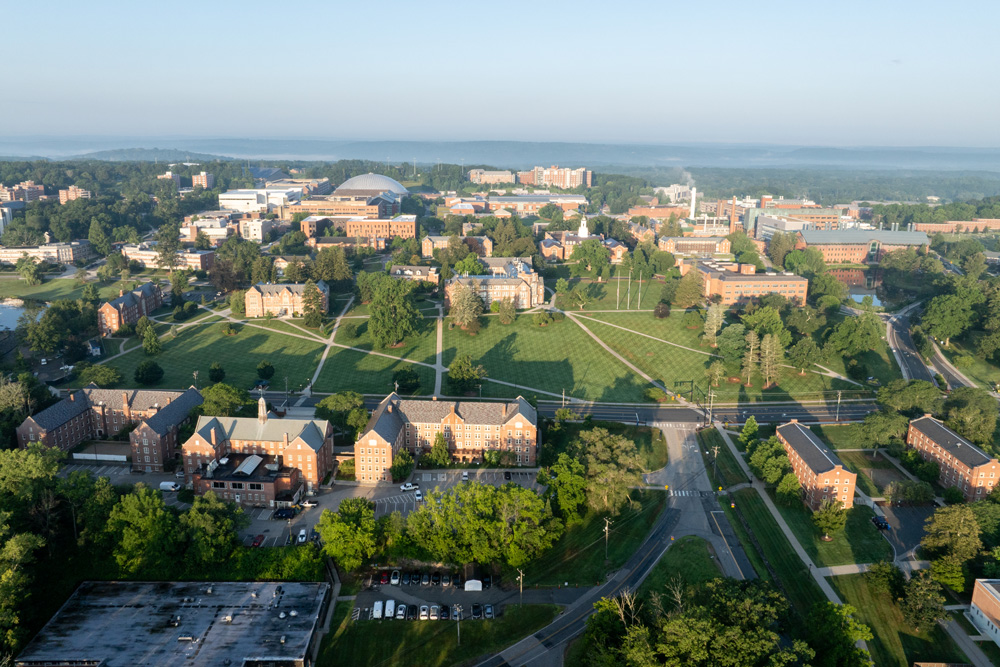
Life at UConn's Storrs campus is that of a classic, self-contained college town—a place where the university is the town. The campus itself is frequently described as 'pretty,' with a blend of historic and modern architecture set across a sprawling landscape. A significant majority of students (67%) live in university-owned, -operated, or -affiliated housing, creating a densely populated residential core buzzing with activity.
The Student Union acts as a central hub, featuring a movie theater, game room, TV lounges, and a food court. Campus life is highly active, driven by over 700 student organizations, a visible Greek life presence, and intramural sports. Seven cultural centers provide spaces for community and exploration. The social calendar is packed with events like karaoke nights and trivia competitions. Of course, the heartbeat of campus life is Huskies athletics, particularly basketball, which unites the student body and the state of Connecticut in a shared, intense passion. The international student community adds a global dimension, with students from around the world finding opportunities for involvement.
A UConn degree delivers strong, measurable returns. The university reports a 91% 'positive outcomes' rate for its undergraduates within six months of graduation. This figure encompasses those who are employed (56%), continuing their education (30%), or engaged in volunteerism or military service (5%). For those entering the workforce directly, the early returns are impressive: the average starting salary for recent graduates is reported to be $67,500.
The six-year graduation rate is a solid 83%, indicating strong student support and persistence. The median earnings ten years after entry are $73,997, showcasing the degree's long-term value and the success of alumni in building their careers. These outcomes underscore UConn's role as a powerful engine of social and economic mobility for Connecticut and beyond, providing a high-value public education that leads directly to employment or advanced study for the vast majority of its graduates.
As a public institution, UConn's sticker price presents a significant investment, but the university works to offset costs with financial aid. The average —what students actually pay after grants and scholarships are applied—is $25,097. Roughly half of all students (51.12%) receive financial aid, with the average aid package totaling $20,681.
The university provides a Net Price Calculator to help families estimate their individual cost based on financial circumstances. It's important to note that the figures for tuition and fees represent direct costs before aid is applied. While the provided sources discuss colleges that meet full financial need with no-loan policies in general, none of the UConn-specific sources indicate that the University of Connecticut has a formal 'no-loan' policy or a guarantee to meet 100% of demonstrated financial need for all admitted students. Financial aid packages are typically a mix of grants, scholarships, work-study, and loans, and adjustments may be made based on changes in a student's circumstances.
UConn distinguishes itself by masterfully blending the scale and opportunity of a major research university with the cohesive, spirited identity of a classic New England college. It's a place where you can pursue a highly specialized major alongside 30,000 other students, yet still feel part of a tight-knit community bound by Huskies pride. The academic offering is vast and pragmatic, channeling students directly into high-demand fields with remarkable success—evidenced by the 91% positive outcome rate. Unlike many large publics, it fosters a residential, on-campus experience for most undergraduates, creating a immersive environment where learning and social life are deeply intertwined. Ultimately, UConn offers a specific kind of value: the intellectual resources of a flagship, the career launchpad of a professional school, and the unforgettable, rallying-campus culture of a sports powerhouse, all wrapped into one package. It's for the student who wants it all—rigor, spirit, and a clear path forward.
Gallery
University of Connecticut seal · sourceCampuses | University of Connecticut · sourceVisit Campus | University of Connecticut · sourceUniversity of Connecticut's impressive Storrs main campus - Kaplan International Pathways · source