Admit rate has ranged 12%–19% over the last 5 years, though the latest figure above (11%) falls outside that window. Source: IPEDS via Urban Institute.
Acceptance & SAT from Common Data Set / IPEDS; net price, earnings & graduation from the U.S. Dept. of Education College Scorecard. Figures lag ~1–2 years — verify with the school.
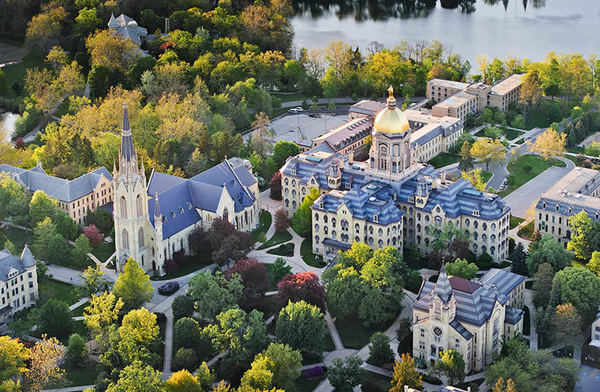
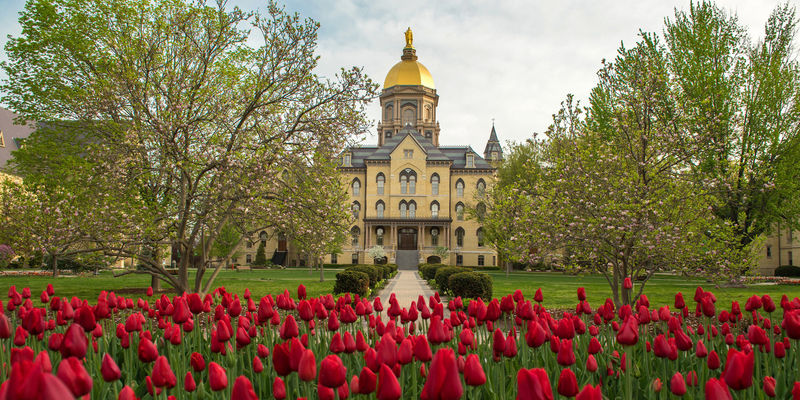
The University of Notre Dame operates less like a typical university and more like a self-contained, fiercely loyal tribe, where the golden dome is a beacon for a distinct blend of high-stakes academics, deep Catholic tradition, and a campus culture that is both intensely communal and proudly insular. Its identity is forged in the single-sex residence halls that replace Greek life, a powerhouse football program that serves as a national liturgy, and a financial aid policy that has recently thrown open its doors to a broader economic range of students. The result is an environment where intellectual rigor, faith, and a formidable alumni network converge to produce graduates with exceptional outcomes and a lifelong sense of belonging.
Admission requirements
Test-optional — scores considered if submitted
Required
High school transcript
Grade point average
Letters of recommendation
College-prep program
TOEFL (non-native English)
Considered (not required)
Class rank
Test scores (SAT/ACT)
Demonstrated competencies
Source: IPEDS Admissions survey (2022) via Urban Institute. Covers formal factors only — it does not reflect essays, extracurriculars, or other holistic criteria.
More details
Undergrad enrollment
8,818
In-state tuition
$65,025
Out-of-state tuition
$65,025
No-Loan Policy
Yes, for all students
Graduation Rate
95%
Meets Full Need
Yes
First-Year Retention
98%
Demonstrated Interest
Not considered
Median Earnings (10yr)
$99,980
Residential (First-Years)
100%
Outcomes & value
Outcomes & value
Median earnings (10 yr)
$99,980
Value (earnings ÷ net price)
3.7×
Median debt at graduation
$19,000
Graduation rate
95%
First-year retention
99%
Reducing loan balance (3 yr)
93%
Pell (lower-income) share
14%
First-gen share (among federal-aid recipients)
10%
Top-earning majors
Median earnings by field of study (highest credential), ~2 years after completion.
Computer and Information Sciences, General$89,968
Finance and Financial Management Services$86,375
Mathematics and Statistics, Other$80,273
Computer Engineering$79,598
Chemical Engineering$76,460
Electrical, Electronics, and Communications Engineering
Applicants here also applied to
The schools that most often appear alongside Notre Dame on applicants’ lists, from our self-reported outcomes corpus.
Co-application frequency from self-reported results — directional peer discovery, not a recommendation.
Campus & location
Campus safety
On-campus violent crimes (2024)
8
Per 1,000 students
0.62
On-campus criminal offenses classed as violent (murder/non-negligent manslaughter, rape, robbery, aggravated assault) for the most recent reported year. Source: U.S. Dept. of Education Campus Safety and Security (Clery Act). Counts reflect what’s reported to the school, and urban campuses often report more partly due to non-student incidents nearby — read alongside campus size and setting, not as a standalone safety verdict.
Climate
Pleasant days / yr
88
Summer high
81°F
Winter low
23°F
Annual rain
43.7"
Annual snow
33.1"
Natural-hazard risk
Relatively Moderate
Pleasant days counts days per year with a mean temperature of 55–75°F, a high at or below 90°F, a low at or above 45°F, and little precipitation — a transparent comfort measure, not a weighting we invented. Computed from Open-Meteo ERA5 daily history (2019–2023). Natural-hazard risk is the county’s composite rating from the FEMA National Risk Index.
Deep dive — research, future-scholar output & economic mobility▾
Research output
Institutional h-index
747
Scholarly works
99,051
Institutional research volume and impact from OpenAlex. The h-index reflects large research universities and will be low for teaching-focused liberal-arts colleges — not a measure of undergraduate quality.
Future-scholar output
Humanities & social-science PhDstop 35 nationally
Share of this school’s graduates who go on to earn research doctorates (2010–20), by national rank and per-capita yield (NSF institutional-yield ratio). A signal of a research-oriented student culture — not a causal promise, since it partly reflects who enrolls. Only top producers appear. Source: NSF NCSES, Baccalaureate Origins of U.S. Research Doctorate Recipients.
Economic mobility
Mobility rate
0.9%
Bottom → top quintile
Quick answers
What is the acceptance rate at University of Notre Dame?
University of Notre Dame's acceptance rate is approximately 11% (Notre Dame, IN), based on the most recent figures we compiled from public and primary sources.
What SAT score do you need for University of Notre Dame?
Admitted students at University of Notre Dame typically score 1455–1560 on the SAT (the middle-50% range). Scores outside this band are still admitted, especially with strong applications.
How much does University of Notre Dame cost?
At University of Notre Dame, the average net price (after aid) is about $26,780 per year. Actual cost varies with financial aid and residency.
How many undergraduates attend University of Notre Dame?
University of Notre Dame enrolls approximately 8,818 undergraduate students.
Where is University of Notre Dame located?
University of Notre Dame is located in Notre Dame, IN.
Admissions
Gaining admission to Notre Dame is an exercise in navigating a highly selective, holistic process where academic pedigree is the baseline, not the finish line. The university's Restrictive Early Action (REA) program offers a strategic advantage, with an historically higher than the regular decision pool; for the Class of 2030, 12% of REA applicants were admitted. The admissions office is through the 2026-27 cycle, but for those who submit, the enrolled student profile is formidable, with mid-50% SAT scores of 1460-1540 and ACT scores of 33-35. The evaluation criteria, as outlined in the , prioritize a student's academic record above all else: class rank, rigor of secondary school record, and GPA are the most important factors. Essays, recommendations, and extracurricular activities are also considered very important. Notably, while Notre Dame reads for fit within its unique mission, demonstrated interest is not a rated factor in the admissions decision—applying is the signal. The enrolled class is notably homogeneous in one key aspect: 82% of the Class of 2029 identifies as Catholic, underscoring the institution's core identity. About 20% of that class are or Pell Grant recipients, a figure the university's new aid policies aim to increase.
Earnings = median of students working ~10 years after entry; debt = median of graduates. Value divides 10-yr earnings by one year’s net price — read it as earnings per dollar of annual cost, not a full lifetime ROI; it favors lower-cost schools. Source: U.S. Dept. of Education College Scorecard. Figures lag ~2 years and reflect all students, not your intended major.
$75,518
Management Information Systems and Services$74,307
Mechanical Engineering$71,320
Source: U.S. Dept. of Education College Scorecard (field-of-study earnings). Figures cover graduates who received federal aid and lag ~2 years; not all programs report data.
Mobility rate = the share of students who both start in the bottom household-income quintile and reach the top quintile; bottom → top is that chance conditional on starting at the bottom. Source: Opportunity Insights Mobility Report Cards (Chetty, Friedman, Saez, Turner & Yagan). Reflects 1980–82 birth cohorts, so it’s directional, not current.
Notre Dame's academic structure is built around four undergraduate colleges: the College of Arts and Letters, the Mendoza College of Business, the College of Engineering, and the College of Science. This setup creates clear intellectual pathways, but the university encourages cross-pollination, particularly through its robust undergraduate research opportunities available to all majors. The curriculum is unapologetically rigorous, with a core that often includes philosophy and theology requirements reflecting its Catholic character. While the university is nationally ranked for its undergraduate teaching, the student experience varies by college. The Mendoza College of Business is a perennial powerhouse, known for its ethics-focused curriculum and exceptional Wall Street and consulting pipelines. The College of Engineering is highly regarded, particularly for its chemical and aerospace programs. Within the largest college, Arts and Letters, popular and versatile majors like Economics, Political Science, and various pre-professional tracks (including a dedicated Arts and Letters Pre-Health program) attract students seeking a liberal arts foundation with clear postgraduate direction. The academic culture is collaborative rather than cutthroat, supported by a 9:1 student-to-faculty ratio that facilitates close mentorship, though introductory lectures in popular majors can be large.
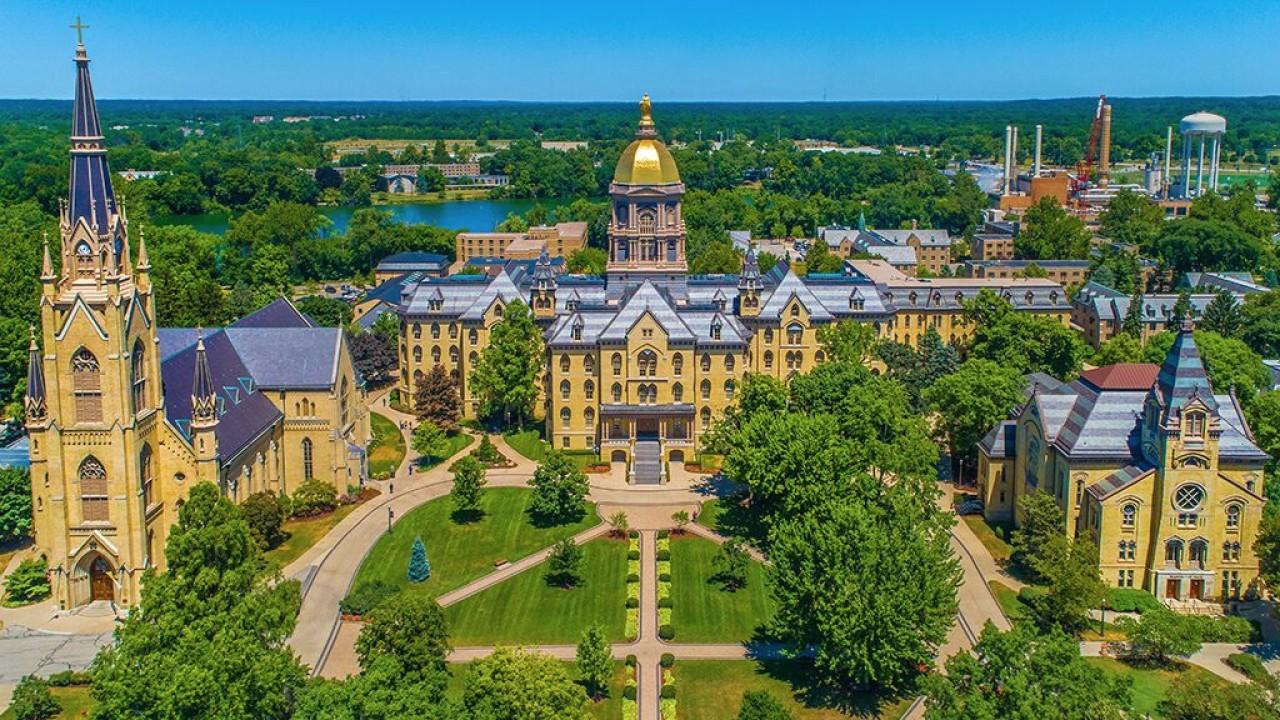
Life at Notre Dame is defined by an all-encompassing residential community that actively supplants the need for Greek life. A remarkable 100% of first-year students and over 80% of all undergraduates live on campus in one of 33 single-sex residence halls. These are not mere dormitories; they are the heart of social life, each with its own traditions, intramural sports teams, and loyalties. This system creates an immediate sense of belonging but can feel insular to some, as the campus is geographically isolated in northern Indiana. The social scene revolves around dorm parties, campus-wide events like the AnTostal festival, and, of course, football. Game days in the fall are a cultural phenomenon that shut down the campus and town, transforming it into a national pilgrimage site for the alumni network. The Catholic identity is pervasive but not oppressive; daily mass is offered, and faith formation is a part of the community fabric, but students of all (or no) faiths find a place. The lack of a vibrant off-campus "college town" means students largely make their own fun on campus, leading to a tight-knit, almost familial atmosphere that graduates famously romanticize. As one admitted student researching vlogs noted, the campus looks 'dreamy' and the people seem 'really nice,' capturing the aesthetic and communal appeal.
A Notre Dame degree is a launchpad with remarkable reliability. The university reports that 97% of graduates are successful in securing employment, graduate school placement, or volunteer work within six months of graduation. This stellar outcome is fueled by the powerful Meruelo Family Center for Career Development and an alumni network known for its fervent willingness to hire and mentor fellow Domers. The financial return is significant, with graduates earning a median early-career salary well above the national average for college graduates. The university's focus on holistic formation—combining intellectual, professional, and ethical development—prepares students for leadership roles across sectors, particularly in business, law, medicine, and engineering. The four-year graduation rate is exceptionally high, ensuring students enter the workforce or advanced study without the delay and debt of additional years.
Notre Dame has dramatically reshaped its affordability proposition with one of the most aggressive financial aid policies in the country. The university is now need-blind for all undergraduates, including international students, and meets 100% of demonstrated financial need for every admitted student without using loans. This 'no-loan' policy means financial aid packages are composed entirely of grants and scholarships that do not need to be repaid. The policy includes groundbreaking income thresholds: families with typical assets and incomes up to $60,000 pay nothing toward tuition, and families with incomes up to $200,000 receive aid covering at least half of tuition costs. This commitment fundamentally alters the accessibility of a Notre Dame education, moving it from a high-cost, high-prestige model to one that actively recruits a socioeconomically diverse student body. The average after aid reflects this substantial institutional investment in affordability.
Notre Dame stands out not merely for its rankings or its football team, but for the singular, cohesive culture it sustains—a culture that is almost tribal in its loyalty and distinct in American higher education. It is a place where the intellectual, the spiritual, and the communal are deliberately intertwined. The residential hall system creates a level of undergraduate immersion and identity that fraternities and sororities provide elsewhere, but without the exclusivity based on selection. Its Catholic mission is not a historical footnote but a living framework that informs dialogues on ethics in business, compassion in medicine, and service in leadership. This mission attracts a predominantly Catholic student body, creating a shared value system that underpins the famed community spirit. Furthermore, its recent transition to a universal need-blind, no-loan admissions and aid policy is a monumental shift, signaling an intent to leverage its substantial endowment to compete for talent at all income levels on pure merit and fit. The outcome is a graduate who is not just well-educated but deeply formed—connected to a network that feels more like family than an alumni association, and carrying a sense of purpose that is rare and marketable. It's a unique proposition: the academic heft of a top-tier research university delivered with the communal ethos of a small liberal arts college, all wrapped in a tradition that commands national attention every Saturday in the fall.
University of Notre Dame seal · sourceCampus Tour | University of Notre Dame · sourceMain Building | Locations | Campus Tour | University of Notre Dame · sourceNotre Dame bringing students back to campus 2 weeks early | Fox Business · source