Admit rate has ranged 51%–71% over the last 5 years — notably volatile. Source: IPEDS via Urban Institute.
Acceptance & SAT from Common Data Set / IPEDS; net price, earnings & graduation from the U.S. Dept. of Education College Scorecard. Figures lag ~1–2 years — verify with the school.
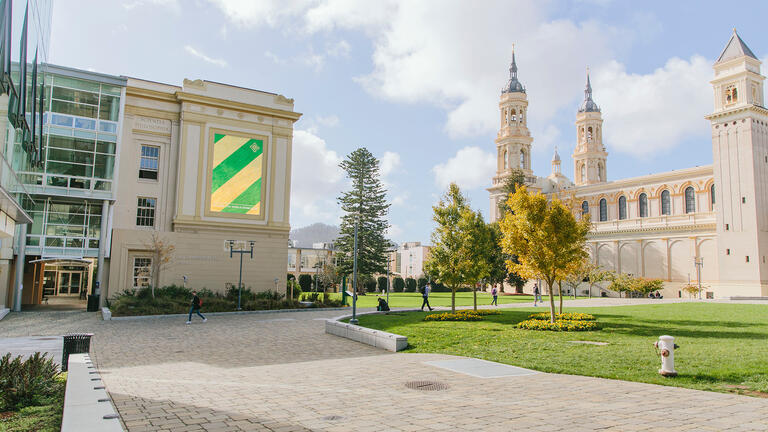
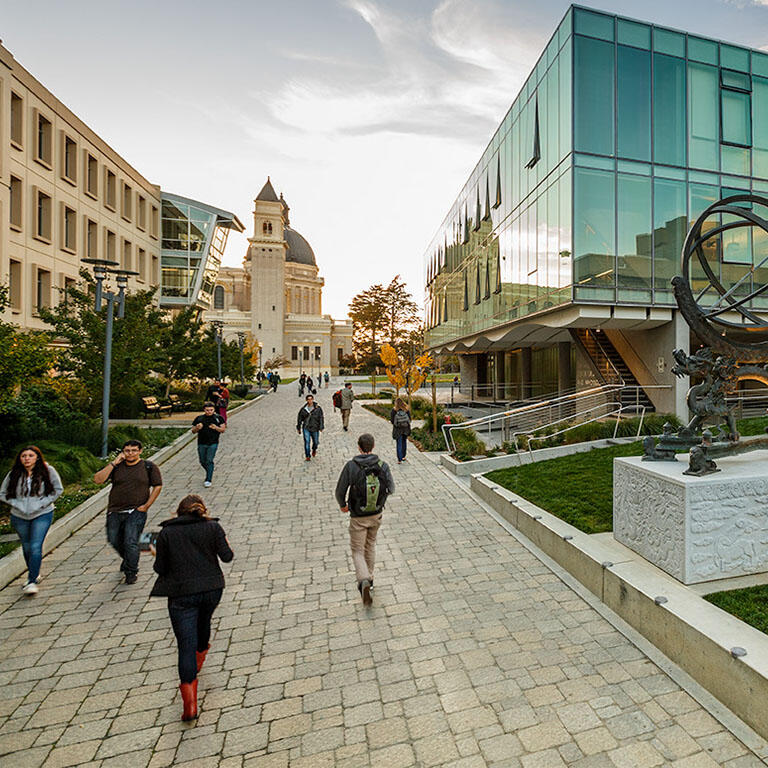
The University of San Francisco (USF) is a Jesuit institution that thrives on its urban energy, social justice ethos, and enviable location in one of the world's most dynamic cities. With a 62% acceptance rate and a student body that's 40.9% first-generation, USF blends accessibility with strong outcomes—95% of 2023 grads were employed or in grad school. Its tight-knit classes (11:1 student-faculty ratio) and prime Silicon Valley adjacency make it a launchpad for mission-driven careers.
Admission requirements
Test-optional — scores considered if submitted
Required
High school transcript
Grade point average
College-prep program
TOEFL (non-native English)
Considered (not required)
Letters of recommendation
Test scores (SAT/ACT)
Source: IPEDS Admissions survey (2022) via Urban Institute. Covers formal factors only — it does not reflect essays, extracurriculars, or other holistic criteria.
More details
Undergrad enrollment
5,287
In-state tuition
$60,492
Out-of-state tuition
$60,492
First-Gen Students
40.9%
Early Career Earnings
$36,427
Student-Faculty Ratio
11:1
6-Year Graduation Rate
76%
Outcomes & value
Outcomes & value
Median earnings (10 yr)
$89,812
Value (earnings ÷ net price)
2.2×
Median debt at graduation
$23,000
Graduation rate
70%
First-year retention
84%
Reducing loan balance (3 yr)
73%
Pell (lower-income) share
28%
First-gen share (among federal-aid recipients)
28%
Financial health
2.4 / 3.0Meets the federal financial-responsibility standard
U.S. Dept. of Education Financial Responsibility Composite Score (FY2022-23). Scale −1.0 to 3.0; ≥1.5 meets the standard. Reported for private nonprofit & for-profit institutions only — public universities are state-backed and not scored, so this is a stability signal, not a ranking.
Top-earning majors
Median earnings by field of study (highest credential), ~2 years after completion.
Registered Nursing, Nursing Administration, Nursing Research and Clinical Nursing$100,292
Computer Science$72,796
Accounting and Related Services$64,068
Finance and Financial Management Services$61,020
Architecture$55,286
Business Administration, Management and Operations
Applicants here also applied to
The schools that most often appear alongside University of San Francisco on applicants’ lists, from our self-reported outcomes corpus.
On-campus criminal offenses classed as violent (murder/non-negligent manslaughter, rape, robbery, aggravated assault) for the most recent reported year. Source: U.S. Dept. of Education Campus Safety and Security (Clery Act). Counts reflect what’s reported to the school, and urban campuses often report more partly due to non-student incidents nearby — read alongside campus size and setting, not as a standalone safety verdict.
Climate
Pleasant days / yr
198
Summer high
66°F
Winter low
46°F
Annual rain
23.6"
Natural-hazard risk
Very High
Pleasant days counts days per year with a mean temperature of 55–75°F, a high at or below 90°F, a low at or above 45°F, and little precipitation — a transparent comfort measure, not a weighting we invented. Computed from Open-Meteo ERA5 daily history (2019–2023). Natural-hazard risk is the county’s composite rating from the FEMA National Risk Index.
Deep dive — research, future-scholar output & economic mobility▾
Research output
Institutional h-index
440
Scholarly works
25,671
Institutional research volume and impact from OpenAlex. The h-index reflects large research universities and will be low for teaching-focused liberal-arts colleges — not a measure of undergraduate quality.
Economic mobility
Mobility rate
2.7%
Bottom → top quintile
46%
From bottom quintile
6%
Mobility rate = the share of students who both start in the bottom household-income quintile and reach the top quintile; bottom → top is that chance conditional on starting at the bottom. Source: Opportunity Insights Mobility Report Cards (Chetty, Friedman, Saez, Turner & Yagan). Reflects 1980–82 birth cohorts, so it’s directional, not current.
Quick answers
What is the acceptance rate at University of San Francisco?
University of San Francisco's acceptance rate is approximately 62% (San Francisco, CA), based on the most recent figures we compiled from public and primary sources.
What SAT score do you need for University of San Francisco?
Admitted students at University of San Francisco typically score 1190–1390 on the SAT (the middle-50% range). Scores outside this band are still admitted, especially with strong applications.
How much does University of San Francisco cost?
At University of San Francisco, the average net price (after aid) is about $41,431 per year. Actual cost varies with financial aid and residency.
How many undergraduates attend University of San Francisco?
University of San Francisco enrolls approximately 5,287 undergraduate students.
Where is University of San Francisco located?
University of San Francisco is located in San Francisco, CA.
Admissions
USF's admissions process is moderately selective, with a 61.7% and an early acceptance rate of 77.8%. The middle 50% SAT range is 1200–1380, while ACT scores fall between 25–30. Notably, USF is —applicants aren't required to submit SAT/ACT scores. The average GPA of admitted first-years is 3.61, and 40.9% are college students. The university draws from 45 U.S. states, creating a geographically diverse cohort.
USF offers over 150 undergraduate and graduate programs across its five schools, with particularly strong offerings in nursing, business, and computer science. The 11:1 student-faculty ratio supports small class sizes—42.7% have fewer than 20 students. The Jesuit emphasis on social justice permeates the curriculum, with experiential learning opportunities amplified by the university's urban setting. USF ranks in the top 15% for social mobility and top 6% for lifetime earnings among graduates.
Earnings = median of students working ~10 years after entry; debt = median of graduates. Value divides 10-yr earnings by one year’s net price — read it as earnings per dollar of annual cost, not a full lifetime ROI; it favors lower-cost schools. Source: U.S. Dept. of Education College Scorecard. Figures lag ~2 years and reflect all students, not your intended major.
$54,594
Hospitality Administration/Management$52,107
International Business$50,231
Source: U.S. Dept. of Education College Scorecard (field-of-study earnings). Figures cover graduates who received federal aid and lag ~2 years; not all programs report data.
Life at USF mirrors the eclectic energy of San Francisco itself. Students describe the culture as 'very mixed'—a blend of 'nerds, bros, stoners, musicians and jocks' who coalesce around shared interests. The urban campus lacks Greek life but compensates with 100+ clubs and easy access to the city's internships, cultural institutions, and outdoor spaces. Housing guarantees for first-years foster community, though many upperclassmen migrate to SF's vibrant neighborhoods. The TikTok generation showcases USF's quintessential draw: 'It's not just about obtaining a degree' but living in a global hub.
USF delivers strong ROI: 95% of 2023 graduates were employed or in graduate school within six months. The median annual income for alumni 10 years out is 51% higher than the national average for four-year colleges. First-year retention rates hover around 80%, with a six-year graduation rate of 76%—well above the national average. Early career median earnings are $36,427, though this climbs sharply with experience (MBA grads average $76,170). The university's Bay Area location and alumni network provide pipelines to tech, healthcare, and nonprofit sectors.
With a sticker price of $58,222 for tuition alone, USF is expensive—but 98% of incoming undergrads receive financial aid, with average packages of $41,708 bringing the down to $42,953. The university meets 85% of demonstrated need on average. Graduate programs offer assistantships and scholarships, though costs vary by program. The Net Price Calculator helps families estimate true costs after grants and scholarships.
USF's magic lies in its contradictions: a Jesuit institution that thrives on progressive San Francisco values, a small-college feel in a global city, and rigorous academics paired with real-world hustle. Its #1 ranking for campus diversity among national universities reflects an inclusive community where 40.9% of first-years are . The curriculum leans into the city's assets—tech internships, public health partnerships, and social entrepreneurship—while maintaining the liberal arts core. For students who want to 'change the world from here,' USF offers both the idealism and the urban toolkit to make it happen.
University of San Francisco logo · sourceSan Francisco Main Campus | University of San Francisco · sourceOur Location | University of San Francisco · sourceUSF Campus Tour · source