Admit rate has ranged 23%–31% over the last 5 years. Source: IPEDS via Urban Institute.
Acceptance & SAT from Common Data Set / IPEDS; net price, earnings & graduation from the U.S. Dept. of Education College Scorecard. Figures lag ~1–2 years — verify with the school.
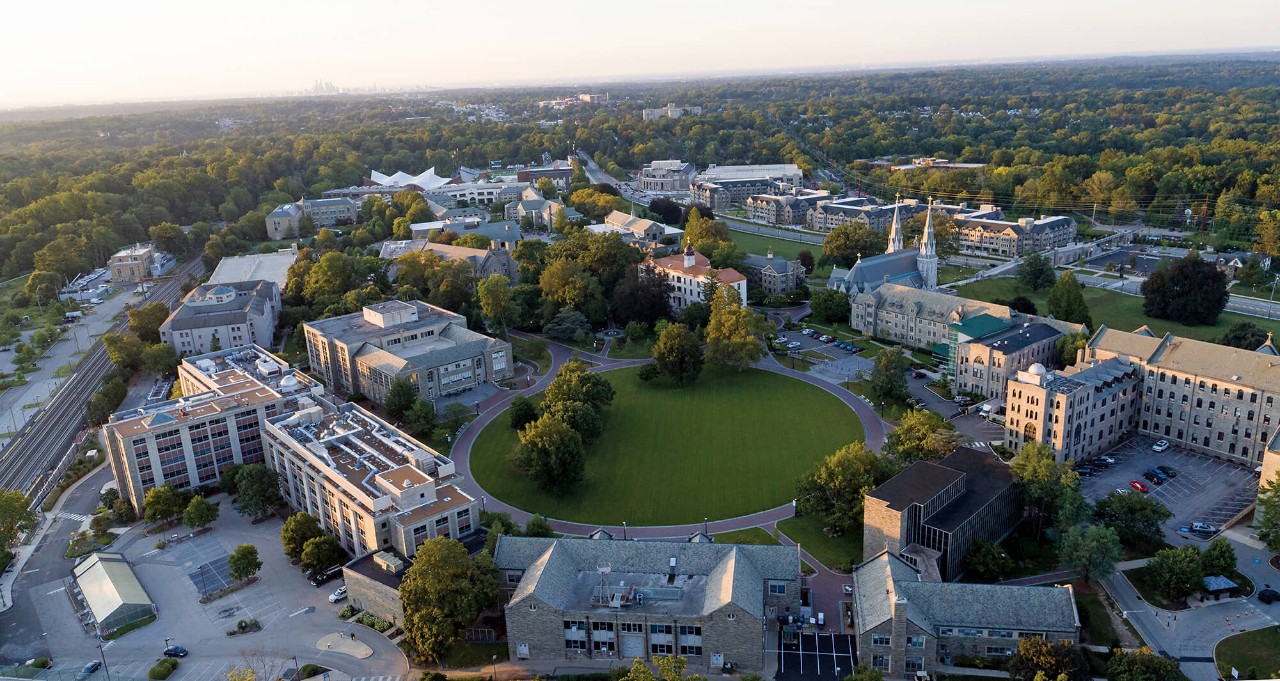
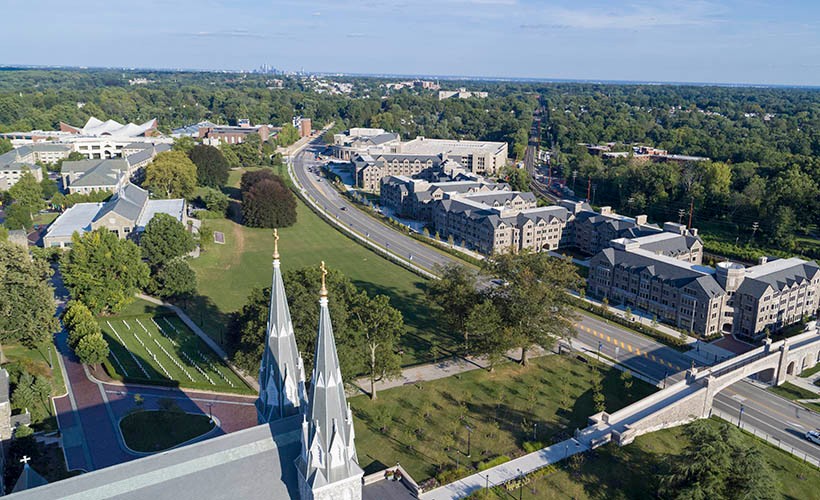
Villanova University is a selective, Augustinian Catholic institution where a powerful sense of community and school spirit is channeled into high-impact professional outcomes. Its identity is split between a nationally-ranked business school that anchors the campus culture and a surprisingly robust liberal arts core, all set on a classic suburban Philadelphia campus humming with activity. This is a place for students who want a tight-knit, spirited undergraduate experience with a clear runway to lucrative careers in finance, consulting, and engineering.
Admission requirements
Test-optional — scores considered if submitted
Required
High school transcript
Grade point average
Letters of recommendation
College-prep program
TOEFL (non-native English)
Considered (not required)
Class rank
Test scores (SAT/ACT)
Source: IPEDS Admissions survey (2022) via Urban Institute. Covers formal factors only — it does not reflect essays, extracurriculars, or other holistic criteria.
More details
Undergrad enrollment
6,938
In-state tuition
$67,776
Out-of-state tuition
$67,776
No-Loan Policy
No
Graduation Rate
92%
Meets Full Need
No
Demonstrated Interest
Considered
Median Earnings (10yr)
$100,423
Average Starting Salary
$79,854
Successful Placement Rate
94.1%
Outcomes & value
Outcomes & value
Median earnings (10 yr)
$100,423
Value (earnings ÷ net price)
2.3×
Median debt at graduation
$25,874
Graduation rate
92%
First-year retention
95%
Reducing loan balance (3 yr)
90%
Pell (lower-income) share
12%
First-gen share (among federal-aid recipients)
13%
Financial health
2.8 / 3.0Meets the federal financial-responsibility standard
U.S. Dept. of Education Financial Responsibility Composite Score (FY2022-23). Scale −1.0 to 3.0; ≥1.5 meets the standard. Reported for private nonprofit & for-profit institutions only — public universities are state-backed and not scored, so this is a stability signal, not a ranking.
Top-earning majors
Median earnings by field of study (highest credential), ~2 years after completion.
Business/Managerial Economics$90,856
Electrical, Electronics, and Communications Engineering$74,576
Finance and Financial Management Services$73,579
Registered Nursing, Nursing Administration, Nursing Research and Clinical Nursing$73,052
Computer Engineering$72,214
Management Information Systems and Services
Applicants here also applied to
The schools that most often appear alongside Villanova on applicants’ lists, from our self-reported outcomes corpus.
Co-application frequency from self-reported results — directional peer discovery, not a recommendation.
Campus & location
Campus safety
On-campus violent crimes (2024)
4
Per 1,000 students
0.40
On-campus criminal offenses classed as violent (murder/non-negligent manslaughter, rape, robbery, aggravated assault) for the most recent reported year. Source: U.S. Dept. of Education Campus Safety and Security (Clery Act). Counts reflect what’s reported to the school, and urban campuses often report more partly due to non-student incidents nearby — read alongside campus size and setting, not as a standalone safety verdict.
Climate
Pleasant days / yr
92
Summer high
84°F
Winter low
29°F
Annual rain
51.6"
Annual snow
15.4"
Natural-hazard risk
Relatively Moderate
Pleasant days counts days per year with a mean temperature of 55–75°F, a high at or below 90°F, a low at or above 45°F, and little precipitation — a transparent comfort measure, not a weighting we invented. Computed from Open-Meteo ERA5 daily history (2019–2023). Natural-hazard risk is the county’s composite rating from the FEMA National Risk Index.
Deep dive — research, future-scholar output & economic mobility▾
Research output
Institutional h-index
312
Scholarly works
24,759
Institutional research volume and impact from OpenAlex. The h-index reflects large research universities and will be low for teaching-focused liberal-arts colleges — not a measure of undergraduate quality.
Economic mobility
Mobility rate
1.3%
Bottom → top quintile
58%
From bottom quintile
2%
Mobility rate = the share of students who both start in the bottom household-income quintile and reach the top quintile; bottom → top is that chance conditional on starting at the bottom. Source: Opportunity Insights Mobility Report Cards (Chetty, Friedman, Saez, Turner & Yagan). Reflects 1980–82 birth cohorts, so it’s directional, not current.
Quick answers
What is the acceptance rate at Villanova University?
Villanova University's acceptance rate is approximately 27% (Villanova, PA), based on the most recent figures we compiled from public and primary sources.
What SAT score do you need for Villanova University?
Admitted students at Villanova University typically score 1395–1510 on the SAT (the middle-50% range). Scores outside this band are still admitted, especially with strong applications.
How much does Villanova University cost?
At Villanova University, the average net price (after aid) is about $43,756 per year. Actual cost varies with financial aid and residency.
How many undergraduates attend Villanova University?
Villanova University enrolls approximately 6,938 undergraduate students.
Where is Villanova University located?
Villanova University is located in Villanova, PA.
Admissions
Gaining admission to Villanova is a competitive proposition, with the university reporting a selective of 27%. The academic profile of admitted students is exceptionally strong; according to analysis of information, 47% of admitted students graduated high school with a perfect 4.0 GPA, and nearly all the rest had a GPA above 3.75. For those who submit scores, the middle 50% SAT range is 1395–1510 and the middle 50% ACT range is 33–35, though Villanova remains for applicants through the Class of 2031.
The admissions strategy here heavily favors the committed. Villanova employs four distinct application rounds: Early Decision I, Early Action, Early Decision II, and Regular Decision. The Early Decision acceptance rate is significantly higher than the overall rate—sources report figures of 49%, 54%, and nearly 60% in recent cycles—making a binding ED application a substantial strategic advantage. Furthermore, Villanova's Common Data Set indicates that 'level of applicant's interest' is a factor 'considered' in the admissions process, meaning demonstrated interest through campus visits, interviews, and engagement can play a role. The admissions office can be reached at 610-519-6450.
Earnings = median of students working ~10 years after entry; debt = median of graduates. Value divides 10-yr earnings by one year’s net price — read it as earnings per dollar of annual cost, not a full lifetime ROI; it favors lower-cost schools. Source: U.S. Dept. of Education College Scorecard. Figures lag ~2 years and reflect all students, not your intended major.
$71,947
Mechanical Engineering$71,575
Real Estate$71,351
Source: U.S. Dept. of Education College Scorecard (field-of-study earnings). Figures cover graduates who received federal aid and lag ~2 years; not all programs report data.
Villanova's academic landscape is dominated by professional and pre-professional studies, yet it maintains a sturdy liberal arts foundation through its College of Liberal Arts and Sciences, which emphasizes critical thinking and strong communication skills. The most popular majors reveal the campus's career-oriented pulse: for a recent graduating class, 29% of degrees were in Business, Management, Marketing, and Related Support Services, 13% in Engineering, 11% in Social Sciences, and a significant portion in Communications. The Villanova School of Business explicitly aims to mold 'creative problem-solvers' who are 'adept with data and technology' and 'globally aware.'
Beyond business, the social sciences and humanities hold their own. Political science and English have been cited as top-three majors, and writing and media programs are particularly popular. This creates an interesting dynamic where a large contingent of students is focused on high-finance recruitment while a substantial cohort is engaged in the traditional liberal arts, all within the same relatively small, community-focused campus. The multidisciplinary curriculum in the College of Liberal Arts and Sciences is designed to encourage creativity and innovation.
If you had to distill Villanova's campus culture to a single word, it would be 'involved.' The culture is characterized by 'heavy commitment, community and even competitiveness,' with an overwhelming array of clubs, activities, and university-sponsored events that foster a powerful sense of school spirit. Students describe a strong, inclusive community where the social life is largely centered on campus. As one student noted, 'On campus you can chill with friends in the dorms, you can throw a smallish to medium [gathering].'
The Division of Student Life provides a vast portfolio of programs and services designed to help students 'engage, serve and ignite change,' supporting them throughout their journey. This curated environment strives to create an inclusive and supportive campus in every aspect, from academics to special programming. The result is a vibrant, self-contained ecosystem where students are deeply plugged in—whether through service, club leadership, athletics, or simply participating in longstanding campus traditions. It's a place where showing up and joining in is the default mode.
Villanova's investment pays off in exceptionally strong postgraduate outcomes, a point of immense institutional pride. The university reports a successful placement rate of 94.1% for graduates, with the Class of 2024 achieving a 95.3% success rate in securing opportunities post-graduation. These 'opportunities' include employment, graduate school, and other endeavors. The average starting salary for recent graduates is reported at $79,854, with figures ranging from about $53,000 to over $94,000 depending on the field. This earning power outpaces expectations; one analysis notes graduates earn about $9,000 more in their early career than might be expected given their majors.
This success is built on a foundation of high graduation rates. Villanova boasts a 92% graduation rate, which places it in the top 5% of institutions nationwide, and men and women graduate at nearly identical rates. The average time to degree is four years, indicating students are progressing efficiently through their structured programs. The outcome is clear: a Villanova degree is a reliable ticket to the professional world, particularly in the business and engineering sectors that dominate its enrollment.
Attending Villanova requires a significant financial commitment, with the average after aid coming in at $43,756. The university states that it 'does not meet 100% of demonstrated financial need,' and a student cannot receive funding that exceeds their . This means Villanova does not have a 'no-loan' policy, where all need is met with grants; students with remaining need after grants and scholarships are eligible for federal loans. plays a notable role, with the average merit-based scholarship awarded reported as $42,088.
For families trying to gauge affordability, Villanova provides a Net Price Calculator on its financial assistance website to offer an early estimate of potential aid. Sources report that about 40.66% of students receive financial aid, with an average aid package of $55,035. The office of financial assistance encourages all families to use the official calculator and apply for aid to understand their specific picture, as the gap between cost and aid can be substantial for many.
Villanova carves out a distinctive niche by fusing the intense school spirit and communal feel of a classic East Coast Catholic university with the career-launching power of a targeted business and engineering school. It’s not just a basketball school with good academics; it’s a place where the pervasive sense of community—that 'Nova Nation' pride—directly fuels professional ambition and networking. The undergraduate experience is notably structured and supported, from the multiple early admission rounds that reward committed applicants to the dense web of student life programming that ensures no one falls through the cracks.
Its uniqueness lies in this specific duality: you can study political philosophy in a rigorous liberal arts setting while your roommate across the hall is prepping for investment banking superdays, and you’ll both meet up at the same packed basketball game or service event. The outcomes speak to the effectiveness of this model. It produces graduates who are not only employable and well-compensated but who also retain a fierce, lifelong loyalty to the institution—a loyalty that begins with the deeply involved, all-in campus culture from day one.
Villanova University seal · sourceCAMPUS SERVICES | Villanova University · sourceVisit Villanova | Villanova University · sourceUniversity | Villanova University · source