Admit rate has ranged 38%–62% over the last 5 years — notably volatile. Source: IPEDS via Urban Institute.
Acceptance & SAT from Common Data Set / IPEDS; net price, earnings & graduation from the U.S. Dept. of Education College Scorecard. Figures lag ~1–2 years — verify with the school.
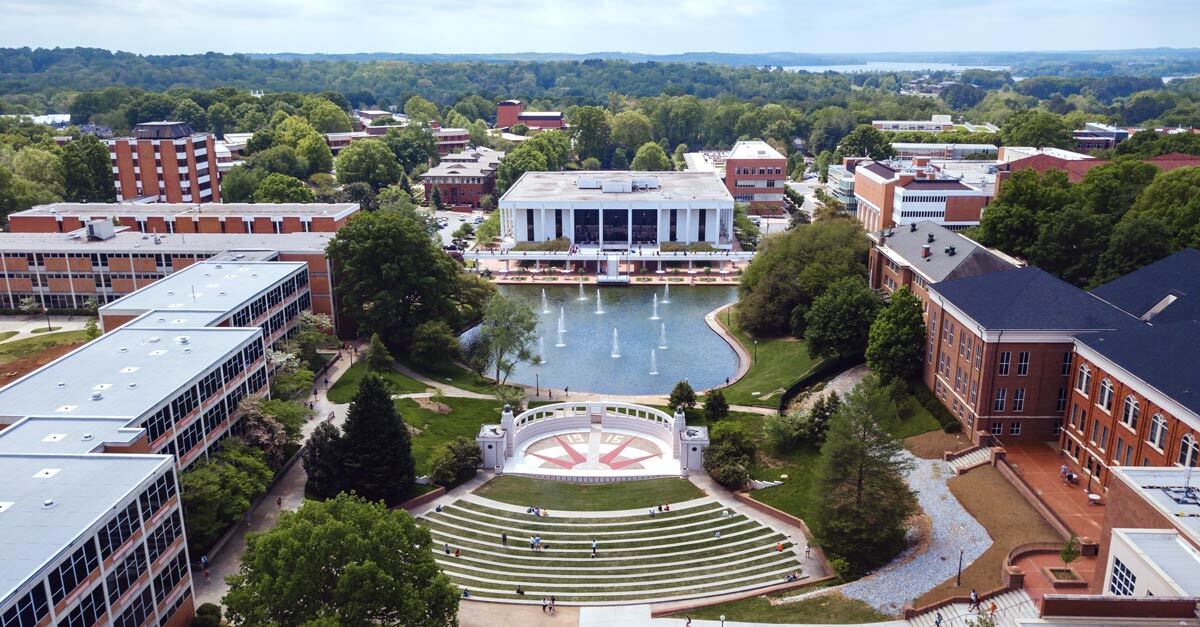
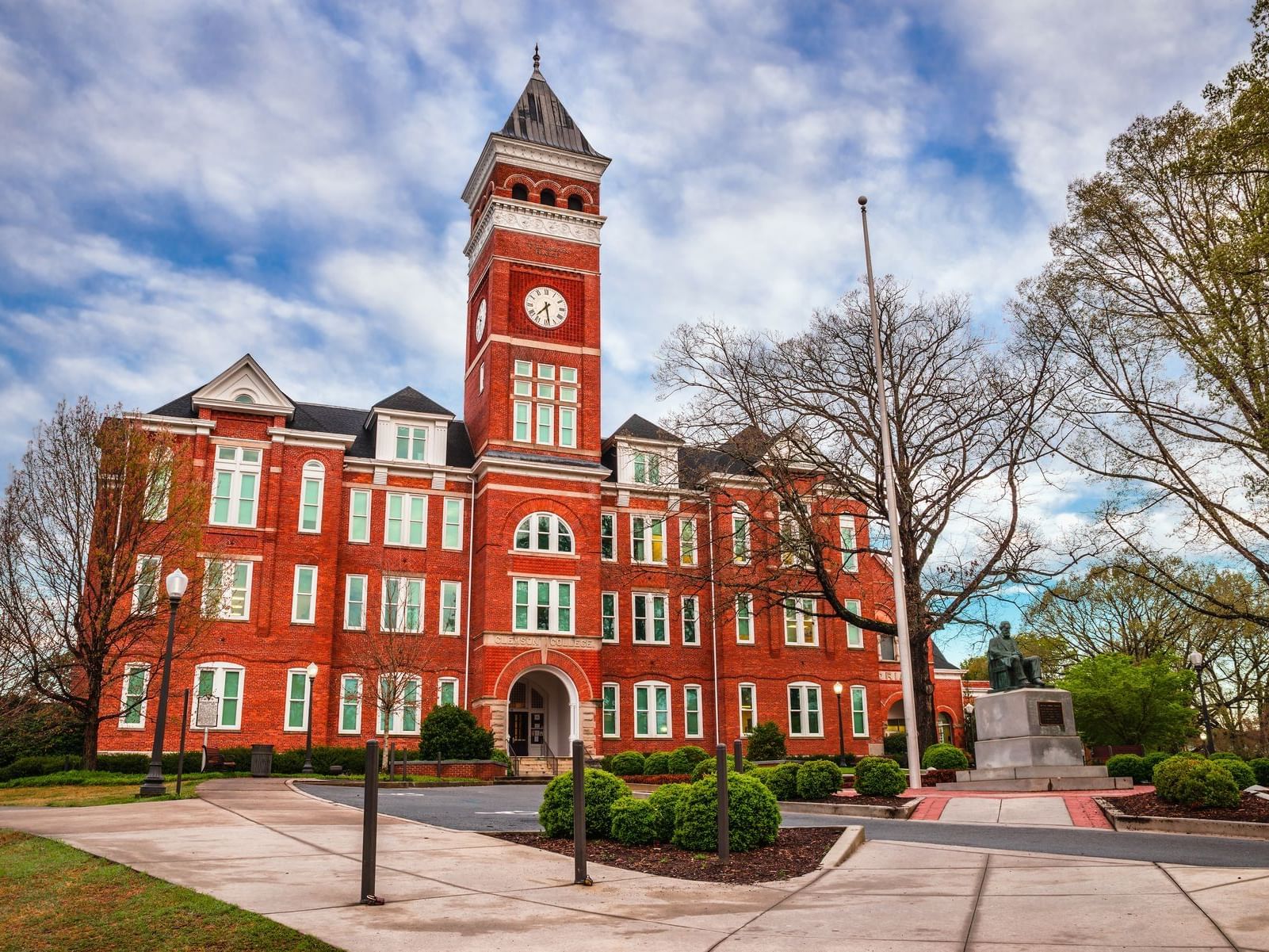
Clemson University is a public land-grant powerhouse where a deep-seated, almost tribal school spirit for the Tigers is the binding agent of campus life. It pairs this intense communal identity with a surprisingly selective admissions process—especially for out-of-state applicants—and a strong return on investment anchored by its renowned engineering and business programs. This is a place where the roar of Death Valley on a Saturday is as central to the experience as the research labs and co-op assignments.
Admission requirements
Test-optional — scores considered if submitted
Required
High school transcript
Grade point average
College-prep program
TOEFL (non-native English)
Considered (not required)
Class rank
Letters of recommendation
Test scores (SAT/ACT)
Demonstrated competencies
Source: IPEDS Admissions survey (2022) via Urban Institute. Covers formal factors only — it does not reflect essays, extracurriculars, or other holistic criteria.
More details
Undergrad enrollment
23,300
In-state tuition
$15,554
Out-of-state tuition
$40,866
No-Loan Policy
No
Graduation Rate
87%
Meets Full Need
No
Demonstrated Interest
Not considered
Median Earnings (10yr)
$71,513
Outcomes & value
Outcomes & value
Median earnings (10 yr)
$71,513
Value (earnings ÷ net price)
3.2×
Median debt at graduation
$21,500
Graduation rate
87%
First-year retention
93%
Reducing loan balance (3 yr)
78%
Pell (lower-income) share
15%
First-gen share (among federal-aid recipients)
17%
Top-earning majors
Median earnings by field of study (highest credential), ~2 years after completion.
Chemical Engineering$74,721
Computer and Information Sciences, General$69,079
Industrial Engineering$68,592
Computer Engineering$67,995
Electrical, Electronics, and Communications Engineering$67,101
Mechanical Engineering$66,673
Applicants here also applied to
The schools that most often appear alongside Clemson on applicants’ lists, from our self-reported outcomes corpus.
On-campus criminal offenses classed as violent (murder/non-negligent manslaughter, rape, robbery, aggravated assault) for the most recent reported year. Source: U.S. Dept. of Education Campus Safety and Security (Clery Act). Counts reflect what’s reported to the school, and urban campuses often report more partly due to non-student incidents nearby — read alongside campus size and setting, not as a standalone safety verdict.
Climate
Pleasant days / yr
103
Summer high
87°F
Winter low
38°F
Annual rain
57.3"
Annual snow
1.9"
Natural-hazard risk
Relatively Low
Pleasant days counts days per year with a mean temperature of 55–75°F, a high at or below 90°F, a low at or above 45°F, and little precipitation — a transparent comfort measure, not a weighting we invented. Computed from Open-Meteo ERA5 daily history (2019–2023). Natural-hazard risk is the county’s composite rating from the FEMA National Risk Index.
Deep dive — research, future-scholar output & economic mobility▾
Research output
Institutional h-index
560
Scholarly works
76,045
Institutional research volume and impact from OpenAlex. The h-index reflects large research universities and will be low for teaching-focused liberal-arts colleges — not a measure of undergraduate quality.
Economic mobility
Mobility rate
1.2%
Bottom → top quintile
38%
From bottom quintile
3%
Mobility rate = the share of students who both start in the bottom household-income quintile and reach the top quintile; bottom → top is that chance conditional on starting at the bottom. Source: Opportunity Insights Mobility Report Cards (Chetty, Friedman, Saez, Turner & Yagan). Reflects 1980–82 birth cohorts, so it’s directional, not current.
Quick answers
What is the acceptance rate at Clemson University?
Clemson University's acceptance rate is approximately 38% (Clemson, SC), based on the most recent figures we compiled from public and primary sources.
What SAT score do you need for Clemson University?
Admitted students at Clemson University typically score 1240–1410 on the SAT (the middle-50% range). Scores outside this band are still admitted, especially with strong applications.
How much does Clemson University cost?
At Clemson University, the average net price (after aid) is about $22,253 per year. Actual cost varies with financial aid and residency.
How many undergraduates attend Clemson University?
Clemson University enrolls approximately 23,300 undergraduate students.
Where is Clemson University located?
Clemson University is located in Clemson, SC.
Admissions
Clemson's admissions process is deceptively competitive, presenting a public-university front with a selectivity that surprises many. While the overall hovers around 38%, the reality is sharply bifurcated by residency: South Carolinians enjoy a significantly higher admit rate—reported as 53% for the Class of 2026—while out-of-state applicants face a steeper climb, with an acceptance rate around 40%. The university does not offer an Early Decision binding option, but it does have an Early Action plan; the acceptance rate for early applicants is noted as being slightly more selective than the regular pool. The middle 50% SAT range for admitted students is 1240–1410, with an ACT equivalent of 28–32. Academic rigor is paramount; the indicates that the most important factors in admission decisions are the rigor of a student's secondary school record, followed by GPA, standardized test scores, and class rank. Notably, Clemson explicitly states that demonstrated interest is not considered in its admissions review, a policy confirmed in the Common Data Set section C7. This means campus visits, emails, and interview requests, while welcome, do not formally influence an applicant's standing. The rate—the percentage of admitted students who enroll—is a relatively modest 18.5%, reflecting the fact that many high-achieving Clemson admits are also recruited by other top public and private institutions.
Earnings = median of students working ~10 years after entry; debt = median of graduates. Value divides 10-yr earnings by one year’s net price — read it as earnings per dollar of annual cost, not a full lifetime ROI; it favors lower-cost schools. Source: U.S. Dept. of Education College Scorecard. Figures lag ~2 years and reflect all students, not your intended major.
Engineering-Related Fields$66,206
Materials Engineering$62,012
Source: U.S. Dept. of Education College Scorecard (field-of-study earnings). Figures cover graduates who received federal aid and lag ~2 years; not all programs report data.
Clemson's academic identity is firmly rooted in its land-grant mission, translating into powerhouse programs in engineering, business, and the biological sciences. The most popular majors cluster in Business, Management, Marketing, and Related Support Services; Engineering; and Biological and Biomedical Sciences. The university promotes an environment of "meaningful research" for undergraduates alongside its internationally recognized faculty. This isn't just rhetoric; the culture leans practical and applied, with a strong emphasis on outcomes. While the academic experience is described as rigorous, the vibe is less cutthroat Ivy and more collaborative, hands-on problem-solving. Students often cite the strength of specific colleges within the university, particularly the College of Engineering, Computing and Applied Sciences, and the Wilbur O. and Ann Powers College of Business. The curriculum is designed to connect classroom theory with real-world application, a philosophy embodied in its robust co-op and internship programs. It's a place where you're as likely to be building a concrete canoe for a competition as you are writing a thesis.
To be a Clemson student is to be part of a tight-knit, tradition-steeped tribe where orange isn't just a color—it's a personality trait. Campus life orbits around a profound and passionate school spirit, most visibly manifested in the near-religious fervor for Clemson Tigers football. Game days in Death Valley are the epicenter of the social calendar, uniting the entire community. Beyond the stadium, student life is active and organization-rich. The university boasts a diverse range of over 500 student clubs and organizations, including a significant Greek life presence, intramural sports, cultural festivals, and student government. While only about 8% of students live in college-owned housing, the campus itself remains a vibrant hub where most students live nearby. The consensus from students themselves highlights the pros: an infectious school spirit, a beautiful campus, and plenty of extracurriculars. The culture is overwhelmingly friendly and communal, creating an environment where it's easy to find your niche, whether it's in a research lab, a service organization, or the student section cheering on the Tigers.
Clemson delivers a compelling return on investment, a key reason for its growing popularity. The graduation rate is a robust 87%, a figure that places it among the top tier of public universities nationally. This success translates directly into the job market. Ten years after entry, the median earnings for Clemson graduates is $71,513. The median debt at graduation is reported to be around $21,500, which, when viewed against the strong earnings potential, indicates a favorable debt-to-income ratio for most graduates. The university's Career Center tracks outcomes, and the data underscores the value of Clemson's applied, industry-connected approach to education. Graduates are well-positioned not just in the Southeast but nationally, particularly in engineering, business, and tech fields. This combination of high graduation rates, strong mid-career earnings, and manageable debt is the core of Clemson's value proposition to families.
As a public institution, Clemson's cost structure differs significantly for in-state versus out-of-state students. The average after grants and scholarships—the actual cost a typical student pays—is $22,253. The university reports that 97% of first-time, in-state students receive some form of state scholarship aid. Financial aid packages typically include a mix of grants, scholarships, work-study, and loans. It's important to note that Clemson does not have a "no-loan" policy or a guarantee to meet 100% of demonstrated financial need without loans. Student loans are a standard component of aid packages for those who need to borrow, and the financial aid office provides clear guidance that loans must be repaid. For families estimating costs, Clemson offers a Net Price Calculator on its financial aid website, which provides an early estimate of out-of-pocket expenses based on individual financial circumstances.
Clemson stands out for its potent, almost paradoxical blend: the warm, all-in communal spirit of a big-state sports school fused with the increasingly selective admissions and strong academic outcomes of a rising public flagship. It's a place where you can have a quintessential, football-obsessed college experience without sacrificing academic rigor or post-graduate prospects. The campus culture is uniquely cohesive, binding students through deep traditions and a palpable sense of belonging. Yet, behind the orange cheers lies a serious, career-focused institution with particular strength in engineering and business that commands respect from employers nationwide. This duality—top-tier school spirit paired with top-tier ROI—is Clemson's defining and compelling feature. It's for the student who wants the full-throated, classic American college experience but also expects their degree to be a serious launchpad for their career.
Clemson University seal · sourceClemson University, South Carolina · sourceExperience Clemson - Clemson University Inn · sourceClemson University Long-range Framework Plan – Sasaki · source